

Federated Learning Benefits and Why You Should Care

Federated Learning Benefits: Train AI on Global Data Without Moving a Single Byte
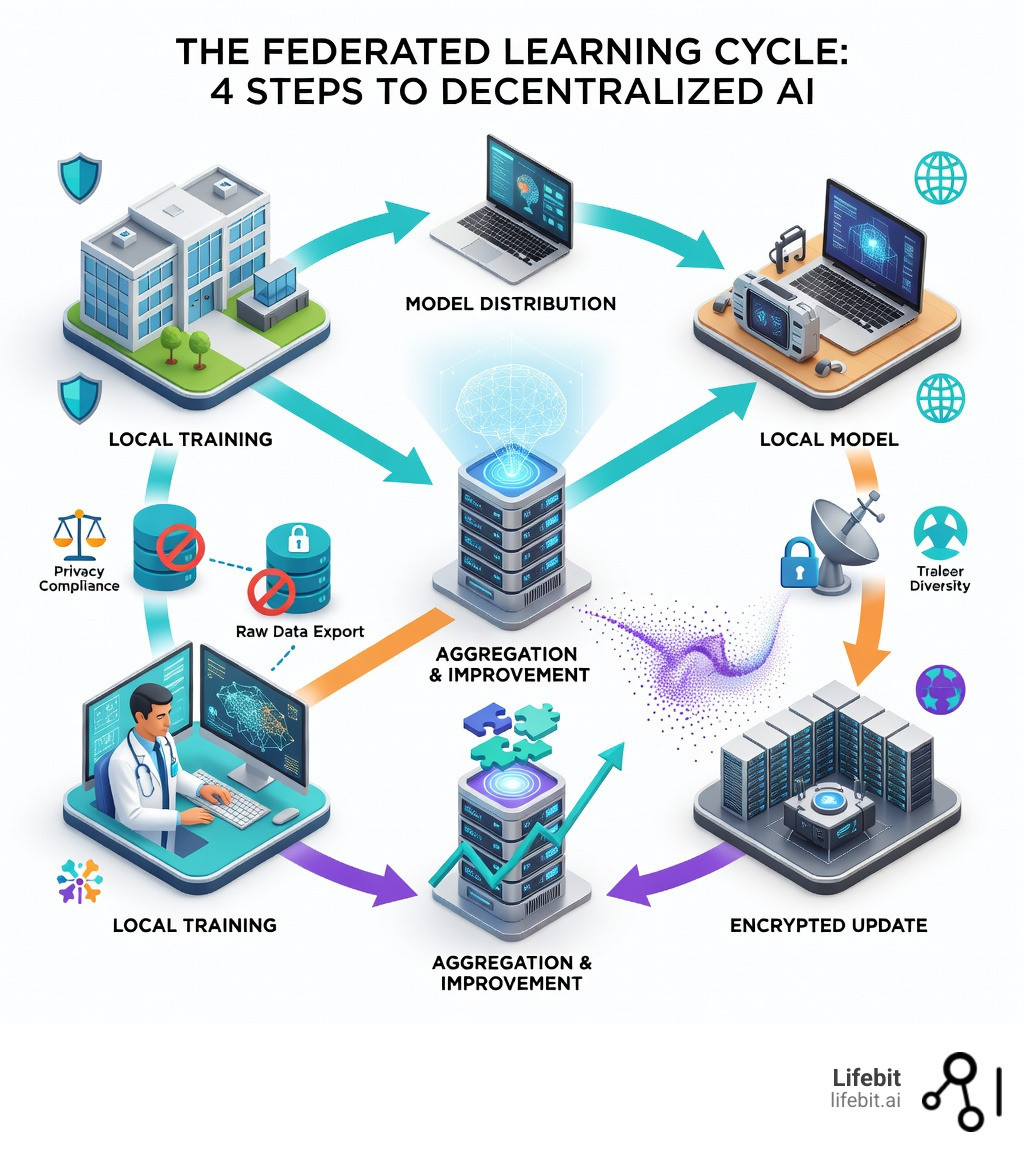
Federated learning benefits are transforming how organizations train AI models by eliminating the need to centralize sensitive data. Instead of moving raw data to a central server—exposing it to privacy risks, compliance violations, and massive transfer costs—federated learning trains models where the data lives. Each device or institution trains locally, then shares only encrypted model updates. This approach delivers:
- Enhanced privacy and security — Raw data never leaves its source, drastically reducing breach risk
- Regulatory compliance — Meets GDPR, HIPAA, and data residency requirements without moving data across borders
- Better model accuracy — Leverages diverse, real-world datasets from multiple sources to reduce bias
- Lower operational costs — Eliminates expensive data transfer and storage in centralized servers
- Faster insights at the edge — Enables real-time predictions on devices without network latency
- Collaborative AI without exposure — Organizations train shared models while retaining full data control
In recent years, health systems, financial institutions, and pharma companies have been drowning in siloed data. Privacy regulations like GDPR and HIPAA have made centralized training impractical or illegal. Traditional AI approaches force you to choose between data access and compliance—federated learning solves both.
Research shows that federated models trained across 10 institutions achieve 99% of the quality of centralized approaches, often outperforming them thanks to larger, more diverse datasets. Google’s Gboard uses federated learning to improve next-word prediction by training on typing patterns directly on millions of devices—without uploading a single keystroke. Intel Labs collaborated with 71 international healthcare institutions to detect brain tumors using federated AI, and 20 institutions worldwide validated federated models for predicting oxygen needs in COVID-19 patients.
As CEO and Co-founder of Lifebit, I’ve spent over 15 years helping pharmaceutical and public sector organizations unlock the federated learning benefits needed to power precision medicine and drug discovery across secure, compliant environments. In this guide, I’ll show you exactly how federated learning overcomes the failures of traditional AI training and why it’s essential for modern data teams.
Learn more about Federated learning benefits:
Why Centralized Data Silos Are Killing Your AI Strategy
For decades, the standard approach to machine learning has been “centralize and conquer.” We would gather every scrap of data from various departments, branches, or devices and dump them into a single, massive data lake. But in 2025, this model is fundamentally broken due to three primary factors: the security paradox, the cost of data gravity, and the tightening noose of global privacy regulations.
The Security Paradox: The “Honey Pot” Effect
Centralized data silos are essentially “honey pots” for hackers. By aggregating all sensitive information into one location, organizations create a single point of failure. If a central repository is breached, the entire organization’s data assets—and the privacy of millions of individuals—are exposed at once. Furthermore, traditional training relies on federated learning to solve the “data silo” problem where valuable information is trapped behind departmental or national borders. Without a federated data sharing complete guide, organizations often find themselves unable to access the very data they need to build robust models.
Traditional methods are also vulnerable to model inversion attacks. In these scenarios, malicious actors can reconstruct sensitive training data just by querying the final model. When data is centralized, the blast radius of these vulnerabilities is catastrophic because the model has had direct access to the raw, unmasked records during its entire training lifecycle.
The High Cost of Data Gravity
As datasets grow into the petabyte and exabyte scale, they develop “data gravity.” Moving this volume of biomedical or financial data isn’t just a security risk; it’s an operational nightmare. Bandwidth constraints often mean that by the time data is transferred, cleaned, and processed, the insights are already stale. Organizations face staggering data egress fees when moving data out of cloud environments, making large-scale centralization financially unsustainable. By using a federated data exchange platform, we can keep the data stationary and move the computation instead, effectively reversing the gravity problem.
Risks of Non-Compliance and Re-identification
Even when data is “anonymized,” the risk of re-identification remains high. Simple de-identification is often insufficient when combined with other public datasets. Furthermore, strict data residency laws in regions like Europe (GDPR), Canada (PIPEDA), and Brazil (LGPD) forbid certain types of sensitive data from leaving their country of origin. If your AI strategy requires centralizing this data in a different jurisdiction, you are effectively blocked from using it, leading to “data deserts” where AI cannot be trained on specific populations.
7 Federated Learning Benefits That Slash Costs and Solve Compliance
To understand why so many leaders are pivoting to decentralized AI, let’s look at the core advantages.
| Feature | Centralized Machine Learning | Federated Learning |
|---|---|---|
| Data Location | Centralized Server/Cloud | Localized on devices/nodes |
| Privacy | High risk of exposure | Privacy-by-design |
| Compliance | Difficult (GDPR/HIPAA hurdles) | Native compliance |
| Bandwidth | High (transfers raw data) | Low (transfers model updates) |
| Bias | High (homogeneous data) | Low (diverse, real-world data) |
| Resilience | Single point of failure | Decentralized and robust |
One of the most significant federated learning benefits is the ability to achieve high model accuracy while maintaining data sovereignty. For a deeper dive, check out our federated analytics ultimate guide.
1. Stop Data Leaks: Keep Raw Records Local and Secure
The most powerful feature of federated learning is that raw data never moves. In a typical Lifebit deployment, the data stays within the client’s secure environment—whether that’s a hospital’s local server, a government’s private cloud, or a pharmaceutical company’s internal database.
The Privacy-Preserving Triad
To ensure maximum security, federated learning often incorporates a “Privacy-Preserving Triad” of technologies that go beyond simple decentralization:
- Differential Privacy (DP): This adds mathematical “noise” to the model updates. This noise is calculated such that it obscures the contribution of any single individual in the dataset, making it mathematically impossible to reverse-engineer a specific patient’s record from the global model.
- Secure Multi-Party Computation (SMPC): This allows multiple parties to jointly compute a function over their inputs while keeping those inputs private. In federated learning, SMPC ensures that the central aggregator only sees the sum of the updates, never the individual updates from a specific hospital or device.
- Homomorphic Encryption (HE): This allows computations to be performed on encrypted data. The model updates are encrypted before they leave the local node, and the central server aggregates them while they are still encrypted, only decrypting the final, combined result.
For high-stakes intellectual property, technologies like OpenFL + SGX Protect IP provide a hardware-based “enclave” (Trusted Execution Environment) that ensures even the model updates cannot be tampered with by the host system. By performing privacy-preserving-statistical-data-analysis-on-federated-databases, we ensure that the final AI model learns the patterns without ever seeing the people, effectively neutralizing the risk of data breaches during the training phase.
2. Clear GDPR and HIPAA Hurdles with Native Data Residency
Compliance is often the “no” that kills AI projects. However, federated learning turns that “no” into a “yes” by respecting data residency. Since the data stays in its original jurisdiction, there is no “transfer” in the eyes of the law.
- GDPR: Federated learning aligns with the principle of “data minimization” by ensuring only the necessary model parameters are processed centrally. GDPR Regulatory Compliance becomes significantly easier when you aren’t actually moving personal data.
- HIPAA: For our partners in the USA, HIPAA Regulatory Compliance is maintained because Protected Health Information (PHI) remains under the hospital’s direct control.
By following a federated governance complete guide, organizations can set clear rules on who can train models and what insights can be extracted, all while satisfying the most stringent regulators.
3. Kill Model Bias: Train on Diverse Global Data in Real-Time
A model is only as good as the data it’s trained on. Centralized models often suffer from “geographic bias”—for example, a skin cancer detection AI trained only on data from one hospital in London might struggle to diagnose patients in Singapore or New York due to differences in skin tones, lighting conditions, and local equipment.
Solving the Non-IID Data Challenge
Federated learning allows us to train on Non-IID (Not Identically and Independently Distributed) data. In the real world, data is messy. One hospital might specialize in oncology, while another focuses on cardiology. Their datasets will look fundamentally different. This is known as “statistical heterogeneity.”
To handle the fact that data looks different in every location, researchers use advanced algorithms like FedProx. Unlike the standard Federated Averaging (FedAvg) approach, FedProx adds a proximal term to the local objective function. This helps to:
- Stabilize training: It prevents local updates from drifting too far from the global model, which is common when data is highly skewed.
- Handle System Heterogeneity: It allows nodes with less computing power to perform fewer local epochs without negatively impacting the global model’s convergence.
Capturing the “Long Tail” of Data
When your data is dispersed enough, the resulting model is far more generalizable and robust. It can capture rare diseases or edge-case financial transactions that a single-site model would never see. This is a core part of effective federated data analysis, ensuring that AI works for everyone, not just a small subset of the population. By training on diverse, real-world data in situ, we eliminate the “selection bias” inherent in centralized datasets where only the most easily accessible data is included.
Cut Bandwidth Costs and Latency with High-Performance Edge Training
Federated learning isn’t just about privacy; it’s about building a more resilient and efficient system. In a centralized setup, the main server is a bottleneck. If the connection drops or the server goes down, the entire training pipeline halts. In a federated system, the training is distributed, creating a fault-tolerant architecture.
The Communication-Efficiency Trade-off
One of the primary federated learning benefits is the massive reduction in network traffic. In traditional AI, you must upload the entire raw dataset. In federated learning, you only upload model parameters (weights and gradients).
Consider a genomic research project:
- Centralized: Uploading 1,000 whole-genome sequences (approx. 100GB each) requires transferring 100 Terabytes of data over the network.
- Federated: The local node trains on the 100GB files and only sends back a model update of roughly 50 Megabytes.
This represents a 2,000,000x reduction in data transfer requirements. This allows for real-time prediction and training even in low-connectivity environments or on mobile devices. For organizations looking to scale, our federated data platform ultimate guide explains how to manage these complex networks.
Adaptive Local Training and 5G Integration
In the real world, not every “node” is a supercomputer. We address systems heterogeneity by using adaptive local training. By understanding the data distribution at each site, the central aggregator can adjust the workload. With the rollout of 5G, federated learning becomes even more potent, enabling ultra-low latency updates from millions of Internet of Things (IoT) devices simultaneously.
Because federated learning accounts for temporal characteristics—how data changes over time—it can adapt to new information faster than a centralized system that requires a full re-upload of data. This “offline functionality” means devices can continue to learn and improve even when they aren’t connected to the main hub. Our federated research environment complete guide provides the blueprint for setting up these high-performance ecosystems.
Federated Learning Benefits in Action: Real-World Case Studies
The federated learning benefits we discuss aren’t theoretical—they are powering critical discoveries today across healthcare, finance, and manufacturing.
Healthcare: The Intel Labs & Penn Medicine Breakthrough
As mentioned, Intel Labs led a groundbreaking case study with 71 institutions across six continents to improve brain tumor detection. Using the OpenFL framework, they trained a Deep Learning model on MRI scans. The result? The federated model improved tumor boundary detection by 33% compared to models trained on individual institutional data. Most importantly, not a single patient image ever left its hospital of origin.
Pharma: The MELLODDY Project
The MELLODDY (Machine Learning Ledger Orchestration for Drug Discovery) consortium is perhaps the most ambitious use of federated learning in the pharmaceutical industry. Ten competing pharma giants (including Janssen, Novartis, and Bayer) collaborated to train AI on their combined library of 10 million chemical compounds. By using federated learning, they were able to:
- Increase the predictive power of their drug discovery models.
- Protect their highly sensitive intellectual property (the chemical structures).
- Share the “intelligence” of the data without sharing the data itself.
Finance: Fraud Detection Without Exposure
Banks use federated learning to combat money laundering and fraud. Traditionally, banks couldn’t share customer data due to privacy laws, meaning a fraudster could hit five different banks before a pattern was detected. With federated AI, multiple institutions can “learn” the mathematical signature of a fraudulent transaction in real-time. When one bank detects a new fraud tactic, the model update is shared globally, protecting all other banks in the network without revealing any customer’s private financial history.
Population Genomics and Beyond
This technology is vital for federated technology in population genomics, where the sheer size of DNA data makes centralization impossible. Beyond medicine, we see federated learning applications in:
- Smart Manufacturing: Improving yield by learning from sensors across different factories without exposing proprietary trade secrets.
- Self-Driving Cars: Training vision systems on diverse road conditions globally without the latency of uploading video feeds to the cloud.
- Biometrics: Improving facial recognition accuracy across different demographics while keeping biometric templates securely stored on the user’s device.
Common Myths About Federated Learning Benefits—Debunked
How does federated learning enhance data privacy?
In federated learning, raw data remains localized on the owner’s device or server. Only model updates—mathematical representations of what the model learned—are shared with a central aggregator. This minimizes the risk of a “single point of failure” breach and ensures that personal information is never exposed during the training process.
Can federated learning help with GDPR and HIPAA compliance?
Yes. By ensuring data residency (data stays where it was created), federated learning eliminates the need for risky cross-border data transfers. It inherently supports the “data minimization” requirements of GDPR and the strict PHI protections of HIPAA, as the central server never “sees” or “possesses” the raw sensitive data.
Does federated learning reduce model accuracy?
Actually, it often increases it. While a single-site model is limited by its small, potentially biased dataset, a federated model learns from a vast, diverse global pool of information. Research has shown that federated models can achieve up to 99% of the quality of centralized models while offering much better performance in real-world, “unseen” scenarios.
Stop Choosing Between Privacy and Innovation: Start Using Federated AI
The era of choosing between innovation and privacy is over. Federated learning benefits provide the bridge that allows us to build the world’s most advanced AI models while respecting the fundamental right to data ownership and security.
At Lifebit, we are proud to lead this charge. Our Federated AI platform—featuring the Trusted Research Environment (TRE) and Trusted Data Lakehouse (TDL)—is designed specifically to help organizations in biopharma and public health access the global data they need to save lives. Whether you are working on global precision medicine or complex pharmacovigilance, we provide the tools to make secure, real-time collaboration a reality.
Ready to unlock the power of your data without the risk? Visit Lifebit today to see how our federated solutions can transform your research.