

Federation in Healthcare Data: How to Analyze Sensitive Records Without Moving Them
You’re sitting on a goldmine of health data. Genomic sequences from thousands of patients. Clinical outcomes spanning decades. Real-world evidence that could validate your next drug target in months instead of years. There’s just one problem: you can’t actually touch any of it.
Not because the data doesn’t exist. Not because institutions won’t collaborate. But because moving that data—centralizing it, copying it, transferring it across borders—is either illegal, impossibly slow, or both. HIPAA says no. GDPR says absolutely not. Your hospital partners’ legal teams say “let’s schedule a meeting in six months to discuss a data sharing agreement.”
Meanwhile, precision medicine programs stall. Drug discovery pipelines slow to a crawl. Population health insights remain locked in silos. The irony is brutal: we have more health data than ever before, and less ability to actually use it together.
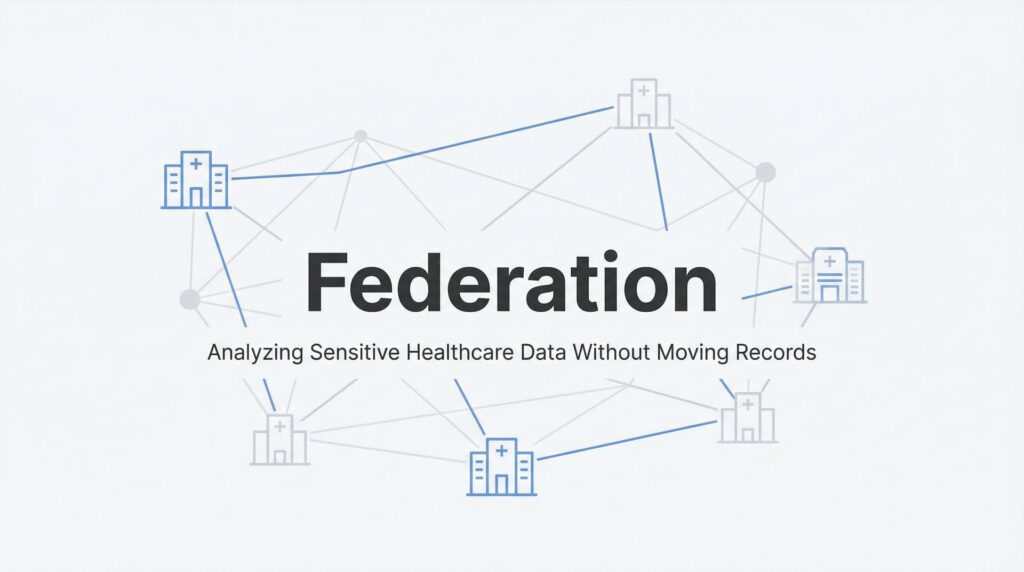
Federation flips this entire problem on its head. Instead of bringing data to your analysis, you bring the analysis to the data. The raw records never move. The algorithms travel. Results aggregate centrally while sensitive information stays exactly where it lives—under the control of the institutions that own it.
This isn’t a theoretical framework for 2030. National health programs are running on federated infrastructure right now. Biopharma R&D teams are using it to accelerate target validation across hospital networks. Academic consortia are conducting cross-border studies that would be impossible any other way.
If you’re a Chief Data Officer trying to unlock insights from siloed datasets, or a Translational Research Head who needs multi-institutional evidence without the compliance nightmare, this is the architecture that makes it possible. Let’s break down exactly how it works and why it’s becoming the standard for sensitive data collaboration.
The Data Mobility Problem That Won’t Go Away
Here’s what the traditional playbook says: collect all your data in one place, harmonize it, then analyze it. Simple. Logical. And completely unworkable when you’re dealing with regulated health records.
HIPAA doesn’t care about your research timeline. GDPR doesn’t have a “but it’s for science” exception. National data sovereignty laws—increasingly common as countries recognize health data as strategic infrastructure—explicitly prohibit moving citizen health records outside their borders. Your compliance team isn’t being difficult. The law is the law.
Even when data movement is technically legal, the practical barriers are crushing. A single data sharing agreement between two academic medical centers can take 18 months to negotiate. Multiply that across a consortium of ten institutions and you’re looking at years before you can start actual research. IRB approvals. Legal reviews. Security assessments. IT infrastructure coordination. Each step adds months.
The financial costs are equally brutal. Centralizing data means someone has to pay for storage, compute, and ongoing maintenance of that central repository. More importantly, someone has to take on the liability risk. When you consolidate sensitive records from multiple sources, you create a single point of failure. One breach exposes everything. One compliance violation triggers cascade liability across all participating institutions.
This isn’t just an inconvenience. It’s blocking real scientific progress. Precision medicine requires analyzing genomic data alongside clinical outcomes across diverse patient populations—but those populations are spread across dozens of hospital systems. Drug discovery increasingly depends on real-world evidence from large patient cohorts—but that evidence lives in separate EHR systems with incompatible data models. Population health research needs to track outcomes across geographic regions—but each region has its own data governance rules.
The result? Researchers work with smaller datasets than they need. Biopharma companies make drug development decisions with incomplete evidence. National health programs struggle to generate insights that could improve care for millions of patients. All because the data can’t move.
How Federation Actually Works
Think of federation like running a distributed election. Instead of bringing every voter to one location to count ballots (impossible, slow, chaotic), you count votes at each local polling station, then aggregate the totals. The raw ballots never leave their precinct. The counting happens locally. Only the results travel.
That’s the core principle of federated data architecture. Your analysis—whether it’s a statistical query, a machine learning model, or a complex research protocol—travels to where the data lives. Each data source executes the computation locally, in its own secure environment, under its own governance rules. Only the aggregated results come back to you. The raw records never move.
Here’s what that looks like technically. Each participating institution maintains its own secure compute node—essentially a cloud workspace where their data stays under their control. When you submit an analysis request, the federated data platform distributes that request to each relevant node. Each node executes the computation against its local data, following whatever privacy and governance rules that institution has defined. The local results—summary statistics, model parameters, aggregated insights—then flow back to a central coordination layer that combines them into your final answer.
The communication happens through secure protocols that ensure two things: first, that only authorized analyses can run (no one can sneak in a “SELECT * FROM patients” query and extract raw records), and second, that results meet privacy thresholds before they’re released (differential privacy techniques can add mathematical guarantees that no individual patient can be identified in the output).
This architecture supports three main patterns, each solving different problems. Federated analytics means running descriptive queries across distributed datasets—think “how many patients with this genetic variant also have this clinical outcome?” across ten hospital systems. Federated learning means training machine learning models without centralizing training data—you send model updates instead of raw records, allowing collaborative AI development while preserving privacy. Federated data platforms combine both capabilities with comprehensive governance, providing full research infrastructure that spans institutions while keeping data distributed.
The technical components that make this work include standardized data models (so your query means the same thing at every site), secure enclaves (isolated compute environments that enforce access controls even within the hosting institution), audit trails (comprehensive logging of who ran what analysis, when, and what results they received), and automated compliance checks (ensuring every query meets regulatory requirements before execution).
What’s crucial to understand: this isn’t just API access or data virtualization. APIs let you query remote databases, but the database owner still sees your query and controls what you can ask. Virtualization creates a logical view over distributed data, but typically requires some level of data movement or replication. True federation keeps computation and governance distributed. Each institution maintains full control. The data never consolidates. The analysis happens in parallel across autonomous nodes.
Where Federation Delivers Measurable Impact
National precision medicine programs are the most visible proof that federation works at scale. When a government health agency needs to analyze genomic data from millions of citizens to identify disease patterns, drug response variations, or population health trends, centralization isn’t an option. Citizens’ genetic information can’t leave the country. Hospital systems won’t transfer patient records to a government database. But federated infrastructure allows the analysis to happen anyway.
These programs typically connect genomic sequencing centers, hospital networks, and research institutions across a country. Each maintains its own data in its own secure environment. When researchers need to run a genome-wide association study or validate a new diagnostic marker, the analysis distributes across all participating nodes. Results aggregate centrally while raw genomic sequences and clinical records stay exactly where they are. The program gets national-scale insights. Institutions keep sovereignty over their data. Patients’ privacy remains protected.
Biopharma R&D teams face a different but equally critical challenge: they need real-world evidence from diverse patient populations to validate drug targets, design clinical trials, and understand treatment effectiveness. But that evidence lives in dozens of separate hospital EHR systems, each with its own data governance policies and legal constraints. Traditional approaches mean negotiating individual data sharing agreements with each hospital—a process that can take years and often fails entirely.
Federation changes the equation. A pharmaceutical company can work with a federation platform that already has trust relationships with hospital networks. Instead of requesting data extracts, they submit analysis protocols. The protocol runs at each hospital site, generating aggregate results that meet privacy thresholds. The company gets the insights they need to make drug development decisions. Hospitals never transfer patient records outside their systems. Time-to-insight drops from years to weeks.
Cross-border research collaborations face the hardest constraints of all. When academic consortia want to conduct studies spanning multiple countries—comparing treatment outcomes across health systems, analyzing disease prevalence in different populations, or validating findings across diverse genetic backgrounds—data sovereignty laws create absolute barriers. Patient data from citizens of one country cannot be transferred to another country’s servers. Full stop.
Federated infrastructure makes these collaborations possible by respecting sovereignty while enabling analysis. A research protocol can run across datasets in the UK, Germany, Singapore, and the US without any data crossing borders. Each country’s data stays in that country’s cloud infrastructure, under that country’s governance rules. The analysis happens in parallel. Results combine into a single study output that reflects insights from all participating regions. What was legally impossible becomes operationally straightforward.
The Common Thread
Notice the pattern: in every scenario, federation solves the same fundamental problem. You need insights from data you can’t centralize. The traditional approach—negotiate agreements, move data, consolidate, analyze—is too slow, too risky, or simply illegal. Federation inverts the model. The data stays distributed. The analysis travels. Compliance is built into the architecture, not bolted on afterward.
Federation vs. Alternatives: When Each Approach Fits
Federation isn’t always the right answer. Understanding when it makes sense requires knowing what else is on the table and where each approach fits.
Centralized data warehouses are the gold standard when they’re actually feasible. If you control all the data sources, if compliance allows consolidation, if you have the infrastructure budget and technical team to maintain a central repository—do it. Centralized architectures are simpler to build, easier to query, and faster for complex analyses. The problem is that “when feasible” increasingly means “almost never” with regulated health data. If you’re facing HIPAA constraints, cross-border regulations, or institutional resistance to data sharing, centralization isn’t an option you’re choosing not to take. It’s an option that doesn’t exist.
Data sharing agreements are the traditional alternative when centralization fails. Two institutions negotiate terms, establish legal protections, define permitted uses, and transfer a specific dataset for a specific purpose. This works fine for small-scale collaborations—two academic medical centers partnering on a single study. It falls apart at scale. Each new institution means a new agreement. Each new research question means renegotiating scope. The legal overhead grows exponentially with the number of participants. You end up spending more time on contracts than on science.
Synthetic data offers an intriguing middle path for certain use cases. Generate artificial datasets that preserve statistical properties of real data without containing actual patient records. No privacy risk. No compliance constraints. No data sharing agreements. The catch is fidelity. Synthetic data works well for testing software, training staff, or running simple descriptive analyses. It breaks down for complex research questions where subtle patterns matter. You can’t validate a drug target using synthetic genomic data. You can’t train a diagnostic AI on synthetic medical images and trust it with real patients. When the analysis requires real-world nuance, synthetic data isn’t a substitute.
Secure multi-party computation (SMPC) and homomorphic encryption represent the cryptographic extreme—analyze data while it’s still encrypted, so even the computing infrastructure never sees plaintext. Mathematically elegant. Practically limited. The computational overhead is massive. The types of analyses you can run are constrained. For specific high-value scenarios—computing aggregate statistics across extremely sensitive datasets, for example—SMPC can be worth the complexity. For general-purpose research infrastructure, it’s overkill.
So when does federation make sense? When you need to analyze data across multiple institutions or jurisdictions. When compliance or governance rules prevent centralization. When the number of data sources or research questions makes individual data sharing agreements impractical. When you need real data fidelity that synthetic alternatives can’t provide. When you need general-purpose research infrastructure, not just one-off analyses. That describes most serious health data collaborations today.
Building a Federation-Ready Infrastructure
Getting federation infrastructure operational requires aligning three layers: technical, governance, and organizational. Miss any one and the whole thing stalls.
The technical foundation starts with cloud deployment. Each participating institution needs secure compute capacity where their data can live and analyses can execute. This doesn’t mean building data centers from scratch—modern federation platforms deploy in your existing cloud environment, whether that’s AWS, Azure, Google Cloud, or on-premises infrastructure. What matters is isolation. The compute environment running federated analyses must be separate from other systems, with strict access controls and comprehensive audit logging.
Standardized data models are non-negotiable. When an analysis runs across ten hospital systems, “patient age” needs to mean the same thing at every site. Common data models like OMOP for clinical data or standards like FHIR for interoperability provide the semantic layer that makes cross-institutional queries possible. This doesn’t mean every institution has to restructure their entire data warehouse. It means mapping local data to a common schema within the federated environment—a transformation that happens once, not for every query.
Secure enclaves—isolated workspaces where approved researchers can run analyses—provide the operational interface. Think of these as cloud-based research environments with built-in governance. A researcher logs in, accesses the data sources they’re authorized to use, runs their analysis, and receives results that have been automatically checked against privacy thresholds. The enclave handles authentication, enforces access policies, logs every action, and ensures results meet disclosure requirements before release.
The governance layer is where most federation initiatives actually succeed or fail. Technical capability means nothing if institutions don’t trust the framework. Governance requirements start with granular access controls—not just “who can access what data,” but “who can run what types of analyses for what purposes.” A researcher approved for cancer genomics studies shouldn’t automatically get access to cardiovascular data. A pharmaceutical company analyzing treatment effectiveness shouldn’t be able to run analyses unrelated to their approved protocol.
Audit trails must be comprehensive and tamper-proof. Every query, every analysis, every result must be logged with full provenance: who requested it, when, under what authority, what data sources were involved, what results were returned. These logs aren’t just for compliance—they’re how institutions maintain confidence that their data is being used appropriately. When a hospital’s data governance board asks “who accessed our patient records last quarter and for what purposes,” you need to provide a complete, verifiable answer.
Automated compliance checks build regulatory requirements directly into the infrastructure. Before any analysis runs, the system verifies that it meets applicable regulations—HIPAA, GDPR, institutional IRB approvals, data use agreements. Before any results are released, the system checks that they meet privacy thresholds—no cell sizes below minimum disclosure limits, no results that could identify individual patients, differential privacy guarantees if required. Compliance isn’t a manual review process. It’s automated enforcement. Organizations seeking HIPAA compliant data analytics find this automation essential for maintaining regulatory standing.
The organizational layer is often the hardest. Federation requires institutional stakeholders to trust not just the technology, but each other. Trust frameworks—formal agreements that define roles, responsibilities, and expectations—provide the social infrastructure that makes technical infrastructure viable. Who governs access decisions? How are disputes resolved? What happens if one institution wants to withdraw? These aren’t technical questions, but they determine whether institutions will actually participate.
Stakeholder alignment means getting buy-in from legal teams, compliance officers, IT security, data governance boards, and research leadership at each participating institution. Each has legitimate concerns. Legal worries about liability. Compliance worries about regulatory violations. Security worries about data breaches. Governance worries about loss of control. Research leadership worries about delays. A successful federation initiative addresses all these concerns explicitly, with clear policies and technical controls that provide concrete assurances. Understanding decentralized data governance principles helps navigate these complex stakeholder dynamics.
Putting It All Together: Your Federation Roadmap
Don’t start by trying to federate everything. Start with one high-value use case that demonstrates clear benefit and manageable complexity. Pick a research question that requires multi-institutional data, has stakeholder support, and can show results in months, not years. Proving the model works is more valuable than building comprehensive infrastructure that never gets used.
The right first use case typically has three characteristics. First, it’s blocked by current approaches—you can’t answer this question with the data you can currently access, and traditional data sharing isn’t working. Second, it matters to stakeholders—there’s real scientific value or operational benefit, not just a proof of concept. Third, it’s scoped—you’re analyzing data from three to five institutions, not trying to federate an entire national health system on day one.
Before selecting a federation platform, answer these questions clearly. What types of analyses do you need to run—descriptive statistics, machine learning, genomic analyses, clinical trial simulations? What compliance frameworks must you support—HIPAA, GDPR, FedRAMP, institutional policies? What level of technical expertise does your team have—are you building infrastructure or do you need a managed platform? How much control do participating institutions require over their data—full sovereignty or delegated governance? What’s your timeline—do you need operational infrastructure in months or can you spend years building custom solutions?
The answers determine whether you need a comprehensive federated data platform, a specialized federated learning framework, or a custom-built solution. Comprehensive platforms provide end-to-end infrastructure—secure enclaves, governance automation, compliance built in, support for multiple analysis types. They’re faster to deploy but less customizable. Specialized frameworks focus on specific use cases like federated machine learning but require more technical expertise to operate. Custom solutions give you complete control but mean you’re building and maintaining complex distributed infrastructure.
Measuring success requires defining metrics before you start. Time-to-insight is the obvious one—how long from research question to actionable results? Track this before and after federation. If you’re going from 18 months (negotiating data sharing agreements) to 6 weeks (running federated analyses), that’s measurable impact. Compliance metrics matter too—how many regulatory reviews are required? How many data sharing agreements? How much legal overhead? Federation should reduce these, not add to them.
Collaboration scale is the long-term measure of success. How many institutions are participating? How many researchers are using the infrastructure? How many analyses are running? A successful federation grows over time as more stakeholders recognize the value and trust builds. If you’re stuck at your initial pilot institutions two years later, something isn’t working.
The most important early metric is simply: are analyses running and producing valid results? It’s easy to get lost in infrastructure complexity and governance frameworks. But the point is to generate scientific insights. If researchers are running analyses, getting results they trust, and using those results to advance their work—you’re succeeding. Everything else is in service of that goal.
The Architecture That Makes Impossible Collaborations Possible
Federation isn’t a future technology that might change how health data collaboration works. It’s operational infrastructure powering national precision medicine programs right now. It’s how biopharma R&D teams are accelerating drug discovery pipelines by accessing real-world evidence across hospital networks. It’s how academic consortia are conducting cross-border studies that would be legally impossible any other way.
The fundamental constraint hasn’t changed: sensitive health data often cannot be moved. Regulatory requirements, institutional policies, and data sovereignty laws create absolute barriers to centralization. What’s changed is the recognition that you don’t need to move data to analyze it. Bring the computation to the data. Keep records distributed. Aggregate only the insights.
This architectural inversion—from centralized to federated—solves problems that traditional approaches can’t touch. Compliance becomes built-in rather than bolted-on. Institutions maintain sovereignty over their data while participating in collaborative research. Time-to-insight drops from years to weeks. Analyses that were impossible become routine.
If you’re managing siloed health data and need insights without the compliance nightmare, if you’re trying to build multi-institutional research collaborations that keep stalling on data sharing agreements, if you’re under pressure to accelerate discovery but blocked by data access constraints—federation is the architecture to evaluate.
The technology is proven. The governance frameworks exist. National health programs and leading research institutions are already operating at scale. The question isn’t whether federated infrastructure works. It’s whether you’re ready to deploy it.
Get-Started for Free and see how federated infrastructure can unlock insights from your distributed data—without the compliance risk, without the delays, without moving a single record.