

Beyond Borders: A Guide to Global Research Partnerships

Global Research Collaboration: Stop Siloed Data from Killing Your Impact
Global research collaboration is reshaping how science gets done—and the stakes have never been higher. In an era defined by rapid technological advancement and complex global crises, the ability of researchers to work across borders is no longer a luxury; it is a fundamental requirement for progress. The shift from localized, isolated studies to massive, international endeavors is driven by several critical factors that are fundamentally altering the scientific landscape:
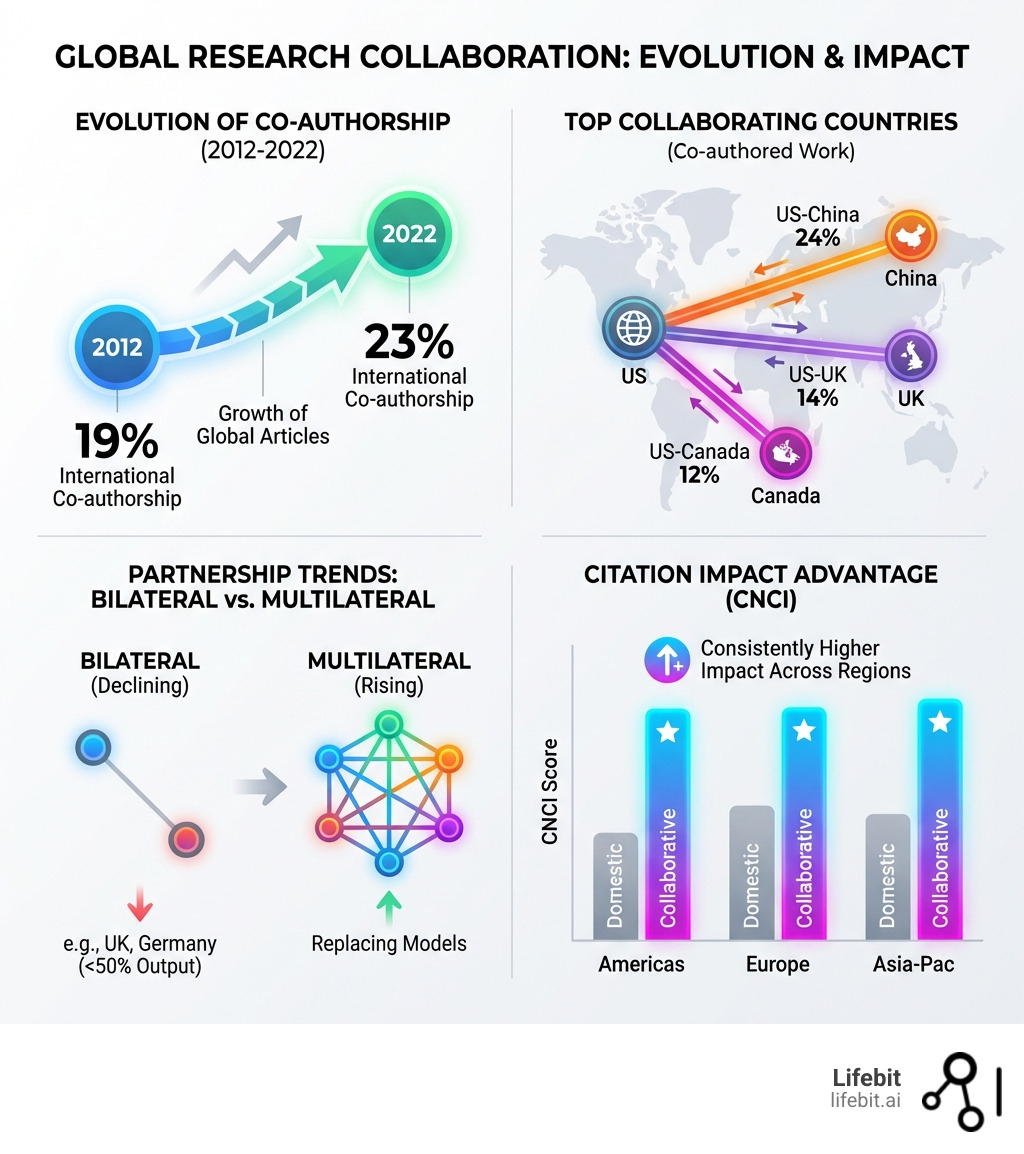
- International co-authorship jumped from 19% to 23% of all science and engineering articles between 2012 and 2022. This trend reflects a growing recognition that the most challenging questions in science—from climate modeling to genomic medicine—require a diversity of expertise that no single nation can provide in isolation.
- Collaborative papers consistently outperform domestic-only publications in citation impact across all regions. Data suggests that when researchers from different cultural and institutional backgrounds collaborate, the resulting work is more robust, more innovative, and more likely to be cited by the global scientific community. This “collaboration premium” is a powerful incentive for institutions to look beyond their own borders.
- The US now collaborates internationally on 40% of its research, with China becoming its largest partner at 24% of co-authored work. This partnership, while currently under geopolitical strain, has been one of the most productive engines of scientific discovery in history, particularly in the physical and life sciences.
- Multilateral partnerships are replacing bilateral models, especially in the UK and Germany where bilateral work now accounts for less than 50% of international output. The rise of “mega-projects” involving dozens of countries is becoming the new norm for high-impact research.
- Geopolitical tensions and pandemic disruptions are forcing strategic pivots in who works with whom—and how. The COVID-19 pandemic served as a catalyst for new forms of rapid, digital-first collaboration, but it also highlighted the fragility of global supply chains and data-sharing agreements.
The landscape is shifting fast. Mainland China’s research output exploded from 26,200 papers in 2000 to over 878,000 in 2024, representing one of the most significant shifts in scientific gravity in modern history. The citation impact of China-EU collaborations now exceeds US-EU partnerships in several key metrics. Meanwhile, policy restrictions and national security concerns are fragmenting established networks, even as the benefits of open collaboration become clearer. This creates a “collaboration paradox”: we need to work together more than ever, yet the barriers to doing so are becoming increasingly complex.
For pharma leaders, public health agencies, and research institutions, this creates both risk and opportunity. Siloed data, slow partner onboarding, and compliance barriers can kill momentum. When data is trapped within institutional or national firewalls, researchers waste valuable time on administrative hurdles rather than scientific discovery. But federated platforms that enable secure, in-place analysis across borders are opening up new speed and scale. These platforms allow for the “democratization of data,” where the size of your local dataset no longer limits the scope of your scientific inquiry.
I’m Maria Chatzou Dunford, CEO and co-founder of Lifebit, where we’ve spent over a decade building platforms that power global research collaboration across genomics, drug discovery, and precision medicine through secure, federated data environments. We’ve seen how the right infrastructure can turn fragmented datasets into high-impact discoveries—without moving sensitive data across borders. Our mission is to ensure that the next great medical breakthrough isn’t delayed by a data transfer agreement or a compatibility issue between two different cloud providers.
Important Global research collaboration terms:
- biotech companies uk
- health data harmonization
- london biotech network
Global Research Collaboration: Why Bilateral Ties Are Dead
The days of simple, one-on-one “handshake” agreements between two universities in different countries are fading. We are witnessing a fundamental change in the architecture of scientific discovery. Global research collaboration is changing, moving away from simple bilateral ties toward complex, multilateral networks that function more like ecosystems than linear partnerships.
In countries like the UK and Germany, the shift is stark. Bilateral co-authorship now accounts for less than 50% of their international output. Instead, researchers are engaging in regional and global “mega-projects” that involve three, four, or even dozens of partner nations. This isn’t just for show; it’s a strategic response to the scale of modern challenges. Whether we are talking about climate change, pandemic preparedness, or the development of sustainable energy sources, no single nation—no matter how wealthy or technologically advanced—has all the answers or all the data. The complexity of these problems requires a “network effect” where the value of the research increases exponentially with each additional diverse partner.
China’s Rise and the US Strategic Inflection Point
The data tells a story of a massive shift in gravity. Mainland China has become the world’s most prolific research publisher, a transformation that has occurred with breathtaking speed. To put that in perspective, their output rose from a modest 26,200 papers in 2000 to a staggering 878,000 in 2024. Their international co-authorship followed suit, growing from 6,000 to over 163,000 papers in the same period. This growth isn’t just in volume; it’s in critical fields like materials science, chemistry, and engineering, where China now leads in many high-impact metrics.
According to NSF data on publication output, the United States remains a powerhouse, contributing to 32% of all internationally co-authored articles in 2022. However, the U.S. is at a strategic crossroads. While China became the largest collaborator for U.S. researchers (accounting for 24% of U.S. international articles), the growth of this partnership has cooled since 2019 due to geopolitical friction and increased regulatory scrutiny. In response, China is rapidly expanding its influence in other regions, with co-authored output in the Middle East growing nearly three times faster than the regional average. This suggests a decoupling of traditional Western-centric networks and the emergence of new, powerful research blocs.
Measuring Success through Global Research Collaboration
How do we know these partnerships are actually working? We look at the Category Normalized Citation Impact (CNCI), a metric that adjusts for the different citation rates across various scientific fields and years. The data is clear: collaborative papers are cited significantly more often than domestic ones. This is likely because international teams are better equipped to tackle high-stakes, high-visibility problems that attract global attention.
Interestingly, the “quality” or influence of these papers is shifting in ways that challenge old assumptions. The CNCI of Mainland China–EU27 papers now exceeds that of U.S.–EU27 collaborations. This suggests that global research collaboration is not just about quantity; it’s about the distribution of knowledge and the creation of high-impact science that moves the needle for the entire global community. It also indicates that European researchers are increasingly finding high-value synergies with Chinese counterparts, potentially creating a new axis of scientific influence that bypasses traditional North American dominance. This shift necessitates a re-evaluation of how institutions prioritize their international outreach and where they invest their collaborative resources.
Global Research Collaboration: 4 Ways to Fix Data Silos
If the benefits of global research collaboration are so obvious, why isn’t it easier? The reality is that we face significant structural and systemic problems that can stall even the most promising projects. These barriers are often deeply rooted in national policy, institutional culture, and technical limitations.
- Visa Policies and Mobility: Research is fundamentally a human endeavor. When visa processing times stretch into months or when political tensions lead to the denial of entry for students and scholars, the flow of talent stops. This “brain friction” prevents the face-to-face interaction that is often necessary for the most creative breakthroughs. Many countries are now experimenting with “Global Talent Visas” to circumvent these issues, but the process remains fragmented and unpredictable.
- National Security and Geopolitics: Governments are increasingly wary of “knowledge leakage,” particularly in dual-use technologies like AI, quantum computing, and biotechnology. This has led to stricter controls on who can access certain types of data or technology, often creating a “chilling effect” on legitimate scientific inquiry. Balancing the need for national security with the necessity of open scientific exchange is one of the greatest policy challenges of our time.
- Funding Gaps and Financial Friction: While everyone wants to collaborate, coordinating budgets across different national agencies is notoriously difficult. Different fiscal years, varying overhead rates, and conflicting reporting requirements create a massive administrative burden. Without harmonized funding mechanisms, many international projects die in the planning phase because the money cannot be moved or accounted for across borders efficiently.
- Data Silos and Technical Incompatibility: This is the most significant technical hurdle. Scientific data is often locked behind institutional or national firewalls, making it nearly impossible for an international team to analyze it together in real-time. Traditional methods of sharing data—such as downloading and shipping large datasets—are no longer viable in the age of “Big Data” due to security risks, privacy regulations like GDPR, and the sheer physical size of the files.
To address these, organizations are leaning into UNESCO Open Science standards to promote transparency and data sharing. However, sharing data doesn’t have to mean moving data. At Lifebit, we advocate for federated models where the analysis goes to the data, maintaining security and compliance while enabling global teams to work as one. This “compute-to-data” approach ensures that sensitive information remains within its original jurisdiction while still contributing to global scientific insights.
The Role of Funding Bodies and the Global Research Council
Funding agencies are the “engine room” of global research collaboration. They have the power to mandate collaboration as a condition of funding, thereby forcing institutions to break out of their silos. Groups like the Global Research Council provide a virtual forum for heads of science and engineering agencies to share best practices and data. They work to create common standards for peer review and research integrity, which are essential for building trust between international partners.
In the health sector, organizations like GloPID-R (Global Research Collaboration for Infectious Disease Preparedness) and the Canadian Institutes of Health Research (CIHR) are leading the charge. CIHR’s “Global Health 3.0” framework, for instance, focuses on health equity, ensuring that Canadian researchers partner with international colleagues to solve problems that affect us all, particularly in the Global South. These bodies identify research gaps and ensure that investments are coordinated, preventing the “double-funding” of the same projects while critical areas remain ignored. By aligning their strategic priorities, these funders can create a more efficient and impactful global research ecosystem.
Global Research Collaboration: Cut Drug Discovery Time with Federated AI
This is where the future of medicine is being written. The sheer scale of data required for modern drug discovery is breathtaking, far exceeding the capacity of any single institution. Take the “Billion Cell Atlas” initiative—a project aimed at analyzing 1 billion individual cells to train AI models that can predict how different diseases will respond to specific treatments. No single lab, or even a single country, can generate or store this amount of data alone.
By leveraging federated AI platforms, we can provide secure, real-time access to global biomedical and multi-omic data. This allows researchers in London, New York, and Singapore to collaborate on drug-response modeling and functional genomics without the nightmare of data transfer agreements or the risk of exposing sensitive patient information. Federated learning allows AI models to be trained on decentralized data, meaning the data never leaves its secure home, but the “intelligence” gained from that data can be shared globally. This is a game-changer for rare disease research, where patient populations are small and scattered across the globe.
Scaling Global Research Collaboration in Infectious Disease and Semiconductors
Two fields highlight the urgent need for better collaboration and the high cost of failure:
- Infectious Disease Preparedness: As we saw with COVID-19, speed is everything. The ability to share viral sequences and clinical trial data in real-time saved millions of lives. Networks like GloPID-R facilitate rapid-response research by having the legal, ethical, and financial frameworks ready before the next outbreak hits. This “pre-competitive” collaboration ensures that when a crisis strikes, the scientific community can move as a single, unified force rather than a collection of fragmented parts.
- Semiconductor Research: The semiconductor industry is perhaps the most globally integrated sector in existence. The SRC Global Research Collaboration (GRC) program is a prime example of pre-competitive innovation. It brings together industry giants like Intel and TSMC, top-tier universities, and national governments to solve the fundamental challenges of Moore’s Law. By sharing the astronomical costs of R&D for next-generation chips, these partners ensure that the entire technological ecosystem continues to advance, even as the physical limits of silicon are reached.
Furthermore, the rise of “Open Science” is beginning to influence even highly commercialized sectors. By sharing baseline data and methodology, companies can avoid redundant failures and focus their competitive efforts on the final stages of product development. This hybrid model of “collaborate on the basics, compete on the specifics” is becoming the blueprint for 21st-century innovation. Whether it is developing a new vaccine or a more efficient microprocessor, the path to success increasingly runs through a global network of partners.
Global Research Collaboration FAQ: Fix Your Data Sharing Problems
Why do collaborative papers have higher citation impact?
Collaborative papers bring together diverse perspectives, specialized equipment, and larger datasets that are often unavailable to single-institution teams. This cross-pollination of ideas typically leads to more robust findings that are relevant to a wider scientific audience. Furthermore, international teams have broader networks for disseminating their work, which naturally results in higher citation rates (CNCI). Essentially, the work is seen by more people and carries the combined prestige of multiple top-tier institutions.
What are the primary barriers to international scientific partnerships?
The most common barriers include restrictive visa policies that prevent the movement of researchers, national security concerns regarding sensitive technologies, and a lack of harmonized data standards. Additionally, the difficulty of coordinating funding across different countries and the administrative burden of complying with multiple sets of regulations (like GDPR in Europe and HIPAA in the US) can be prohibitive. Geopolitical shifts can also lead to sudden policy changes that disrupt long-standing partnerships, making long-term planning difficult.
How is the role of the United States changing in global research?
While the U.S. is still a global leader in terms of total R&D spending and high-impact publications, its share of total world research output is declining as countries like China and India rapidly scale their own capabilities. The U.S. is currently at a “strategic inflection point,” where its continued leadership depends on balancing national security with the need to remain an open, attractive partner for international talent. The U.S. is increasingly focusing on “friend-shoring” its research collaborations, prioritizing partnerships with democratic allies in Europe and the Indo-Pacific.
What is federated data analysis and why is it important for collaboration?
Federated data analysis is a technique that allows researchers to analyze data located on different servers or in different countries without actually moving the data itself. Instead of bringing the data to the code, the code is sent to the data. This is crucial for global research collaboration because it bypasses the legal and technical hurdles of data transfer, ensures compliance with local privacy laws, and allows for the analysis of datasets that are too large to be moved efficiently.
How can small biotech companies participate in global research networks?
Small biotech companies can participate by joining pre-competitive consortia, leveraging open-source data platforms, and partnering with academic institutions that have established international networks. Many governments also offer grants specifically designed to help SMEs (Small and Medium Enterprises) engage in international R&D. Using federated platforms can also allow small companies to access large-scale datasets that would otherwise be out of their reach financially and technically.
What is the impact of “Open Science” on global collaboration?
Open Science promotes the idea that scientific research should be accessible to everyone. This includes open-access publishing, open data, and open-source software. By removing paywalls and data restrictions, Open Science levels the playing field for researchers in developing nations and accelerates the overall pace of discovery. It fosters a culture of transparency and reproducibility, which are the cornerstones of trust in international partnerships.
Global Research Collaboration: Build a Secure, Borderless Platform Today
The future of science is borderless, but the path to getting there requires more than just good intentions and scientific curiosity. It requires a fundamental shift in how we think about data, intellectual property, and international partnership. As global research collaboration evolves from simple bilateral deals to complex, multilateral networks, the winners will be those who can navigate the complexities of policy, funding, and technology with agility.
We are moving toward a world where the location of a researcher or a dataset is secondary to the quality of the questions being asked. In this new paradigm, the ability to connect disparate nodes of knowledge into a coherent whole is the ultimate competitive advantage. This requires not just better tools, but a new mindset that prioritizes collective progress over institutional isolationism.
At Lifebit, we believe that federated data is the key to this evolution. By removing the need to move sensitive data, we can empower researchers to focus on what they do best: making discoveries that save lives and solve global challenges. We are building the infrastructure that allows the world’s best minds to work together, regardless of the borders that separate them. Whether you are a university, a funder, or a policymaker, the goal is the same—building a secure global research platform that turns the world’s data into the world’s cure. The era of the lone genius is over; the era of the global network has begun.