

Beyond the Silos: Achieving Interoperability with EHR Data Integration

Why EHR Data Integration Is Critical for Modern Healthcare
EHR data integration is the process of connecting electronic health records with other clinical, administrative, and research systems to enable seamless data exchange and real-time analytics across your healthcare organization.
Quick Answer: How to Achieve EHR Data Integration
- Adopt standards like FHIR (Fast Healthcare Interoperability Resources) and HL7 for data exchange
- Build APIs that enable bi-directional data flow between systems
- Establish data governance with clear security protocols and HIPAA compliance
- Implement Common Data Models (CDMs) to standardize formats across sources
- Use phased rollouts starting with high-value use cases to prove ROI
- Partner with vendors that support open APIs and minimal data restrictions
Healthcare is drowning in data—but starving for insights. The digital health market is forecasted to exceed $379 billion by 2024, yet as of 2014, only about one-fifth of U.S. hospitals were engaged in all four elements of interoperability: finding, sending, receiving, and integrating information. Even worse, fewer than 50 percent of health systems report that they’re actually integrating information from external sources into their workflows.
The problem isn’t lack of technology. It’s that data sits trapped in silos—across different EHR vendors, legacy systems, claims databases, imaging archives, and research registries. Each system speaks a different language. Each vendor has different contractual restrictions. And every manual workaround creates more risk: in 2023 alone, more than 540 organizations and 112 million individuals experienced healthcare data breaches.
This fragmentation directly impacts patient care. Clinicians waste time hunting for information. Care teams can’t see the full picture of a patient’s health. Researchers lack access to complete datasets for clinical trials. And organizations struggle to meet value-based care requirements that demand accurate tracking of quality and cost metrics across multiple sources.
But interoperability—the ability to exchange and use electronic health information without special effort—is now within reach. New standards like FHIR, policy frameworks like the 21st Century Cures Act, and modern integration approaches are making it possible to break down these walls. The question is no longer if you can integrate EHR data, but how to do it right.
I’m Maria Chatzou Dunford, CEO and Co-founder of Lifebit, where I’ve spent over 15 years building platforms that enable secure, federated EHR data integration for precision medicine and biomedical research across global healthcare institutions. In this guide, I’ll walk you through the practical steps, technical standards, and proven strategies that health systems need to achieve true interoperability—turning isolated data into actionable insights that improve patient outcomes and accelerate research.
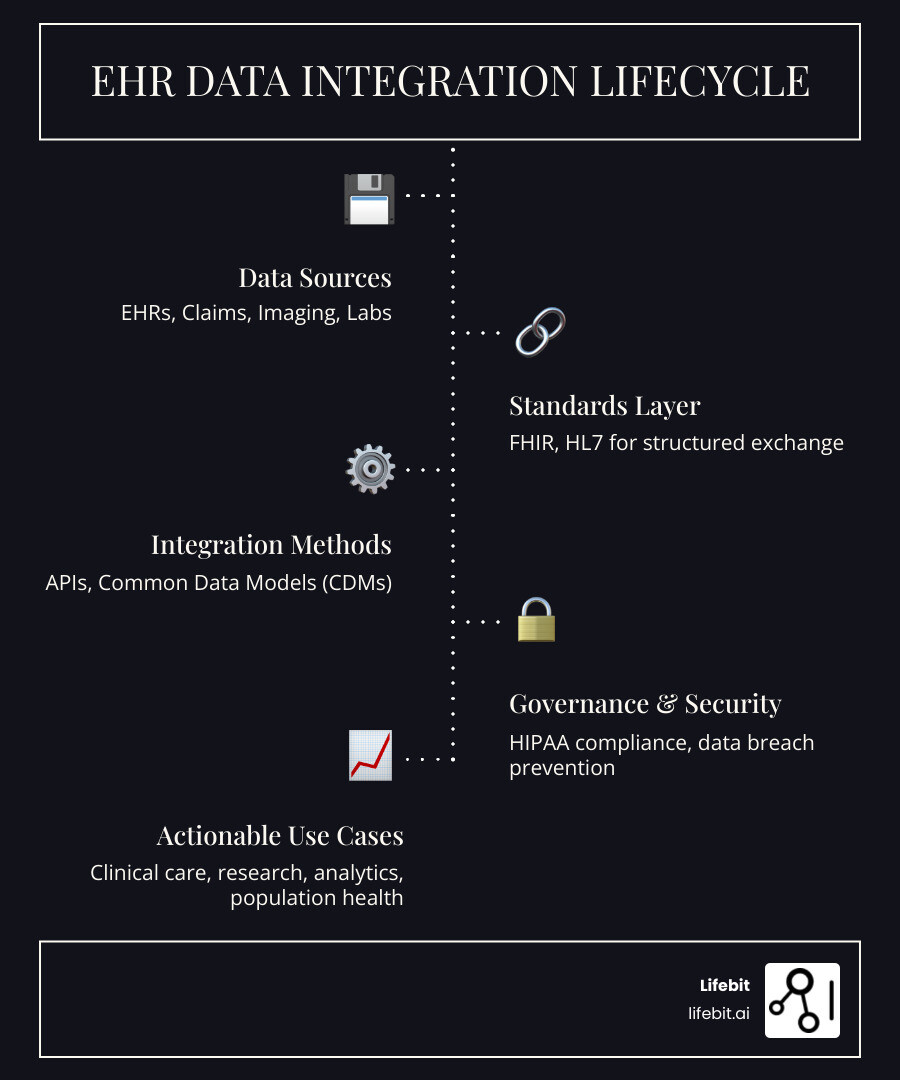
Basic ehr data integration vocab:
Why Your Health System is Failing at EHR Data Integration
It’s a frustrating paradox: we have more digital health tools than ever, but our systems are more fragmented than they were a decade ago. Why is this still an issue? The root causes are rarely just about the code; they are a messy mix of technical debt, administrative friction, and misaligned incentives.
According to the Office of the National Coordinator for Health Information Technology, interoperability is the ability of a system to exchange electronic health information from other systems without special effort on the part of the user. Yet, most clinicians feel that “special effort” is their entire job description.
The Primary Challenges of Modern Integration
- Vendor Resistance and Information Blocking: Historically, some legacy EHR vendors engaged in “information blocking,” creating proprietary walled gardens that made it difficult or prohibitively expensive to pull data out. While the 21st Century Cures Act has introduced strict penalties for this behavior, the technical architecture of many legacy systems still reflects this “closed” philosophy.
- The Burden of Technical Debt: Many health systems are running on EHR versions that are 10 to 15 years old. These systems were designed for billing and documentation, not for real-time data exchange or AI-driven analytics. Upgrading these systems is a multi-million dollar endeavor that often takes years, leaving IT teams to manage brittle “spaghetti code” integrations in the interim.
- Data Silos and Departmental Fragmentation: Information is often trapped in departmental “islands”—radiology (PACS), labs (LIS), and pharmacy systems that don’t talk to the central EHR. This lack of horizontal integration means that a clinician might see a patient’s diagnosis but not their most recent imaging report or medication adherence data.
- The 21st Century Cures Act Gap: While the 21st Century Cures Act mandates that patients have access to their data via APIs, many health systems haven’t yet extended that same fluidity to their internal research or clinical operations. There is a disconnect between “compliance-level” integration and “operational-level” integration.
Overcoming Administrative and Privacy Barriers
Administrative problems often masquerade as technical ones. For instance, contractual limitations between a health system and a vendor can restrict how often data can be refreshed or which third-party apps can connect. These aren’t software bugs; they’re business barriers that require legal and executive intervention to resolve.
Privacy is another massive concern. With 112 million individuals impacted by breaches in 2023, IT leaders are understandably cautious. However, HIPAA doesn’t have to be a wall. By using proper associate agreements, organizations can safely integrate third-party tools while maintaining strict compliance. The key is moving away from manual file transfers (like SFTP), which are error-prone and insecure, toward automated, encrypted pathways that utilize modern authentication protocols like OAuth2.
Leveraging APIs and FHIR for Real-Time EHR Data Integration
If you want to move from “reactive” to “proactive” care, you need real-time data. This is where APIs (Application Programming Interfaces) and FHIR (Fast Healthcare Interoperability Resources) come in.
Unlike old-school batch processing, which might update your database once a week, FHIR allows for bi-directional data flow. This means an external app—like a pharma target identification tool—can pull specific patient data, analyze it, and push an alert back into the clinician’s EHR workflow. This creates a closed-loop system where data doesn’t just sit in a repository but actively informs the point of care. No more hunting for PDFs; the insight is right where the doctor needs it, integrated into the native user interface of the EHR.
The Technical Blueprint: Standards and Methods for Seamless Exchange
Achieving ehr data integration requires choosing the right tool for the job. There is no one-size-fits-all approach. You might use HL7v2 for real-time hospital feeds (like admissions and discharges) while using FHIR for modern mobile app connections. Understanding the nuances of these standards is critical for any IT leader.
Comparison of Integration Methods
| Method | Pros | Cons | Best Use Case |
|---|---|---|---|
| APIs (FHIR) | Real-time, standardized, secure, developer-friendly. | Requires modern EHR versions; setup complexity. | Mobile apps, patient portals, real-time analytics. |
| HL7v2 | Ubiquitous in legacy systems; great for streaming. | Complex parsing; not designed for web/mobile. | Hospital ADT (Admissions, Discharge, Transfer) feeds. |
| RPA (Robots) | Bridges gaps where no API exists; no coding needed. | Brittle; breaks if the UI changes. | Entering data into old legacy systems without APIs. |
| SFTP | Simple to set up; handles large batch files. | Not real-time; security risks if not managed. | Historical data migration; bulk registry uploads. |
| Direct Messaging | Secure, HIPAA-compliant email-like exchange. | Unstructured data; hard to automate. | Provider-to-provider referrals and summaries. |
The Importance of Semantic Interoperability
Many systems suffer during data migration because they don’t account for quality or semantics. Moving “messy” data from an old system to a new one just gives you a faster way to see wrong information. This is the difference between structural interoperability (the ability to move the data) and semantic interoperability (the ability for both systems to understand the meaning of the data).
Working with the Fast Healthcare Interoperability Resources standard helps because it forces data into a consistent structure from the start. However, you must also utilize terminology services like SNOMED CT for clinical findings and LOINC for laboratory results. Without these standardized vocabularies, a “glucose” test in one system might not be recognized as the same test in another, leading to dangerous gaps in the longitudinal patient record.
SMART on FHIR: The App Store for Healthcare
One of the most significant advancements in EHR integration is the SMART on FHIR framework. This allows third-party developers to build applications that can run inside any EHR that supports the standard (like Epic, Cerner, or Allscripts). This “plug-and-play” capability is revolutionary because it allows health systems to adopt specialized tools—such as genomic visualization or advanced risk calculators—without needing to build custom integrations for every single tool. It effectively turns the EHR into a platform rather than just a database.
6 Steps to Implement a Successful Integration Strategy
Ready to break the silos? Follow this blueprint to ensure your ehr data integration project actually delivers value instead of just becoming another IT headache. Successful integration is 30% technology and 70% strategy and governance.
1. Define Your Data Strategy and Use Cases
Don’t integrate for the sake of integration. Identify your “North Star”—is it reducing sepsis deaths? Speeding up clinical trial recruitment? Improving patient check-in? By focusing on a specific clinical or operational outcome, you can prioritize which data elements need to be integrated first. This prevents “scope creep” and ensures that the project has a clear ROI from day one.
2. Build a Scalable Architecture (The Hub-and-Spoke Model)
Move away from point-to-point connections. If you have 10 systems and you connect them all individually, you end up with 45 different connections to maintain. Instead, use a “hub-and-spoke” model or a Trusted Data Lakehouse. This architecture allows you to ingest data from multiple sources (EHR, genomic, imaging, wearables) into a central repository where it can be standardized, cleaned, and then distributed to any application that needs it.
3. Automate Ingestion and Normalization
Manual extracts and CSV uploads are the enemy of scale. They are prone to human error and are outdated the moment they are created. Use FHIR-based APIs to automate the flow of data. Implement automated “data pipelines” that not only move the data but also normalize it against standard terminologies (like RxNorm for medications) in real-time. This ensures that the data is always “research-ready” or “clinical-ready.”
4. Enforce Federated Data Governance
Who owns the data? Who can see it? Establish clear roles and use federated governance to ensure compliance across different jurisdictions. This is especially vital for global organizations operating in the UK, USA, Europe, and Singapore, where GDPR and HIPAA requirements may overlap. Federated governance allows the data to remain in its original location (behind the hospital firewall) while allowing authorized users to run queries and gain insights without moving the raw files.
5. Phased Rollout and Pilot Testing
Start small. Pick one high-value use case—like an automated sepsis alert or a patient-facing pre-op checklist—to prove the ROI to stakeholders. Use this pilot to identify bottlenecks in the data flow and to train staff on the new workflows. Once the pilot is successful, use that momentum to scale the integration to the entire enterprise.
6. Create a Long-Term Roadmap for Evolution
Integration isn’t a one-time event; it’s a continuous process. As new standards emerge (like USCDI Version 5) and new data types become relevant (like social determinants of health or continuous glucose monitor data), your system must be flexible enough to evolve. Establish a permanent “Interoperability Committee” that includes both IT leaders and clinical champions to oversee the long-term roadmap and ensure the technology continues to meet the needs of the frontline staff.
The Role of Change Management
Finally, never underestimate the human element. EHR integration often changes how clinicians work. If a new integrated tool adds three extra clicks to a doctor’s workflow, they won’t use it, regardless of how powerful the data is. Successful integration requires deep engagement with clinicians to ensure that the integrated data is presented in a way that is intuitive and helpful, not overwhelming.
Maximizing ROI: From Clinical Outcomes to Research Breakthroughs
The Return on Investment (ROI) for ehr data integration isn’t just about saving money on paper; it’s about saving lives, reducing clinician burnout, and accelerating the pace of medical discovery. When data flows freely, the entire healthcare ecosystem becomes more efficient.
The Power of Common Data Models (CDMs) in Research
To make EHR data useful for research at scale, we use Common Data Models like OMOP (Observational Medical Outcomes Partnership). Think of OMOP as a universal translator. If one hospital records “Heart Attack” and another records “Myocardial Infarction,” OMOP maps them both to a single standard code.
This allows researchers to run the same analysis across 10 different hospitals simultaneously without having to rewrite the code for each one. This is the foundation of “Federated Research,” where a pharmaceutical company can analyze real-world evidence (RWE) from millions of patients across the globe to identify new drug targets or monitor safety, all while the data remains securely within the health system’s infrastructure.
Transitioning to Value-Based Care (VBC)
In a value-based care model, providers are paid based on patient outcomes rather than the volume of services. This shift is impossible without deep EHR integration. To succeed in VBC, organizations must be able to:
- Identify High-Risk Patients: Use integrated data from EHRs and claims to predict which patients are at risk for readmission.
- Track Quality Metrics: Automatically pull data for HEDIS or MIPS reporting without manual chart abstraction.
- Manage Population Health: See a bird’s-eye view of an entire patient population to identify gaps in care, such as overdue screenings or unmanaged chronic conditions.
Closing the Patient Engagement Gap
There is also a huge operational ROI in patient experience. A 2022 poll found that 83% of patient check-ins still happen at the “front desk.” This is a massive inefficiency that leads to long wait times and administrative errors.
By integrating patient-facing apps directly with the EHR, you can move check-ins online, reducing staff burden and improving the patient experience. When data flows bi-directionally, the patient fills out a form on their phone, and it automatically populates the clinician’s screen. This reduces the “clipboard fatigue” that patients hate and ensures that the clinician has the most up-to-date information before they even walk into the exam room.
Accelerating Clinical Trials
Traditionally, clinical trials and EHRs lived in separate worlds. Researchers had to manually abstract data from charts—a process that is slow, expensive, and riddled with errors. However, as noted in Electronic health records: new opportunities for clinical research, integrating these systems allows for “Learning Health Systems.” In this model, the EHR can automatically flag patients who meet the criteria for a clinical trial, speeding up recruitment and ensuring that life-saving treatments reach the market faster.
Frequently Asked Questions about EHR Data Integration
What is the difference between HL7 and FHIR?
Think of HL7v2 as a telegram—it’s a long string of text separated by pipes (|) that tells you everything that happened in one go (e.g., “Patient X was admitted to Room Y”). It’s great for older systems and simple event notifications. FHIR (Fast Healthcare Interoperability Resources) is more like a modern website API. It allows you to “query” just the specific piece of data you need (like “give me the last three blood pressure readings”) without having to download the entire medical record. FHIR is much easier for web and mobile developers to work with.
How do Common Data Models (CDMs) facilitate clinical research?
CDMs like OMOP or PCORnet standardize the meaning and structure of data. This allows for “federated” research, where you can ask a question like “How many patients over 65 had a stroke after taking X drug?” across dozens of different health systems at once. Because everyone is using the same “language” (the CDM), the query works everywhere, even if the underlying EHR vendors are different.
What are the primary security risks during EHR integration?
The biggest risks are unauthorized access, data leakage during transit, and “credential stuffing” attacks on APIs. In 2023, over 540 organizations faced breaches. To mitigate this, we use encryption at rest and in transit (TLS 1.3), multi-factor authentication (MFA), and “federated” access—where the data stays securely behind the health system’s firewall, and only the insights (not the raw patient data) are shared with external partners.
What is TEFCA and why does it matter?
TEFCA (Trusted Exchange Framework and Common Agreement) is a federal initiative in the U.S. designed to create a “network of networks.” It establishes a technical and legal floor for health information exchange nationwide. For health systems, TEFCA means that once you connect to a Qualified Health Information Network (QHIN), you can theoretically exchange data with any other connected provider in the country without needing individual contracts with each one.
How does EHR integration support Artificial Intelligence (AI)?
AI is only as good as the data it is trained on. EHR integration provides the high-volume, high-velocity data streams that AI models need to make accurate predictions. Whether it’s a machine learning model predicting sepsis or a natural language processing (NLP) tool extracting insights from clinician notes, integration ensures that the AI has access to the full clinical context in real-time.
What is the role of USCDI in integration?
The United States Core Data for Interoperability (USCDI) is a standardized set of health data classes and constituent data elements for nationwide, interoperable health information exchange. It sets the minimum standard for what data must be shareable via APIs. As USCDI evolves (moving to Version 4 and 5), it includes more complex data like social determinants of health (SDOH), which are critical for holistic patient care.
Conclusion
The era of isolated data is over. To survive and thrive in a $379 billion digital health market, health systems must move beyond the silos. Successful ehr data integration isn’t just a technical upgrade—it’s a strategic imperative that empowers clinicians, protects patients, and accelerates the next generation of medical breakthroughs.
At Lifebit, we believe that data should be accessible, not exposed. Our federated AI platform and Trusted Research Environment (TRE) enable organizations to achieve secure, real-time access to global biomedical data without ever moving the raw files. Whether you are building a Learning Health System or power-charging your pharmacovigilance, we provide the tools for harmonization and advanced analytics that turn fragmented records into life-saving insights.
Visit Lifebit to learn more about secure data integration and how we can help your organization lead the charge in the new era of interoperable healthcare.