

Everything You Need to Know About Biotechnology Software

Pharmaceutical Software: How to Stop Losing 90% of Drugs and Secure Your 2026 Pipeline
Pharmaceutical software encompasses digital tools that automate and streamline drug discovery, clinical trials, manufacturing, quality control, and regulatory compliance across the entire drug development lifecycle. These solutions range from Electronic Data Capture (EDC) and Clinical Trial Management Systems (CTMS) to Manufacturing Execution Systems (MES), Laboratory Information Management Systems (LIMS), and Enterprise Resource Planning (ERP) platforms.
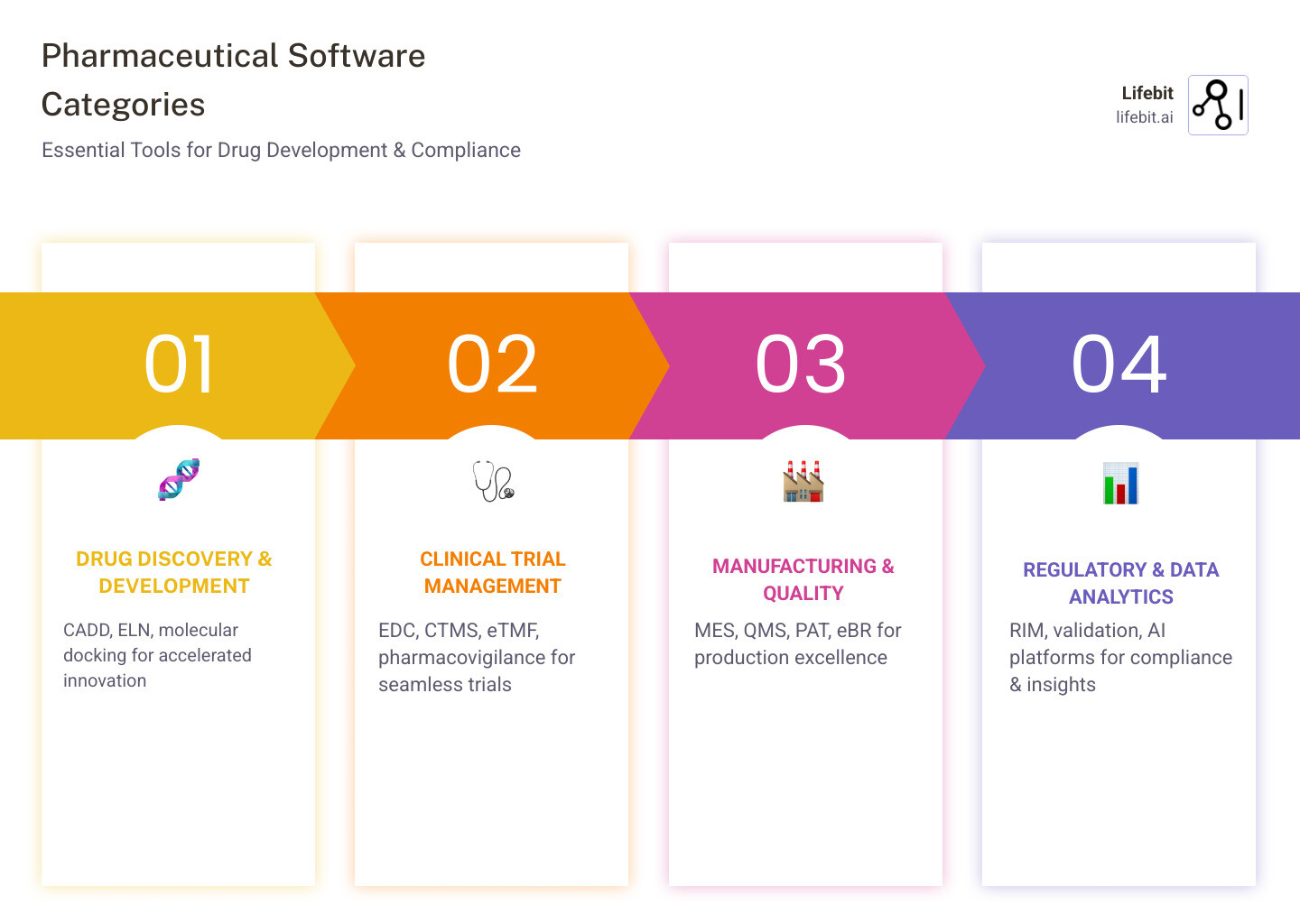
Primary types of pharmaceutical software include:
- Drug Discovery & Development Tools – Computer-Aided Drug Design (CADD), Electronic Lab Notebooks (ELN), molecular docking platforms
- Clinical Trial Management – EDC, CTMS, Electronic Trial Master File (eTMF), pharmacovigilance systems
- Manufacturing & Quality – MES, Quality Management Systems (QMS), Process Analytical Technology (PAT)
- Regulatory & Compliance – Regulatory Information Management (RIM), validation tools, audit trail systems
- Data Analytics & AI Platforms – Real-world evidence generation, predictive analytics, federated learning systems
The pharmaceutical industry is under more pressure than ever. Regulatory demands are tighter, production timelines are shorter, and data is more complex. Add global teams and supply chain volatility, and you’ve got zero room for error. Yet 26% of life science companies still rely on paper and spreadsheets for vital quality and compliance operations. That’s risky business in 2026. This reliance on legacy systems is a primary contributor to the industry’s staggering failure rate, where nearly 90% of drug candidates fail to reach the market. By failing to digitize, companies are essentially flying blind through the most expensive and risky phases of development.
Modern pharmaceutical software is no longer a back-office utility—it’s a strategic driver of innovation, efficiency, and compliance. The FDA and ICH expect optimized, digitized operations. Software enables smarter workflows, provides real-time data you can trust, helps teams collaborate across borders, and contains advanced tools to keep you compliant with cGMP, 21 CFR Part 11, ALCOA+ principles, and DSCSA 2024 interoperability requirements. As we approach 2026, the focus has shifted from simple digitization to “intelligent automation,” where software doesn’t just store data but actively predicts outcomes and identifies risks before they manifest in the lab or on the factory floor.
The future is cloud-first, AI-powered, and fully paperless. Organizations that invest in the right pharmaceutical software systems today will accelerate development timelines, improve patient outcomes, and build stronger connections with regulators, healthcare providers, and patients alike. This digital transformation is particularly critical for the rise of personalized medicine and cell and gene therapies (CGT), where the complexity of the supply chain and the precision required in manufacturing make manual processes physically impossible to maintain.
I’m Maria Chatzou Dunford, CEO and Co-founder of Lifebit, where we’ve built a pioneering federated AI platform that transforms how pharmaceutical companies and public health institutions access and analyze global health data. With over 15 years of expertise in computational biology, AI, and high-performance computing, I’ve seen how pharmaceutical software can unlock the full potential of secure, compliant drug development and precision medicine.
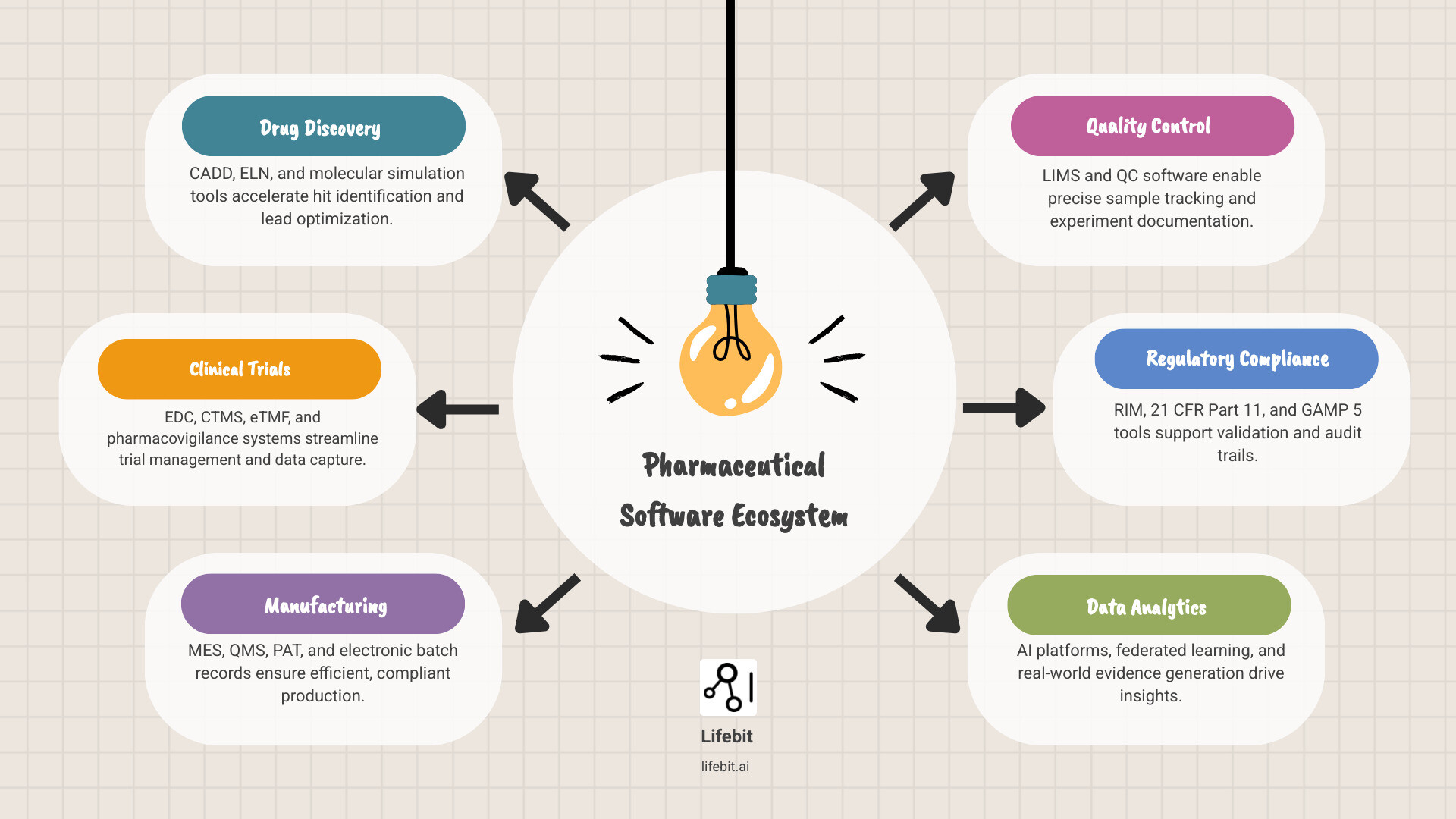
Pharmaceutical software basics:
Why Modern Pharmaceutical Software is No Longer Optional
If you are still managing your drug pipeline with Excel and paper logs, you aren’t just “old school”—you’re at high risk for regulatory rejection. As we move toward 2026, the complexity of biological data and the speed of global competition have made manual processes a liability. The sheer volume of data generated by modern high-throughput screening and multi-omic analysis is simply too vast for human-led spreadsheets to manage without catastrophic errors.
According to recent industry quality trends reports, 26% of life science companies still rely on paper and spreadsheets for their vital quality and compliance operations. This creates massive data silos and increases the likelihood of human error. In an industry where only 10% of drugs make it through to human clinical trials, we cannot afford to lose the remaining 90% to poor data management. When data is siloed in physical notebooks or disconnected files, researchers cannot see the “big picture,” leading to redundant experiments and missed safety signals that could have been caught months earlier.
Modern pharmaceutical software acts as the central nervous system of a drug manufacturer. It ensures that every action—from the first pipetting step in a lab to the final shipment of a vaccine—is recorded, traceable, and secure. This shift is driven by the need for “Quality Management Maturity” (QMM), a standard the FDA increasingly uses to evaluate how well a company manages its risks. QMM goes beyond basic compliance; it measures a company’s ability to proactively manage quality through digital oversight, ensuring that supply chains are resilient and product quality is consistent across different manufacturing sites.
| Feature | Manual Paper/Spreadsheets | Integrated Digital Workflow |
|---|---|---|
| Data Entry | Prone to transcription errors | Automated and validated at source |
| Traceability | Difficult and time-consuming | Instant audit trails |
| Compliance | Reactive and manual | “Always-on” and built-in |
| Collaboration | Limited to physical location | Secure, global, and real-time |
| Security | Physical locks or basic passwords | Encryption, MFA, and tamper-logs |
Supporting cGMP and FDA Compliance
The FDA doesn’t just suggest digitization; it practically mandates it through strict guidelines. Pharmaceutical software is the primary tool for adhering to 21 CFR Part 11, which governs electronic records and signatures. This regulation requires that digital systems have high-integrity audit trails to prove who did what, and when. Without these digital fingerprints, a company cannot prove the validity of its clinical data, which is the fastest way to receive a Complete Response Letter (CRL) or a Form 483 observation.
As noted in the FDA whitepaper on digitized operations, optimized and accelerated operations are now part and parcel of how modern companies must function. By using specialized software, companies can automate the generation of compliance reports, ensuring they are always “audit-ready” without the weeks of panic that usually precede a regulatory visit. This “constant state of readiness” is a hallmark of Pharma 4.0, where the software handles the administrative burden of compliance, allowing scientists to focus on science.
Supporting Data Integrity and ALCOA+
Data integrity is the cornerstone of trust in the pharmaceutical world. Regulators look for ALCOA+ principles: data must be Attributable, Legible, Contemporaneous, Original, and Accurate. The “+” refers to the data also being Complete, Consistent, Enduring, and Available.
Modern systems enforce these principles by default. For example, Computer Software Assurance (CSA) for Production and Quality System Software guidelines encourage a risk-based approach to validation. Instead of testing every single line of code, companies use GAMP 5 guidelines to focus validation efforts on the functions that most impact patient safety and product quality. This speeds up software deployment while keeping the data bulletproof. Furthermore, digital systems prevent “back-dating” or unauthorized data deletion, which are common red flags during regulatory inspections that can lead to massive fines or product recalls.
The 6 Essential Types of Pharmaceutical Software for 2026
To thrive in the coming years, we believe companies must move away from “point solutions” (software that only does one thing) and toward integrated ecosystems. Here are the six heavy hitters you need in your tech stack, expanded with the detail required for modern operations.
- ERP (Enterprise Resource Planning): Integrated enterprise systems act as the backbone, managing finance, procurement, and HR alongside manufacturing data. In pharma, the ERP must be “validated” and often includes modules for recipe management and batch tracking. It ensures that the cost of raw materials is balanced against production yields, providing a clear view of the “cost of goods sold” (COGS) in real-time.
- LIMS (Laboratory Information Management System): This is where your science lives. It tracks samples, manages reagent inventory, and ensures quality control results are captured accurately. A modern LIMS integrates directly with lab hardware (like mass spectrometers), pulling data automatically to eliminate manual entry errors. It also manages the calibration schedules of lab equipment, ensuring every test is performed on a compliant device.
- CRM (Customer Relationship Management): Specialized CRM tools help manage the complex web of interactions with healthcare providers (HCPs) and sales campaigns. In 2026, these tools are “omnichannel,” meaning they track whether a doctor preferred a webinar, a physical sample, or a digital whitepaper, allowing for highly personalized medical education and marketing.
- Drug Discovery Platforms: These are high-tech environments where AI helps identify new targets. You can find more info about drug discovery platforms and how they accelerate the R&D phase. These platforms now use generative AI to design novel molecules that have a higher probability of success in clinical trials, significantly reducing the “90% failure” risk mentioned earlier.
- Compliance/QMS (Quality Management System): Digital quality management platforms manage CAPAs (Corrective and Preventive Actions), deviations, and SOPs (Standard Operating Procedures) in one centralized place. When a deviation occurs on the factory floor, the QMS automatically triggers an investigation workflow, ensuring that no product is released until the quality issue is resolved and documented.
- Supply Chain Management: With global volatility, knowing exactly where your raw materials are (and where your finished products are going) is critical. This software now includes “Control Tower” capabilities, using IoT sensors to monitor the temperature and humidity of sensitive biologics during transit, ensuring that a power outage in a shipping container doesn’t ruin a multi-million dollar batch of medicine.
Manufacturing Execution Systems (MES) and Electronic Batch Records
In the factory, the MES is king. It guides operators through production steps and automatically generates electronic batch records. This eliminates the “fat finger” errors common in paper logs. The MES acts as a bridge between the high-level planning of the ERP and the low-level control of the factory floor equipment.
By integrating Process Analytical Technology (PAT), an MES can monitor chemical reactions in real-time, adjusting parameters like temperature or pH to prevent a batch from failing. This not only supports CARES Act reporting requirements regarding drug shortages but also reduces downtime by predicting when equipment might fail before it actually does. This “predictive maintenance” is a core component of reducing the overall cost of manufacturing.
Supply Chain and DSCSA 2024 Interoperability in Pharmaceutical Software
The Drug Supply Chain Security Act (DSCSA) 2024 requirements have fundamentally changed how we track products. Every unit must have a unique identifier, including a GTIN (Global Trade Item Number) and NDC# (National Drug Code). This level of serialization is designed to prevent counterfeit drugs from entering the legitimate supply chain.
If a “suspect product” (like a counterfeit or contaminated batch) is identified, the software must be able to quarantine it immediately and notify the FDA within 24 hours. Advanced ERPs and Supply Chain modules now automate this entire workflow, providing a “track and trace” history that can be shared with pharmacies and hospitals instantly. For more on how software handles these complex outputs, see the FDA’s Regulatory Considerations for Prescription Drug Use-Related Software.
Laboratory Information Management Systems (LIMS) for Quality Control
A LIMS is essential for managing the sheer volume of data generated during quality testing. It integrates with Electronic Lab Notebooks (ELN) to create a searchable, compliant record of every experiment. When paired with an AI-powered drug discovery ultimate guide, a LIMS becomes a powerful tool for spotting trends in sample purity or stability that a human might miss. For instance, a LIMS can flag a subtle drift in the purity of a raw material over six months, allowing the company to switch suppliers before the drift impacts the final product’s efficacy.
Open-Source vs. Proprietary Pharmaceutical Software Solutions
A major shift is occurring in the industry: the move toward open-source. Historically, pharma was locked into expensive proprietary systems that were difficult to customize and even harder to integrate. Today, tools like RDKit (for cheminformatics) and GROMACS (for molecular dynamics) are industry standards used by nearly every major player, from startups to Big Pharma.
The benefit of open-source is flexibility and community-driven innovation. You aren’t at the mercy of a single vendor’s roadmap or licensing fees. However, “free” software often requires more internal expertise to maintain and secure. Many companies now use a hybrid model—using open-source for the heavy-duty science (like virtual screening and genomic alignment) and proprietary platforms for the highly regulated compliance and business functions where “one throat to choke” (vendor accountability) is preferred. Check out our AI Drug Discovery Complete Guide for a deeper look at how these tools fit together.
Validating Open-Source Tools for Regulatory Submissions
Can you use “free” software for an FDA submission? Yes, but you must validate it. The FDA increasingly accepts open-source tools—in fact, they use many of them themselves for their own internal reviews. The challenge lies in the documentation. While a proprietary vendor provides a validation package, with open-source, the burden of creating that documentation falls on the user.
The key is following General Principles of Software Validation. Automated validation tools have become the gold standard for validating clinical data against CDISC (Clinical Data Interchange Standards Consortium) standards before submission, preventing costly delays. Whether the tool is open-source or proprietary, the manufacturer must prove the system is “fit for purpose” through Installation Qualification (IQ), Operational Qualification (OQ), and Performance Qualification (PQ).
High-Performance Computing (HPC) in Pharmaceutical Software
Drug discovery is now a data-crunching race. High-Performance Computing (HPC) allows researchers to run thousands of molecular docking simulations using AutoDock Vina or manage complex bioinformatics pipelines with Nextflow. These tasks require massive parallel processing power that traditional office computers cannot provide.
As the Cloud-Based Drug Discovery Platforms Market expands, more of this computing is moving to the cloud. This allows even small biotech startups to access the same “supercomputing” power as global giants, democratizing the path to new therapies. Cloud-based HPC also offers better security than many on-premise servers, as cloud providers invest billions in cybersecurity infrastructure that individual pharma companies often cannot match. This scalability means a company can spin up 1,000 virtual servers for a weekend of intense simulation and shut them down on Monday, paying only for what they used.
Emerging Trends: AI, Cloud-First, and Pharma 4.0
The next frontier is Pharma 4.0—the complete digitization of the value chain. This isn’t just about moving files to the cloud; it’s about Agentic AI—intelligent systems that can autonomously perform tasks like predictive maintenance on a bioreactor or identifying a safety signal in real-world data. Imagine an AI agent that monitors global health news and clinical trial registries, automatically alerting your R&D team if a competitor’s failure opens a new market opportunity for your pipeline.
Cloud-first infrastructure is now the baseline. It allows for remote collaboration across global teams, which is essential for multi-site clinical trials. By using a Trusted Research Environment, we can ensure that sensitive patient data remains secure while still being accessible to researchers around the world. This “data-to-the-researcher” model is replacing the old “researcher-to-the-data” model, which was slow, insecure, and prone to data leakage.
The Shift to Federated AI and Real-Time Evidence
One of the biggest hurdles in pharma is the “data silo.” Valuable patient data is often trapped behind institutional walls due to privacy laws like HIPAA and GDPR. At Lifebit, we solve this through Federated AI. Instead of moving massive, sensitive datasets to the AI (which is risky and often illegal), we move the AI to the data. The data stays safely within the hospital or national health system’s firewall, while the AI learns from it and brings back only the insights.
This approach, supported by a Trusted Data Lakehouse, allows for secure collaboration without compromising privacy. It is a game-changer for AI-Driven Drug Discovery, enabling us to harmonize multi-omic data (genomics, proteomics, etc.) at a scale that was previously impossible. By analyzing diverse datasets from different populations, we can ensure that new drugs are effective for everyone, not just the narrow demographic typically represented in traditional clinical trials.
Digital Twins and In-Silico Trials
Another massive trend is the use of “Digital Twins”—virtual replicas of physical systems. In manufacturing, a digital twin of a bioreactor can predict how a change in temperature will affect the final yield without wasting expensive raw materials. In clinical research, we are seeing the rise of “in-silico” trials, where software simulates the human body’s response to a drug. While we aren’t yet at the point of replacing human trials entirely, these simulations help researchers optimize dosages and identify potential side effects long before the first patient is ever enrolled, potentially saving years of development time.
Frequently Asked Questions about Pharmaceutical Software
What is the difference between MES and eQMS?
Think of the MES (Manufacturing Execution System) as the “how-to” guide for the factory floor—it manages the actual production steps, equipment integration, and electronic batch records in real-time. The eQMS (Electronic Quality Management System) is the “governing body”—it handles the high-level quality processes like training records, CAPAs (Corrective and Preventive Actions), document control, and audit management for the entire organization, not just the manufacturing floor.
How does software support DSCSA 2024 compliance?
Software provides the “interoperability” required by the law. It allows different trading partners (manufacturers, distributors, and pharmacies) to exchange electronic data about a product’s journey using standardized formats like EPCIS. It automates the tracking of GTINs, serial numbers, and lot numbers, making it possible to trace a single bottle of pills back to its origin in seconds during a recall or investigation.
Why is the industry moving toward cloud-based solutions?
Scalability, speed, and security. On-premise servers are expensive to maintain, difficult to scale during peak research periods, and hard to update. Cloud-based pharmaceutical software allows for real-time updates to keep pace with changing regulations, provides superior disaster recovery, and enables global teams to work on the same data simultaneously without the latency issues of traditional VPNs.
What is the role of AI in pharmaceutical software validation?
AI is now being used to automate the validation process itself. Instead of humans manually writing and executing thousands of test scripts, AI-driven testing tools can simulate user behavior and verify that the software meets its requirements. This reduces the time required for “Computer Software Assurance” (CSA) and ensures that software updates can be deployed faster without compromising regulatory compliance.
Can pharmaceutical software help with patient recruitment for clinical trials?
Yes, modern CTMS and EDC systems often include patient recruitment modules that use AI to scan Electronic Health Records (EHR) and identify eligible participants based on complex inclusion/exclusion criteria. This significantly speeds up the recruitment phase, which is traditionally one of the biggest bottlenecks in drug development.
Conclusion: Future-Proofing Your Drug Development Pipeline
The transition from paper to pixels is no longer a choice—it’s a survival strategy. To stay competitive in 2026 and beyond, pharmaceutical companies must embrace an integrated, cloud-first approach to their digital infrastructure.
At Lifebit, we are proud to be at the forefront of this revolution. Our federated AI platform provides the secure, real-time access to global biomedical data that modern research demands. By breaking down data silos and providing built-in harmonization and governance, we empower you to turn complex multi-omic data into life-saving insights.
Ready to see how the Lifebit Platform can transform your research? Let’s build the future of medicine together.