
What is Secure Cloud Data and Why Should You Care

Stop Data Leaks: How Secure Cloud Data Slashes Breach Risk in 2026
Secure cloud data refers to the protection of digital information stored, processed, and transmitted across cloud infrastructure through encryption, access controls, and compliance frameworks. At its core, secure cloud data combines three essential elements:
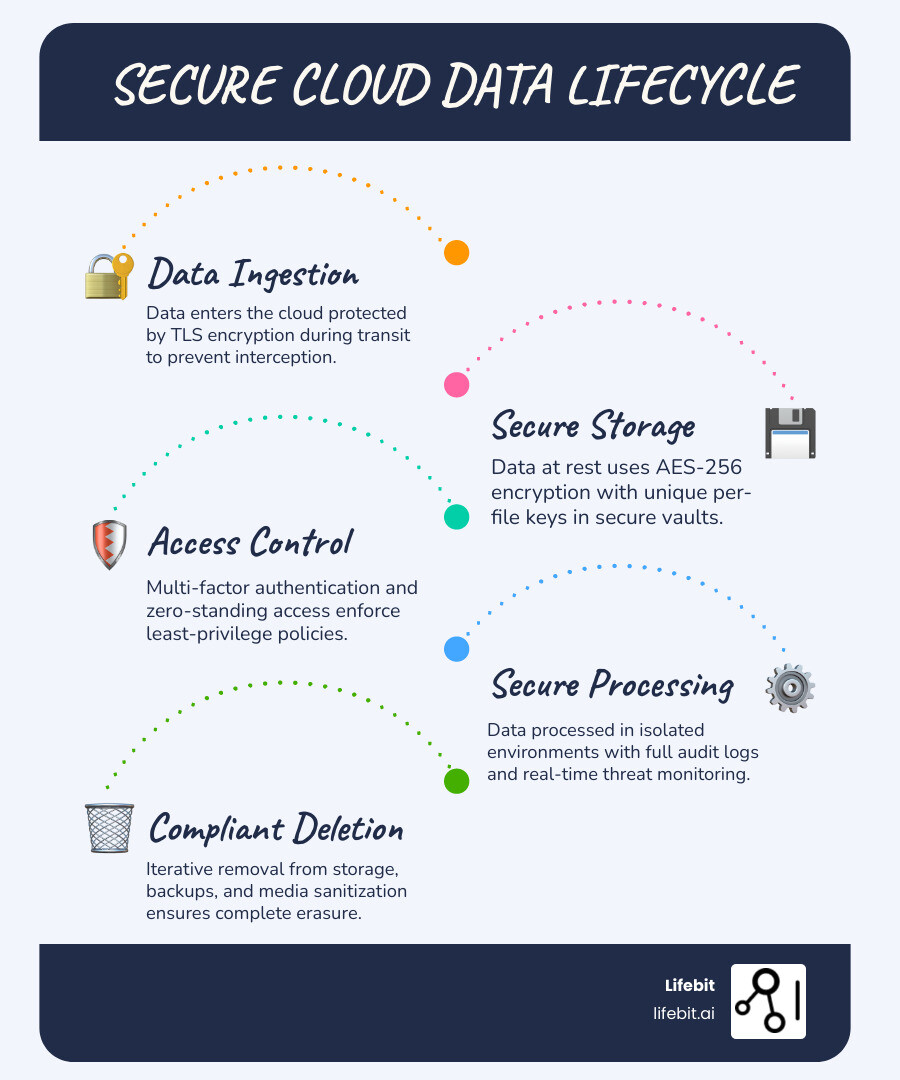
- Encryption: Data is protected at rest and in transit using industry-standard protocols like AES-256 and TLS. This ensures that even if data is intercepted or the physical storage media is stolen, the information remains unreadable without the corresponding cryptographic keys.
- Access controls: Multi-factor authentication (MFA), zero-standing access policies, and least-privilege principles prevent unauthorized access. This involves a shift from traditional perimeter-based security to a “Zero Trust” architecture where every request is verified, regardless of its origin.
- Compliance: Adherence to regulatory standards like ISO 27001, SOC 2, FedRAMP, and HIPAA ensures your data meets legal requirements. These frameworks provide a baseline for security controls and are validated through rigorous third-party audits.
The cloud isn’t just about storage anymore. It’s about accessibility without vulnerability. Organizations moving sensitive data—especially genomics, EHR records, and multi-omic datasets—face a stark reality: slow onboarding, poor data quality, and regulatory bottlenecks kill innovation. In the past, security was often seen as a barrier to speed. However, modern secure cloud data platforms integrate security into the DevOps pipeline (DevSecOps), allowing for rapid deployment without compromising safety.
Meanwhile, the shared responsibility model means both cloud providers and customers must actively protect data. Providers handle infrastructure security, while customers control access policies, encryption keys, and user permissions. This distinction is critical; a provider can offer the most secure data center in the world, but if a customer leaves an S3 bucket public, the data is at risk.
The stakes are high. In 2023 alone, Google awarded over $10 million through its Vulnerability Reward Program to researchers identifying security gaps. Microsoft 365 maintains a zero-standing access policy, meaning engineers have no default access to customer data. Each file in OneDrive is encrypted with a unique AES-256 key, with those keys further encrypted by master keys stored in secure vaults. Data centers mirror information across regions hundreds of miles apart to survive natural disasters. These aren’t marketing claims—they’re the baseline for trusted cloud infrastructure.
But here’s the problem: siloed datasets, compliance paralysis, and inaccessible AI tools still block real-time evidence generation. Pharma companies, regulatory agencies, and public health organizations need more than encryption. They need federated analytics, in situ computation, and secure collaboration—without moving data or waiting months for approvals. The “security-versus-accessibility paradox” has long plagued the industry, where the more secure a dataset was, the less useful it became for research. Modern cloud solutions are finally breaking this cycle.
I’m Maria Chatzou Dunford, CEO and Co-founder of Lifebit, where we’ve spent over 15 years building secure cloud data platforms that power genomic and biomedical research across compliant, federated environments. Our work with public sector institutions and pharmaceutical organizations has taught us that the future of precision medicine depends on solving the security-versus-accessibility paradox. We believe that data should be as open as possible for science, but as closed as necessary for privacy.
Related content about secure cloud data:
Lose Data, Lose Millions: Why Secure Cloud Data is Your Business Lifeline
In today’s digital landscape, data is more than just information; it is the lifeblood of your organization. For businesses operating in highly regulated sectors like biopharma or public health, the transition from on-premises servers to the cloud is often hindered by a fear of the unknown. However, the reality is that secure cloud data often provides superior protection compared to traditional setups. On-premises environments are frequently plagued by unpatched legacy software, physical security vulnerabilities, and a lack of specialized security personnel.

Cloud environments offer unparalleled scalability and agility. Instead of worrying about physical hard drives failing or being stolen—risks that are very real with on-premises hardware—cloud storage saves files to remote, professionally managed databases. This eliminates the risk of losing physical possession of your data. Furthermore, cloud computing allows for data sovereignty, ensuring that even while data is accessible globally, it remains within specific geographic boundaries to meet local regulations. This is particularly important for international research consortia where data must remain in its country of origin due to legal mandates like the GDPR or the UK Data Protection Act.
At Lifebit, we take this a step further. Our Lifebit Federated Biomedical Data Platform allows you to keep your data exactly where it resides. You don’t have to move sensitive datasets to the cloud; instead, we bring the analysis to the data. This “in situ” approach drastically reduces the risk of data exposure during migration. Moving petabytes of genomic data is not only a security risk but also a massive logistical and financial burden. By keeping data stationary, organizations maintain absolute control over their most valuable assets.
The Economic Reality of Data Insecurity
The financial impact of a data breach in the healthcare and life sciences sector is staggering. According to IBM’s Cost of a Data Breach Report, the average cost of a healthcare breach has reached nearly $11 million. This includes not just the immediate costs of incident response and legal fees, but also the long-term damage to brand reputation and the loss of intellectual property. For a biopharma company, the theft of proprietary clinical trial data could mean the loss of years of research and billions in potential revenue. Secure cloud data is not just a technical requirement; it is a fundamental business insurance policy.
The Power of End-to-End Encryption for Cloud Data Security
Encryption is the “secret sauce” that makes secure cloud data possible. It ensures that even if a bad actor intercepts your files, they see nothing but gibberish.
- Data at Rest: This refers to data sitting on a server. Leading providers use AES-256 encryption, where each file often receives its own unique key. For example, in OneDrive, these keys are further protected by master keys in an Azure Key Vault. This layered approach ensures that even a compromise of a single key does not expose the entire dataset.
- Data in Transit: When you upload or download files, they are protected by Transport Layer Security (TLS). This ensures that only HTTPS connections are permitted, creating a secure tunnel for your information. This prevents “man-in-the-middle” attacks where hackers attempt to eavesdrop on data as it moves across the internet.
How Lifebit encrypts your data involves these industry standards but also incorporates advanced concepts like Confidential Computing. This protects data while it is in use, using Trusted Execution Environments (TEEs) to ensure that even the cloud provider cannot peek at your sensitive computations. This is the “holy grail” of data security: ensuring data is encrypted while being stored, while being moved, and even while being analyzed.
Secure Collaboration and Real-Time Teamwork
The old way of collaborating—emailing spreadsheets back and forth—is a security nightmare. It creates multiple uncontrolled copies of sensitive data, often stored on unencrypted local devices. secure cloud data solutions solve this by providing a single point of access. Teams can work simultaneously on documents, leave annotations, and track version history in real-time, all within a controlled environment.
For researchers, this is transformative. By using a secure research environment, scientists can collaborate on massive genomic datasets without ever downloading a single file to their local machines. This “look but don’t touch” policy ensures that data remains secure while still being fully exploitable for life-saving research. It allows for a global exchange of insights without the global exchange of raw, sensitive data.
Stop Assuming Your Provider Does Everything: The Shared Responsibility Model
One of the biggest misconceptions in cloud security is that the provider handles everything. In reality, security is a “handshake” known as the Shared Responsibility Model. This model defines exactly where the cloud service provider’s (CSP) responsibility ends and the customer’s begins. Failing to understand this boundary is one of the leading causes of cloud-based data breaches.
- The Provider’s Duty: They are responsible for the security of the cloud—the physical data centers, the hardware, the hypervisor layer, and the core software that runs the services. They ensure that the physical servers are protected from fire, flood, and unauthorized entry.
- The Customer’s Duty: You are responsible for security in the cloud. This includes managing who has access to your data (Identity and Access Management), setting strong passwords, configuring network firewalls, and ensuring that your applications are not vulnerable to exploits.
The Three Pillars of the Shared Responsibility Model
Depending on the type of cloud service you use, your responsibilities will shift:
- Infrastructure as a Service (IaaS): You have the most control and the most responsibility. You manage the operating system, middleware, and all data. The provider only manages the physical hardware and virtualization.
- Platform as a Service (PaaS): The provider manages the operating system and runtime, while you focus on the security of your applications and the data they process.
- Software as a Service (SaaS): The provider manages almost everything, but you are still responsible for the data you put into the system and who you grant access to.
Understanding this balance is vital for Lifebit Data Governance & Security. We provide the tools to enforce your obligations, but your team must implement the policies that keep your specific environment safe.
Physical and Logical Controls in Lifebit-Enabled Data Centers
While we focus on the software, the physical world still matters. Major cloud providers protect their data centers with layered defense-in-depth strategies that far exceed what most private companies can afford:
- Biometrics and 24/7 Monitoring: Physical access is restricted to a handful of authorized personnel using biometric scans, laser intrusion detection, and high-definition surveillance. Access is granted on a “need-to-be-there” basis and is strictly logged.
- Geo-distribution and High Availability: To mitigate natural disasters, data is mirrored across multiple regions. For instance, Google Cloud mirrors data in at least two regions several hundred miles apart. This ensures that even if an entire geographic region suffers a catastrophic event, your secure cloud data remains safe and accessible.
- Redundant Power and Cooling: Backup generators and industrial-grade cooling systems ensure that even during a city-wide blackout or extreme heatwave, the hardware remains operational.
Lifebit infrastructure security leverages these world-class physical protections while adding logical layers that prevent unauthorized “hops” across the public internet. We use Virtual Private Clouds (VPCs) and private endpoints to ensure that data traffic never touches the public web unless absolutely necessary.
Personnel Security and Access Safeguards
Human error and insider threats are significant risks. To combat this, we advocate for a zero-standing access policy. This means that by default, no engineer—not even ours—has access to your data. If a technician needs to troubleshoot a specific incident, they must request time-limited access under the principle of least privilege. This request must be justified, approved, and is automatically revoked once the task is complete.
This Privacy by Design approach ensures that all employees undergo rigorous security training and background checks. It’s about building a culture where security isn’t an afterthought—it’s the foundation. We also implement “Just-In-Time” (JIT) administration, which provides elevated permissions only when needed, reducing the “attack surface” of privileged accounts.
7 Advanced Features That Block Hackers and Secure Your Data
To stay ahead of modern hackers, secure cloud data platforms use advanced technology that goes far beyond simple passwords. This includes the use of Trusted Research Environments (TREs), which provide a secure perimeter for data analysis without allowing raw data to be downloaded. TREs are becoming the standard for national health data initiatives, as they allow researchers to run complex queries and AI models while the data remains behind a high-security firewall.
Confidential Computing: The Next Frontier
One of the most exciting developments in secure cloud data is Confidential Computing. Traditionally, data was encrypted at rest and in transit, but it had to be decrypted in memory to be processed. This created a brief window of vulnerability. Confidential Computing uses hardware-based Trusted Execution Environments (TEEs) to encrypt data even while it is being processed by the CPU. This means that even if a hacker gains root access to the server, or if the cloud provider’s own staff tries to view the memory, they will only see encrypted data. This is a game-changer for highly sensitive genomic research.
Monitoring and Incident Response for Secure Cloud Data
Cloud providers don’t just wait for something to go wrong; they actively hunt for threats using sophisticated AI and machine learning models. This includes:
- Red Teaming: Intrusion specialists (the “Red Team”) simulate real-world attacks to find weak spots in the infrastructure, while defense engineers (the “Blue Team”) build and refine detection technologies. This constant “war gaming” ensures that defenses are always evolving.
- Vulnerability Rewards: As mentioned, programs like Google’s Vulnerability Reward Program pay millions to ethical hackers who find bugs before the bad guys do. This crowdsources security to the best minds in the world.
- Automated Mitigation and AI-Driven Detection: Systems are designed to automatically detect suspicious activity—like a login from a new country at 3 AM or a sudden attempt to export a large volume of data—and trigger immediate alerts or blocks. AI can identify patterns of behavior that would be impossible for a human analyst to spot in real-time.
Our protocols align with the NIST SP 800–61 Incident Handling guidance, ensuring a rigorous, repeatable process for any security event. This includes preparation, detection, analysis, containment, recovery, and post-incident activity.
Data Sovereignty, Recovery, and Deletion
What happens if the worst occurs? secure cloud data provides a safety net that on-premises systems often lack. Microsoft 365, for example, allows users to recover files up to 30 days after a ransomware attack through versioning and point-in-time restoration. Similarly, mass file deletion notifications alert you if a large number of files are suddenly removed, allowing for instant recovery before the deletion is synchronized across all backups.
Data residency is also key. With Lifebit, you can ensure your data stays within your jurisdiction, helping you maintain GDPR-compliant data. This is not just about where the data is stored, but also where it is processed. When it’s time to say goodbye, we follow strict media sanitization processes (such as NIST 800-88 standards), ensuring data is iteratively removed from active and backup systems until it is completely unrecoverable. This “right to be forgotten” is a core component of modern privacy regulations.
Meet Compliance and Cut Costs: Essential Secure Cloud Data Standards
Navigating the alphabet soup of compliance is easier when your platform does the heavy lifting. Leading cloud services hold various certifications that prove they meet high security bars. These certifications are not just one-time events; they require ongoing monitoring and annual re-certification to ensure that security standards are maintained over time.
| Feature | Encryption at Rest | Encryption in Transit |
|---|---|---|
| Protocol | AES-256 (Standard) | TLS / HTTPS |
| Protection | Protects data on disks | Protects data moving over networks |
| Key Management | Managed in secure vaults (e.g., Azure Key Vault) | Handled via SSL/TLS certificates |
| Lifebit Status | Enabled by default | Mandatory for all connections |
These standards, including ISO 27001 (Information Security Management), SOC 2 Type II (Security, Availability, and Confidentiality), and FedRAMP (Federal Risk and Authorization Management Program), are not just badges; they are continuously validated through independent audits. Our Lifebit ISO Certification is a testament to our commitment to protecting sensitive genomic data. For organizations working with the US government, FedRAMP compliance is a mandatory requirement that ensures cloud services meet the highest levels of security for federal data.
Navigating Global Data Privacy Frameworks
Compliance is not a “one-size-fits-all” endeavor. Different regions have different requirements:
- GDPR (Europe): Focuses on data minimization, purpose limitation, and the rights of the individual. It requires strict controls on how data is transferred outside of the European Economic Area.
- HIPAA (USA): Sets the standard for protecting sensitive patient data. Any cloud provider handling Protected Health Information (PHI) must sign a Business Associate Agreement (BAA) and implement specific technical safeguards.
- GXP (Global): For pharmaceutical companies, maintaining “Good Practice” (GXP) compliance is essential for clinical trials and manufacturing. This requires detailed audit trails and validation of the software used to process data.
Essential Safeguards for Individual Users
Even the best platform can’t protect you if you leave the front door open. Human error remains the #1 cause of security breaches. We recommend every user follow these best practices:
- Use Strong, Unique Passwords: Avoid “Password123.” Use a password manager to generate and store complex passwords for every service. Check the strength of your password using online tools.
- Enable Two-Step Verification (MFA): This requires a code from your phone or a physical security key in addition to your password. It’s one of the single most effective ways to stop account takeovers, blocking 99.9% of automated attacks.
- Update Security Info: Ensure your alternate email and phone number are current so you can recover your account if needed. Regularly review your account activity logs for any unrecognized logins.
- Device Encryption: Enable BitLocker (Windows) or FileVault (Mac) on your laptop to protect data if the physical device is stolen. A secure cloud is of little use if your local access point is wide open.
Protecting the Software Supply Chain
Security doesn’t stop at the data; it extends to the code that processes it. We use Binary Authorization to ensure that only trusted, verified code is deployed in our environments. By adhering to frameworks like SLSA (Supply chain Levels for Software Artifacts), we protect against vulnerabilities in open-source components and ensure the integrity of the research software used on our platform. This involves signing every piece of code and verifying its provenance before it is allowed to run. This is a critical part of navigating data privacy regulations effectively, as it prevents “poisoned” software from being used to exfiltrate data.
Secure Cloud Data: Your Top Questions Answered
How does Lifebit handle data sovereignty and deletion?
We use a federated model, meaning your data stays in its original location (e.g., your own AWS or Azure bucket in a specific region). You maintain full ownership and control. When you request deletion, we follow a rigorous process to ensure the data is eliminated from all active and backup systems in accordance with local laws. We provide certificates of destruction where required for compliance audits.
What is the difference between private and public cloud security with Lifebit?
Public clouds offer massive scale and built-in security features, while private clouds (or our federated approach) provide improved data sovereignty and control. Lifebit bridges this gap by allowing you to use public cloud tools within your own secure, private perimeters. This gives you the “best of both worlds”: the power of the public cloud with the security of a private environment.
Can I recover data after a ransomware attack using Lifebit?
Yes. Our platform integrates with cloud-native backup and versioning tools. For example, if your integrated storage supports it, you can restore files to a state prior to the attack, typically within a 30-day window. We also recommend implementing “immutable backups,” which are copies of data that cannot be changed or deleted for a set period, providing a foolproof defense against ransomware.
How does federated analysis improve security?
Federated analysis allows you to run computations on data without the data ever leaving its secure environment. Instead of moving the data to the code, we move the code to the data. This eliminates the risks associated with data transfer and ensures that the data owner maintains 100% control over who accesses the information and for what purpose.
Secure Your Research Future Today
The transition to secure cloud data is no longer a luxury—it’s a necessity for any organization that wants to remain competitive and compliant in an increasingly data-driven world. By combining the massive infrastructure of major cloud providers with Lifebit’s specialized federated AI and governance tools, you can open up the power of your data without compromising on safety.
As we look toward 2026 and beyond, the volume of biomedical data will only continue to grow. The organizations that succeed will be those that view security not as a checkbox, but as a strategic enabler of innovation. Secure cloud data allows for the kind of large-scale, multi-institutional collaboration that is required to solve the world’s most pressing health challenges.
The future of research is collaborative, real-time, and, above all, secure. Whether you are managing patient records or global genomic datasets, the right cloud strategy ensures that your most valuable information assets are protected today and ready for the breakthroughs of tomorrow.
Ready to secure your research? Explore the Lifebit Federated Biomedical Data Platform and see how we turn data security into a competitive advantage. Don’t let security concerns hold back your next discovery.