

Clinical Data Standardization Platform: How to Unify Siloed Health Data in Weeks, Not Years
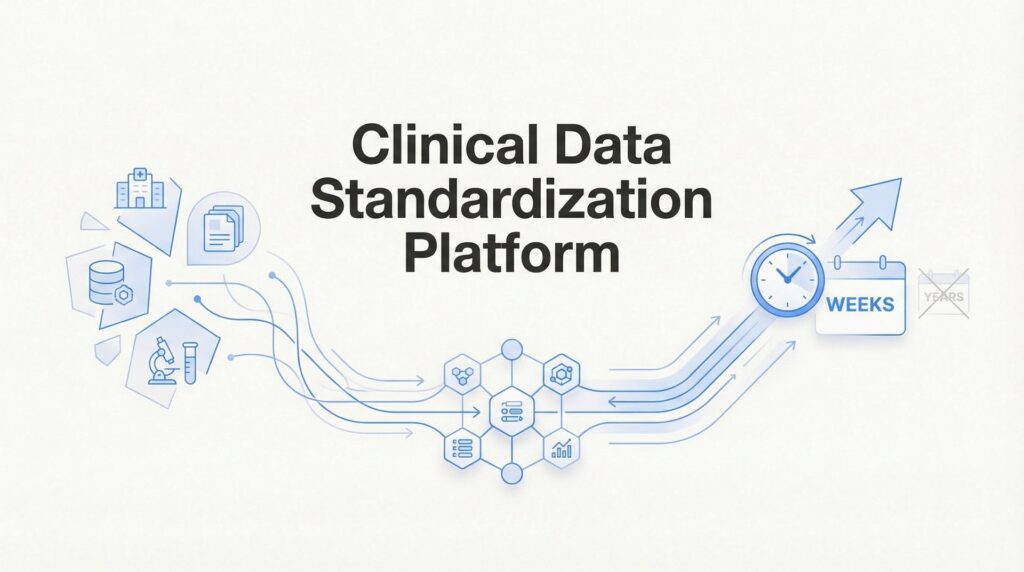
Your research consortium has approval. Funding is secured. The scientific questions are clear. Then you hit the wall: patient data from Hospital A uses ICD-10 codes, Hospital B’s EHR exports in proprietary XML, and the national registry you need is structured completely differently. A single patient’s journey through the healthcare system generates records in seventeen different schemas. Your data scientists spend six months just trying to align date formats.
This isn’t a technical inconvenience. It’s the reason promising drug candidates miss regulatory windows. It’s why multi-site clinical trials collapse under the weight of incompatible data. It’s why precision medicine programs announce bold visions and then quietly stall.
A clinical data standardization platform solves this foundational problem. It transforms incompatible clinical data into analysis-ready, interoperable formats—without requiring you to move sensitive information from secure environments. The difference between organizations that launch precision medicine programs and those that endlessly prepare comes down to this infrastructure layer.
Why Unstandardized Data Costs More Than You Think
Research teams routinely spend 60-80% of project time on data preparation rather than actual analysis. That’s not an exaggeration—it’s the reality when clinical data arrives in dozens of incompatible formats.
Traditional ETL tools and data warehouses weren’t designed for clinical complexity. They handle structured business data well enough, but they break when confronted with medical ontologies, evolving terminology standards, and the regulatory requirements of HIPAA and GDPR. A standard data warehouse approach assumes you can freely copy and centralize data. Healthcare regulations make that assumption catastrophic.
The downstream costs compound quickly. Regulatory submissions get delayed because you can’t produce consistent safety data across trial sites. Multi-institutional research collaborations fail because participating organizations can’t agree on a common data format. Your precision medicine initiative—the one that would identify patient subgroups for targeted therapies—never moves beyond the planning phase because the underlying data remains siloed and incompatible.
Consider what happens when a biopharma company tries to combine real-world evidence from multiple sources for a regulatory submission. Claims data uses one coding system. EHR data uses another. Lab results arrive in proprietary formats. Without standardization, analysts spend months manually mapping fields, validating transformations, and inevitably discovering errors late in the process.
The opportunity cost is equally significant. Every month spent wrangling data is a month not spent discovering biomarkers, validating drug targets, or identifying patient cohorts that could benefit from existing therapies. Organizations that solve standardization early create compounding advantages—their cleaned, harmonized data becomes a reusable asset for every subsequent project.
What Actually Defines a Standardization Platform
Not every tool that claims to “integrate” or “harmonize” clinical data qualifies as a true standardization platform. The distinguishing capabilities matter.
Semantic Mapping to Recognized Standards: The platform must map source data to established common data models—OMOP CDM for observational research, FHIR for healthcare interoperability, and medical vocabularies like SNOMED CT and ICD-10. The depth of vocabulary coverage determines what you can actually do with the standardized data. A platform that handles basic demographics but fails on complex lab results or medication histories leaves you with unusable output.
AI-Powered Automated Harmonization: Manual data mapping doesn’t scale. Modern platforms use machine learning to automatically detect patterns, suggest mappings, and handle the messy inconsistencies that define real-world clinical data. This isn’t about replacing human expertise—it’s about automating the repetitive 80% so your clinical informaticists can focus on the complex 20%.
The difference in speed is dramatic. Traditional manual approaches take 6-12 months per data source. AI-powered platforms reduce that to days or weeks. When you’re managing dozens of data sources across a research program, this time compression changes what’s possible.
Built-In Governance and Compliance: Standardization platforms for healthcare must include compliance capabilities from day one—not as an afterthought. That means comprehensive audit trails showing exactly how data was transformed, consent management systems that track patient permissions across data uses, and alignment with regulatory frameworks like HIPAA, GDPR, and FedRAMP.
Organizations that try to retrofit compliance onto basic integration tools discover the hard way that it doesn’t work. Data governance isn’t a feature you add—it’s architectural. The platform must be designed so that every transformation, every access event, and every data export is logged and auditable.
Federated Architecture Changes the Compliance Equation
Here’s the fundamental tension in clinical data standardization: you need to harmonize data from multiple sources, but regulations increasingly prohibit moving that data to a central location.
Federated data standardization solves this by bringing the harmonization logic to the data rather than bringing the data to a central repository. The standardization platform deploys in each participating organization’s secure environment. Data stays where it lives. Only the standardized query results—properly anonymized and approved—move across organizational boundaries.
This architecture isn’t just theoretically elegant—it’s often legally required. GDPR’s data localization provisions, various national health data residency laws, and institutional policies at research hospitals frequently prohibit copying patient data to external systems. Federated approaches make previously impossible collaborations suddenly feasible.
Consider a multi-country precision medicine initiative. Hospital systems in Germany, the UK, and Singapore all want to contribute patient data for cancer biomarker discovery. Under traditional centralized approaches, this project dies in legal review—no organization will export identifiable patient data across borders. With federated standardization, each institution runs the harmonization platform in their own cloud environment. Researchers query the federated network, and only aggregate, anonymized results return.
The contrast with legacy data pooling approaches is stark. Centralized data warehouses create single points of failure for security breaches, require extensive data use agreements that take months to negotiate, and often violate emerging privacy regulations. Federated platforms eliminate these problems by design—because the sensitive data never moves.
The Questions Your Vendor Evaluation Must Answer
Most organizations evaluating clinical data standardization platforms focus on feature checklists. The critical questions get overlooked until implementation reveals gaps.
What’s the Actual Time to Value? Ask vendors for documented evidence of how long standardization takes for a new data source. Not theoretical capabilities—actual customer timelines. Can they harmonize a complex EHR export in days or does it take months? Request references from organizations with similar data complexity to yours.
The difference between platforms that deliver value in weeks versus those that require months of configuration determines whether your precision medicine program launches this year or next. Time to value isn’t a nice-to-have metric—it’s the primary predictor of success.
Who Controls the Infrastructure? Deployment flexibility matters more than vendors admit. Can the platform run in your cloud environment, on-premise, or in a hybrid configuration? More importantly, who actually owns and controls that infrastructure? Platforms that lock you into vendor-managed infrastructure create dependencies that limit your flexibility and increase long-term costs.
Organizations with strict data governance requirements—government health agencies, academic medical centers, biopharma companies handling pre-approval trial data—need platforms they can deploy and control entirely within their own security perimeter. Anything less creates compliance risks and vendor lock-in.
Prove the Interoperability at Scale: Request evidence of successful multi-site, multi-format standardization projects. How many different source systems has the platform successfully harmonized? What’s the largest number of participating institutions in a single federated network? Can they demonstrate successful standardization of both structured data and unstructured clinical notes?
Vendors excel at demos using clean sample data. Real-world clinical data is never clean. The platform must handle missing fields, inconsistent coding, evolving terminology standards, and the countless edge cases that define actual healthcare data. Only evidence from production deployments proves this capability.
What Standardized Data Actually Enables
Data standardization isn’t the end goal—it’s the foundation that makes everything else possible. Once your clinical data conforms to common standards, entirely new capabilities become accessible.
Cohort Discovery Across Institutions: Researchers can identify patient populations matching specific criteria across multiple healthcare systems. Instead of limiting studies to patients at a single institution, you can discover rare disease cohorts, treatment response patterns, or genetic variants across your entire federated network. This scale transforms statistical power and the types of research questions you can answer.
AI Model Training on Real-World Data: Machine learning models for clinical prediction require massive, diverse training datasets. Standardized data makes it possible to train models on patient populations from multiple institutions while maintaining privacy and compliance. The resulting models generalize better because they’ve learned from broader patient diversity.
Real-World Evidence for Regulatory Submissions: Biopharma companies increasingly need real-world evidence in clinical research to support drug approvals and label expansions. Standardized clinical data from multiple sources provides the evidence base regulators demand—but only if the standardization process itself meets regulatory requirements for data quality and traceability.
The compounding value effect matters more than organizations initially realize. When you standardize data for one research project, that cleaned, harmonized dataset becomes a reusable asset. The next project that needs similar data starts from a standardized baseline rather than from raw, incompatible sources. Over time, your library of standardized datasets grows, and each new project becomes faster and cheaper.
Leading organizations connect their standardization platforms directly to downstream analytics environments, biomarker discovery pipelines, and regulatory workflow systems. The standardized data flows automatically to where it’s needed—no manual exports, no reformatting, no re-validation. This clinical data integration eliminates the friction that typically exists between data preparation and analysis.
Standardization Is Infrastructure, Not a Project
Clinical data standardization platforms aren’t optional infrastructure for organizations serious about precision medicine. They’re the foundational layer that determines whether ambitious programs succeed or collapse under the weight of incompatible data.
The non-negotiables are clear: semantic mapping to recognized standards like OMOP and FHIR, AI-powered harmonization that reduces months of manual work to days, federated architecture that maintains compliance while enabling collaboration, and proven time-to-value with evidence from production deployments.
Organizations that treat standardization as a one-time project—something to solve for a single research initiative—miss the strategic opportunity. The right platform becomes permanent infrastructure that makes every subsequent project faster, cheaper, and more capable. It’s the difference between repeatedly solving the same data problems and building on a foundation that compounds value over time.
If your organization manages clinical data across multiple sources and struggles with interoperability, the question isn’t whether you need a standardization platform. The question is how much longer you’ll accept the current limitations. Delayed research programs, failed collaborations, and precision medicine initiatives that never launch all trace back to this foundational problem.
The platforms that solve this challenge exist. They’re deployed at scale in government health agencies, academic medical centers, and biopharma companies managing hundreds of millions of patient records. The technology works. The question is whether your organization will continue operating with 20th-century data infrastructure or build the foundation that makes 21st-century precision medicine possible.
Get-Started for Free and discover how quickly standardized, analysis-ready clinical data can transform what your research programs accomplish.