

The Rise of the Hybrid Cloud Data Platform

Why Enterprises Can No Longer Afford to Ignore the Hybrid Cloud Data Platform
A hybrid cloud data platform is an integrated software-defined layer that unifies data stored across on-premises infrastructure, multiple public clouds, and edge locations — giving organizations a single, consistent way to access, govern, and analyze all their data, regardless of where it lives.
Here’s what it does at a glance:
| Capability | What It Means for You |
|---|---|
| Unified data access | Query on-prem and cloud data without moving it |
| Federated governance | Enforce security and compliance policies everywhere, from one place |
| Portable workloads | Run analytics and AI where the data lives, not where it’s copied to |
| Cost control | Eliminate or drastically reduce egress fees and redundant storage |
| AI readiness | Feed ML and generative AI models from any data source, in real time |
Enterprise data is no longer in one place. It never really was — but the gap between where data lives and where it needs to go has never been wider.
Today, organizations store data across mainframes, private data centers, block storage appliances, public cloud buckets, SaaS platforms, and edge devices. Each environment was built to solve a different problem. Together, they create a fragmented mess that slows down analytics, blocks AI adoption, and creates serious compliance risk.
The numbers tell the story. 87% of organizations expect their applications to be spread across even more locations over the next two years. Meanwhile, 52% say governance and compliance are the single biggest barrier to end-to-end data management. And Gartner projects that consolidated data storage platforms will grow from 35% of file and object storage in 2023 to 70% by 2028 — a clear signal that the industry is moving fast toward unification.
Traditional siloed storage was built for a different era. It wasn’t designed for the data volumes, the regulatory complexity, or the AI workloads that define enterprise computing today. Organizations that stick with fragmented architectures are paying the price in slow insights, runaway cloud costs, and missed opportunities.
The shift to a hybrid cloud data platform isn’t a trend. It’s a structural response to a structural problem.
I’m Maria Chatzou Dunford, CEO and Co-founder of Lifebit, and I’ve spent over 15 years building computational infrastructure for some of the most data-intensive environments in the world — from genomics research pipelines to federated biomedical networks where a hybrid cloud data platform isn’t optional, it’s the only architecture that works at scale. In this guide, I’ll walk you through exactly how to design one that holds up under real-world pressure.
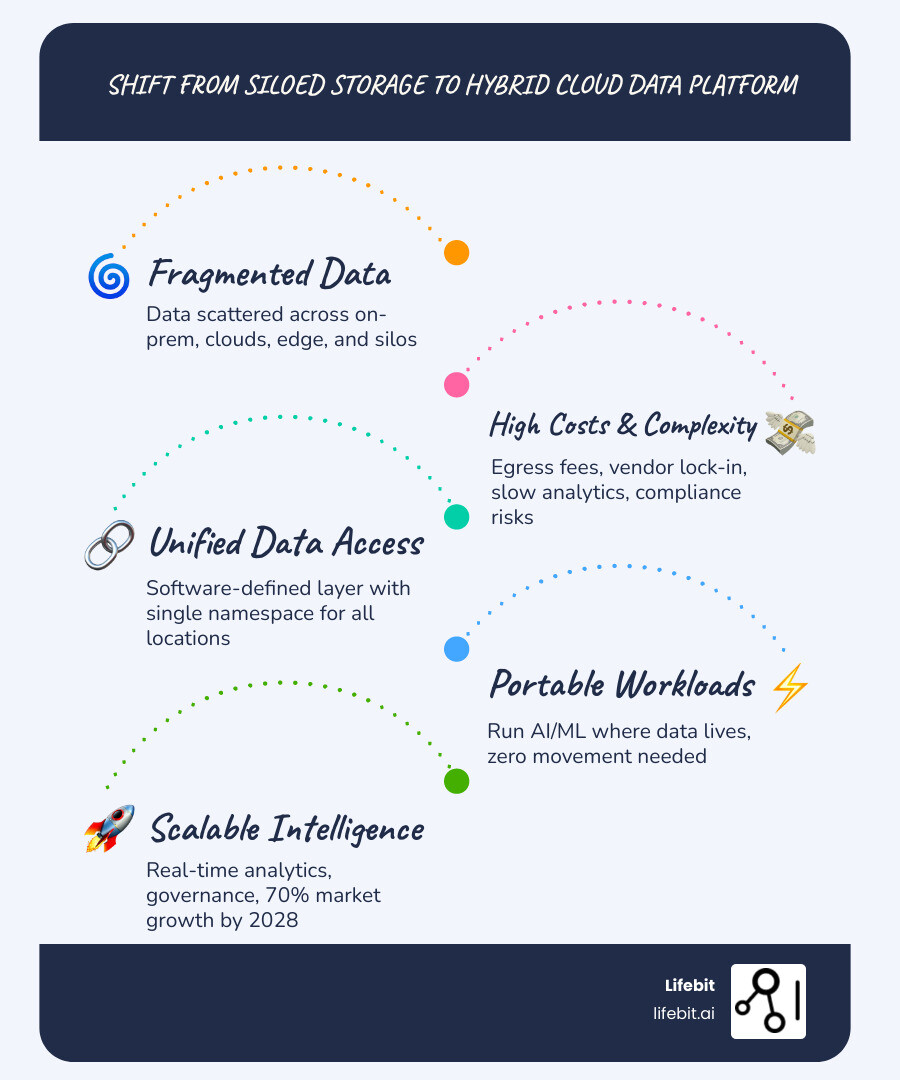
Simple hybrid cloud data platform word guide:
What is a Hybrid Cloud Data Platform and Why is it Replacing Traditional Storage?
For decades, we’ve lived in a world of “data silos.” You had your high-performance block storage for databases, your file storage for documents, and eventually, your object storage for the cloud. These were separate islands. If you wanted to run an analysis that required data from all three, you had to embark on a massive ETL (Extract, Transform, Load) project, moving data across networks and creating redundant copies. This process was not only time-consuming but also introduced significant data latency and increased the risk of errors during transformation.
A hybrid cloud data platform flips this script. It acts as an overarching software-defined layer—a “common data plane”—that sits above your physical storage. It doesn’t necessarily move the data; it virtualizes it. Gartner projects that consolidated data storage platforms will constitute 70% of file and object storage by 2028, doubling from just 35% in 2023. This shift is happening because organizations realize they can no longer manage 12 different security protocols for 12 different storage locations.
The core difference lies in the unified data plane. Traditional storage is hardware-centric and localized, often requiring specialized administrative skills for each vendor-specific appliance. A modern platform is software-defined and distributed, abstracting the underlying hardware complexity. It provides real-time access and a single point of control, allowing administrators to manage petabytes of data across continents as if they were on a single local drive. This is the foundation of what is a data lakehouse—the ability to combine the structure and reliability of a data warehouse with the scale and flexibility of a data lake across any environment.
Furthermore, the transition to these platforms is driven by the need for “Data Fabric” and “Data Mesh” architectures. While a Data Fabric focuses on the automated integration of data objects, a hybrid cloud data platform provides the actual infrastructure to make that integration possible. It allows for a decentralized data ownership model where different business units can manage their own data while still adhering to global corporate standards for security and metadata tagging.
| Feature | Traditional Siloed Storage | Hybrid Cloud Data Platform |
|---|---|---|
| Data Location | Fixed to specific hardware/cloud | Distributed & location-agnostic |
| Management | Manual, per-silo administration | Unified software-defined control |
| Access | Requires data movement (ETL) | In-place access & virtualization |
| Scalability | Limited by physical appliance | Elastic, cloud-native scaling |
| Governance | Fragmented & inconsistent | Centralized & federated |
| Cost Model | High CapEx & unpredictable OpEx | Optimized OpEx with reduced egress |
| AI Readiness | Low (Data is too fragmented) | High (Unified access for LLMs) |
Solving the Complexity of Distributed Data and High Egress Fees
The “cloud-first” mantra of the last decade led many to believe everything would eventually live in a single public cloud. Reality has been much messier. Most of us now operate in a multi-cloud reality where data is scattered across AWS, Azure, on-premise data centers, and the edge. This is often referred to as “Data Gravity”—the idea that as data sets grow, they become harder and more expensive to move, attracting applications and services toward them like a planetary body.

This distribution creates two massive headaches: vendor lock-in and egress fees. When your data is “trapped” in one provider’s ecosystem, moving it to another for a specific AI tool can cost a fortune. Major cloud providers often charge significant fees for data leaving their network, which can lead to “bill shock” for enterprises attempting to run cross-cloud analytics. Some organizations report that egress fees—the cost of moving data out of a cloud—can consume a massive chunk of their IT budget, sometimes exceeding the cost of the storage itself.
A true hybrid cloud data platform addresses this by enabling “zero data movement” architectures. Instead of moving the data to the compute, we move the compute to the data. This is achieved through containerization and orchestration tools like Kubernetes, which allow analytical workloads to be deployed directly into the environment where the data resides. By utilizing location-aware execution, platforms can reduce egress fees by up to 99%. This is a core pillar of key features of a federated data lakehouse, where data stays in its original, compliant location while still being available for global analysis.
Consider a global pharmaceutical company conducting a clinical trial. The genomic data might be stored in a secure on-premise facility in Germany to comply with local laws, while the clinical notes are in an AWS bucket in the US. Without a hybrid platform, the company would have to pay to move these massive datasets to a central location for analysis, risking compliance breaches and incurring high costs. With a hybrid platform, the analysis is federated: the algorithms run locally in both Germany and the US, and only the non-sensitive, aggregated results are combined. With 87% of organizations expecting applications to be distributed across even more locations, the ability to maintain data portability is no longer a “nice-to-have.” It is a financial and operational imperative.
Essential Features of a True Hybrid Cloud Data Platform
Not every platform that claims to be “hybrid” actually is. Some are just cloud tools with a clunky on-prem connector that still requires manual data syncing. A “true” hybrid cloud data platform must support a distributed cloud model. This means it operates as a single logical entity across private clouds, public clouds, and the edge, allowing for bi-directional movement of both data and workloads without manual intervention.
According to research by Enterprise Strategy Group on multi-cloud complexity, the primary benefit of these platforms is the ability to simplify and optimize existing infrastructure. Key features include:
- Portable Data Services: The ability to run ingestion, transformation, and ML services anywhere without rewriting code. This is often achieved through a “write once, run anywhere” philosophy, leveraging S3-compatible APIs across both on-prem and cloud environments.
- Interoperability: Seamlessly handling structured (SQL), semi-structured (JSON/Parquet), and unstructured data (Images/Video) across different storage formats. The platform should act as a translator, allowing a single query to join a table in a PostgreSQL database with a CSV file in an Azure Blob storage.
- Zero Data Movement: Using intelligent caching or federation to query data in-place. This involves sophisticated query optimizers that can break down a single request into multiple sub-queries, sending them to the respective data locations and merging the results in memory.
- Automated Tiering: The platform should automatically move “cold” data to cheaper storage (like Glacier or on-prem tape) while keeping “hot” data on high-performance SSDs, all without changing the file path for the end-user.
Architecture for a Scalable Hybrid Cloud Data Platform
To build this, the architecture must focus on compute affinity. This means the platform understands the physical and logical topology of the network. It understands where the data lives and assigns the processing task to the nearest available compute resource to minimize latency.
A unified namespace is also critical. It gives your researchers and data scientists a single view of the data. They don’t see “S3 Bucket A” or “On-prem Server B”; they see a “Genomics” folder or a “Customer_Insights” table. Behind the scenes, the platform handles the routing, authentication, and protocol translation. Following data lakehouse best practices ensures that this abstraction doesn’t sacrifice performance or data integrity. This layer of abstraction is what allows for “cloud bursting,” where an organization uses on-prem resources for steady-state workloads but automatically scales into the public cloud when demand spikes.
Unified Security and Governance in a Hybrid Cloud Data Platform
Security is the #1 reason organizations hesitate with hybrid setups. If your data is in 12 locations, you have 12 potential points of failure and 12 different sets of IAM (Identity and Access Management) roles to manage. A unified platform solves this through federated governance.
Instead of setting permissions in every individual database, you define a policy once—at the platform level—and it is enforced everywhere. This includes data masking, encryption at rest and in transit, and automated PII (Personally Identifiable Information) discovery. This is essential for maintaining compliance with strict regulations like HIPAA, GDPR, and SOC 2. Effective data lakehouse governance ensures that even if a researcher in Singapore is querying data stored in London, the access controls remain ironclad, with full audit trails and row-level security. The platform should provide a “single pane of glass” for compliance officers to see exactly who accessed what data, when, and from where, regardless of the physical storage location.
Accelerating Generative AI with Hybrid Data Intelligence
Generative AI is the new “data hungry” beast in the room. To train or fine-tune Large Language Models (LLMs), you need massive amounts of high-quality, diverse data. However, enterprise data is often too sensitive to move to the public cloud for training, or it is simply too large to transfer efficiently. This has led to the rise of “Retrieval-Augmented Generation” (RAG), where an AI model queries an organization’s private data in real-time to provide accurate, context-aware answers.
A hybrid cloud data platform provides the “data readiness” required for GenAI and RAG. It allows you to bring the AI models to your secure, on-prem data, ensuring privacy while leveraging the scale of cloud-based LLMs for the reasoning layer. A recent Enterprise Strategy Group survey on generative AI benefits found that the top advantage was improving data processes and workflows—exactly what a unified platform enables.
Key advantages for AI include:
- Vector Database Integration: Modern hybrid platforms often include or integrate with vector databases, which are essential for storing the “embeddings” that LLMs use to understand semantic meaning.
- Data Lineage for AI: Knowing exactly which version of a dataset was used to train a specific model is critical for AI ethics and debugging. Hybrid platforms track this lineage across the entire distributed environment.
- Privacy-Preserving Machine Learning: Techniques like federated learning allow models to be trained on decentralized data without the data ever leaving its secure silo. This is a game-changer for industries like healthcare and finance.
By creating a metadata-rich environment, these platforms simplify data management for AI applications, allowing them to consume data more efficiently and with higher confidence in the data’s provenance. For a deeper dive, check out our AI data lakehouse ultimate guide.
Transitioning to a Unified Hybrid Cloud Data Platform
Moving from a siloed mess to a unified platform doesn’t happen overnight. It requires a staged approach that balances immediate business value with long-term architectural goals:
- Assessment and Data Profiling: Identify your most critical data silos and where your “gravity” (the most data-heavy apps) currently sits. Use automated discovery tools to map out data dependencies and identify redundant or obsolete data that doesn’t need to be migrated.
- Modernization and Containerization: Containerize legacy applications using Docker and Kubernetes to make them portable across environments. This ensures that the application logic is decoupled from the underlying infrastructure.
- Cloud-Adjacent Strategy: For workloads that require the scale of the cloud but the security of on-prem, use colocated hardware near cloud data centers (like Equinix or specialized data centers). This provides low-latency, high-bandwidth access (often via direct fiber) without full migration to the public cloud.
- Establish Federated Governance: Before moving data, establish your global security policies. Define who has access to what at a metadata level so that as you bring new storage locations online, they are automatically covered by your security umbrella.
- Pilot Programs: Start with a specific, high-impact use case, such as trusted data lakehouse for clinical omics data, where the benefits of federation and zero data movement are immediately obvious and measurable.
Automation is your best friend here. Use software-defined tools to handle the orchestration of data and workloads. This includes automated data lifecycle management, where the platform decides the most cost-effective place for data to live based on its usage patterns. By automating the “plumbing,” your team can focus on extracting insights and building AI models, not managing infrastructure.
Frequently Asked Questions
How does a hybrid cloud data platform reduce TCO?
It reduces Total Cost of Ownership (TCO) by eliminating redundant storage and slashing egress fees. By virtualizing data, you avoid the “copy-paste” tax of traditional ETL. Furthermore, it reduces the administrative overhead by allowing a smaller team to manage a much larger, distributed footprint through a single interface. Some organizations see up to 70% in infrastructure savings by optimizing where data is stored and how it is accessed.
What defines a “true hybrid” architecture?
A true hybrid architecture is a single logical platform that spans on-prem, cloud, and edge. It must support bi-directional workload movement (not just one-way cloud backup), consistent security across all zones, and open extensibility to avoid vendor lock-in. If you can’t run the same query or the same ML model on-prem and in the cloud without changing the code, it’s not a true hybrid platform.
How does this platform support global compliance?
Through federated governance. It allows data to stay in its region of origin (meeting data residency requirements like those in the EU or Saudi Arabia) while still being queryable by global teams. It provides centralized audit logs and fine-grained access control (down to the row or column level) across the entire distributed network, ensuring that sensitive data is only seen by authorized personnel.
Can I use my existing legacy hardware with a hybrid platform?
Yes. One of the primary benefits of a software-defined hybrid cloud data platform is that it can abstract existing legacy storage (SAN, NAS, or even older object stores) and present them as part of a modern, unified namespace. This allows you to extend the life of your existing capital investments while still gaining the benefits of cloud-native data management.
Does a hybrid platform impact data latency?
Actually, it often improves it. By using “compute affinity” to run processing tasks near the data and employing intelligent edge caching for frequently accessed files, a hybrid platform can deliver faster results than a centralized cloud-only model, especially for users distributed across different geographic regions.
Conclusion
The era of choosing between the security of on-premises and the agility of the cloud is over. The hybrid cloud data platform is the bridge that allows you to have both. At Lifebit, we’ve built our platform to handle the most complex, sensitive, and distributed data on the planet. Whether you are powering biomedical research or managing global pharmacovigilance, our Trusted Data Lakehouse and Federated AI platform ensure your data is always secure, compliant, and ready for the next wave of AI innovation.
Explore the Lifebit Platform and see how we can help you turn your distributed data into your greatest competitive advantage.