

Artificial Intelligence in Healthcare: Transforming Practice and Patient Outcomes

AI for Healthcare: Cut Diagnostic Time by 90% and Fix Staff Gaps
AI for healthcare is changing how we diagnose diseases, plan treatments, and manage patient care—addressing critical workforce shortages while improving outcomes. Here’s what you need to know:
Key Applications of AI for Healthcare:
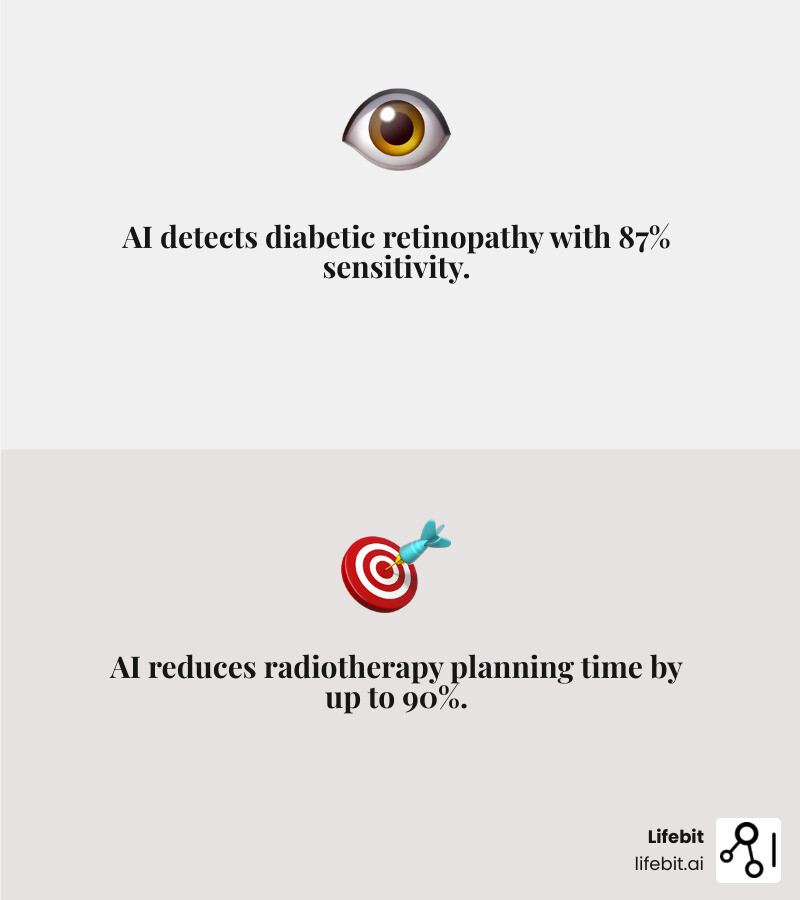
- Diagnostic Imaging – AI detects diabetic retinopathy with 87% sensitivity and identifies skin cancer with 94% accuracy
- Treatment Planning – Reduces radiotherapy preparation time by up to 90% for head and neck cancers
- Predictive Analytics – Analyzes electronic health records to predict disease risk with 70-72% accuracy
- Drug Discovery – Accelerates protein structure prediction and identifies new therapeutic compounds
- Remote Monitoring – Uses wearable devices and ambient sensors to track patient health in real-time
The need is urgent. By 2030, the world will face a shortage of 18 million healthcare professionals—including 5 million fewer doctors than required. Meanwhile, the NHS alone could see a gap of nearly 250,000 full-time staff. These numbers represent real patients waiting longer for care, clinicians overwhelmed by administrative burdens, and health systems struggling to meet demand.
AI offers a way forward. It’s not about replacing doctors—it’s about augmenting human intelligence so clinicians can focus on what matters most: patient care. From analyzing millions of medical images to identifying drug interactions in real-time, AI handles the data-heavy tasks that would be impossible for humans to manage at scale.
But AI’s promise comes with challenges. Algorithmic bias can perpetuate health disparities. Data privacy concerns slow adoption. Regulatory frameworks are still catching up to the technology. And many healthcare leaders remain skeptical about implementation.
The path forward requires understanding both the transformative potential and the practical problems. It demands rigorous validation, transparent governance, and a commitment to equity. Most importantly, it needs leadership from those who understand both the clinical realities and the technical possibilities.
I’m Maria Chatzou Dunford, CEO and Co-founder of Lifebit, where we’ve spent over 15 years building federated platforms that enable secure, compliant AI for healthcare across genomics and biomedical data. My background in computational biology, AI, and health-tech entrepreneurship has shown me how the right infrastructure can open up AI’s potential while protecting patient privacy and ensuring data quality.
AI for healthcare glossary:
AI for Healthcare: Predict Patient Risk with 72% Accuracy
At its core, artificial intelligence in the medical field is the science of making intelligent machines that mimic human cognitive functions—specifically learning and problem-solving. It isn’t a single “magic” tool but a suite of technologies designed to find patterns in the massive, multimodal datasets that modern medicine generates every second.
To understand AI for healthcare, we need to break it down into its primary subfields:
Machine Learning (ML)
Machine learning is the engine of medical AI. It involves algorithms that improve their performance as they are exposed to more data. In healthcare, we use supervised learning (where the AI learns from labeled data, like “this is a tumor”) and unsupervised learning (where the AI finds hidden patterns in unlabeled data, like identifying new sub-types of a disease).
Deep Learning and Neural Networks
Deep learning is a more advanced version of ML that uses “neural networks” with many layers. This mimics the human brain’s structure and is particularly powerful for analyzing complex data like medical images or genomic sequences. If machine learning is a basic calculator, deep learning is a supercomputer capable of “seeing” a microscopic skin cell and identifying its type with 94% accuracy.
Generative AI and Large Language Models (LLMs)
Beyond traditional ML, Generative AI is now revolutionizing administrative workflows. LLMs can summarize patient histories, draft referral letters, and even assist in clinical decision support by synthesizing vast amounts of medical literature into actionable summaries. However, the risk of “hallucinations”—where the AI generates plausible but incorrect medical information—remains a critical area for human oversight and rigorous validation.
Reinforcement Learning (RL)
RL is being explored for dynamic treatment regimes. Unlike supervised learning, RL learns through trial and error to maximize a “reward” (e.g., patient survival or reduced tumor size). This is particularly promising in sepsis management and anesthesia titration, where the AI can suggest real-time adjustments to medication based on the patient’s physiological response, effectively acting as a co-pilot for intensive care clinicians.
Natural Language Processing (NLP)
Doctors spend an incredible amount of time writing clinical notes. NLP is the technology that allows AI to “read” and understand this unstructured text. It can consolidate medical terms, identify redundant phrases, and even extract potential drug-drug interactions from vast libraries of medical literature. Modern NLP can also perform sentiment analysis on patient feedback to identify areas where care quality may be lagging.
Computer Vision
This is the “eyes” of AI. It allows systems to interpret visual data from X-rays, MRIs, and CT scans. Between 2015 and 2020, more than half of the AI-based medical devices approved in the USA and Europe were for radiological use, proving that computer vision is one of the most mature areas of AI for healthcare. It is now expanding into pathology, where it can count mitotic figures in tissue samples faster and more accurately than a human pathologist.
Predictive Modeling
By looking at Electronic Health Records (EHR), which are now used by 80% of medical practices, AI can predict future health events. Predictive modeling has already achieved 70–72% accuracy in predicting how an individual might respond to a specific treatment, moving us closer to the goal of truly personalized medicine.
AI for Healthcare: Detect Cancer with 94% Accuracy
The impact of AI for healthcare is felt across almost every corridor of a hospital. We are seeing a shift from simple digitization—moving paper records to computers—to gaining actual clinical insight from those digital assets.
Radiology and Imaging
Radiology is the “early adopter” of medical AI. AI systems are now used to triage urgent cases, such as identifying a potential stroke on a CT scan so a specialist can see it immediately. These tools don’t just find problems; they improve quality by reducing “noise” in images and allowing for lower radiation doses without sacrificing clarity. In breast cancer screening, AI acts as a second reader, reducing the workload for radiologists by up to 44% while maintaining or improving detection rates.
Oncology and Cancer Management
In cancer care, timing is everything. AI tools are being used to analyze DNA methylation profiles to distinguish between primary lung cancers and metastases. Projects like BrainWear use AI to analyze raw motion data from wrist-worn accelerometers (captured 100 times per second) to track the progression of brain tumors through subtle changes in a patient’s gait. Furthermore, AI-driven liquid biopsies are now being developed to detect cancer DNA in blood samples long before tumors are visible on a scan.
AI-Assisted Surgery and Robotics
Robotic platforms are being augmented with AI to provide “active constraints” or virtual boundaries that prevent surgeons from accidentally damaging critical structures like nerves or blood vessels. AI also analyzes surgical video to provide real-time feedback on technique, effectively acting as a digital mentor for residents. This reduces surgical variability and improves post-operative recovery times by ensuring the most minimally invasive approach is consistently applied.
Cardiology
AI is often non-inferior to human experts in interpreting echocardiograms. In emergency settings, AI can sometimes diagnose a heart attack more accurately than a physician by instantly analyzing complex ECG patterns. Wearable biosensors now allow for the detection of obstructive hypertrophic cardiomyopathy in patients while they go about their daily lives, providing a continuous stream of data that a standard office visit could never capture.
Mental Health and Behavioral Analysis
AI is opening new doors in psychiatry, where objective biomarkers are often lacking. Natural Language Processing (NLP) can analyze speech patterns and word choices to detect early signs of depression, anxiety, or even the onset of psychosis. Wearable sensors track sleep patterns and physical activity, providing a holistic view of a patient’s mental state that goes beyond the snapshot provided during a 15-minute consultation. This allows for proactive intervention before a mental health crisis occurs.
Drug Discovery and Pharmacy
The traditional drug discovery process is slow and expensive, often taking over a decade and billions of dollars to bring a single drug to market. AI is changing this by predicting how proteins fold—a 50-year-old challenge recently solved by systems like AlphaFold. Companies are now using AI to design entirely new molecules that have never existed in nature, specifically tailored to bind to disease-causing proteins. In the pharmacy, AI helps identify potential adverse drug-drug interactions by parsing millions of reports in the FDA Adverse Event Reporting System (FAERS).
Learn more about our approach to AI in Drug Development and AI-Driven Drug Discovery.
AI for Healthcare: Detect Diseases Faster
Early detection is often the difference between a routine treatment and a life-threatening crisis. AI excels here because it never gets tired and can spot patterns that are too subtle for the human eye.
- Diabetic Retinopathy: The IDx-DR algorithm was a landmark in AI for healthcare. It demonstrated 87% sensitivity and 90% specificity for detecting more-than-mild diabetic retinopathy, allowing for screening in primary care settings rather than requiring every patient to visit an ophthalmologist. This is critical in rural areas where specialists are scarce.
- Skin Cancer: Deep learning algorithms have achieved “dermatologist-level” accuracy in identifying melanoma. Tools like TzanckNet use convolutional neural networks to identify cells in microscopic images with a 94% accuracy rate, helping clinicians diagnose erosive-vesiculobullous diseases faster and reducing the number of unnecessary biopsies.
- Gastroenterology: During colonoscopies, AI systems act as a “second set of eyes,” highlighting polyps or abnormal tissue in real-time. Early trials show these systems have a sensitivity close to that of expert endoscopists, significantly reducing the “miss rate” for potential cancers and ensuring that precancerous lesions are removed during the initial procedure.
AI for Healthcare: Cut Treatment Prep Time by 90%
Once a diagnosis is made, AI helps customize the journey. This is where AI for clinical trials and treatment planning become vital.
- Radiotherapy Precision: Planning radiotherapy for head, neck, or prostate cancer is a painstaking manual process that involves “contouring” or drawing around organs on hundreds of CT slices. AI technologies like InnerEye can cut this preparation time by up to 90%, allowing patients to start their treatment sooner and freeing up oncologists for direct patient interaction and complex decision-making.
- Chronic Disease Management: For young patients with type 1 diabetes, AI-based decision support systems can optimize insulin doses automatically by predicting blood sugar fluctuations based on diet, exercise, and stress levels. This reduces the risk of dangerous hypoglycemic events and improves long-term health outcomes.
- Ambient Intelligence: We are moving toward “touchless” monitoring. Systems like Emerald use wireless sensors and machine learning to monitor sleep, breathing, and behavior in the elderly without requiring them to wear any devices. This “ambient care” alerts clinicians to changes in health—such as increased nighttime wandering or changes in gait—before a fall or emergency occurs.
AI for Healthcare: Stop Bias and Build Compliant Systems
As much as we believe in the power of AI for healthcare, we must be honest about the risks. “Do no harm” applies to code just as much as it applies to clinicians. Ethical AI is not just a checkbox; it is a fundamental requirement for clinical safety.
Stop Algorithmic Bias
AI is only as good as the data it’s trained on. If an algorithm is trained primarily on data from one demographic (e.g., white males), it may be less accurate for women or ethnic minorities. For example, some AI tools have been found to miss causes of knee pain in Black patients because the “standard” markers used to train the AI were biased toward different physiological presentations. We must move beyond proxy measures like “cost of care”—which often reflects systemic inequalities—to measure actual “health needs” to avoid this “label choice bias.” Diversity in training datasets is the only way to ensure equitable outcomes.
The ‘Black Box’ Problem and Explainable AI (XAI)
A major barrier to clinical adoption is the “black box” nature of deep learning models. If a doctor doesn’t understand why an AI suggested a specific diagnosis, they are less likely to trust it, and liability becomes a major concern. Explainable AI (XAI) techniques, such as Saliency Maps or LIME (Local Interpretable Model-agnostic Explanations), aim to highlight the specific features in a medical image or data point that led to the AI’s conclusion. This transparency is essential for clinical accountability and for identifying when an algorithm might be failing due to irrelevant artifacts in the data, such as a watermark on an X-ray.
Protect Patient Privacy
Patients are understandably cautious about how their most sensitive information is used. A UK survey found that 63% of the population is uncomfortable sharing personal data to improve AI. This is why Trusted Research Environments (TREs) are so critical. They allow researchers to analyze data without it ever leaving a secure environment, maintaining HIPAA and GDPR compliance while still powering innovation. By bringing the code to the data, rather than the data to the code, we eliminate the risk of data leakage during transit.
Navigate EU and FDA Regulations
The landscape is shifting rapidly as governments realize the unique risks of medical AI.
- In the UK: The MHRA is currently leading a National Commission into the Regulation of AI in Healthcare, seeking evidence to ensure fast access to safe medical devices while maintaining high safety standards.
- In the EU: The EU AI Act (approved in 2024) classifies AI-enabled medical devices as “high-risk,” requiring strict oversight, detailed technical documentation, and human-in-the-loop requirements.
- In the USA: The FDA has released an AI/ML-Based Software as a Medical Device (SaMD) Action Plan, focusing on patient-centered transparency and real-world performance evaluation. They are moving toward a “Total Product Lifecycle” approach, recognizing that AI systems change and improve over time.
AI for Healthcare: 4 Steps to Launch Trusted Systems
Building an AI tool is easy; building a trusted healthcare system is hard. Based on international consensus among healthcare leaders, we recommend a four-stage roadmap:
-
Design and Develop: Start with a problem-driven, human-centered approach. Don’t build AI for the sake of AI. Engage clinicians and patients early to understand the actual “pain points” in the patient journey. This ensures that the resulting tool actually fits into the clinical workflow rather than adding to the administrative burden.
-
Evaluate and Validate: AI needs more than just statistical accuracy. It needs clinical utility (does it help patients?) and economic utility (does it save the system money?). Retrospective studies are a start, but real-world “silent” trials are essential to see how the AI performs with live data before it is allowed to influence actual patient care. This phase must also include “stress testing” the model against edge cases and diverse patient populations.
-
Scale and Diffuse: Moving from a single hospital to a national health system requires interoperable data standards. This is where federated AI platforms excel, allowing models to be retrained and tuned for local populations without moving sensitive data. Adoption of international standards like HL7 FHIR (Fast Healthcare Interoperability Resources) is non-negotiable for ensuring that AI tools can communicate with different EHR systems across a network.
-
Monitor and Maintain: AI is not “set and forget.” “Data drift” occurs when the population or clinical practices change, causing the AI’s performance to degrade over time. For example, an AI trained before a pandemic may struggle to interpret respiratory data during one. Continuous monitoring and “algorithmic auditing” are required to ensure the system remains safe, effective, and unbiased throughout its entire lifecycle.
Workforce Training and Cultural Shift
Implementing AI is as much a cultural challenge as a technical one. Healthcare professionals need “AI literacy” to understand the strengths and limitations of these tools. This involves updating medical school curricula to include data science fundamentals and creating new roles, such as “Clinical AI Officers,” who bridge the gap between IT departments and frontline clinicians. Success depends on clinicians viewing AI as a supportive partner rather than a replacement for their expertise.
AI for Healthcare: Top 3 Risks and Results Answered
How does AI improve healthcare efficiency?
AI improves efficiency by automating administrative tasks—like transcribing notes via “ambient clinical intelligence”—and by triaging patients. By handling the 80% of data that is repetitive or routine, AI allows the human workforce to focus on the 20% of cases that are complex and require emotional intelligence.
Can AI diagnose diseases more accurately than doctors?
In specific, narrow tasks—like identifying certain skin cancers or reading screening mammograms—AI has shown it can match or even exceed human performance. However, AI lacks the “clinical reasoning” and holistic understanding of a patient that a doctor provides. The most successful model is human-AI collaboration, where the AI acts as a highly skilled assistant.
What are the biggest risks of AI in medicine?
The primary risks include algorithmic bias, data privacy breaches, and over-reliance (where clinicians stop questioning the AI’s output). There is also the risk of “reproducibility issues” in scientific literature, where an AI works in a lab but fails in a real clinic.
AI for Healthcare: The Future is Precise and Predictive
The long-term vision for AI for healthcare is not a world of robot doctors, but one of empowered healthcare professionals. We foresee a “virtuous cycle” where every patient encounter contributes to a “collective memory” of health services, informing better care for the next person.
At Lifebit, we are building the infrastructure to make this a reality. Our Trusted Research Environments and federated AI platforms provide the secure, real-time access to global biomedical and multi-omic data that researchers need. By enabling secure collaboration across hybrid data ecosystems, we help turn “big data” into “big cures.”
The future of medicine is precise, predictive, and portable. By embracing AI as a partner, we can solve the workforce crisis and deliver the high-quality care that every patient deserves.
Ready to open up the power of your health data?
Find how Lifebit’s AI-Powered Medical Research Guide can transform your clinical outcomes.