

NGS in the Clouds: Finding Your Perfect Commercial Platform
Why Choosing the Right Cloud Platform Transforms Your NGS Analysis
The best commercial cloud platforms for next-gen seq provide a powerful solution to the data challenges in genomics. These platforms range from foundational infrastructure-as-a-service (IaaS) offerings from major cloud providers to specialized platform-as-a-service (PaaS) and advanced federated data systems. Each approach offers unique strengths in scalability, compliance, tool availability, and collaboration, allowing research organizations to find a model that fits their specific needs.
The genomics field faces an unprecedented data challenge. The Human Genome Project took 13 years to complete. Today, whole-genome sequencing finishes in hours. But this speed creates new problems.
A single human genome generates roughly 150 GB of data. Large genome-wide association studies require petabytes of storage. Single-cell RNA sequencing produces millions of data points per experiment. Traditional on-premises infrastructure simply cannot keep up.
Local computing creates bottlenecks at every stage. Storage fills up quickly. Processing pipelines run sequentially instead of in parallel. Hardware becomes obsolete. Maintenance costs pile up. Collaboration across institutions requires moving massive files. And scaling up for larger studies means major capital investments.
Cloud platforms solve these problems by providing unlimited storage, elastic computing power, and global collaboration tools on demand. You pay only for what you use. You scale up or down instantly. You access cutting-edge bioinformatics tools without installation. And you collaborate with researchers worldwide without moving data.
As Maria Chatzou Dunford, CEO and Co-founder of Lifebit, I have spent over 15 years in computational biology and genomics helping organizations steer the transition to cloud-based NGS analysis. This guide will help you compare the best commercial cloud platforms for next gen seq and find the right fit for your research needs.
Why the Cloud is the New Standard for Genomics Research
The sheer volume of data generated by next-generation sequencing (NGS) has created a “data problem” in modern biology. Traditional on-premises environments struggle to keep pace with the demands of managing and analyzing these massive datasets. We are talking about terabytes and petabytes of data, not just megabytes, pushing the limits of conventional computing.
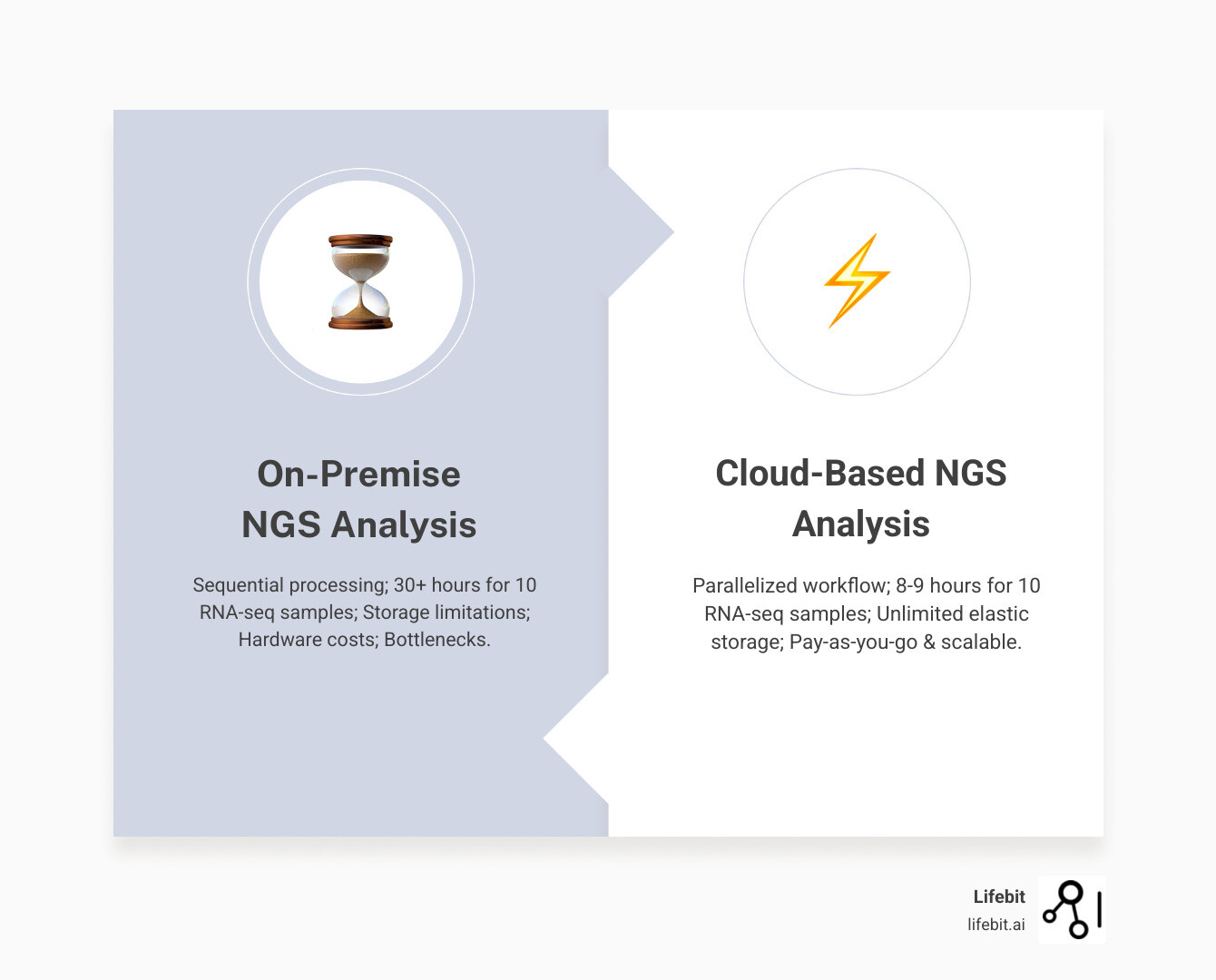
Our research indicates that a modestly-sized RNA-seq experiment of 10 samples can take over 30 hours to complete on a local computer. The same dataset can be processed within a single workday (8-9 hours) using cloud assemblies. This dramatic difference highlights the inefficiency of local infrastructure when dealing with the scale of modern genomic studies.
Cloud computing offers a transformative solution, acting like a “rent-a-supercomputer” that is available whenever you need it. This model addresses the core limitations of traditional setups by providing unparalleled scalability, storage capacity, and processing power.

Addressing the Core Challenges of NGS Data
In a traditional on-premises environment, researchers face several primary challenges when managing and analyzing NGS data:
- Scalability Limitations: When a project grows or new research begins, traditional systems require significant lead time and capital investment to acquire and set up new hardware. This creates bottlenecks and delays, preventing researchers from rapidly expanding their analytical capabilities.
- Storage Bottlenecks: NGS data volumes are enormous. Storing petabytes of raw and processed data locally is expensive, requires constant maintenance, and quickly exhausts available capacity. Data archiving and retrieval become cumbersome, often leading to data loss or the premature deletion of valuable raw data.
- Processing Power Deficiencies: Complex NGS analyses, such as whole-genome sequencing or single-cell RNA sequencing, demand immense computational resources. A local desktop, even a powerful one, can take days or even weeks to complete multi-sample analyses. Parallel processing, crucial for speed, is often limited by the number of available cores, creating a sequential queue of jobs that slows down the entire research cycle.
- High Hardware Costs and Maintenance: Purchasing, maintaining, and upgrading local servers, storage arrays, and networking equipment is a substantial ongoing expense. This includes not only the initial capital outlay but also the “hidden” operational costs of power, cooling, physical server room space, and the salaries of specialized IT staff required to manage the infrastructure. The hardware lifecycle also means that expensive equipment becomes obsolete in just a few years.
- Collaboration Barriers: Sharing large datasets with collaborators across different institutions or geographical locations is notoriously difficult and slow. It often involves physically shipping hard drives, which is insecure and time-consuming, or using slow and unreliable FTP servers. This friction severely hampers the progress of large-scale, multi-center research projects.
- Data Security and Integrity Risks: While it may seem counterintuitive, on-premises systems can pose significant security risks. They require a dedicated, expert-level security team to manage firewalls, patch vulnerabilities, and ensure physical security. For many research institutions, this is a major burden and a potential point of failure, leaving sensitive genomic data vulnerable to breaches or loss.
The Transformative Benefits of Cloud Computing
Cloud computing directly addresses these challenges, offering a new paradigm for genomic research:
- Scalability on-demand: Cloud platforms allow us to instantly scale computing resources up or down based on our needs. Whether we require a few virtual machines for a small project or thousands for a large-scale population genomics study, the cloud provides it instantly. This elasticity means we only pay for what we use, avoiding costly over-provisioning.
- Elastic computing: Cloud assemblies jobs complete more quickly—even factoring in upload and download times—because they can run on multiple cloud computers simultaneously. This parallel processing significantly reduces turnaround times, turning multi-day analyses into hours.
- Unlimited storage: Cloud providers offer virtually unlimited, highly durable, and cost-effective storage solutions. This eliminates the worry of running out of space and simplifies data management, allowing us to focus on research rather than infrastructure.
- Global collaboration and data sharing: Cloud platforms break down geographical barriers. Researchers can securely access and analyze shared datasets from anywhere in the world, fostering collaboration and accelerating findings. For example, a global cancer research consortium can use a shared cloud workspace to allow researchers from the US, Europe, and Asia to analyze a unified dataset using standardized pipelines, all without moving petabytes of data across continents. Features like shared workspaces and fine-grained access controls enable seamless and secure teamwork.
- Reduced IT overhead and no hardware maintenance: With cloud computing, we rent the necessary computing power instantly without concerns about maintenance, hardware upgrades, or storage limits. Cloud providers handle all the underlying infrastructure, including security, power, and cooling, freeing up our IT teams and budgets for more strategic tasks that directly support research.
- Cost-effectiveness: The pay-as-you-go model ensures that we only pay for the resources we consume. This can lead to significant cost savings compared to the upfront capital expenditure and ongoing operational costs of maintaining on-premises infrastructure.
- Improved reproducibility: Cloud environments often come with built-in features for workflow management and versioning, logging every tool, version, parameter, and piece of data used in an analysis. By packaging analysis environments into containers (like Docker) and defining workflows with languages like CWL or WDL, researchers can ensure that an experiment run today can be perfectly replicated by a colleague years from now, a cornerstone of robust scientific research.
Key Features to Compare in the Best Commercial Cloud Platforms for Next Gen Seq
Choosing among the best commercial cloud platforms for next gen seq requires a careful evaluation of their capabilities. We need a platform that not only handles vast datasets but also provides the tools, security, and collaborative features essential for cutting-edge genomic research. Different platform models offer distinct advantages:
| Feature | Infrastructure as a Service (IaaS) | Platform as a Service (PaaS) | Federated Platform |
|---|---|---|---|
| Ease of Use | Low (Requires expert setup) | Medium (Managed environment) | High (Analysis-ready) |
| Tool Availability | High (Bring your own) | Curated (Platform-provided) | Extensible (Bring compute to data) |
| Security Model | User-Managed (High responsibility) | Shared Responsibility | Federated (Data does not move) |
| Collaboration | Basic (Requires manual setup) | Built-in (Within platform) | Advanced (Cross-organizational) |
| Cost Structure | Pay-per-use (Complex to manage) | Subscription + Usage | Platform License + Cloud Usage |
Essential Bioinformatics Tools and Workflows
One of the most critical aspects of any cloud platform for NGS is the availability and flexibility of bioinformatics tools and workflows. Researchers need robust solutions for both secondary and tertiary analysis.
Many leading platforms host complete libraries of hundreds of optimized tools and workflows maintained by expert bioinformaticians. This includes pipelines for demanding tasks like whole-genome analysis, which can be completed in approximately five hours on an optimized cloud setup—more than twice as fast as a typical execution on a single cloud-based node.
For secondary analysis, common tasks include alignment, variant calling, and quality control. Cloud platforms offer pre-built pipelines for these, often based on widely accepted best practices. For tertiary analysis, which involves interpreting results and performing advanced statistical analyses or machine learning, top platforms provide environments for R/RStudio, Jupyter notebooks, and integration with powerful machine learning services.
Many platforms also accept open standards like the Common Workflow Language (CWL) or Workflow Definition Language (WDL), allowing researchers to define, share, and execute workflows consistently across different environments. This facilitates reproducibility and enables users to bring their own custom tools and proprietary algorithms via Software Development Kits (SDKs). Even desktop software with tools for assembly, alignment, and variant analysis can complement cloud-based solutions by allowing local exploration of results or preparation of data for cloud upload.
Data Security, Governance, and Compliance for the best commercial cloud platforms for next gen seq
Working with sensitive genomic data demands the highest standards of data security, governance, and compliance. The best commercial cloud platforms for next gen seq must offer robust features to protect patient information and adhere to strict regulatory frameworks.
Our collective research highlights the importance of these aspects:
- Data Transfer and Storage Security: Data must be encrypted both in transit (when being uploaded or downloaded) and at rest (when stored on servers). Leading cloud providers build their services on a secure global infrastructure with strong encryption options.
- Access Controls and Permissions: Fine-grained access controls are crucial. Platforms allow administrators to specify who can access what data, what actions they can perform (read, write, execute), and under what conditions. This is often managed through Identity and Access Management (IAM) systems, enabling secure collaboration by specifying team members’ access levels.
- Audit Trails and Logging: To ensure accountability and reproducibility, every action performed on the platform—from data uploads to pipeline executions—must be logged. This creates an immutable audit trail, vital for scientific rigor and regulatory compliance, by logging every tool, version, parameter, and data used in an analysis.
- Compliance with Regulations: For genomic data, compliance with regulations like HIPAA (in the USA) and GDPR (in Europe and the UK) is non-negotiable. Cloud platforms often provide specific guidance, services, and certifications to help researchers meet these requirements. Many services are designed to support Business Associate Agreements (BAAs) and operate in secure, compliant environments suitable for sensitive health data, such as those used by national biobanks.
- Data Governance Frameworks: Beyond technical security, platforms help establish governance frameworks for data usage, retention, and deletion. For instance, some platforms can be configured to automatically archive unused files after a set period and permanently delete them after a year.
- Virtual Private Clouds (VPCs): Many platforms operate within VPCs, providing an isolated and secure network environment within the public cloud, further enhancing data protection.
As noted in a relevant study, Cloud-based biomedical data storage and analysis for genomic research emphasizes the critical role of data governance in emerging NIH-supported platforms. This underscores the need for robust governance models within commercial cloud offerings.
Performance, Scalability, and Reproducibility
The ability of a cloud platform to deliver high performance, scale seamlessly, and ensure reproducible results is paramount for NGS analysis.
- Elastic Scaling: Cloud platforms excel at elastic scaling, meaning they can dynamically provision or de-provision compute resources as needed. This allows for parallel job execution, where multiple analyses or samples can be processed simultaneously, drastically reducing overall pipeline runtimes. For example, a 10-sample RNA-seq experiment that might take 30+ hours locally can be completed in 8-9 hours on the cloud due to parallel processing.
- Pipeline Speed: Optimized pipelines and powerful compute instances contribute to impressive speed. Some platforms boast the ability to complete a GATK-based whole-genome pipeline in about five hours. The availability of GPU and FPGA instances can accelerate specific genomic algorithms, with some reports showing FPGA-enabled variant calling reducing whole-genome data analysis from hours to around 20 minutes.
- Reproducibility and Auditability: Ensuring that scientific results can be consistently reproduced is a core tenet of research. Cloud platforms facilitate this through:
- Versioning: All tools, workflows, and data are version-controlled.
- Containerization (Docker): Workflows can be packaged into Docker containers, ensuring that the exact computational environment (software versions, libraries, dependencies) used for an analysis can be recreated anywhere, anytime. Cloud platforms widely support container deployment and orchestration.
- Workflow Orchestration: Support for standards like CWL and WDL ensures that complex multi-step analyses are executed consistently and can be easily audited.
- APIs for Automation: Most platforms offer robust Application Programming Interfaces (APIs) that allow researchers to automate data upload, pipeline execution, and results retrieval, minimizing manual errors and enhancing reproducibility. A fully automatable platform is a significant advantage.
The Next Frontier: AI, Hybrid Models, and the Future of NGS Analysis
The landscape of NGS data analysis is constantly evolving, with artificial intelligence (AI) and hybrid cloud approaches shaping its future.
The Role of AI and Machine Learning in Enhancing NGS Data Analysis
AI and machine learning (ML) are becoming indispensable for extracting deeper insights from the ever-growing volume of NGS data.
- Improved Analysis and Interpretation: AI algorithms can automate complex analyses, identify subtle patterns in genomic data that human experts might miss, and accelerate variant prioritization and functional annotation. For example, Google’s DeepVariant uses deep learning to call genetic variants from sequencing data with higher accuracy than previous methods. In single-cell analysis, ML algorithms are essential for clustering cells into distinct types and inferring developmental trajectories. Beyond genomics, AI excels in areas like gene modeling, microscopic image analysis, and protein structure prediction, as demonstrated by DeepMind’s AlphaFold.
- Accelerating Drug Discovery and Personalized Medicine: ML models can sift through vast genomic and clinical datasets to predict drug responses, identify novel drug targets, and stratify patients for clinical trials. This enables the design of personalized treatment strategies tailored to an individual’s genetic makeup. Leading cloud platforms offer integrated ML solutions (like Amazon SageMaker or Google AI Platform) to build, train, and deploy custom models for this kind of advanced tertiary analysis.
- Predictive Modeling for Disease Risk: A rapidly growing application of AI is the development of polygenic risk scores (PRS). These models analyze thousands or millions of genetic variants across a person’s genome to predict their susceptibility to complex diseases like coronary artery disease, type 2 diabetes, or breast cancer. Building and validating these models requires massive datasets and significant computational power, making the cloud the only feasible environment for this work.
- Automation of Complex Workflows: AI-driven tools can automate repetitive and time-consuming tasks in the analysis pipeline, such as quality control checks and report generation. This allows highly skilled bioinformaticians and researchers to focus on higher-level tasks like experimental design and biological interpretation.
Hybrid Cloud Approaches for Flexibility
Hybrid cloud approaches offer a powerful combination of on-premises and cloud resources, providing flexibility for NGS data analysis. This model allows organizations to keep sensitive data or specific compute workloads on-premises while leveraging the cloud for scalable, on-demand processing.
- On-Premises and Cloud Integration: Advanced platforms can operate in virtual private clouds, local High-Performance Computing (HPC) environments, or hybrid setups. This means researchers can build pipelines and analyze data locally, then burst to the cloud for more powerful computing resources when local infrastructure is overtasked. The Common Workflow Language (CWL) facilitates the easy movement of tools and pipelines between these environments.
- Data Locality and Security: For highly sensitive genomic data, hybrid and federated models offer a critical balance between control and scalability. Many countries have data sovereignty laws (such as GDPR in Europe) that legally restrict patient-identifiable data from leaving national borders. In these cases, a hybrid or federated model is not just an option but a requirement. Data can reside on-premises or in a local cloud instance, with only anonymized results being shared, or compute can be brought to the data, a model Lifebit champions with our federated approach.
Future Trends and Advancements
The future of cloud-based NGS data analysis is bright, with several key trends emerging:
- Decentralized Cloud Computing: This trend aims to improve data security for sensitive genetic data by distributing data and compute, reducing reliance on centralized repositories that can be single points of failure or targets for attack.
- Federated Learning: This approach allows AI models to be trained on decentralized datasets without the data ever leaving its local, secure environment. This is particularly impactful for genomic data, enabling collaborative research across hospitals and countries while maintaining strict data privacy and security. Lifebit’s platform is built on this principle, enabling secure, real-time access to global biomedical and multi-omic data without centralizing it.
- Increased Automation and AI Integration: We will see even deeper integration of AI into every stage of NGS analysis, from raw data processing to complex biological interpretation, leading to faster insights and more efficient research.
- Improved Interoperability and FAIR Data: Greater standardization and interoperability between different platforms and data types will simplify multi-omics research and data integration. Initiatives like the Global Alliance for Genomics and Health (GA4GH) are developing standards (e.g., CRAM for file compression, Beacon API for data discovery) that are essential for making data FAIR (Findable, Accessible, Interoperable, and Reusable). Adherence to these standards ensures that data generated on one platform can be understood and used on another, maximizing its value.
Making Your Decision: Practical Considerations for Your Lab
Selecting the best commercial cloud platforms for next gen seq for your specific needs requires careful consideration of costs, the types of analyses you perform, and the technical expertise available in your team.
Decoding Pricing: How to Budget for Cloud NGS Analysis
Understanding the cost considerations and pricing models is crucial for effective budgeting. Cloud platforms typically operate on a pay-as-you-go model, which offers flexibility but requires careful management.
- Pay-as-You-Go Pricing: You only pay for the compute resources (e.g., CPU hours, GPU hours), storage (per GB per month), and data transfer (egress fees) that you actually consume. This contrasts sharply with the large upfront capital expenditure of on-premises hardware.
- Subscription Models: Some specialized platforms or managed services may offer subscription tiers that bundle certain resources, support levels, or access to proprietary tools for a fixed monthly or annual fee.
- Data Storage Costs: While storage is virtually unlimited, costs accumulate, especially for large datasets stored over long periods. Cloud providers offer different storage classes (e.g., standard for frequently accessed data, infrequent access, and deep archival storage like AWS Glacier for long-term retention) at varying price points. A smart data lifecycle policy is essential for cost optimization.
- Data Egress Fees: A significant and often overlooked cost is data egress—the cost of transferring data out of the cloud. This can be substantial for large datasets. However, some providers offer data egress waivers for qualified researchers and academic customers to help offset these costs, particularly for sharing public datasets.
- Compute Instance Pricing: The cost of virtual machines varies significantly based on their type (CPU vs. GPU), size (number of cores, RAM), and pricing model. Spot instances (unused capacity at a steep discount) or reserved instances (committing to usage for 1-3 years for a lower price) can offer significant cost savings for predictable or fault-tolerant workloads.
- Total Cost of Ownership (TCO): When comparing cloud to on-premises, it’s crucial to perform a TCO analysis. An on-premise TCO must include not just the server hardware cost, but also software licenses, power, cooling, physical space, and IT staff salaries for maintenance and support. A cloud TCO includes subscription fees, compute, storage, and egress costs. For many labs, a detailed TCO analysis reveals that the pay-as-you-go cloud model is more economical than the perpetual cycle of purchasing and maintaining local hardware.
Matching the Platform to Your Research: A guide for the best commercial cloud platforms for next gen seq
The optimal cloud platform will depend on the specific types of NGS applications you are undertaking:
- Whole-Genome Sequencing (WGS): WGS generates enormous datasets, requiring platforms with high-throughput processing and massive storage capabilities. Foundational cloud services are well-suited due to offering scalable compute and object storage. Specialized platforms that use advanced methods like pan-genome graph references can offer deeper population insights and data compression for WGS secondary analysis.
- RNA-seq: RNA-seq experiments often involve multiple samples and replicates. Cloud platforms’ parallel processing capabilities significantly accelerate these analyses. As noted in our research, a 10-sample RNA-seq experiment can be completed within a single workday using cloud assemblies, compared to 30+ hours locally.
- Single-Cell Sequencing: Single-cell RNA sequencing (scRNA-seq) generates millions of data points per experiment, demanding platforms capable of handling high dimensionality and complex analytical workflows. Cloud environments with strong AI/ML integration are particularly beneficial here for tertiary analysis tasks like cell clustering, trajectory inference, and visualization.
- Metagenomics: This field involves sequencing DNA from entire environmental samples (e.g., the human gut microbiome). The resulting datasets are massive and computationally complex to assemble and annotate. The cloud provides the necessary power to run tools like MetaSPAdes or Kaiju on a scale that is impossible on local hardware, along with access to vast, continuously updated reference databases.
- Epigenomics: Studies like ChIP-seq and ATAC-seq, which map protein-DNA interactions or chromatin accessibility, benefit greatly from the cloud’s ability to parallelize pipeline execution across many samples. The standardized nature of these analysis pipelines makes them ideal for deployment on PaaS platforms with pre-built, optimized workflows.
- Desktop Software Integration: Some researchers may prefer to perform initial analysis or visualization on desktop software. Cloud platforms can complement this by handling the heavy lifting of raw data processing (e.g., alignment and variant calling), allowing researchers to download refined data files (like BAM or VCF) for local exploration with their preferred desktop tools.
Evaluating the Learning Curve and Support
Adopting a new cloud platform involves a learning curve. Evaluating the required technical expertise and available support resources is essential for a smooth transition.
- Technical Expertise: While cloud platforms democratize access to computing power, a certain level of technical understanding is beneficial. Familiarity with command-line interfaces (CLI) and basic cloud concepts can be helpful, though many platforms offer user-friendly graphical interfaces (UI) to lower the barrier to entry.
- Training Resources: Major providers and platforms offer extensive documentation, tutorials, and training courses, including online academies, user guides, and direct contact with solution architects and bioinformatics experts.
- Documentation and Community Support: Comprehensive documentation, active user communities (e.g., on forums or Slack), and responsive technical support are invaluable for troubleshooting and optimizing workflows. Look for platforms that provide a knowledge center, status pages, and dedicated support resources.
- Mitigating Vendor Lock-in: A practical risk to consider is vendor lock-in, where it becomes difficult or costly to move your data and workflows from one cloud provider to another. You can mitigate this risk by prioritizing platforms that support open standards like the Common Workflow Language (CWL) and containerization (Docker, Singularity). These technologies make your pipelines portable, ensuring you can execute them on different cloud environments or even on-premises with minimal modification.
Conclusion: Accelerate Your Findies with the Right Cloud Strategy
The genomics revolution, fueled by next-generation sequencing, has brought an unprecedented deluge of data. Traditional on-premises environments are simply no match for the scalability, storage, and processing demands of modern genomic research. The transition to cloud-based platforms is not just an option; it is a necessity for any organization serious about accelerating findings and staying at the forefront of genomic science.
The best commercial cloud platforms for next gen seq offer a suite of advantages: unparalleled scalability, virtually limitless storage, dramatically faster processing times through parallelization, robust security and compliance features (including HIPAA and GDPR support), and powerful tools for collaboration and reproducibility. From pre-built pipelines for RNA-seq and variant calling to advanced AI/ML capabilities for tertiary analysis and personalized medicine, these platforms empower researchers to open up deeper insights from their genomic data.
As we look to the future, hybrid cloud models and emerging trends like decentralized computing and federated learning will further improve the flexibility, security, and collaborative potential of cloud-based NGS analysis. Lifebit embodies this future, providing a next-generation federated AI platform that enables secure, real-time access to global biomedical and multi-omic data. With built-in capabilities for harmonization, advanced AI/ML analytics, and federated governance, we power large-scale, compliant research and pharmacovigilance across biopharma, governments, and public health agencies.
By carefully evaluating your specific needs against the features, pricing models, and support offered by leading commercial cloud platforms, you can choose the right cloud strategy to accelerate your findings, foster global collaboration, and drive the next wave of genomic breakthroughs.
Ready to transform your research with cutting-edge cloud technology? Learn how a federated biomedical data platform can transform your research