

Beyond the Surface: Exploring Link Analysis Tools for Intelligence

Find Hidden Risks 10x Faster: Why Link Analysis Software is Non-Negotiable
Link analysis software helps you uncover hidden connections in massive datasets—fast. It transforms scattered data into visual networks that reveal patterns, risks, and opportunities you’d otherwise miss.
Quick Answer: What is Link Analysis Software?
Link analysis software is a specialized tool that:
- Visualizes relationships between people, transactions, events, and entities as interactive graphs
- Detects patterns and anomalies across millions of data points in minutes, not weeks
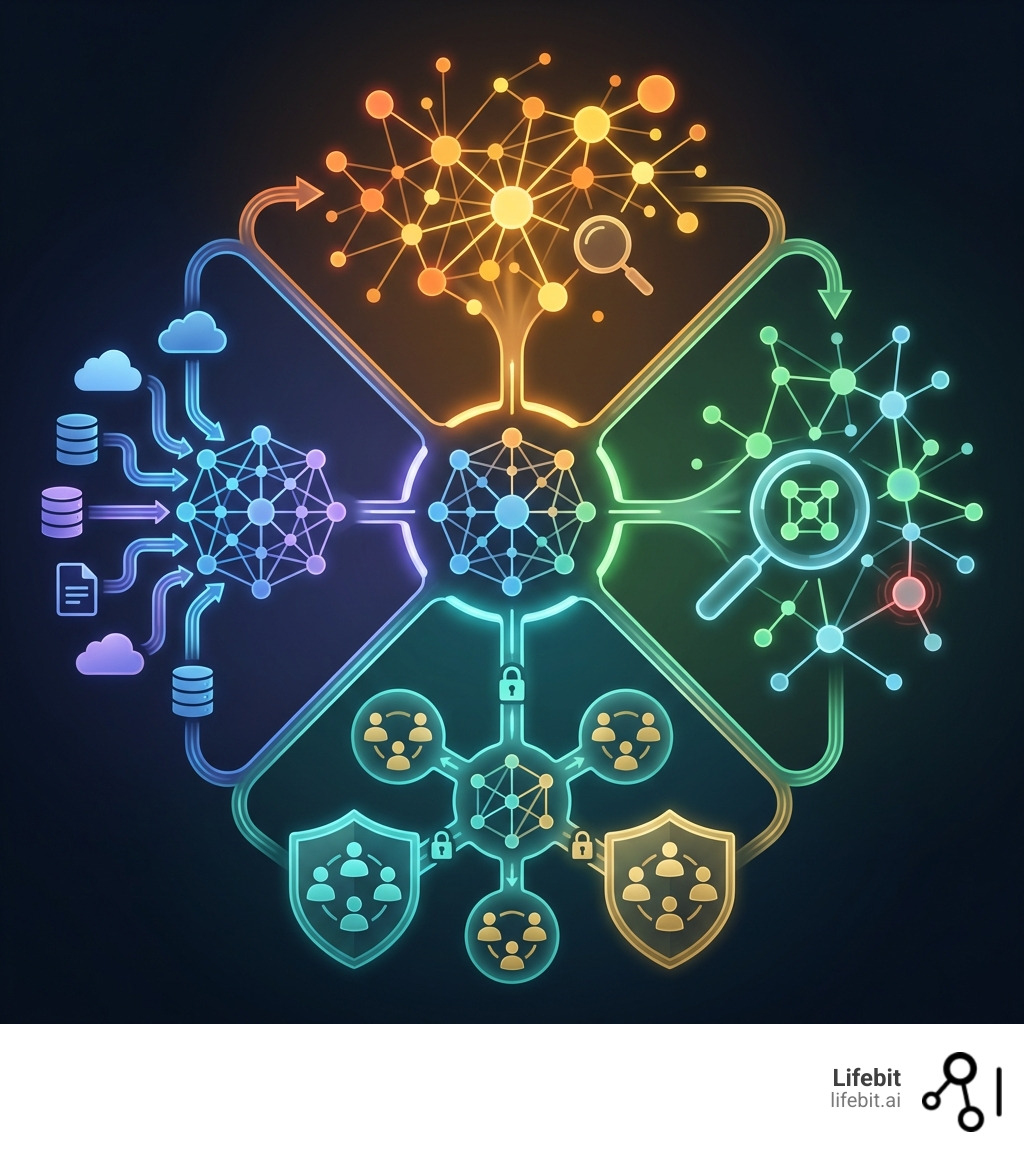
- Integrates disparate data sources (databases, documents, APIs) into a unified view
- Accelerates investigations by 10x while detecting up to 20% more suspicious cases
- Powers decisions in law enforcement, fraud detection, cybersecurity, and biomedical research
How it works: The software uses graph theory—representing data as nodes (entities) and edges (relationships)—to map connections that traditional spreadsheets and dashboards can’t reveal. Instead of analyzing data in isolation, you see how everything connects.
Common use cases:
- Financial crime: Trace money laundering networks and identify fraud rings
- Law enforcement: Map criminal networks and accelerate case-building
- Cybersecurity: Detect threat actors and trace attack patterns
- Public health: Track disease outbreaks and analyze patient cohorts
- Biomedical research: Connect genomic data, clinical records, and research findings across federated datasets
Organizations using these tools report investigating sophisticated activities up to 10x faster and reducing time spent on alerts by an average of 30%. For teams drowning in data silos—especially in pharma, public health, and regulatory environments—this technology turns complexity into clarity.
I’m Maria Chatzou Dunford, CEO and Co-founder of Lifebit, where we’ve spent over 15 years building platforms that enable secure, federated analysis of biomedical data. Throughout my work in computational biology and genomics, I’ve seen how link analysis software transforms fragmented healthcare data into actionable intelligence—without compromising privacy or moving sensitive information. Let me show you how the right tools can revolutionize your investigations.
Relevant articles related to link analysis software:
See How Everything Connects: What Link Analysis Reveals in Your Data
At its heart, link analysis is about uncovering relationships. While traditional data analysis often focuses on aggregates and statistics within structured tables, link analysis software dives deeper, revealing the intricate web of connections that exist between individual data points. Imagine trying to understand a sprawling family tree by only looking at a list of names. You’d miss the parents, children, spouses, and cousins—the very relationships that define the family. Link analysis does exactly that for your data.
The core purpose of link analysis software is to transform raw, often disparate, data into an intuitive, visual representation that highlights these relationships. This process is fundamentally based on a branch of mathematics called graph theory. In this context, individual pieces of information, whether they are people, organizations, bank accounts, messages, or even genes, are represented as “nodes” (or entities). The connections or interactions between these nodes are represented as “edges” (or links).
For instance, in a financial investigation, a node might be a person, and an edge could represent a transaction between two people. In public health, a node might be a patient, and an edge could indicate a shared infection source or a family relationship.
How does this differ from other data analysis tools? Standard business intelligence (BI) tools are excellent for reporting on trends, KPIs, and structured data queries. They tell you what happened, how many, or how often. Link analysis software, however, tells you who is connected to whom, how they’re connected, and why those connections matter. It’s about context and network structure, which standard tools often struggle to visualize or query effectively. We move beyond simple statistics to find hidden networks and patterns.
The main types of data that link analysis tools can process are incredibly diverse, reflecting the interconnected nature of the modern world. This includes:
- Transactional Data: Financial transfers, purchase records, billing information.
- Communication Data: Phone calls, emails, social media interactions, chat logs.
- Identity Data: Names, aliases, addresses, phone numbers, IP addresses.
- Organizational Data: Company structures, partnerships, employee relationships.
- Geospatial Data: Locations, travel patterns, property ownership.
- Biomedical Data: Patient records, genetic sequences, drug interactions, research collaborations.
- Cybersecurity Data: Network logs, malware signatures, threat intelligence feeds.
By integrating and visualizing these varied data types, link analysis software makes complex data accessible and actionable, allowing us to spot critical insights that would otherwise remain buried.
The 10x Investigation Advantage: How Link Analysis Changes the Game
The sheer volume of data we encounter daily can be overwhelming. In investigations, this “data deluge” often hides critical connections, slows down analysis, and can lead to missed opportunities or even compromised outcomes. This is where link analysis software provides a profound strategic advantage, changing chaos into clarity and significantly boosting efficiency and effectiveness.

The benefits of using link analysis tools for investigations are not just theoretical; they are backed by hard numbers. Our partners and other organizations report remarkable improvements:
- They can investigate sophisticated criminal activities up to 10x faster.
- They detect up to 20% more suspicious cases.
- They reduce time spent on alerts by an average of 30%.
These aren’t just incremental gains; they represent a fundamental shift in how complex problems are approached. Imagine the impact of detecting 20% more fraud or accelerating critical public health investigations by a factor of ten.
Which industries or fields commonly use link analysis software, and for what specific applications? The reach is broad, underscoring the universal need to understand connections:
- Law Enforcement and National Security: Mapping criminal networks, identifying terrorist cells, tracking illicit financial flows, and supporting major crime investigations. For example, by fusing phone records with travel manifests and financial data, analysts can uncover the command structure of a drug cartel or identify a previously unknown operative in a terror cell. For example, 100% of UK Police Forces and 80% of the Top 15 US Police Departments use such tools, alongside 70% of NATO Member States.
- Financial Services: Detecting fraud rings, combating money laundering (AML), identifying insider trading, and managing supplier risk in large-scale projects. This involves tracing complex transaction chains across multiple banks and jurisdictions to uncover layering schemes, or identifying collusive bidding patterns among contractors by analyzing shared directors and hidden ownership structures. such as a billion-Euro redevelopment project in Europe.
- Cybersecurity: Tracing attack vectors, identifying threat actors, mapping compromised systems, and understanding the spread of malware. By visualizing network traffic, analysts can spot low-and-slow attacks that evade traditional firewalls and see how an attacker pivots from a non-critical system to a high-value target.
- Public Health: Tracking disease outbreaks, identifying patient zero, analyzing contact networks, and understanding the spread of misinformation related to health crises. This allows health officials to allocate resources more effectively, such as deploying mobile testing to neighborhoods with high network centrality, thereby curbing the spread of infection.
- Biomedical Research: Analyzing complex genetic pathways, identifying drug-target interactions, mapping protein-protein networks, and connecting disparate clinical and genomic datasets for advanced insights. For instance, researchers can map how a specific gene variant connects to a network of proteins, which in turn are linked to clinical symptoms from patient records, suggesting a new therapeutic target. This is particularly crucial for us at Lifebit, where we use advanced Data Linking strategies to enable breakthroughs. The promises and challenges of Health Data Linkage: Promise and Challenges are a testament to this field’s importance.
Link analysis software contributes to making data more accessible and improving analytical metrics by providing a visual, intuitive interface to explore complex data. Instead of sifting through spreadsheets or writing complex database queries, analysts can “see” the data, interact with it, and quickly identify patterns and anomalies. This visual accessibility empowers users—even non-technical personnel—to derive insights more rapidly, leading to faster, smarter decisions and ultimately, more effective outcomes.
The Investigator’s Checklist: 4 Must-Have Features in Link Analysis Software
Selecting the right link analysis software is crucial for maximizing its benefits. It’s not just about flashy visualizations; it’s about finding a tool that aligns with your specific investigative needs, data landscape, and team’s workflow. We’ve seen that the time invested in mastering these tools is significant, so making an informed choice upfront is paramount.
When we evaluate different link analysis tools, we consider several essential features that contribute to their overall utility, effectiveness, and ease of use. These generally include pricing and deployment, onboarding and learning resources, data integrations, visualization capabilities, advanced analytics, and collaboration features.
Data Integration: The Foundation of Effective Link Analysis
The effectiveness of any link analysis software hinges on its ability to access and unify all relevant data. Data integration is not just a feature; it’s the bedrock upon which meaningful analysis is built. Many organizations struggle with data silos, where critical information is locked away in disparate systems. A robust link analysis tool must bridge these gaps.
Key aspects of data integration include:
- Connectors and APIs: The ability to seamlessly connect to a wide range of internal and external data sources, including databases, cloud platforms, social media feeds, and proprietary systems.
- Real-time Ingestion: For dynamic investigations, consuming data in real-time or near real-time is vital to ensure analyses are based on the most current information.
- Entity Resolution: This is a sophisticated capability that identifies and merges records referring to the same real-world entity (e.g., two different records for “John Doe” with slightly different spellings or addresses). Without this, an investigation might see two separate individuals instead of one person using an alias, completely missing the critical link. Modern systems use probabilistic matching, considering multiple fields (name, address, DOB) to calculate a likelihood score that two records are the same. Entity Resolution AI uses advanced algorithms to build a single, consistent view of an entity, revealing connections that might otherwise be missed. As we’ve seen, combining entity resolution and graph technology can lead to cost-effective, advanced decision intelligence.
- Data Harmonization: The tool should be able to normalize and standardize data from various sources into a common format, ensuring consistency for analysis.
For us, especially in biomedical research, effective Data Linking Software is non-negotiable. It ensures that critical patient data, genomic sequences, and research findings can be securely brought together for analysis without compromising privacy.
Visualization and Exploration
Once data is integrated, its visual representation becomes key to understanding. The power of link analysis software lies in its ability to present complex networks in an intuitive, interactive graphical format. This turns abstract data into a tangible landscape that analysts can explore.
Essential visualization and exploration features include:
- Interactive Graphs: Users should be able to pan, zoom, filter, and expand nodes and edges dynamically.
- Variety of Layouts & Views: Different graph layouts (e.g., hierarchical, circular, organic) can reveal different patterns. For instance, some tools offer five different layout modes and eight different views to help investigators identify connections faster.
- Time-Based Analysis: The ability to see how relationships evolve over time, allowing for the detection of temporal patterns and sequences of events.
- Geospatial Mapping: Integrating geographical information to visualize connections in a spatial context, which is crucial for tracking movements or identifying regional clusters.
- Custom Views and Filters: Allowing analysts to tailor their view of the data, focusing on specific entity types, relationship strengths, or attributes.
- Visual Cues: Features like colored bookmarks, notes, and customizable node/edge styling improve navigation and comprehension, especially in large graphs.
These features collectively enable analysts to transform complexity into clarity, making it easier to spot critical insights.
Advanced Analytics and AI
Beyond just visualizing connections, leading link analysis software incorporates advanced analytical capabilities and artificial intelligence (AI) to uncover deeper insights and automate parts of the investigative process.
Key advanced analytics and AI features include:
- Pattern and Anomaly Detection: Algorithms that automatically identify recurring network structures (e.g., fraud rings, common communication patterns) or unusual deviations from normal behavior.
- AI/ML Enrichment: Using machine learning models to enrich data with additional context, such as sentiment analysis on communications, risk scoring for entities, or predicting future connections. This can involve 65+ graph and AI algorithms.
- Risk Scoring: Assigning risk scores to entities or relationships based on their characteristics and their network position, helping analysts prioritize their efforts.
- Social Network Analysis (SNA) Metrics: Calculating metrics like centrality (identifying key influencers), shortest path (finding the most direct connection), and community detection (grouping closely related entities). For example, a node with high ‘betweenness centrality’ acts as a crucial bridge or broker between different groups; disrupting this node could fragment an entire criminal network. ‘Community detection’ algorithms automatically partition the graph into dense clusters, instantly revealing distinct fraud rings or terrorist cells that might have taken an analyst weeks to identify manually.
- Graph Analytics: Leveraging specialized algorithms designed for graph structures to perform complex queries and identify non-obvious relationships.
- Automated Transforms: Capabilities to automate repetitive data mining tasks, speeding up investigations.
These capabilities are critical for turning raw data into actionable intelligence, allowing us to go beyond basic observation to predictive insights. Our work often involves sophisticated Data Matching Software to ensure the accuracy and richness of these analyses.
Collaboration and Reporting
Investigations are rarely solitary endeavors. Effective link analysis software must facilitate secure and efficient collaboration among team members and enable clear communication of findings to stakeholders.
Essential collaboration and reporting features include:
- Shared Workspaces: Allowing multiple users to work on the same investigation, view real-time updates, and contribute to the analysis.
- Commenting and Tagging: Tools for analysts to add notes, highlight specific findings, and tag colleagues for feedback or action.
- Role-Based Access Control (RBAC): Crucial for security and data governance, ensuring that users only access data and features relevant to their roles and permissions. This is particularly vital in federated environments where sensitive data is involved.
- Export Options: Flexible options to export graphs, data, and reports in various formats (e.g., images, PDFs, CSV, JSON) for presentation, further analysis, or integration with other systems.
- Audit Trails: Comprehensive logging of all actions taken within the software, providing transparency, accountability, and supporting compliance requirements.
These features ensure that teams can work together seamlessly, securely, and effectively, turning individual insights into collective intelligence.
The Future of Intelligence: Key Trends Shaping Link Analysis
The landscape of link analysis software is continuously evolving, driven by advancements in AI, big data technologies, and the increasing demand for deeper, faster insights. The future promises even more sophisticated capabilities that will further transform how we understand and act upon interconnected information.
Here are some key trends and innovations shaping the future of link analysis:
- Real-time and Predictive Analytics: The shift towards processing and analyzing data as it arrives, enabling immediate detection of emerging threats or opportunities. Predictive models built on graph structures will forecast future connections and behaviors, moving from reactive to proactive intelligence.
- Federated Analysis: This is a game-changer, especially for highly sensitive data environments like biomedical research. Federated analysis allows organizations to run complex link analyses across distributed, disparate datasets without ever moving the underlying data. Instead, the analytical algorithms travel to the data, process it locally, and return only aggregated, privacy-preserving insights. This model is essential for international research collaborations where data sovereignty laws (like GDPR) prohibit data from leaving a country’s borders. It enables analysis on a global scale while maintaining the highest levels of security and compliance. This approach is fundamental to platforms like ours, ensuring secure collaboration and analysis across hybrid data ecosystems while maintaining strict data governance.
- Explainable AI (XAI): As AI and machine learning become more integrated into link analysis software, there’s a growing need for transparency. XAI aims to make AI models understandable and interpretable, allowing analysts to comprehend why a particular connection was flagged or how a risk score was calculated. This builds trust and facilitates better decision-making.
- The Rise of Knowledge Graphs: Knowledge graphs are becoming central to enterprise data strategies. They provide a structured, semantic representation of information, integrating diverse data sources into a unified, intelligent network. Unlike a simple graph, a knowledge graph includes an ontology—a formal model of the types of entities and relationships—which allows for more powerful reasoning and inference. For example, the system can infer that if Company A owns Company B, and Company B is based in a high-risk country, then Company A has an elevated risk profile. Future link analysis software will increasingly leverage and contribute to these knowledge graphs, enabling richer context, more intelligent queries, and deeper insights. This forms the backbone of a sophisticated Decision Intelligence Platform Overview.
- Improved User Experience and No-Code/Low-Code Platforms: Tools will become even more intuitive, allowing non-technical users to perform complex analyses and build custom applications with minimal coding, democratizing access to powerful link analysis capabilities.
- Integration with Broader Ecosystems: Seamless integration with other enterprise systems—such as case management, SIEM (Security Information and Event Management), and data governance platforms—will ensure that link analysis insights are operationalized efficiently across an organization.
These innovations collectively point towards a future where link analysis software isn’t just a tool for investigators, but a core component of an organization’s decision intelligence framework, empowering faster, more informed actions across all sectors.
Your Top 3 Link Analysis Questions, Answered
We often encounter common questions about link analysis software and its applications. Here, we address some of the most frequent inquiries to provide a clearer understanding.
How does link analysis differ from standard data analysis?
The fundamental difference lies in their primary focus:
- Standard Data Analysis (e.g., SQL queries, spreadsheets, BI dashboards): Typically focuses on quantitative metrics, aggregates, and patterns within columns or rows of data. It answers questions like “How many sales did we make last quarter?” or “What is the average customer age?” It’s often table-based.
- Link Analysis: Concentrates on the relationships and connections between entities. It answers questions like “Who is connected to whom?” “How are they connected?” and “What network patterns exist?” It’s inherently graph-based.
While standard analysis might show you a list of suspicious transactions, link analysis software visualizes the network behind those transactions, revealing the individuals, accounts, and organizations involved, and how they interact. It’s about uncovering hidden networks and contextual understanding, not just isolated metrics.
What industries benefit most from link analysis?
While almost any industry with interconnected data can benefit, certain sectors find link analysis software indispensable due to the critical nature of uncovering relationships:
- Law Enforcement and National Security: For intelligence gathering, criminal network mapping, and counter-terrorism.
- Financial Services: For fraud detection, anti-money laundering (AML), and identifying financial crime syndicates.
- Insurance: For detecting claims fraud and understanding complex policyholder relationships.
- Cybersecurity: For tracing attack paths, identifying threat actors, and mapping compromised systems.
- Biomedical Research and Public Health: For analyzing disease transmission, drug interaction networks, genetic pathways, and secure data linkage across federated datasets.
- Government Agencies: For compliance, regulatory oversight, and understanding complex social or economic networks.
These industries deal with vast, complex, and often sensitive data where understanding relationships is paramount to their mission.
What are the biggest challenges when using link analysis tools?
Despite their immense power, implementing and effectively using link analysis software comes with its own set of challenges:
- Data Quality and Integration: The adage “garbage in, garbage out” applies strongly here. Poor data quality (inconsistencies, missing information) can lead to inaccurate or misleading graphs. Integrating data from numerous disparate sources, especially in real-time, requires robust ETL (Extract, Transform, Load) processes and often sophisticated entity resolution capabilities.
- Scaling to Big Data: As datasets grow into billions of entities and relationships, performance can become an issue. Tools need to be designed to handle massive scale efficiently, both in processing and visualization.
- User Learning Curve: While many tools aim for intuitiveness, mastering the full range of features, especially advanced analytics and customization, can require significant training and experience.
- Ensuring Privacy and Governance: Especially for sensitive data (e.g., personal, health, financial), strict privacy regulations (like GDPR) and internal governance policies must be adhered to. This requires robust access controls, anonymization techniques, and secure, auditable environments, particularly in federated analysis scenarios where data ownership remains distributed.
- Avoiding Information Overload: Paradoxically, a tool designed to clarify can also overwhelm if not managed properly. Large, dense graphs can be difficult to interpret, necessitating strong filtering, grouping, and visualization management features.
Overcoming these challenges often involves strategic planning, investing in data governance, providing comprehensive training, and choosing platforms that prioritize scalability, security, and user-friendliness.
Conclusion
In an era defined by data overload, link analysis software emerges as an indispensable tool, changing overwhelming information into clear, actionable intelligence. We’ve seen how these powerful solutions leverage graph theory to visualize relationships, accelerate investigations by up to 10x, and detect significantly more suspicious cases across diverse industries—from law enforcement and financial crime to public health and biomedical research.
The journey to effective link analysis begins with choosing the right toolkit. Key considerations include robust data integration capabilities (especially with entity resolution), intuitive visualization and exploration features, advanced analytics driven by AI and machine learning, and comprehensive collaboration and reporting functionalities. These elements ensure that your team can not only uncover hidden insights but also act upon them efficiently and securely.
Looking ahead, the future of link analysis software is bright, with trends like real-time and predictive analytics, explainable AI, and federated analysis promising even greater power and precision. For organizations dealing with highly sensitive and distributed datasets, such as those in complex biomedical research, federated platforms like Lifebit’s deliver secure, powerful analysis without ever requiring the movement of sensitive data. This approach is critical for compliant research and pharmacovigilance across global enterprises.
Link analysis software empowers us to move beyond the surface of data, revealing the intricate connections that drive real-world events and enabling faster, more informed decisions that protect, innovate, and advance our collective understanding. To explore how our platform can improve your intelligence capabilities, visit our platform overview today.
[https://lifebit.ai/platform/]