
9 Best Biomedical Data Standardization Tools in 2026

Biomedical data standardization is the unglamorous bottleneck that determines whether your research moves or stalls. Genomic files in one format, EHR data in another, clinical trial records in a third — and none of them talking to each other. The result is months of manual harmonization before a single analysis can run.
This list covers the tools that serious teams — government health agencies, biopharma R&D groups, academic consortia — are actually using to solve this problem in 2026. We evaluated each on depth of standards support (OMOP, FHIR, GA4GH, HL7), automation capability, compliance posture, and suitability for large-scale or federated environments.
If you’re a CIO managing siloed hospital data, a CDO at a national health program, or a translational research head trying to get genomic and clinical data speaking the same language, this is your reference. No filler. Just what each tool does, who it’s built for, and what it costs.
1. Lifebit Trusted Data Factory (TDF)
Best for: National health programs and biopharma teams needing AI-automated, compliant harmonization at scale.
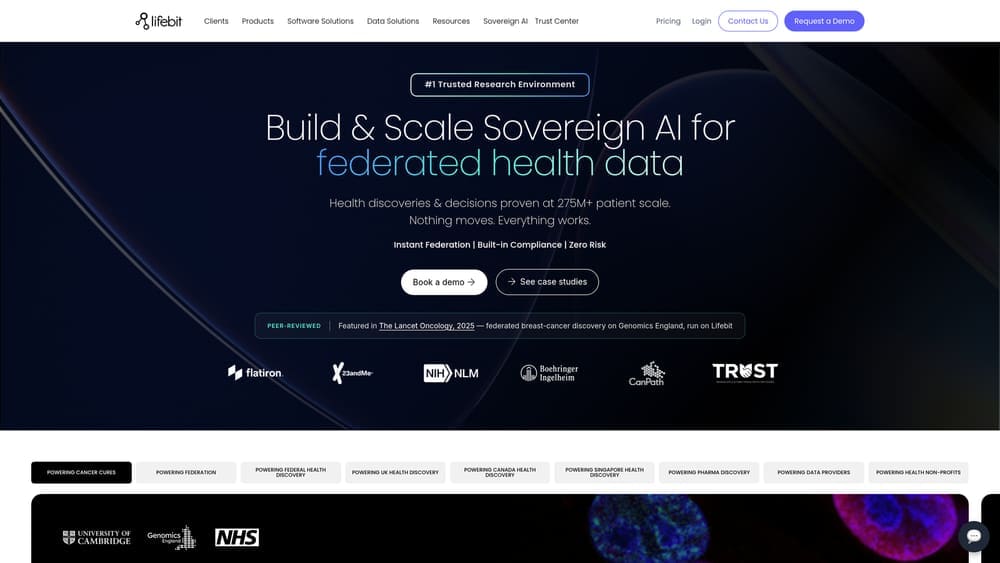
Lifebit Trusted Data Factory is an AI-powered biomedical data harmonization platform that standardizes genomic and clinical data to OMOP, FHIR, and GA4GH standards in 48 hours, without moving data out of your environment.
Where This Tool Shines
Most harmonization projects stall because the process requires armies of data engineers manually mapping fields, reconciling terminologies, and wrestling with compliance requirements simultaneously. TDF collapses that timeline. Its AI layer handles what would otherwise take months of manual ETL work, and it does so inside your secure environment, so your data never leaves the perimeter.
What separates TDF from general-purpose ETL platforms is that it was purpose-built for regulated biomedical data at national scale. It’s the infrastructure behind programs managing hundreds of millions of records across multiple countries, not a generic connector tool adapted for healthcare as an afterthought.
Key Features
AI-Automated Harmonization: Standardizes to OMOP, FHIR, and GA4GH in 48 hours, replacing months of manual mapping effort.
No Data Movement: Standardization runs inside your secure environment, eliminating the compliance and security risks of data transfer.
Built-In Compliance: FedRAMP, HIPAA, GDPR, and ISO 27001 compliance is built into the platform architecture from day one, not bolted on later.
Federated Integration: Connects natively with Lifebit’s Federated Data Platform and Trusted Research Environment for end-to-end secure research infrastructure.
Proven Scale: Supports 275M+ records and is deployed in 30+ countries, including national health programs such as Genomics England and Singapore MOH.
Best For
Government health agencies building national precision medicine programs, biopharma R&D teams under pressure to accelerate pipelines, and academic consortia handling regulated multi-source data. Particularly strong for organizations that need federated analysis capability alongside harmonization, not just a standalone ETL tool.
Pricing
Enterprise pricing — contact Lifebit for a quote. A free data standardization offer is available for teams ready to see results before committing.
2. OHDSI OMOP CDM Tools (White Rabbit, Usagi, Rabbit-in-a-Hat)
Best for: Observational research teams converting health data to OMOP CDM with community support.
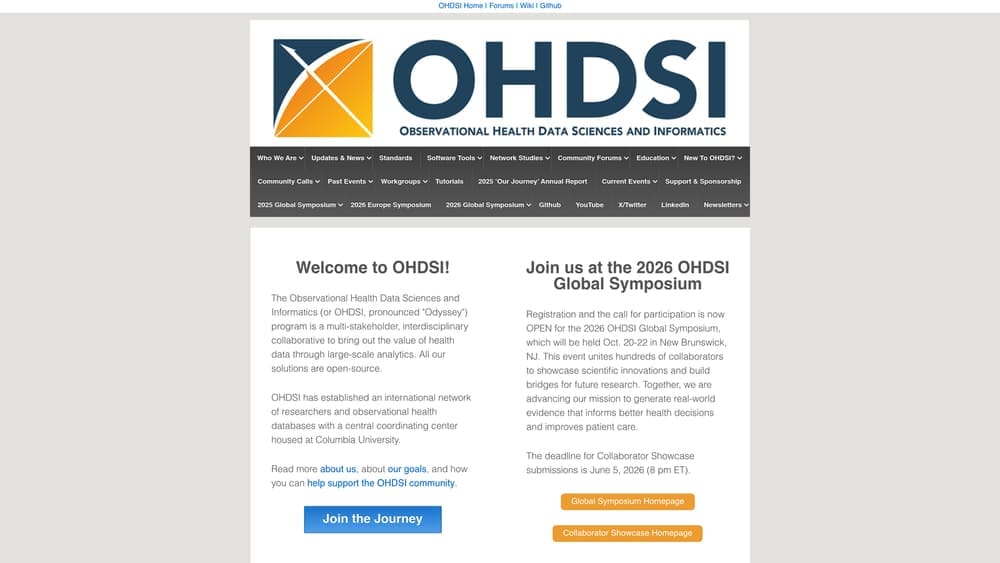
OHDSI’s OMOP toolset is a suite of open-source utilities for profiling source data, mapping fields to the OMOP Common Data Model, and aligning clinical codes to standard concepts.
Where This Tool Shines
The OHDSI ecosystem is the de facto standard for observational health research globally. White Rabbit scans your source database and produces a detailed scan report of its structure and content. Rabbit-in-a-Hat then lets you visually map source fields to their OMOP CDM targets. Usagi handles the terminology side, helping analysts map source codes to OMOP standard concepts with a combination of search algorithms and human review.
The real value here isn’t just the tools themselves — it’s the community. OHDSI chapters operate globally, and networks like EHDEN have helped hundreds of data partners complete OMOP conversions using these utilities. When you hit a mapping problem, there’s a good chance someone in the community has solved it already.
Key Features
White Rabbit: Scans and profiles source database structure, producing a detailed report to inform ETL design.
Rabbit-in-a-Hat: Visual interface for mapping source fields to OMOP CDM target fields, with documentation output.
Usagi: Semi-automated source code to OMOP concept mapping with search-assisted suggestions and manual review workflow.
Global Community: Backed by OHDSI chapters and EHDEN network partners worldwide, with active forums and shared ETL specifications.
Free and Open-Source: No licensing cost; all tools available on GitHub under open licenses.
Best For
Academic medical centers, research networks, and health data partners already operating within the OHDSI ecosystem. Best suited for teams with technical capacity to manage ETL development, since these tools assist the process but don’t automate it end-to-end.
Pricing
Free and open-source. Implementation costs vary based on data complexity, team capacity, and whether external consultants are engaged.
3. Athena (OHDSI Vocabulary Service)
Best for: Teams needing a reliable, community-maintained source of standardized clinical concept sets for OMOP implementation.
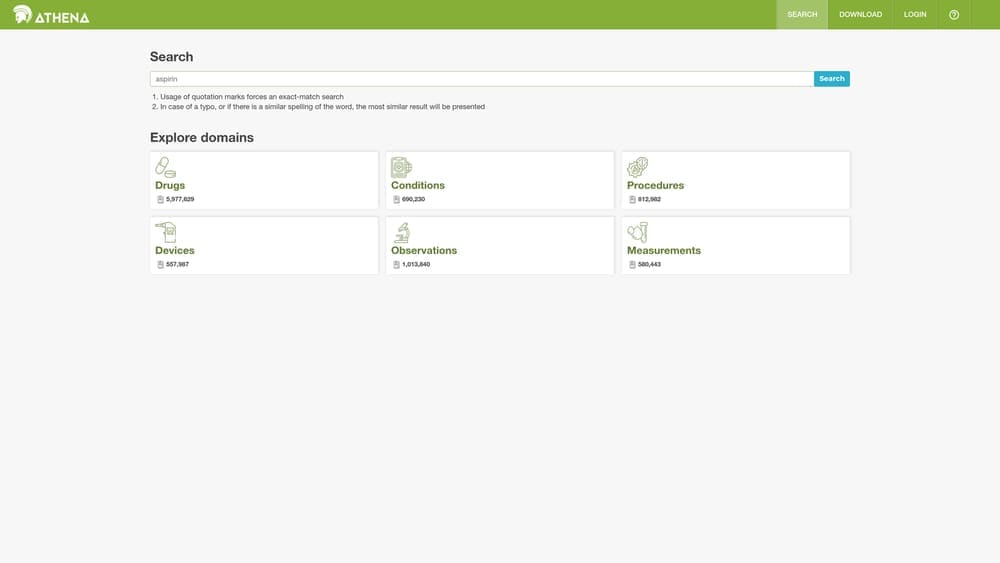
Athena is the OHDSI community’s free vocabulary browser and download service, providing standardized concept mappings across the major clinical terminologies used in OMOP CDM implementations.
Where This Tool Shines
Terminology mapping is one of the most time-consuming and error-prone parts of any OMOP conversion. Athena solves the foundational layer by giving you a single, searchable, downloadable source of truth for how source codes in ICD, SNOMED, RxNorm, LOINC, and other systems map to OMOP standard concepts.
It’s not a full ETL tool, and it doesn’t pretend to be. But no OMOP implementation is complete without it. The vocabulary tables you download from Athena become the backbone of your CDM, and the browser interface lets analysts verify mappings before committing them to a pipeline.
Key Features
Broad Terminology Coverage: Covers SNOMED CT, ICD-9/10, RxNorm, LOINC, CPT4, and a wide range of additional vocabularies.
Search and Browse Interface: Lets analysts search, inspect, and verify concept relationships before downloading.
Downloadable Concept Sets: Full vocabulary tables can be downloaded and loaded directly into your OMOP CDM database.
Community Maintenance: Vocabulary updates are released regularly, keeping mappings current as clinical terminologies evolve.
Free Access: No cost to access or download; requires a free OHDSI account registration.
Best For
Any team implementing OMOP CDM. Athena is a required dependency, not an optional add-on. Also useful for analysts who need to verify how specific clinical codes are represented in the OMOP standard vocabulary before building cohort definitions.
Pricing
Free. Some restricted vocabularies (such as CPT4) require a separate license agreement with the originating organization before download is permitted.
4. HAPI FHIR
Best for: Development teams building FHIR-compliant data pipelines, endpoints, and interoperability infrastructure.
HAPI FHIR is an open-source Java-based FHIR server and client library, widely used in health systems and health information exchanges to build standards-compliant clinical data infrastructure.
Where This Tool Shines
As FHIR mandates expand — particularly under ONC interoperability rules in the US and equivalent frameworks internationally — health systems need a reliable, production-grade FHIR implementation they can build on. HAPI FHIR is the most widely deployed open-source option in this space. It handles FHIR R4 and R5 compliance, validation, and terminology services, and it’s backed by a large developer community with extensive documentation.
The commercial backing from Smile CDR matters here. Unlike purely community-driven projects, HAPI FHIR has a company investing in its maintenance and offering enterprise support contracts. That makes it a credible choice for health systems that need open-source economics with enterprise-grade reliability.
Key Features
Full FHIR R4 and R5 Support: Implements the current FHIR specification with regular updates as the standard evolves.
Validation and Transformation: Built-in FHIR resource validation and terminology services for data quality assurance.
Broad Deployment: Widely used in health systems, HIEs, and payer organizations globally as a production FHIR endpoint.
Developer Ecosystem: Extensive documentation, active GitHub community, and a large base of developers familiar with the library.
Commercial Support: Enterprise support and extended capabilities available through Smile CDR for organizations that need SLAs and professional services.
Best For
Software development teams in health systems, HIEs, and digital health companies building FHIR-compliant APIs and data pipelines. Less suited to non-technical teams looking for a point-and-click solution, since HAPI FHIR is fundamentally a developer library and server framework.
Pricing
Open-source and free to use. Commercial support and enterprise features are available through Smile CDR at custom pricing.
5. Talend Data Fabric
Best for: Enterprise data teams needing visual ETL pipeline design with healthcare connector support and built-in data quality profiling.
Talend Data Fabric is an enterprise data integration platform offering visual pipeline design, data quality profiling, and connector support for healthcare data sources including HL7 and FHIR.
Where This Tool Shines
Talend’s strength is breadth. Its visual drag-and-drop ETL designer lowers the barrier for data engineers who don’t want to write custom transformation code for every pipeline. The built-in data quality profiling gives teams a way to score and monitor data quality as it flows through standardization workflows, which is particularly valuable when you’re ingesting from multiple heterogeneous sources.
Since its acquisition by Qlik in 2023, Talend has been positioned within a broader data integration and analytics portfolio. For organizations already in the Qlik ecosystem, that integration can be an advantage. For others, it’s worth evaluating whether the combined platform fits your architecture or adds unnecessary complexity.
Key Features
Visual ETL Pipeline Builder: Drag-and-drop interface for designing data transformation workflows without heavy custom coding.
Data Quality Profiling: Built-in data quality scoring and profiling to identify issues before they propagate downstream.
Healthcare Connectors: Pre-built connectors and HL7/FHIR adapters available, reducing integration effort for common health data sources.
Unified Platform: Combines data integration, quality, and governance capabilities in a single product suite.
Qlik Portfolio Integration: Now part of Qlik’s data integration stack, enabling tighter connection to Qlik’s analytics and data management tools.
Best For
Enterprise data engineering teams at health systems, payers, or biopharma organizations managing complex, multi-source data integration needs. Best suited for teams with dedicated data engineering resources who want visual tooling over code-first approaches.
Pricing
Enterprise pricing — contact Talend/Qlik directly for a quote. No publicly listed pricing tiers.
6. Informatica Intelligent Data Management Cloud (IDMC)
Best for: Large enterprises managing complex, multi-source data estates with serious governance and compliance requirements.
Informatica IDMC is an AI-powered enterprise cloud platform for data cataloging, quality, integration, and governance at scale, with healthcare-specific accelerators for regulated data environments.
Where This Tool Shines
Informatica’s CLAIRE AI engine does the heavy lifting on metadata discovery and data quality automation. In large health systems or biopharma organizations where data spans hundreds of source systems, manually cataloging and profiling data is not realistic. CLAIRE surfaces data relationships, flags quality issues, and builds lineage automatically, giving data governance teams visibility they couldn’t achieve manually.
The governance and audit trail capabilities are particularly relevant for regulated environments. When a regulator or internal audit asks how a specific data element was transformed and who had access to it, Informatica’s lineage and access logging can answer that question with precision.
Key Features
CLAIRE AI Engine: Automated metadata discovery, data quality scoring, and intelligent recommendations powered by Informatica’s AI layer.
Unified Data Catalog: Enterprise-wide data catalog with full lineage and impact analysis across source systems.
Healthcare Accelerators: Pre-built templates and connectors for common healthcare data sources and compliance scenarios.
Governance and Audit: Comprehensive access controls, data lineage tracking, and audit logging for regulated environments.
Scalability: Designed for large, complex data estates with high volumes and many source systems.
Best For
Large health systems, national health programs, and biopharma organizations with mature data management functions that need enterprise-grade governance alongside integration. Organizations with smaller data estates or simpler requirements may find the platform’s depth exceeds their immediate needs.
Pricing
Enterprise pricing with custom quotes required. Informatica’s pricing model is consumption-based in the cloud; expect significant investment for large-scale deployments.
7. Palantir Foundry
Best for: Government health agencies and large biopharma organizations needing ontology-driven data standardization with rigorous access control.
Palantir Foundry is an ontology-driven data integration and standardization platform deployed in government health agencies and regulated enterprise environments globally.
Where This Tool Shines
Foundry’s ontology approach is distinct from traditional ETL platforms. Rather than just moving and transforming data, Foundry models data as versioned, governed objects within a shared ontology. Every data element has a defined relationship to other elements, a version history, and a clear lineage. For organizations where data governance isn’t optional, that architecture provides a level of control that pipeline-based tools struggle to match.
Palantir has publicly documented deployments with government health agencies and large biopharma organizations. The platform’s access control and audit capabilities are built for environments where who saw what data, and when, must be answerable at any time.
Key Features
Ontology-Based Data Modeling: Data objects are modeled, versioned, and governed within a shared ontology rather than transformed through traditional pipelines.
Audit Trail and Access Controls: Granular access controls and comprehensive audit logging built for regulated and government environments.
Multi-Source Integration: Integrates clinical, genomic, and operational data at scale across complex source landscapes.
Pipeline Flexibility: Supports both code-based and no-code pipeline options, accommodating different technical skill levels within a team.
Regulated Deployment: Proven deployment track record in government and regulated enterprise settings where security and compliance are non-negotiable.
Best For
Government agencies, large biopharma organizations, and defense-adjacent health programs where data governance, security, and auditability are primary requirements alongside integration capability. The platform’s complexity and cost make it best suited to organizations with substantial resources and dedicated implementation capacity.
Pricing
Enterprise pricing — significant implementation investment typically required. Contact Palantir directly for commercial terms.
8. GA4GH Data Connect
Best for: International genomics consortia and research networks needing federated data discovery without centralizing sensitive data.
GA4GH Data Connect is an open standard and reference implementation enabling federated search and standardized data access across genomic and phenotypic datasets without requiring data movement.
Where This Tool Shines
The fundamental challenge in multi-institutional genomics research is that the data can’t always move. Legal, ethical, and jurisdictional constraints mean that genomic data often must stay within its originating institution. GA4GH Data Connect solves the discovery problem: it lets researchers search and query across participating nodes without the data ever leaving those nodes.
As a GA4GH standard, Data Connect is designed to interoperate with the broader GA4GH framework, including Phenopackets for structured phenotypic data representation and the Variant Representation Specification. For consortia already operating within the GA4GH ecosystem, it’s a natural fit that avoids proprietary lock-in.
Key Features
Federated Discovery API: GA4GH-compliant API enabling cross-institutional genomic data search without centralizing data.
No Data Movement: Queries execute at the source node; only results (not raw data) traverse the network.
GA4GH Ecosystem Compatibility: Supports Phenopackets and other GA4GH data models for structured phenotypic and genomic data representation.
International Adoption: Adopted by international genomics consortia as part of federated data sharing infrastructure.
Open Standard: Free to implement; no proprietary licensing; community-governed specification.
Best For
International genomics research consortia, biobanks, and academic research networks that need to enable cross-institutional discovery while respecting data sovereignty constraints. Requires technical implementation expertise; not a turnkey solution for non-technical teams.
Pricing
Free and open standard. Infrastructure and implementation costs depend on the scale of deployment and technical resources available within participating institutions.
9. Pentaho Data Integration (PDI / Kettle)
Best for: Budget-conscious teams needing flexible, open-source ETL capabilities for health data warehouse and standardization workflows.
Pentaho Data Integration is an open-source ETL tool, now part of the Hitachi Vantara portfolio, offering drag-and-drop pipeline design and broad connector support for data standardization and warehouse workflows.
Where This Tool Shines
Pentaho has been a workhorse for data engineering teams that need capable ETL tooling without enterprise platform pricing. Its Community Edition is free, its pipeline designer is visual and approachable, and its connector library covers a wide range of source systems. For smaller health organizations or research teams that need to build standardization pipelines on a constrained budget, it offers genuine capability without the cost of Talend or Informatica.
The active Kettle/PDI open-source community means that common healthcare ETL patterns, including OMOP conversion workflows, have been implemented and shared by community members. That accumulated knowledge base reduces the time needed to get a functional pipeline running.
Key Features
Visual Pipeline Designer: Drag-and-drop interface for building ETL transformations without writing code from scratch.
Broad Connector Support: Connects to a wide range of databases, file formats, and data sources relevant to health data environments.
Community Edition: Fully functional free version with an active open-source community providing support and shared pipeline templates.
Healthcare ETL Patterns: Community-contributed pipeline patterns for common health data standardization workflows, including OMOP conversions.
Enterprise Edition: Commercial version with additional features, scheduling, and Hitachi Vantara support for organizations that outgrow the Community Edition.
Best For
Smaller health systems, academic research teams, and budget-constrained organizations that need capable ETL tooling without enterprise platform costs. Teams with dedicated data engineering capacity will get more from it than those without technical resources to manage pipeline development and maintenance.
Pricing
Community Edition is free and open-source. Enterprise Edition pricing is available from Hitachi Vantara on request.
Which Tool Is Right for Your Use Case
The right choice depends less on which tool is “best” in the abstract and more on your specific constraints: data volume, regulatory environment, technical capacity, and whether you need harmonization alone or harmonization plus federated analysis.
Here’s a quick-reference breakdown by use case:
National health programs and large biopharma pipelines: Lifebit TDF is the strongest option when you need AI-automated harmonization to OMOP, FHIR, and GA4GH at scale, with compliance built in and no data movement required. It’s the only tool in this list that combines all three capabilities natively.
Observational research and real-world evidence: The OHDSI toolset (White Rabbit, Rabbit-in-a-Hat, Usagi) paired with Athena is the community standard. Expect manual effort, but benefit from a global support network and shared ETL specifications.
EHR interoperability and FHIR compliance: HAPI FHIR is the go-to for development teams building FHIR endpoints and pipelines. Open-source, production-grade, and widely understood by health IT developers.
Enterprise data estates with governance requirements: Informatica IDMC or Palantir Foundry, depending on whether your priority is AI-powered data quality at scale (Informatica) or ontology-driven governance with rigorous audit controls (Palantir).
International genomics consortia: GA4GH Data Connect for federated discovery, ideally combined with Lifebit’s Federated Data Platform for analysis capability across nodes without data movement.
Budget-constrained teams: Pentaho PDI Community Edition gives you functional ETL capability at no licensing cost. Pair it with OHDSI tools and Athena for a fully open-source OMOP implementation stack.
If you’re ready to see what AI-automated harmonization actually looks like in your environment, Lifebit’s free standardization offer lets you get started without a lengthy procurement process. Get-Started for Free and see how fast your data can be analysis-ready.
Related Lifebit reading
Continue with these pillar guides:
- The complete guide to Trusted Research Environments — what a TRE is, the Five Safes framework, and why federated architectures became the procurement default after the UK Biobank incident.
- Federated learning in healthcare — how machine-learning models train across hospitals and biobanks without the data ever leaving its source.
- The biomedical data lakehouse — the open-format storage layer that powers clinical, research, and AI workloads from one copy of the data.
- Federated data governance — how each data custodian retains control while participating in multi-institution research and AI.
- Lifebit’s federated biomedical data platform — see how Genomics England, Singapore Synapxe, NIH, and Boehringer Ingelheim use Lifebit to run Sovereign AI on federated health data.