

7 Painless Ways to Find Biotech Companies in London

Why London is the Biotech Hub You Can’t Afford to Ignore
Biotech companies in London are reshaping global healthcare. As the third-largest biotech hub in the world—after Boston and San Francisco—the city boasts over 1,000 biotech companies, 20,000+ employees, and has attracted $5 billion+ in funding in the last year alone.
Quick answer: Where to find biotech companies in London:
- Academic powerhouses – Imperial College London, UCL, King’s College London, Francis Crick Institute
- Industry associations – BioIndustry Association (BIA), One Nucleus, MedCity
- Government databases – GOV.UK company search, UK Life Sciences Vision portal
- Specialized directories – Beauhurst, Wellfound, Biotech Company List
- Funding trackers – PitchBook, Crunchbase, venture capital news
- Industry events – Festival of Genomics & Biodata, OCT UK & Ireland
- News outlets – Labiotech.eu, Fierce Biotech, BioPharma Reporter
London is the heart of the “Golden Triangle” (with Oxford and Cambridge), a cluster generating £8.4 billion annually. With the UK government committing over $1 billion to the life sciences, significant investment is flowing directly into London-based innovation. However, this vibrant ecosystem is fragmented across therapeutic areas and development stages. Finding the right partner means cutting through the noise—fast.
I’m Maria Chatzou Dunford, CEO and Co-founder of Lifebit. With over 15 years in the global biotech space, I’ve helped pharma leaders and researchers accelerate drug findy by enabling secure, compliant data collaboration.
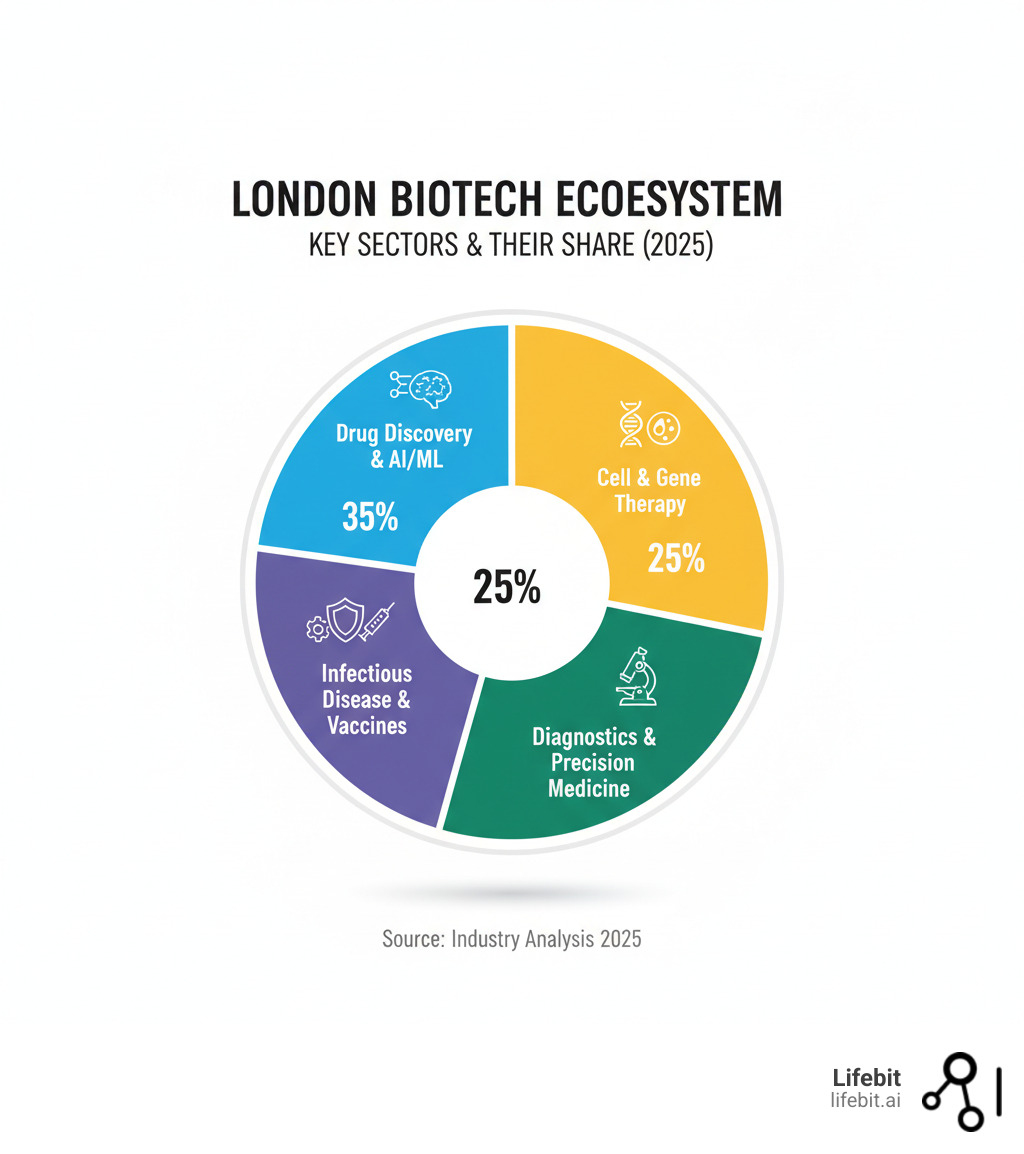
1. Start with London’s Academic Powerhouses and Innovation Hubs
To find the most innovative biotech companies in London, start where the science begins: the universities.
London’s world-class academic institutions—Imperial College London, University College London (UCL), and King’s College London—are the engines of its biotech ecosystem. They attract top researchers, secure massive funding, and spin out commercial biotech companies at a remarkable rate.

Biomedical research hubs like the Francis Crick Institute and MedCity act as launchpads for commercial innovation, connecting academic centers with industry partners. This systematic pipeline turns laboratory findings into market-ready therapies.
Many of London’s leading biotechs started as university research projects. Quell Therapeutics, a leader in cell therapy, spun out from King’s College London and UCL. Orchard Therapeutics, a gene therapy pioneer, has roots in UCL. These companies are prime examples of how university tech transfer offices help researchers patent findings, secure seed funding, and form startups.
London’s position within the Golden Triangle (alongside Oxford and Cambridge) amplifies this advantage, creating a concentration of talent and resources that rivals Boston and the Bay Area. To tap into this pipeline, check university tech transfer websites and attend their industry partnership events. These relationships often provide early access to promising technologies. As we’ve seen, collaboration between universities and industry accelerates drug findy timelines and improves research outcomes.
2. Use Official Industry and Government Resources
Navigating London’s biotech landscape is easier with the right resources. Industry associations and government programs offer curated directories and strategic insights that save valuable research time.
Industry Groups:
- BioIndustry Association (BIA): The most comprehensive starting point, representing over 600 life sciences companies. Its member directory allows you to filter by therapeutic area, company stage, and location to pinpoint the biotech companies in London you need.
- One Nucleus: A networking hub that fosters connections between executives, scientists, and investors through events and working groups.
- MedCity: Promotes London and the South East as a unified life sciences cluster, publishing reports on investment trends and emerging technologies.
Government & Tech Resources:
- UK Life Sciences Vision: Outlines the government’s strategic priorities and highlights areas of focused growth, backed by over $1 billion in recent investment.
- GOV.UK Company Search: Provides official registration details and filing histories, essential for due diligence.
- Builtinlondon.uk: A tech-focused directory that includes many of London’s innovative biotech firms.
Industry Events:
Don’t overlook conferences like the Festival of Genomics & Biodata or OCT UK & Ireland. These are not just networking events; they are intelligence-gathering missions where you can spot emerging trends and forge partnerships.
At Lifebit, we know these official channels are crucial for identifying legitimate partners. The verified, up-to-date information they provide is smart due diligence, especially when dealing with sensitive biomedical data and seeking collaborators you can trust.
3. Target Companies by Therapeutic Focus
London’s biotech ecosystem is a collection of specialists focused on specific therapeutic areas. Zeroing in on these niches is the fastest way to find the right partner for your needs, whether in drug findy, diagnostics, or cell therapy.
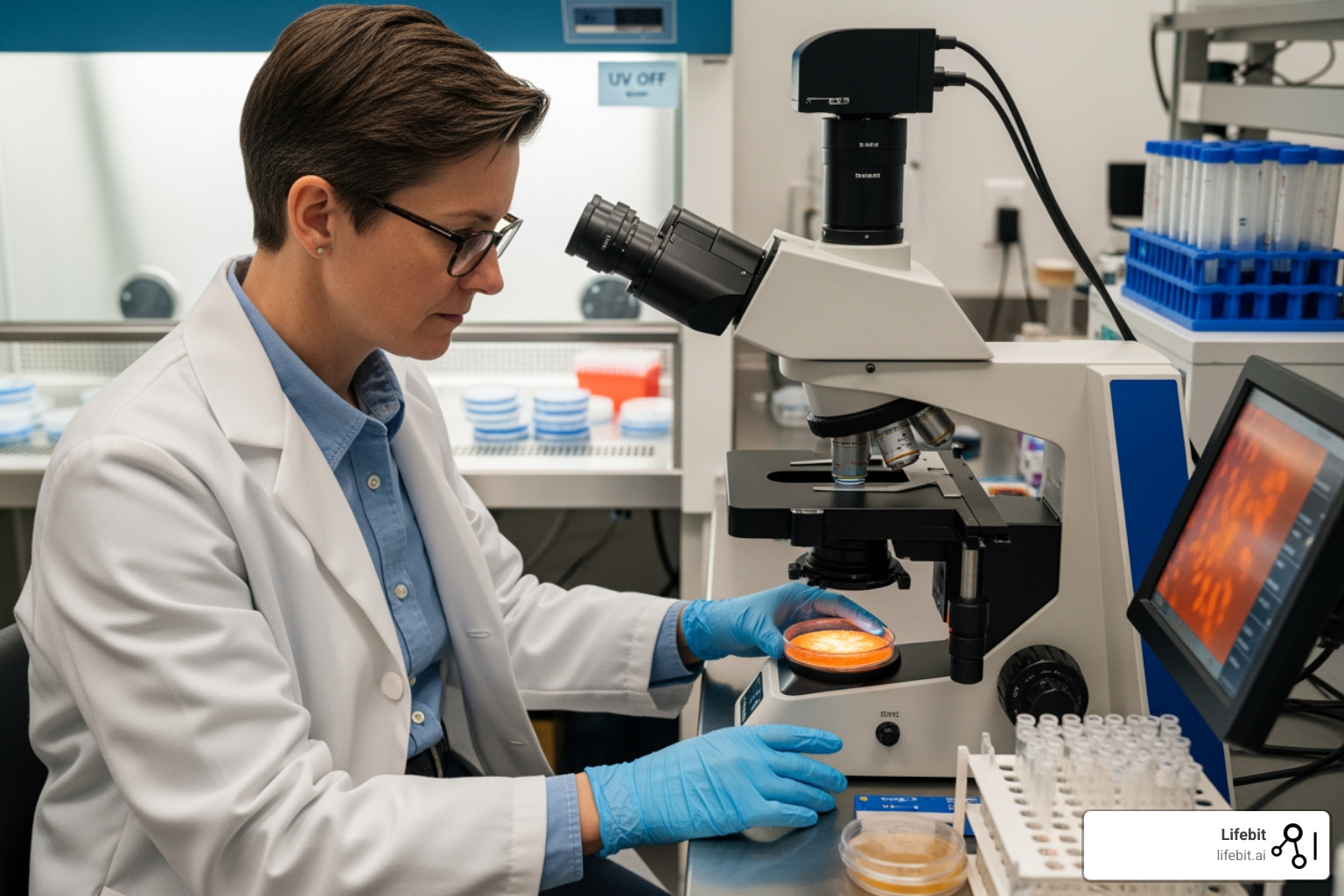
Oncology and Advanced Therapies
London is a global center for cell and gene therapy innovators who are revolutionizing cancer treatment.
- Autolus Therapeutics exemplifies this shift. Its CAR-T therapy, which engineers a patient’s T-cells to fight cancer, recently earned FDA approval. The company has attracted over $250 million from Blackstone Life Sciences, signaling strong investor confidence.
- Quell Therapeutics, a spin-out from King’s College London and UCL, engineers regulatory T cells (Tregs) to suppress unwanted immune activity. Its technology secured a landmark $2 billion licensing deal with AstraZeneca.
Other key players include Myricx Bio, developing Antibody-Drug Conjugates (ADCs), and NK:IO, which is pioneering natural killer cell therapies. These companies are not just making incremental improvements; they are fundamentally reimagining how we fight cancer.
Neurology and Rare Diseases
London’s biotechs are also tackling some of the toughest challenges in neurology and rare diseases, where unmet medical needs are immense.
- AstronauTx, a spin-out from the Dementia Research Institute, focuses on restoring healthy brain cell function in neurodegenerative diseases. It closed a $61 million Series A round led by the Novartis Venture Fund.
- AviadoBio is advancing precision gene therapy for neurodegenerative conditions. Its lead candidate for frontotemporal dementia received FDA fast-track designation, highlighting its potential to be a game-changer.
Companies like Sania Therapeutics are developing treatments for dysfunctional neural circuits, while Epiome and Mendelian focus on precision diagnostics for neurological and rare diseases. This work offers hope for conditions long considered untreatable. For more on the innovative thinking happening across the UK, the work of TauRx Pharmaceuticals on Alzheimer’s treatments provides valuable context.
4. Track the AI Revolution in London Biotech
To find the most boundary-pushing biotech companies in London, follow the AI trail. Artificial Intelligence and Machine Learning are fundamentally reshaping drug findy, diagnostics, and healthcare delivery, and London is a global hub for this revolution.
AI in drug findy is accelerating the path from target to treatment. AI platforms analyze massive genomic, proteomic, and clinical datasets to identify promising drug targets in a fraction of the traditional time.
- Isomorphic Labs, an Alphabet company, is reimagining drug findy with an AI-first approach. Building on the groundbreaking AlphaFold3 model, it has secured partnerships with Eli Lilly and Novartis potentially worth nearly $3 billion and recently raised $600 million in external funding.
- BenevolentAI combines its AI platform with deep scientific expertise to decode disease biology. It supports over 25 in-house drug programs and has attracted £253 million in funding.
- Kuano blends quantum mapping with AI-led chemistry to accelerate candidate development.
The AI revolution also extends to machine learning diagnostics. Companies like Niramai are developing AI-powered breast cancer detection, while Vivan Therapeutics uses AI-driven digital health tools to personalize cancer treatment.
In data-driven healthcare, companies like Relation Therapeutics and Sable Bio are building AI platforms to generate actionable insights from real-world data. This diverse ecosystem shows how AI is being creatively applied across London’s biotech landscape.
At Lifebit, we are at the center of this change. Our federated AI platform enables researchers to train powerful AI models on global biomedical data without compromising patient privacy or data security. The challenge with AI isn’t just the algorithms; it’s accessing enough high-quality, diverse data to make them effective. Our platform solves this by bringing the computation to the data, not the other way around. For more on this topic, explore our resources on AI in drug findy.
5. Follow the Funding to Spot High-Growth Biotech Firms
In biotech, investment signals validation. Following the funding trail is a smart way to identify high-growth biotech companies in London with validated science and market potential. When investors commit millions, they’re betting on the future.

London’s biotech sector raised over $5 billion in funding last year, while the UK biotech sector overall saw a 94% increase in funding in 2024, securing approximately £3.5 billion. This capital fuels the entire innovation lifecycle, from early-stage research to commercialization.
Examining specific funding rounds reveals where sophisticated investors are placing their bets:
- Isomorphic Labs raised an eye-watering $600 million for its AI drug findy platform.
- Autolus Therapeutics secured over $250 million from Blackstone Life Sciences for its CAR-T cell therapy.
- Quell Therapeutics landed a $2 billion licensing deal with AstraZeneca on top of £198 million in equity.
- BenevolentAI has raised £253 million to power its AI-driven drug programs.
- Guide Therapeutics raised a $170 million Series B for its ophthalmic gene therapies.
- Verdiva Bio launched with a landmark £140 million first fundraising for its cardiometabolic pharmaceuticals.
This investment creates a virtuous cycle, attracting talent, generating innovation, and creating jobs for the 20,000+ people employed in London’s biotech sector. The continuous influx of capital, coupled with over $1 billion in government investment, is a powerful engine for economic growth.
Here’s a snapshot of recent major funding rounds for top biotech companies in London and the broader UK:
| Company Name | Therapeutic Area | Technology Focus | Latest Major Funding Round | Amount Raised |
|---|---|---|---|---|
| Isomorphic Labs | AI Drug Findy | AI/ML | External Funding Round | $600 million |
| Autolus Therapeutics | Oncology | CAR-T Cell Therapy | Blackstone Life Sciences | $250 million |
| Quell Therapeutics | Autoimmune Diseases, Oncology | Treg Cell Therapy | AstraZeneca Licensing Deal | $2 billion (potential) |
| Pulmocide | Infectious Diseases | Inhaled Anti-infectives | Series C | £181 million (total equity) |
| BenevolentAI | AI Drug Findy | AI/ML | Various | £253 million (total) |
| Guide Therapeutics | Ophthalmology | Gene Therapy | Series B | $170 million |
| Resolution Therapeutics | Liver Diseases, Cancer | Macrophage Cell Therapy | Series B | £63.5 million |
| AstronauTx | Neurodegenerative Diseases | Small Molecules | Series A | $61 million |
| Verdiva Bio | Cardiometabolic Disorders | GLP-1 Receptor Agonists | First Fundraising | £140 million |
At Lifebit, we’ve seen how secure access to well-governed data accelerates the research that attracts this kind of investment. When companies can analyze global biomedical datasets faster, they reduce development risks and become more attractive to investors.
6. Identify Leaders in Advanced Therapies and Manufacturing
London’s biotech companies are pioneering advanced therapies that target disease at its molecular root. These innovations in cell therapy, gene therapy, and pandemic preparedness require not just brilliant science but also cutting-edge manufacturing and novel delivery technologies.
The Future of Medicine: Cell & Gene Therapy
Cell and gene therapies modify a patient’s cells or genetic material to treat, prevent, or cure diseases. London is home to several leaders in this field:
- Autolus Therapeutics has an FDA-approved CAR-T cell therapy, engineering immune cells to fight blood cancers.
- Quell Therapeutics engineers regulatory T cells (Tregs) to suppress unwanted immune activity, with potential in autoimmune diseases and transplant rejection. Their technology secured a $2 billion licensing deal with AstraZeneca.
- Orchard Therapeutics and Guide Therapeutics are developing gene therapies for rare diseases and blindness, respectively, backed by hundreds of millions in funding.
These complex therapies require specialized manufacturing. Hubs like ViroCell Biologics and Ori Biotech provide the critical infrastructure to produce viral vectors and streamline cell therapy manufacturing at scale. For more on this topic, Adthera Bio offers insights into advanced therapy manufacturing.
Innovations in Pandemic Preparedness
The COVID-19 pandemic spurred innovation in tools to combat future health crises. London’s biotechs are at the forefront of developing novel delivery systems and rapid diagnostics.
- Pulmocide is developing inhaled medicines for respiratory infections. Its flagship product, in Phase 3 trials, delivers drugs directly to infected lung tissue, a potential game-changer for treating respiratory illnesses.
- Vicebio is working on a “Molecular Clamp” vaccine platform designed for broad protection against multiple respiratory viruses.
- Prokarium is exploring oral vaccines, which could transform global immunization by simplifying administration.
Rapid diagnostics from companies like Virax Biolabs and human challenge trials from hVIVO are also crucial components of the response infrastructure. Major pharmaceutical players like GSK, with a significant London presence, provide the scale and resources necessary for global health security.
At Lifebit, we know that pandemic preparedness requires rapid, secure data sharing. Our federated platform enables researchers to collaborate on sensitive health data across borders, identifying threats and developing responses faster than ever before.
7. Use Specialized Databases and News Outlets for Real-Time Intel
To keep pace with London’s fast-moving biotech landscape, you need real-time intelligence. Funding rounds, clinical trial data, and strategic partnerships are announced daily. Tapping into the right sources is key to identifying the biotech companies in London that matter.
Stay Informed with Key Resources:
- Industry News: Outlets like Fierce Biotech, Labiotech.eu, and BioPharma Reporter provide daily news, CEO interviews, and market analysis that put funding rounds and clinical milestones in context.
- Professional Databases: PitchBook and Crunchbase offer comprehensive data on funding histories, investors, and leadership teams. While subscription-based, their data quality is invaluable for serious market evaluation.
- LinkedIn Networking: Follow executives and scientists from London biotechs for unfiltered insights. Joining groups run by the BioIndustry Association (BIA) or One Nucleus connects you to active discussions and emerging opportunities.
How to Find the Right Biotech Companies
To focus your search, follow these steps:
- Define Your Criteria: Be specific. Are you interested in oncology or neurology? Early-stage startups or IPO-ready leaders? AI drug findy or cell therapy manufacturing? Clear criteria will help you filter London’s 1,000+ biotechs efficiently.
- Conduct Thorough Due Diligence: Once you have a shortlist, verify their claims. Check scientific publications on PubMed for research quality. Search ClinicalTrials.gov for active trials and results. Review press releases for partnership and funding announcements.
- Scrutinize the Science: Look for strong intellectual property, experienced leadership, and a clear regulatory pathway. If a company claims a breakthrough, dig into their methodology and validation studies. Peer-reviewed, reproducible science is a must.
At Lifebit, we understand that the right partner has both scientific and technical compatibility. Our federated platform enables secure collaboration across institutional boundaries. When evaluating biotech companies in London, consider not just their science but also their data infrastructure and readiness for secure, federated research.
Conclusion: Open up London’s Biotech Goldmine—Before Your Competitors Do
London’s biotech ecosystem is a global force, driven by academic powerhouses, fueled by $5 billion+ in recent funding, and populated by over 1,000 innovative companies. From Isomorphic Labs’ AI-driven drug findy to Autolus Therapeutics’ FDA-approved cell therapy, London’s biotechs are delivering breakthroughs across oncology, neurology, and rare diseases.
The numbers are compelling: as the world’s third-largest biotech hub and the heart of the £8.4 billion “Golden Triangle,” London’s growth is accelerating. But this explosive growth creates a critical challenge: data access and secure collaboration. Valuable genomic, clinical, and real-world data sits in isolated silos, hindering the large-scale research needed for the next wave of findies.
This is the problem Lifebit solves. Our next-generation federated AI platform enables secure, real-time access to global biomedical data without it ever leaving its secure environment. This allows biopharma companies, researchers, and public health agencies to collaborate on sensitive data while upholding the highest standards of privacy, security, and governance.
With built-in tools for harmonization, advanced AI/ML analytics, and federated governance, our platform is designed to power the compliant, large-scale research that London’s ecosystem demands. The future of biotech belongs to those who can collaborate effectively across boundaries.
Will you tap into this goldmine before your competitors do?
To learn how Lifebit’s federated platform can accelerate your research and connect you to London’s thriving biotech landscape, discover Lifebit’s federated platform for secure data collaboration.