

Why AI is the New MVP of Modern Clinical Research

Why Clinical Trials AI Is the New MVP of Modern Research
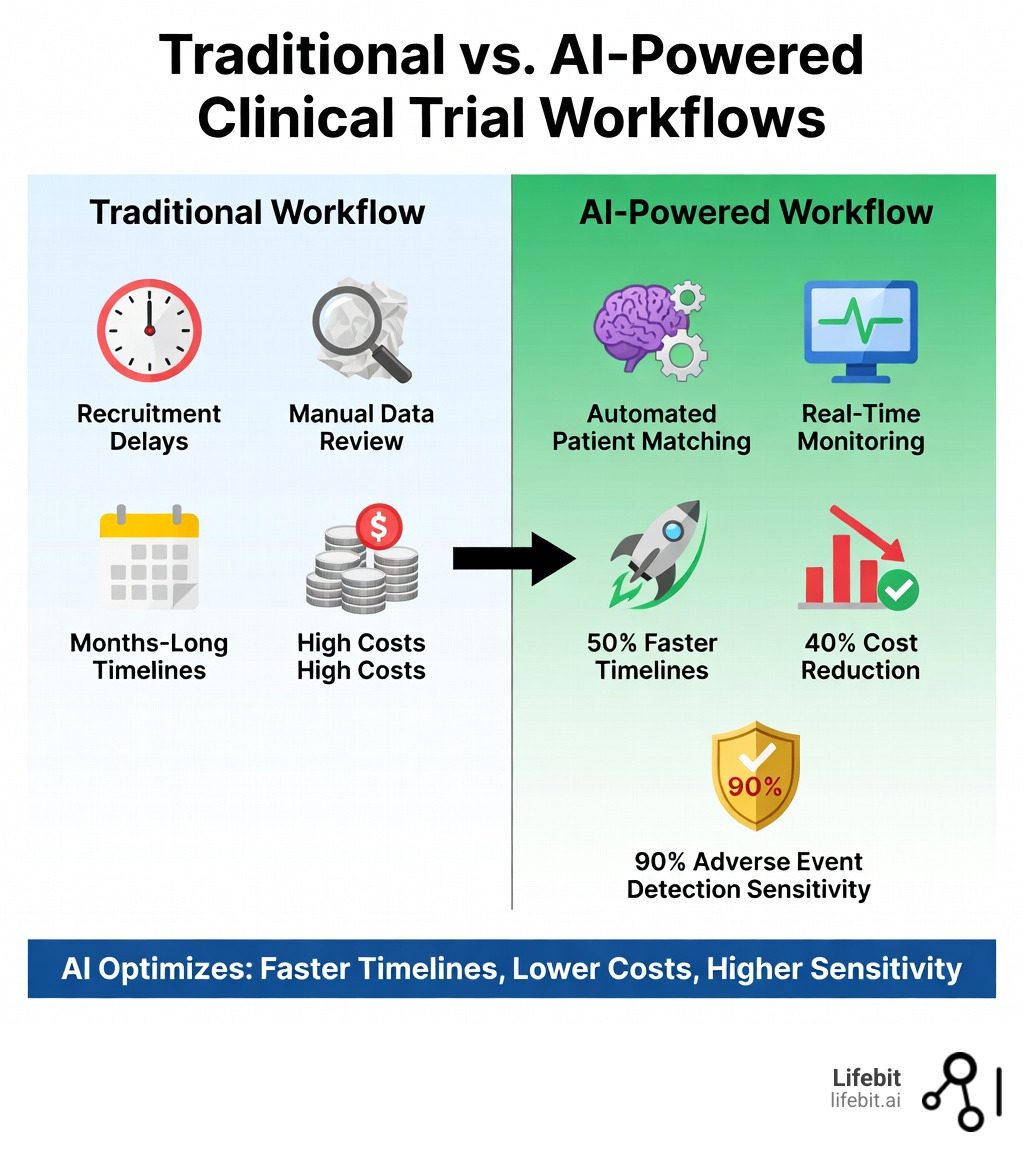
Clinical trials AI is fixing the biggest problems in modern drug development: 80% of trials face recruitment delays, costs exceed $200 billion annually, and success rates sit below 12%. AI-powered platforms are now cutting trial timelines by 30–50%, reducing costs by 40%, and improving patient enrollment rates by 65%.
How Clinical Trials AI Optimizes Recruitment and Design:
- Patient Matching: AI screens electronic health records to identify eligible participants with 85% accuracy, eliminating weeks of manual review
- Adaptive Design: Machine learning adjusts trial protocols in real-time based on emerging data patterns
- Digital Twins: Virtual patient populations reduce sample size needs and accelerate rare disease research
- Real-Time Monitoring: AI-powered digital biomarkers detect adverse events with 90% sensitivity
- Cost Reduction: Automated data management saves up to 90 minutes per query, cutting R&D spend by 40%
Clinical trials are failing at scale. Nearly a third of all phase III studies collapse because of enrollment issues, and 86% of all trials do not reach recruitment schedules. Data quality problems plague 50% of datasets, while medication non-adherence rates hit 50% despite optimal adherence being essential for meaningful results. These aren’t minor inefficiencies—they’re systemic breakdowns that waste years of research and billions of dollars.
AI is changing this reality by attacking recruitment bottlenecks, accelerating data analysis, and enabling precision trial design. From predictive analytics that forecast trial outcomes to digital twins that simulate patient responses, AI tools are making trials faster, cheaper, and more likely to succeed. Federated AI platforms now enable secure, real-time analysis across millions of patient records without moving sensitive data—opening new possibilities for global collaboration and pharmacovigilance.
I’m Maria Chatzou Dunford, CEO and Co-founder of Lifebit, where we’ve spent over 15 years building AI-powered platforms that transform how Clinical trials AI works in practice—from federated genomic analysis to secure multi-institutional research environments. Our work powers data-driven drug findy for pharmaceutical organizations and public health institutions worldwide, helping them turn siloed datasets into actionable insights at unprecedented speed.
Clinical trials AI vocab to learn:
Stop Losing $200B: How Clinical Trials AI Cuts R&D Costs by 40%
The pharmaceutical industry is currently facing a “productivity gap” that is quite literally costing hundreds of billions. Traditional clinical trials are protracted, labor-intensive, and—far too often—uninformative. Research shows that clinical trial success rates are below 12%, while the costs for R&D continue to escalate beyond $200 billion annually. This economic burden is driven by the “Eroom’s Law” phenomenon, where drug discovery becomes slower and more expensive over time despite technological advances.
At the heart of this waste is the recruitment bottleneck. Nearly 86% of all trials fail to reach their recruitment schedules on time. When a trial stalls, the “burn rate” of capital remains high while the patent clock keeps ticking. Clinical trials AI offers a direct solution to these systemic failures. By integrating AI, we can achieve up to a 40% reduction in total trial costs and accelerate timelines by 30-50%. These aren’t just marginal gains; they represent a fundamental shift in the economic viability of bringing new medicines to market.
Smarter Patient Matching with Clinical Trials AI
Finding the right patient for the right trial at the right time has historically been like looking for a needle in a haystack—if the haystack were spread across ten different countries and locked in incompatible filing cabinets.
Clinical trials AI transforms this through:
- Predictive Analytics: Models can now achieve 85% accuracy in predicting trial outcomes and identifying which patients are most likely to respond to a treatment. This involves analyzing multi-omic data—genomics, proteomics, and transcriptomics—to find specific biological signatures that correlate with drug efficacy.
- Automated Eligibility Screening: Instead of manual chart reviews, AI-powered emulations can run on real-world data (RWD) to optimize inclusion criteria. Natural Language Processing (NLP) algorithms can scan millions of unstructured clinician notes, pathology reports, and imaging metadata to find patients who meet complex criteria that traditional databases might miss. Research in Nature suggests that broadening eligibility criteria using AI can double the pool of available patients without compromising safety or treatment efficacy.
- Improved Retention: Machine learning can predict which participants are at high risk of dropping out based on behavioral patterns, travel distance to sites, or historical adherence data. This allows sponsors to intervene with patient support before the data is lost, potentially saving millions in re-recruitment costs.
- Diversity and Inclusion: By analyzing diverse datasets, AI helps identify underrepresented groups who have been historically excluded by rigid, non-data-driven inclusion rules. This is essential for making trials more representative, as highlighted by Kim et al. in J. Clin. Oncol.. AI can identify geographic “hotspots” of diverse patient populations, allowing sponsors to place trial sites in more accessible locations.
Cutting R&D Timelines with Automated Data Management
Data management is often the “silent killer” of trial timelines. Data quality issues affect 50% of clinical trial datasets, leading to endless cycles of queries and manual cleaning. In a traditional setup, a data manager might spend weeks reconciling discrepancies between a patient’s electronic health record and the trial’s Case Report Form (CRF).
We are seeing a revolution in how this data is handled. Modern AI technologies can save up to 90 minutes per query on identification and generation time. By automating the data integration process, we move from a reactive “clean-at-the-end” model to real-time monitoring. This allows for adaptive trial designs, where the trial can be adjusted as data comes in—such as dropping an ineffective dose arm or increasing the sample size for a promising subgroup—potentially stopping early for success or shifting resources away from failing arms. This agility is only possible when AI provides a live, high-fidelity view of the trial’s progress.
Cut Trial Timelines in Half with Digital Twins and Virtual Populations
One of the most exciting frontiers in Clinical trials AI is the use of digital twins—virtual representations of individual patients. By leveraging historical data from previous trials, electronic health records, and real-time health inputs, we can create a “prognostic covariate” that predicts how a patient would have fared in a control group. This is not just a statistical model; it is a high-dimensional simulation of human biology.
This technology allows for:
- Smaller Control Arms: If we can accurately predict a patient’s trajectory using a digital twin, we can reduce the number of real people who need to be assigned to a placebo. This makes trials more attractive to patients (who all want the active treatment) and significantly reduces the sample size required. In rare diseases, where the total patient population might only be a few hundred people globally, this is often the only way to achieve statistical significance.
- Precision Medicine: Digital twins enable us to simulate how a specific drug will interact with a specific patient’s biology. In oncology, for example, predictive digital twins are being used to optimize radiotherapy regimens for high-grade gliomas. By simulating different dosage schedules on a digital twin first, clinicians can select the one that maximizes tumor destruction while minimizing toxicity to healthy tissue.
- In Silico Trials: We are moving toward a future where “virtual patient populations” allow us to test drug efficacy in a computer before a single human is ever dosed. This is particularly powerful for single-gene mutation diseases where the biology is well-understood. In silico trials can identify potential safety signals years before a Phase I trial begins, preventing dangerous compounds from ever reaching human subjects.
Synthetic Data and In Silico Trials: Opening New Possibilities
For rare diseases, the “patient matching” problem is even more acute—there simply aren’t enough patients to fill traditional trial designs. Synthetic data generation provides a privacy-preserving way to augment these small datasets. By using Generative Adversarial Networks (GANs) to create “fake” patients that share the same statistical characteristics as real ones, we can perform robust analyses without compromising patient privacy. This synthetic data can be shared across borders more easily than real patient data, facilitating global collaboration.
Generative AI is also being used to optimize trial protocols. Large Language Models (LLMs) can scan thousands of previous protocols to suggest the most efficient primary and secondary endpoints, optimal dosage schedules, and even the best geographic locations for sites. This ensures that the trial is built for success from day one, avoiding the costly protocol amendments that plague nearly 60% of all Phase III studies. By analyzing the “failure modes” of past trials, AI can warn researchers if their proposed design is likely to lead to recruitment failure or uninterpretable results.
Slash Adverse Event Detection Time by 90% with Real-Time AI Monitoring
Adherence is the “elephant in the room” of clinical research. Up to 50% of prescriptions in the US are taken incorrectly. In a clinical trial, this can completely invalidate the results, leading to a “false negative” where a drug appears ineffective simply because it wasn’t taken.
| Feature | Traditional Monitoring | AI-Enabled Monitoring |
|---|---|---|
| Data Collection | Periodic site visits (every 4-8 weeks) | Continuous via wearables and IoT |
| Safety Detection | Reactive (after patient reports symptoms) | Proactive (90% sensitivity via biomarkers) |
| Patient Adherence | Self-reporting (often inaccurate diaries) | Real-time tracking (Smart pillboxes/Computer Vision) |
| Site Burden | High (manual data entry and verification) | Low (automated sync to cloud) |
| Patient Experience | Burdensome (frequent travel to clinics) | Convenient (at-home monitoring) |
Digital biomarkers—data collected from wearables like smartwatches, continuous glucose monitors, or strain sensors—allow for continuous surveillance. We can now detect atrial fibrillation, changes in gait that indicate neurological decline, or subtle changes in tumor volume in real-time. This not only improves safety but also enables decentralized clinical trials (DCTs), where patients can participate from the comfort of their own homes.
In a DCT environment, AI acts as the connective tissue. It can analyze video feeds of patients taking their medication to ensure adherence (using computer vision), monitor vital signs for early warnings of adverse events, and use chatbots to collect Patient-Reported Outcomes (PROs) in a more engaging, timely manner. This shift is essential for improving the patient experience and boosting enrollment across diverse geographies, particularly for patients with mobility issues or those living in rural areas far from major academic medical centers.
How to Steer FDA and EU AI Act Regulations Without Delays
As we push the boundaries of what Clinical trials AI can do, regulators are working hard to keep up. The regulatory landscape is shifting from a “wait and see” approach to providing active frameworks for AI integration. The FDA has issued guidance on adjusting for covariates in randomized trials, and the EU AI Act is setting the global standard for high-risk AI applications in healthcare.
To ensure responsible adoption and avoid regulatory “refusal to file” letters, we must focus on:
- Explainability (XAI): Clinicians and regulators need to understand why an AI made a certain prediction. If an AI identifies a patient as a high-risk for a cardiovascular event, it must be able to point to the specific features (e.g., specific genomic markers combined with heart rate variability) that led to that conclusion. “Black box” models are no longer acceptable in a clinical context where lives are at stake.
- Reporting Standards: Guidelines like CONSORT-AI and DECIDE-AI provide the framework for how AI interventions should be reported in clinical literature. These standards ensure that AI trials are transparent, reproducible, and subject to the same rigorous peer review as traditional trials.
- Data Privacy and Sovereignty: This is perhaps the biggest hurdle. Federated learning and swarm learning are critical. These technologies allow AI models to be trained on data located at different institutions (e.g., a hospital in London and a clinic in New York) without the raw data ever leaving its home. Only the model weights are shared, satisfying both privacy laws (like GDPR and HIPAA) and the competitive needs of research institutions to protect their intellectual property.
- Validation of Digital Biomarkers: Regulators require proof that a digital biomarker (like a step count from a phone) is a valid proxy for a clinical outcome (like physical function). AI is being used to bridge this gap by correlating high-frequency wearable data with gold-standard clinical assessments, creating a robust evidence base for new types of trial endpoints.
Frequently Asked Questions about Clinical Trials AI
How does AI cut clinical trial costs?
AI reduces costs by automating the most expensive and time-consuming parts of a trial: patient recruitment and data management. By matching patients 65% faster and reducing manual data queries by up to 90 minutes each, AI can cut overall R&D spend by 40%. Additionally, digital twins can reduce the required sample size, meaning fewer patients need to be recruited, insured, and monitored, which significantly lowers the per-patient cost of the study.
Can AI boost patient diversity in trials?
Yes. Traditional inclusion criteria are often unnecessarily rigid and based on historical biases or “convenience sampling.” Clinical trials AI can analyze real-world data to show that relaxing certain criteria (like minor lab value variations or specific age cut-offs) can double the eligible patient pool—often including more diverse populations—without affecting the trial’s safety or outcome. AI also helps identify trial sites in diverse neighborhoods that were previously overlooked.
What are the main risks of using AI in research?
The primary risks include algorithmic bias (if the training data isn’t diverse, the AI’s predictions won’t be accurate for all populations), “hallucinations” in generative models where the AI creates plausible but false data, and data privacy concerns. This is why we advocate for a “human-in-the-loop” approach, where AI assists experts rather than replacing them, and the use of Trusted Research Environments (TREs) to keep patient data secure and audited.
Is the FDA supportive of AI in clinical trials?
Yes, the FDA is actively encouraging the use of AI and machine learning. They have released several discussion papers and guidance documents focusing on the use of AI for drug development and the use of Real-World Evidence (RWE) to support regulatory decision-making. The key for the FDA is “fit-for-purpose” validation—proving that the AI tool is appropriate for the specific task it is performing.
How does Federated Learning work in this context?
Federated learning allows multiple organizations to collaborate on an AI model without sharing their underlying patient data. For example, three different hospitals can train a model to detect early signs of Alzheimer’s. Each hospital trains the model on its own data locally, and then only the “learnings” (mathematical weights) are sent to a central server to be combined. This protects patient privacy while creating a much more powerful and generalizable model than any single hospital could build alone.
The Future of Research: Secure, Federated Clinical Trials AI
The “old way” of running clinical trials—siloed, manual, and prohibitively expensive—is no longer sustainable in an era of precision medicine and global health challenges. Clinical trials AI is not just a tool; it is the new MVP that makes modern medicine possible by turning the “data graveyard” of past research into a launchpad for future discoveries.
At Lifebit, we believe the future of research is federated. Our platform provides the secure infrastructure needed to connect global biomedical and multi-omic data in real-time, overcoming the traditional barriers of data silos and strict privacy regulations. By bringing the analysis to the data, rather than the data to the analysis, we enable biopharma companies, academic researchers, and public health agencies to collaborate at scale while maintaining the highest standards of governance and privacy.
This federated approach is particularly vital for the next generation of trials, which will increasingly rely on “Real-World Evidence” to supplement traditional clinical data. By connecting trial data with long-term health records, we can understand how drugs perform in the real world, over years rather than months.
From AI-powered recruitment to real-time safety surveillance and the creation of virtual patient populations, the change is already happening. It’s time to stop losing billions to inefficiency and start delivering life-changing medicines to patients faster. The technology is here; the data is available; the only thing left is the widespread adoption of these AI-driven workflows to transform the landscape of human health.