

Collaborate Globally, Innovate Locally: A Guide to Research Partnerships

Why Global Research Collaboration Matters More Than Ever
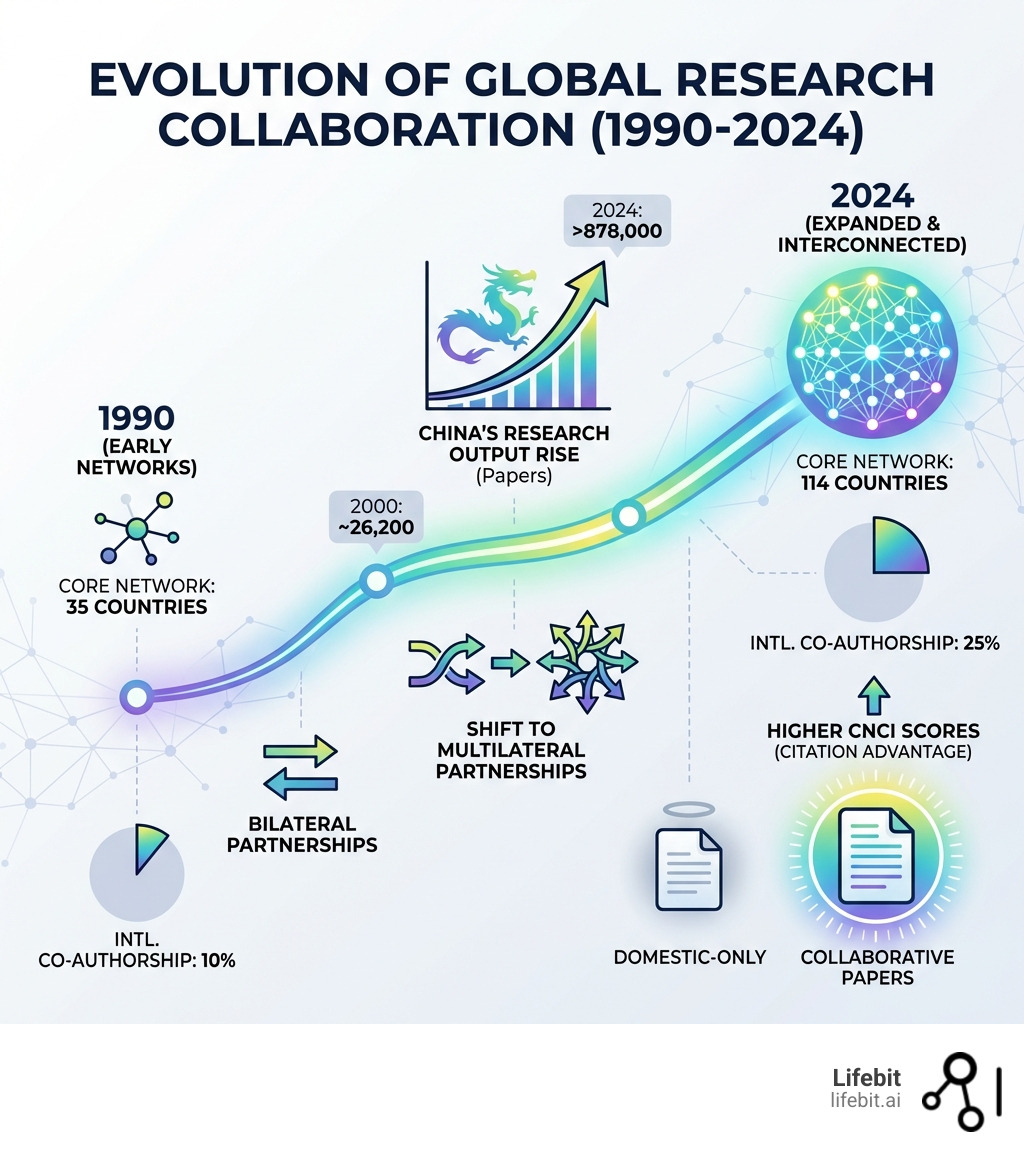
Global research collaboration has transformed how science advances—and the numbers prove it. Here’s what you need to know:
- International papers have more than doubled in 20 years, now representing 25% of all scientific publications
- Collaborative research gets cited more than domestic-only work, with higher impact scores across all major economies
- China has become the world’s most prolific publisher, growing from 26,200 papers in 2000 to over 878,000 in 2024
- The US faces a crossroads, with declining collaboration shares and policy restrictions threatening its research leadership
- Multilateral partnerships are rising while bilateral collaborations decline, especially in Europe
- Emerging economies are growing fast, with Middle East-China collaborations growing 2.76x faster than regional averages
The landscape is shifting. Geopolitical tensions, pandemic disruptions, and national security concerns are reshaping who works with whom. Meanwhile, the data is clear: international partnerships drive better science. Papers with authors from multiple countries consistently outperform domestic-only publications in citation impact. The global research network has expanded from 35 countries in 1990 to 114 in 2011, becoming denser and more interconnected.
But opportunity comes with complexity. Researchers face visa delays, funding gaps, data sharing restrictions, and trust deficits. Success requires navigating legal frameworks, ethical standards, and technical infrastructure across borders. The stakes are high—from mRNA vaccine development to climate solutions, the world’s biggest challenges demand coordinated global effort.
I’m Maria Chatzou Dunford, CEO and Co-founder of Lifebit, where I’ve spent over 15 years building platforms that enable secure global research collaboration across federated data networks. Through my work with public institutions and pharmaceutical organizations worldwide, I’ve seen how the right infrastructure can break down barriers and accelerate findy.
Global research collaboration helpful reading:
The Shifting Landscape of global research collaboration
The way we conduct research has undergone a seismic shift. Gone are the days when a single lab in a single city could solve a global crisis. Today, global research collaboration is the engine of innovation. According to Global research collaboration is changing: Key insights from our latest ISI report, the landscape is no longer dominated by a few Western powers. Instead, we are seeing a “de-centering” of science, where the traditional hierarchies of knowledge production are being replaced by a more distributed, globalized network.
In the early 1990s, the global scientific network was a relatively exclusive club of 35 nations. By 2011, that core had expanded to 114 nations. This isn’t just about more people writing papers; it’s about a fundamental change in how knowledge flows. We’ve moved from a world where researchers primarily collaborated within their own borders to one where nearly a quarter of all scientific papers are internationally co-authored. This expansion has been fueled by the rise of the “Global South,” with countries like Brazil, India, and South Africa significantly increasing their R&D investments and becoming essential nodes in the global network. The democratization of access to digital communication tools and the standardization of scientific protocols have further lowered the barriers to entry for researchers in developing economies.
The Rise of Multilateralism in global research collaboration
One of the most fascinating trends we’ve observed is the shift from bilateralism to multilateralism. In the past, a partnership usually meant two countries—say, the US and the UK—working together. Today, that is changing. In countries like the UK and Germany, bilateral co-authorship now accounts for less than 50% of their international output. This trend is particularly evident in the European Research Area (ERA), where the European Union’s Framework Programmes (like Horizon Europe) have incentivized large-scale, multi-country projects that require a minimum of three partners from different member states.
Instead, researchers are joining large, multi-country consortia. Why? Because the challenges we face, like climate change or pandemic preparedness, are too big for any two nations to tackle alone. Networks like the Worldwide Universities Network (WUN) are leading this charge. WUN brings together 23 member universities across six continents to focus on urgent global challenges, such as:
- Sustainable Development: Addressing social justice, ethical computing, and the circular economy.
- Health Humanities: Developing patient-centered education and exploring the cultural determinants of health.
- Climate Change: Mapping evidence for reproductive and maternal health in the face of environmental degradation.
- Global Higher Education: Analyzing the impact of digital transformation on university accessibility and equity.
These strategic networks allow institutions to pool resources, share risks, and access a much broader range of expertise than a simple one-to-one partnership would allow. They also provide a platform for “Science Diplomacy,” where research collaboration serves as a bridge between nations even when political relations are strained.
China vs. US: Navigating the New Power Dynamics
We cannot talk about global research collaboration without addressing the elephant in the room: the changing relationship between the US and China. The data is staggering. China’s research output has exploded from 26,200 papers in 2000 to over 878,000 in 2024. More importantly, their international co-authorship has grown from 6,000 to more than 163,000 papers in that same period. This growth is not just quantitative; it is qualitative. Chinese researchers are increasingly leading high-impact studies in fields like nanotechnology, telecommunications, and renewable energy materials.
In many metrics, China is no longer just “catching up”—it is leading. For instance, the Category Normalized Citation Impact (CNCI) of China–EU27 papers now exceeds that of U.S.–EU27 collaborations. This suggests that the highest-quality, most impactful research in certain fields is increasingly happening in partnerships that involve Chinese institutions. This shift has led to a “re-balancing” of global science, where the US is no longer the undisputed center of the scientific universe.
However, the US is at a crossroads. While the US still contributes to 32% of all internationally co-authored articles, it faces growing pressure. Policy restrictions, such as the CHIPS and Science Act and various national security concerns, are creating a risk of “research isolation.” If US researchers are restricted from collaborating with their most prolific counterparts, the overall impact of US science could suffer. At Lifebit, we believe the solution isn’t isolation, but rather building Trusted Research Environments that allow for secure, compliant collaboration even in sensitive geopolitical climates. These environments provide the necessary guardrails to protect intellectual property and national security while still allowing for the free exchange of scientific ideas.
Why International Partnerships Outperform Domestic Research
If you want your research to be noticed, go global. The statistics are undeniable: internationally co-authored papers are more highly cited than single-nation papers. This isn’t just a minor bump; it’s a significant “citation advantage.” Studies have shown that papers with international co-authors receive up to 50% more citations than those with only domestic authors. This phenomenon, often referred to as the “Diversity Dividend,” suggests that the combination of different cultural perspectives, institutional backgrounds, and methodological approaches leads to more robust and innovative scientific findings.
| Metric | Domestic-Only Papers | International Collaborative Papers |
|---|---|---|
| Average Authors per Paper | ~2.5 | 4.3+ |
| Citation Impact (CNCI) | Baseline | Consistently Higher (1.2x to 1.5x) |
| Global Reach | Limited to National Journals | High Visibility in International Journals |
| Resource Access | Local Facilities | Shared High-Cost Equipment (Synchrotrons, etc.) |
| Funding Success Rate | Standard | Higher for Multi-National Grants |
According to the International Collaboration and Citations report, this impact is seen across all disciplines, from the humanities to high-energy physics. When you collaborate internationally, you aren’t just adding a name to a paper; you are integrating different pools of talent. You are also gaining access to specialized equipment—like the telescopes in Chile, the particle accelerators at CERN in Switzerland, or the deep-sea research vessels of the Schmidt Ocean Institute—that no single country could afford to maintain alone. This “Big Science” model is essential for tackling questions that require massive data sets or extreme physical conditions.
Leveraging Bibliometric Data for Strategic global research collaboration
How do you find the right partner? You don’t have to guess. Bibliometric data and network analysis have become essential tools for universities and funding agencies. By analyzing co-authorship metrics, institutions can identify “strategic gaps” in their research portfolio. For example, a university might discover that while it has a strong output in oncology, it lacks connections to the emerging biotech hubs in Singapore or South Korea.
As discussed in the webinar Building Research Collaboration in Global Environments, tools like the Nature Index and SciVal allow us to track:
- Authorship Trends: Seeing who is collaborating with whom in real-time and identifying emerging clusters of excellence.
- Hyperauthorship: The rise of papers with more than 50 authors, which has surged in health sciences post-COVID. These papers often represent massive clinical trials or genomic studies that require global coordination.
- Partner Identification: Using data to spot rising stars in emerging economies before they become household names, allowing for “early-mover” advantages in strategic partnerships.
- Impact Mapping: Visualizing how research from a specific institution travels across the globe and which regions are most receptive to its findings.
This data-driven approach helps institutions move away from “accidental” collaborations toward strategic partnerships that maximize impact and funding potential. It allows for a more surgical approach to internationalization, focusing resources on the partnerships that yield the highest scientific and social returns.
The Role of Emerging Economies in Future Science
The future of global research collaboration isn’t just about the US, Europe, and China. Emerging economies are playing an increasingly vital role. We are seeing rapid growth in R&D investment across the Middle East, Southeast Asia, and Latin America. These regions are no longer just providing data or field sites for Western scientists; they are leading the research agenda.
For example, the Middle East’s co-authored output with China grew by a factor of 2.76 between 2015 and 2024. These aren’t just “junior partner” roles; emerging nations are building their own capacity and leading projects on issues that affect their regions specifically, such as water scarcity, tropical diseases, and sustainable urban development. The African Child and Youth Wellbeing in the Context of Migration and Displacement project is a perfect example of how inclusive models can tackle complex socio-economic issues by combining local knowledge with global research standards. This project involves researchers from across Africa, Europe, and North America, ensuring that the solutions developed are both scientifically rigorous and culturally appropriate.
Overcoming Barriers to Effective International Partnerships
If international collaboration is so great, why isn’t everyone doing it even more? Because it’s hard. Really hard. The barriers are numerous and often systemic, requiring more than just individual effort to overcome:
- Visa Delays and Mobility Restrictions: Moving researchers across borders is becoming more difficult and time-consuming. Political shifts have led to stricter visa requirements for scientists from certain countries, disrupting the flow of talent and slowing down project timelines.
- Funding Shortages and Misalignment: Coordinating grants across different national agencies is a bureaucratic nightmare. Often, a project is approved in one country but rejected in another, leaving the collaboration in limbo. There is a desperate need for more “joint calls” for proposals where multiple national funders agree on a single evaluation process.
- Data Silos and Sovereignty: Many countries have strict laws (like GDPR in Europe, HIPAA in the US, or the Data Security Law in China) that prevent sensitive data from leaving their borders. This creates a “sovereignty-collaboration paradox” where the data needed for global breakthroughs is locked behind national walls.
At Lifebit, we focus on that last point. We know that data is the lifeblood of modern research, but you can’t always move it. That’s why we advocate for Federated Data Sharing. Instead of moving the data to the researcher, we move the analysis to the data. This allows for global collaboration while respecting national sovereignty and data privacy laws. By using federated learning and secure computation, researchers can gain insights from diverse datasets across multiple countries without the raw data ever being transferred or exposed.
Solving the Data Sharing and Trust Dilemma
Trust is the foundation of any partnership. In science, this means Data Sharing in Scientific Research must be transparent, ethical, and mutually beneficial. Many researchers, particularly those in the Global South, fear that their data will be “scooped” or used without proper credit, a practice sometimes called “helicopter research.”
To combat this, the scientific community is moving toward standardized frameworks like The TRUST code. This code ensures that research in lower-income countries is conducted equitably, preventing exploitation and ensuring that local communities benefit from the findings. Furthermore, Inclusion and Ethics in Global Research policies are now being built into the world’s top journals, requiring authors to disclose how they ensured their partnership was fair and inclusive. This includes ensuring that local researchers are given appropriate authorship credit and that the research addresses local priorities.
Supporting Researchers in Complex Legal Frameworks
For an individual researcher, navigating the legal requirements of an international project can be overwhelming. You need to be a scientist, a lawyer, and a diplomat all at once. You have to understand Material Transfer Agreements (MTAs), Data Use Agreements (DUAs), and Intellectual Property (IP) rights across multiple jurisdictions. Institutions must step up to provide better support through dedicated international research offices.
This is where a Lifebit Trusted Research Environment comes in. By providing a secure, pre-configured workspace that meets international compliance standards (such as ISO 27001 and SOC2), we take the legal and technical burden off the researcher. Our platform implements the “Five Safes” framework: Safe People, Safe Projects, Safe Settings, Safe Data, and Safe Outputs. Additionally, resources like Nature Masterclasses can help scientists develop the “soft skills” needed for collaboration, such as project management, cross-cultural negotiation, and conflict resolution in diverse teams.
Institutional Strategies for Future-Proofing Research
To thrive in this new era, universities and funding agencies need a “global first” strategy. It is no longer enough to have a few isolated international projects; collaboration must be embedded into the institutional DNA. We can look to successful models like the University of Alberta for inspiration. They don’t just wait for collaborations to happen; they build them through a multi-layered approach:
- Strategic Hubs and Long-term Partnerships: The Helmholtz-Alberta Initiative (HAI) has fostered energy and environment research for over a decade. By committing to long-term funding and shared goals, they have moved beyond transactional projects to deep, transformative research.
- Mobility Programs and Talent Exchange: Using Fulbright Canada and other exchange programs to move the best and brightest minds between Canada and the US. These programs create “human bridges” that sustain collaborations long after the initial project ends.
- Joint Doctoral Programs and Dual Degrees: Partnering with institutions like the Fraunhofer Institute in Germany to create joint development programs. This ensures that the next generation of researchers is trained in a global environment from day one.
- International Branch Campuses (IBCs): Many universities, such as NYU and Monash, have established physical campuses in other countries. These IBCs act as permanent gateways for research collaboration, allowing for deep integration into local innovation ecosystems.
Another powerful model is the Horizon Europe framework, which provides a blueprint for how regional blocks can incentivize cross-border work. By requiring diversity in consortia, it forces researchers to look beyond their usual networks and find partners with complementary skills. This has led to the creation of “innovation clusters” that combine academic excellence with industrial application.
By embedding collaboration into the very fabric of the institution—through joint doctoral programs, shared funding pots, and dedicated administrative support—universities can ensure they remain at the center of the global network. This “global-first” mindset is not just about prestige; it is about survival in an increasingly competitive and interconnected scientific landscape. Institutions that fail to adapt will find themselves unable to attract top talent or secure the large-scale funding required for modern breakthroughs.
Frequently Asked Questions about Global Research
How does international collaboration affect citation rates?
It boosts them significantly. Papers with international co-authors typically receive more citations and have a higher CNCI (Category Normalized Citation Impact) than those with authors from only one country. This is due to wider visibility, diverse expertise, and combined promotional efforts.
What are the main barriers to global research?
The top barriers include geopolitical tensions, restrictive data privacy laws, visa and travel delays, and the “trust gap” between different national systems. Technical challenges like data interoperability also play a major role.
How is China’s role in research changing?
China has moved from a peripheral player to the world’s most prolific publisher. Its collaborations are no longer just about gaining Western expertise; in many fields like engineering and materials science, China is now the senior partner providing the primary innovation and funding.
Conclusion
The era of the “lone genius” is over. We are living in the era of the global network. The strategic implications are clear: institutions that fail to accept global research collaboration will find themselves isolated and irrelevant. To stay competitive, we must move toward more inclusive, multilateral, and data-driven models of partnership.
At Lifebit, we are committed to making this transition easier. Our Lifebit Federated Trusted Research Environment is designed to bridge the gap between global data and local innovation. By providing a secure, compliant, and powerful platform for findy, we help researchers collaborate across five continents without ever compromising on data security.
Ready to take your research global? More info about Lifebit services can help you build the partnerships of tomorrow, today. Let’s innovate together, no matter where the data lives.