

Data Harmonization Services: Bridging the Gap Between Disparate Datasets

Why Your Business Is Drowning in Data But Starving for Insight
Data harmonization services transform fragmented, incompatible data from multiple sources into unified, analysis-ready datasets that drive accurate insights and faster decision-making.
What You Need to Know:
- What it solves: Eliminates inconsistent formats, measurement units, and terminology across disparate data sources
- Key benefit: Creates a single source of truth for reliable analytics and AI/ML model training
- Primary use cases: Healthcare research, financial reporting, regulatory compliance, and cross-organizational collaboration
- Critical stat: 80% of data scientists’ time is wasted cleaning and organizing data instead of generating insights
Your organization is likely sitting on mountains of data—EHRs, claims databases, genomics files, lab results, imaging studies. But here’s the brutal reality: 97% of all hospital data goes untouched because it’s trapped in incompatible formats, scattered across silos, and too messy to analyze. Different departments use different coding systems. Multiple vendors store data differently. Legacy systems can’t talk to modern platforms.
This isn’t just an IT headache. It’s a strategic crisis. When your data can’t be compared or combined, your analytics are unreliable, your AI models fail, and your competitors who’ve solved this problem are already three steps ahead. Every day without harmonized data means missed research breakthroughs, regulatory delays, and millions in wasted resources.
The gap between having data and using data has never been wider—or more expensive. Organizations need data harmonization services to bridge this divide, changing chaos into clarity and raw information into competitive advantage.
I’m Maria Chatzou Dunford, CEO and Co-founder of Lifebit, where we’ve spent over 15 years pioneering federated data harmonization platforms that enable secure, compliant analysis of biomedical data across global institutions. Through our work powering precision medicine initiatives and pharmaceutical research, we’ve seen how effective data harmonization services open up the true value hidden in disparate datasets.
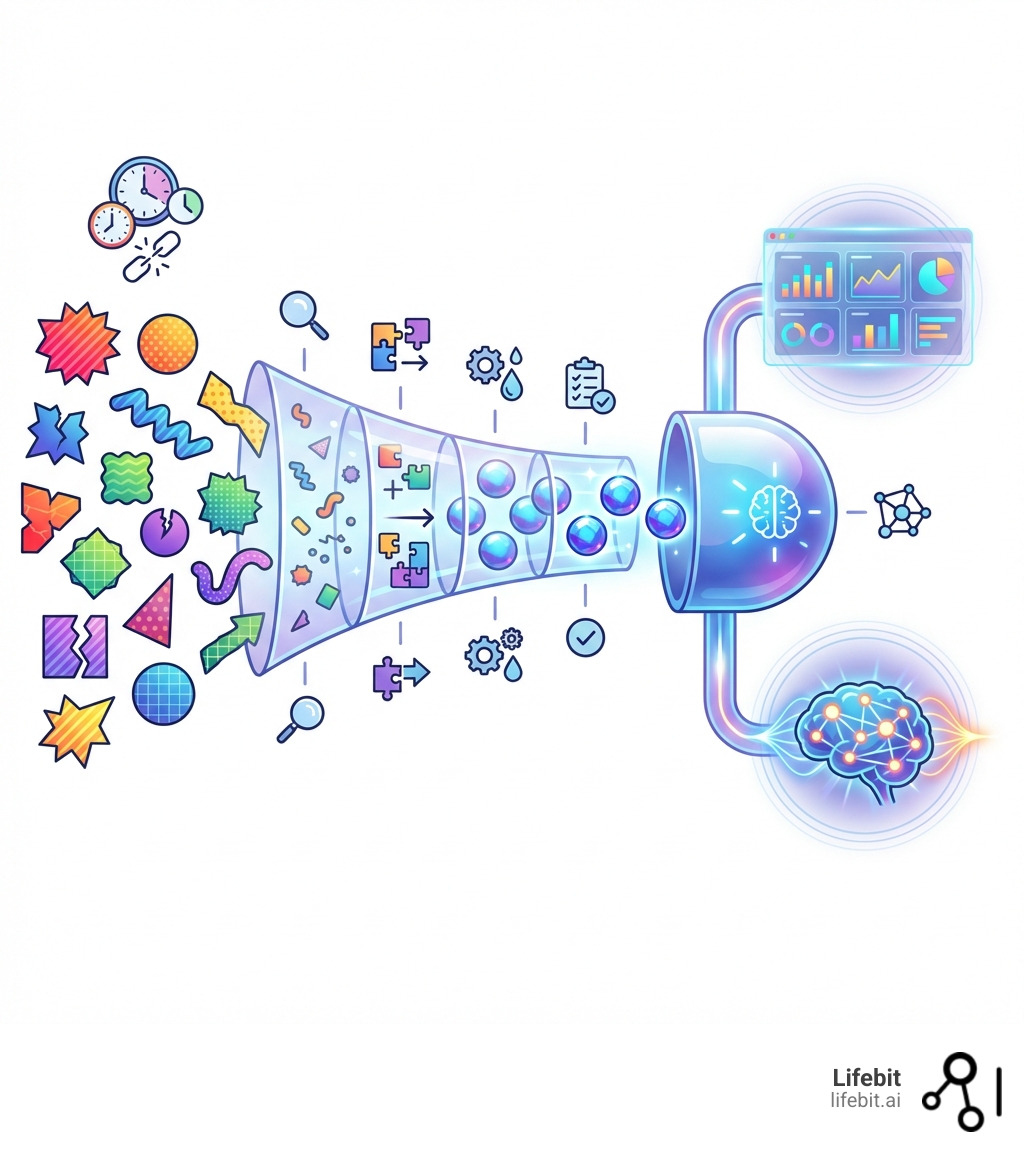
Data harmonization services definitions:
What is Data Harmonization and Why Is It Critical?
At its core, data harmonization is the process of ensuring that data from various, often massive, datasets is consistent, compatible, and comparable. Imagine trying to conduct a global study on patient outcomes if one hospital records patient weight in pounds, another in kilograms, and a third uses stone. Or, if “young adults” is defined as 18-22 in one dataset and 18-30 in another. Without harmonizing these different formats, units, and definitions, any attempt at analysis would be a mess.
Data harmonization services aim to merge distinct levels, genres, and sources of data to create a unified, analysis-ready dataset. This means organizing and aligning data to a common format or standard, effectively creating a common language for all your information. The goal isn’t just to collect data, but to make it usable for meaningful insights and sound decision-making.
Why is this so critical for businesses and researchers today? The sheer volume and diversity of data we generate mean that inconsistencies are inevitable. Without effective data harmonization services, we risk missing critical findings that could drive new findies and improve patient outcomes, or making flawed business decisions. It’s about changing raw, disparate data into a coherent narrative that tells a complete and accurate story. For a deeper dive into the foundational concepts, you can refer to A General Primer for Data Harmonization and explore More info about Data Harmonization Meaning.
Harmonization vs. Standardization: A Key Distinction
While often used interchangeably, data harmonization and standardization are distinct but complementary processes. Standardization enforces format consistency (e.g., all dates are YYYY-MM-DD), while harmonization ensures semantic compatibility, making data from different sources comparable in meaning. Harmonization allows us to bridge conceptual gaps—like comparing “anxiety” measured by two different questionnaires—to make diverse datasets truly useful together.
| Feature | Data Harmonization | Data Standardization |
|---|---|---|
| Primary Goal | Make disparate data comparable | Make data consistent in format |
| Focus | Semantic compatibility, meaning, context | Format conformity, syntax, structure |
| Approach | Aligns data despite inherent differences | Enforces uniformity to a predefined format/standard |
| Flexibility | Allows for differences, then maps them | Requires strict adherence to rules |
| Example | Converting miles to kilometers for comparison | Ensuring all dates are in YYYY-MM-DD format |
| Outcome | Data can be analyzed together meaningfully | Data is uniformly structured and formatted |
The High Cost of Inaction: Risks of Ignoring Data Harmonization
Ignoring data harmonization creates an unstable foundation for analytics, leading to severe consequences:
- Inaccurate Reporting: Conflicting data sources generate confusing reports and erode trust in data-driven insights.
- Flawed AI/ML Models: Unharmonized data trains biased or inaccurate models, producing unreliable predictions.
- Wasted Resources: A staggering 80% of data scientists’ time is spent cleaning and organizing data, wasting talent and budget that could otherwise drive innovation.
- Poor Business Decisions: Fragmented data leads to uninformed decisions, missed market opportunities, and significant financial losses.
- Compliance Risks: Inconsistent data in regulated industries like healthcare and finance can lead to non-compliance, hefty fines, and reputational damage.
- Competitive Disadvantage: Competitors who harmonize their data can react faster and innovate with greater agility, leaving others behind.
The fact that 97% of all hospital data is going untouched due to these challenges is a stark reminder of the immense value locked away in unharmonized data. This isn’t just about efficiency; it’s about open uping potential breakthroughs and improving lives.
Creating a ‘Single Source of Truth’ for Unbeatable Insights
One of the most profound benefits of effective data harmonization services is the creation of a “single source of truth.” This isn’t just a catchy phrase; it’s a fundamental shift in how an organization perceives and uses its data.
A single source of truth means that all critical data elements—whether it’s customer information, product specifications, financial transactions, or patient records—are consistent, accurate, and accessible from a unified, authoritative repository. It eliminates data silos, those isolated pockets of information that often lead to conflicting reports and fragmented understanding.
With harmonized data, every department, every analyst, and every AI model operates from the same, reliable foundation. This fosters consistent metrics across the organization, ensuring that everyone is speaking the same data language. The result is trustworthy data that fuels truly actionable analytics and robust business intelligence. We can explore how to build this foundation with More info about Data Intelligence Platforms.
The Core Process of Data Harmonization Services
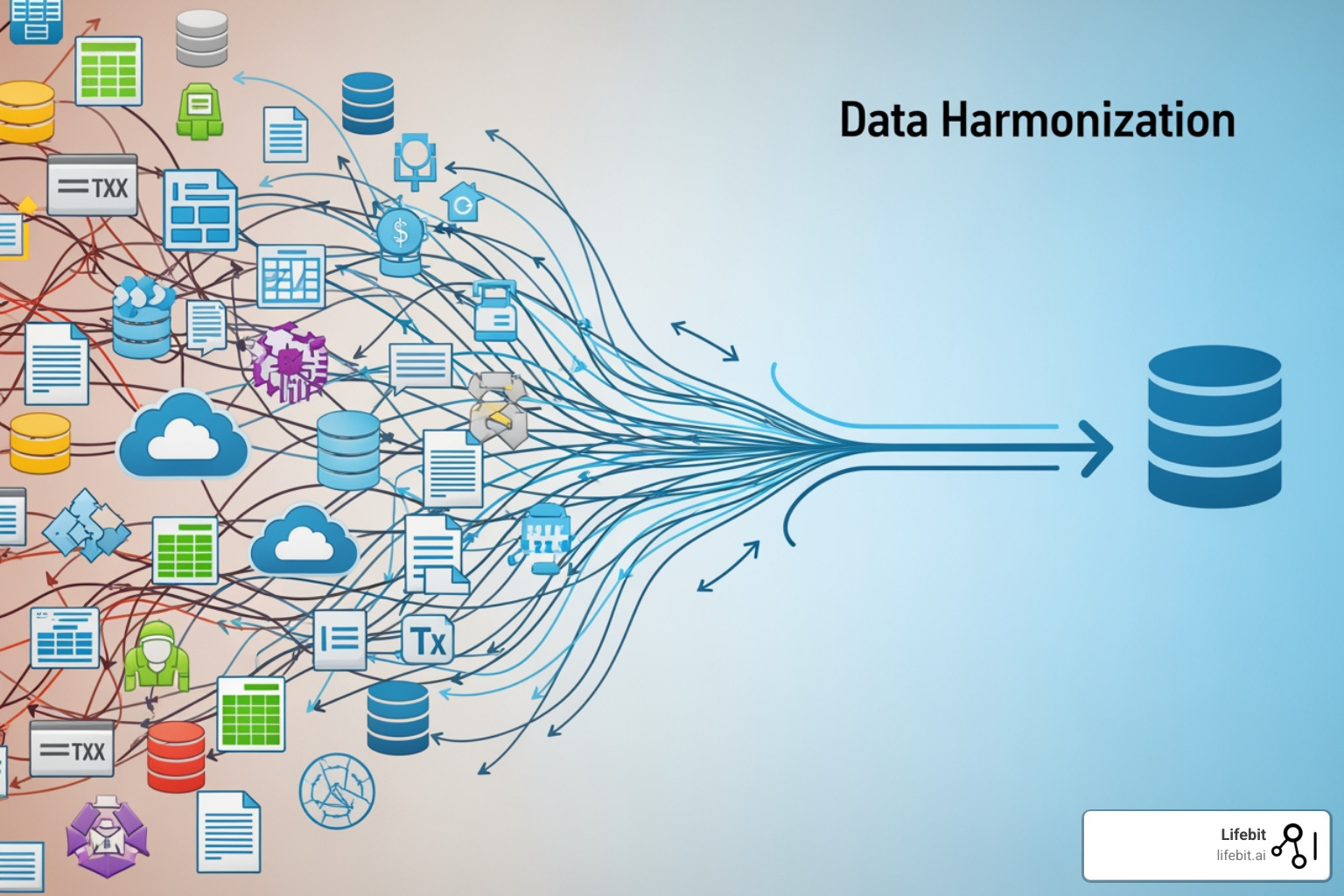
Data harmonization services are not a one-time fix but a structured, ongoing process. It requires careful planning, execution, and continuous monitoring to ensure that data remains clean, consistent, and valuable over time.
Navigating Common Harmonization Challenges
The path to harmonized data has several common challenges, especially with large-scale, multi-modal datasets:
- Data Heterogeneity: Data comes in countless formats, structures, and types, making unification a complex task.
- Semantic Differences: Different datasets may use the same term for different concepts (or vice versa), requiring deep domain expertise to reconcile meanings.
- Varying Data Quality: Source data is often riddled with errors, missing values, or outdated information that must be identified and managed.
- Scalability Issues: Manual harmonization doesn’t scale with exponential data growth, necessitating automated solutions.
- Data Governance: A lack of clear data governance—including policies, roles, and ownership—can undermine harmonization efforts.
- Lack of Expertise: Research shows that 64% of health data users don’t have the expertise to easily standardize data, a talent gap that hinders harmonization.
These challenges highlight why specialized data harmonization services are often essential. For a deeper dive into overcoming these problems, you can read More info about Overcoming Data Harmonization Challenges.
A Step-by-Step Guide to the Harmonization Process
While every project is unique, a typical data harmonization process follows a clear set of steps:
- Data Findy and Profiling: We begin by thoroughly cataloging all relevant data sources, understanding their formats, structures, and content. Data profiling helps us assess the quality, identify inconsistencies, and understand the characteristics of the raw data.
- Defining a Target Schema: This involves designing the “harmonized” structure. We define common formats, units of measure, and categorization schemes that all incoming data will conform to. This is where we establish the common language for our data.
- Data Mapping and Change: In this crucial step, we establish clear rules for how data from each source will be converted and mapped to the target schema. This can involve simple conversions (e.g., Celsius to Fahrenheit) or complex logical changes.
- Data Cleansing and Validation: Before integration, data must be clean. We identify and correct errors, handle missing values, remove duplicates, and ensure the data adheres to the defined quality standards of the target schema. Validation checks confirm accuracy and completeness.
- Loading and Integration: Finally, the cleansed and transformed data is loaded into the unified, harmonized dataset. This step often involves continuous integration, where new data is periodically refreshed, monitored, and maintained to ensure ongoing consistency and quality.
For a comprehensive guide on these steps and associated best practices, refer to Data Harmonisation: Steps, Techniques, and Best Practices.
Key Techniques Used in Data Harmonization Services
To execute the steps above, a variety of techniques are employed by data harmonization services:
- Schema Mapping: This involves aligning the structural elements (fields, tables, attributes) of different datasets to a unified target schema. It’s like creating a translation dictionary for database structures.
- Semantic Mapping: Moving beyond structure, this technique focuses on aligning the meaning of data elements. For instance, ensuring that “patient ID” means the same thing across all clinical systems, even if different systems use different labels.
- Data Change Rules: These are the specific instructions that dictate how data values are converted, aggregated, or restructured during the harmonization process. This could be converting text fields to standardized codes, or combining multiple fields into one.
- Entity Resolution (or Record Linkage): This powerful technique identifies and merges duplicate records referring to the same real-world entity (e.g., the same patient or customer) across different datasets. It’s crucial for creating a truly unified view.
- Probabilistic Matching: A sophisticated form of entity resolution, it uses statistical algorithms to calculate the likelihood that two records refer to the same entity, especially when exact matches are not available.
- Using Common Data Models (CDMs): CDMs are standardized, domain-specific data structures that act as a common language or blueprint for data. They are designed to facilitate interoperability and dramatically simplify harmonization. Instead of creating a custom target schema for every project, organizations can map their disparate data sources to a widely accepted, pre-defined model. A prime example in healthcare is the OMOP (Observational Medical Outcomes Partnership) CDM, which provides a common structure for observational health data from sources like EHRs and claims databases. By mapping data to OMOP, research institutions can run the same analysis code across different datasets with minimal changes, enabling large-scale, reproducible studies. Other notable CDMs include the PCORnet CDM for patient-centered outcomes research and the FHIR (Fast Healthcare Interoperability Resources) standard, which, while more of an exchange standard, defines resources that act as a model for health data interoperability. Adopting a CDM accelerates harmonization, promotes data reuse, and fosters collaboration across organizations.
For more detailed technical insights, explore More info about Data Harmonization Techniques and understand the importance of models like More info about OMOP.
Data Harmonization in Action: Changing Industries
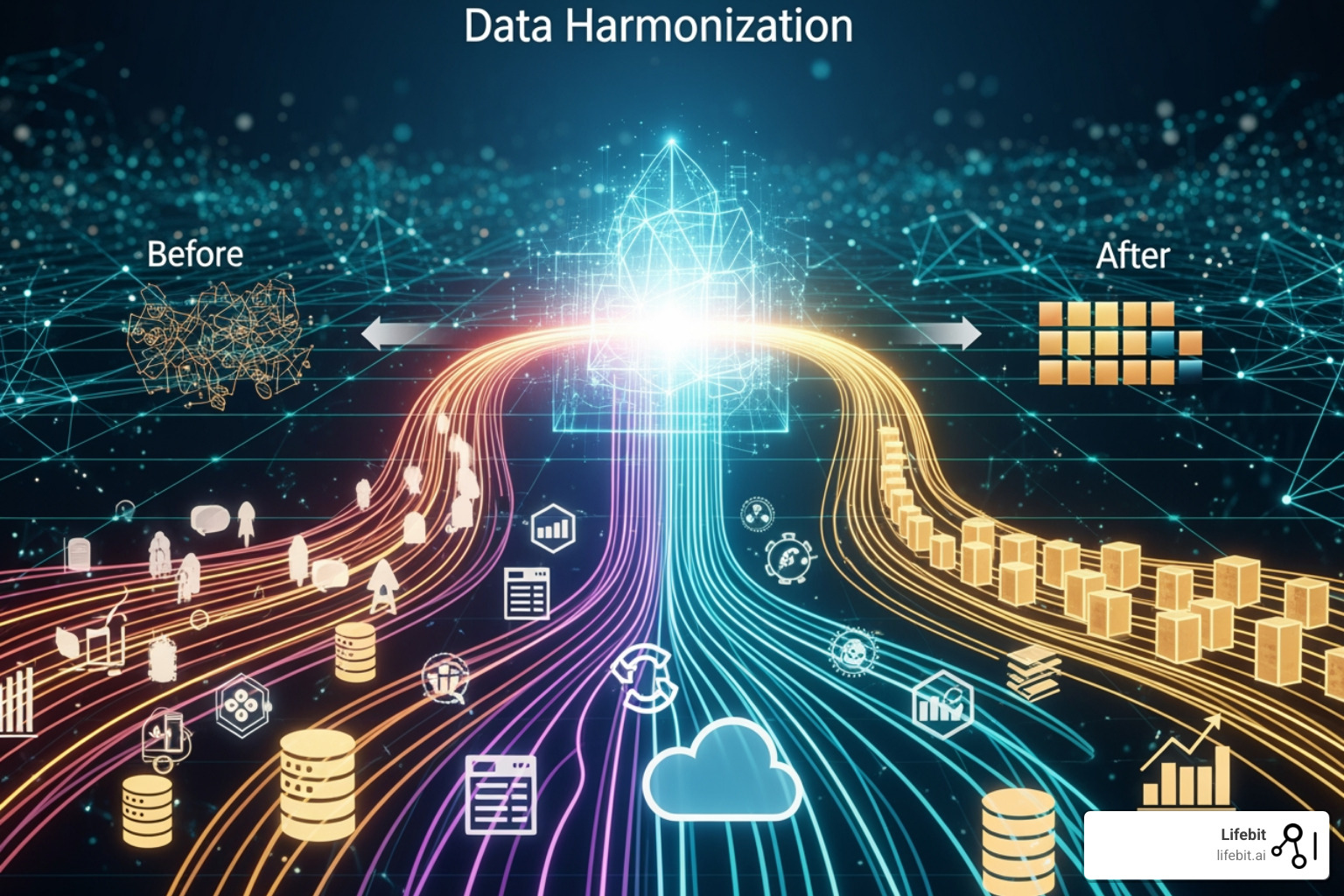
The need for data harmonization services transcends industries, empowering organizations across various sectors to open up the full potential of their data.
Healthcare and Life Sciences: Accelerating Findies
In healthcare and life sciences, harmonized data accelerates research that leads to new treatments and saves lives. At Lifebit, we leverage our federated platforms to enable secure, compliant analysis of biomedical data across global institutions in the UK, USA, Canada, and Europe.
Data harmonization services in this sector are crucial for:
- Combining Clinical Trial Data: Integrating data from multiple clinical trials, often conducted by different organizations or in different regions, allows for larger, more robust analyses and faster drug development.
- Integrating EHRs and Genomic Data: To power precision medicine, we need to link a patient’s electronic health records with their unique genomic information. Harmonization makes this complex integration possible.
- Real-World Data (RWD) Analysis: RWD from sources like EMRs, claims databases, and registries offers invaluable insights into treatment effectiveness and patient populations. Harmonizing RWD is essential for generating reliable Real-World Evidence (RWE). You can learn more about this at More info about Real-World Data.
- Powering Precision Medicine: By creating unified datasets that combine clinical, genomic, and real-world data, we can identify specific patient subgroups that respond best to certain treatments, ushering in a new era of personalized healthcare. More info about Health Data Harmonization further elaborates on this.
- Improving Patient Outcomes: All these efforts converge on one goal: better patient care. Harmonized data accelerates findies, informs clinical guidelines, and enables more effective interventions. We’ve seen projects where harmonized datasets accelerated cohort recruitment by 60%, drastically speeding up research.
Finance: Enhancing Risk Management and Compliance
In finance, where data accuracy and consistency are paramount, data harmonization services are vital for:
- Aggregating Financial Data from Global Sources: Banks and financial institutions often operate across multiple countries and continents (including the USA, UK, and Europe), each with different currencies, accounting standards, and regulatory frameworks. Harmonizing this data provides a consolidated view of global operations.
- Fraud Detection: By harmonizing transaction data from various systems and customer profiles, institutions can build more accurate models to detect anomalous patterns indicative of fraud.
- Regulatory Reporting: Compliance with complex regulations like MiFID II in Europe or various SEC requirements in the USA demands consistent, auditable data. Harmonization simplifies the process of generating accurate regulatory reports.
- Customer 360-Degree View: Harmonizing customer data from sales, marketing, service, and transaction systems creates a holistic view of each customer, enabling better service and targeted product offerings.
- Algorithmic Trading: High-frequency trading models rely on clean, consistent data feeds. Harmonization ensures the integrity of this critical input.
Manufacturing and Supply Chain: Optimizing Operations
In the manufacturing sector, global supply chains generate vast amounts of data from disparate systems, including Enterprise Resource Planning (ERP), Manufacturing Execution Systems (MES), supplier portals, and IoT sensors on the factory floor. Data harmonization services are essential for creating a cohesive, real-time view of the entire value chain. Key applications include:
- Supply Chain Visibility: By harmonizing data from suppliers, logistics providers, and internal production systems, companies can gain end-to-end visibility. This allows them to track materials, anticipate disruptions (like a delay at a port), and optimize inventory levels, reducing both shortages and carrying costs.
- Predictive Maintenance: Modern machinery is equipped with sensors that monitor temperature, vibration, and performance. Harmonizing this IoT data with maintenance logs and operational schedules enables manufacturers to build predictive models that forecast equipment failures before they happen, minimizing downtime and extending asset life.
- Quality Control and Root Cause Analysis: When a product defect is found, tracing its origin can be difficult. Harmonizing quality testing data from different production stages and locations allows for rapid root cause analysis, helping companies identify and fix systemic issues faster.
- Demand Forecasting: Integrating historical sales data, current market trends, promotional calendars, and even external factors like weather patterns into a single, harmonized dataset allows for far more accurate demand forecasting, leading to optimized production schedules and reduced waste.
Research: Enabling Large-Scale Collaborative Studies
Research across all fields thrives on combining diverse datasets. Data harmonization services are the backbone of large-scale collaborative initiatives:
- Combining Survey Data: Researchers often conduct meta-analyses, combining results from multiple surveys to identify broader trends or increase statistical power. Harmonization ensures that questions and responses are comparable, even if worded differently in original surveys. Projects like the North Atlantic Population Project have harmonized census data from the 1800s across Great Britain, Canada, and the US.
- Meta-Analysis of Studies: Harmonization allows researchers to pool data from numerous studies, overcoming limitations of small sample sizes and enabling more robust conclusions.
- Cross-National Research Projects: When studying global phenomena, data from different countries often needs to be harmonized to account for cultural, linguistic, and methodological variations.
- Fostering Interoperability: Harmonized data is inherently more shareable and reusable, promoting collaboration among researchers and institutions.
- Enabling Federated Analysis: Our federated platforms allow researchers to analyze sensitive data across multiple institutions (such as those in Canada, UK, and USA) without centralizing it, maintaining data privacy while enabling collaborative insights. Learn more about this approach at More info about Federated Data Analysis.
Advanced Strategies for a Future-Proof Data Ecosystem
As data continues to grow in volume and complexity, so too do the strategies and technologies we employ for harmonization.
How AI is Revolutionizing Data Harmonization Services
The days of purely manual, labor-intensive data harmonization are rapidly becoming a relic of the past. Artificial intelligence (AI) and machine learning (ML) are changing data harmonization services, making them faster, more accurate, and more scalable.
AI and ML capabilities are now being leveraged for:
- Automated Schema Detection: AI can automatically analyze incoming data sources, infer their schemas, and suggest mappings to a target model, drastically reducing manual effort.
- AI-Powered Data Mapping: Beyond simple rules, ML algorithms can learn complex mapping patterns between disparate data elements, even when explicit rules are hard to define.
- Machine Learning for Entity Resolution: ML models are becoming incredibly adept at identifying and merging duplicate records, even with partial or inconsistent information, improving the accuracy of a unified view.
- Anomaly Detection: AI can continuously monitor harmonized data for unusual patterns or outliers, flagging potential data quality issues that might otherwise go unnoticed.
- Predictive Data Cleansing: Advanced AI can even predict potential data errors and suggest corrections proactively, moving beyond reactive data cleaning.
This automation is critical. With 80% of data scientists’ time currently spent cleaning and organizing data, AI offers a powerful solution to free up valuable human expertise for higher-value tasks. Our own AI-powered platforms are designed to automate and accelerate this process, allowing researchers to focus on insights, not infrastructure. Dive deeper into this exciting field with More info about AI for Data Harmonization.
The Role of Master Data Management (MDM)
Master Data Management (MDM) is the strategic discipline of keeping an organization’s most important data (master data like customers, products, and locations) consistent and accurate. It provides a critical framework for data harmonization services.
MDM acts as a foundation by:
- Creating Golden Records: MDM establishes a single, authoritative “golden record” for each core business entity, eliminating inconsistencies.
- Ensuring Consistency: It maintains the integrity of these key entities across all operational and analytical systems.
- Working with Harmonization: MDM defines the target “master” structure, while harmonization is the process of changing source data to fit that structure. Together, they create and maintain a single source of truth.
This synergy is vital for robust data governance. For more insights into the broader context, check out More info about Data Governance Platforms. The case of a $12Bn Oil and Gas company classifying 150,000 materials into UNSPSC and HTS codes with AI-powered tools highlights how MDM and harmonization work together to improve operational efficiency and industrial safety.
Ensuring Data Privacy and Security Throughout the Process
When dealing with sensitive data, especially in healthcare (such as patient records and genomic data), data privacy and security are non-negotiable. Data harmonization services must be built with robust safeguards from the ground up, particularly when operating across regions with stringent regulations like GDPR in Europe and HIPAA in the USA.
Key strategies include:
- Data Anonymization and Pseudonymization: Techniques to remove or mask personally identifiable information (PII) from datasets, protecting individual privacy while retaining data utility for research.
- Role-Based Access Control (RBAC): Limiting access to harmonized data based on a user’s specific role and permissions, ensuring only authorized individuals can view or manipulate sensitive information.
- Compliance with Regulations: Adhering strictly to data protection laws like GDPR, HIPAA, and other local regulations is paramount. This often involves regular audits and certifications (e.g., ISO standards).
- Using Trusted Research Environments (TREs): TREs provide secure, controlled, and audited environments where researchers can access and analyze sensitive data without direct data download. Data remains within the secure environment, reducing the risk of breaches. We provide extensive details on this at More info about Trusted Research Environments.
- Federated Learning and Federated Architectures: Our federated approach allows AI models to be trained on data residing in its original secure location (e.g., within a hospital in the UK or a research institution in Canada) without the need to centralize the raw data. This preserves privacy and security while enabling collaborative insights, a cornerstone of our platforms. Explore More info about Preserving Patient Data Privacy to understand our commitment.
Frequently Asked Questions about Data Harmonization
How long does a data harmonization project take?
The timeline for a data harmonization services project varies significantly based on:
- Data Complexity: The degree of heterogeneity and semantic discrepancies.
- Data Volume: The size of the datasets being processed.
- Number of Sources: The quantity of disparate data sources to integrate.
- Data Quality: The cleanliness and completeness of the original data.
- Level of Automation: The extent to which AI/ML tools are used.
A project can range from a few weeks for simple cases to several months or more for complex, enterprise-wide implementations.
Can data harmonization be fully automated?
While AI is automating more of the process, 100% automation is still rare for complex scenarios. A successful strategy blends advanced technology with human expertise.
- What AI Automates: AI tools excel at schema detection, profiling, and suggesting mappings, significantly reducing manual effort.
- Where Humans are Crucial: Human oversight and domain expertise remain essential for semantic mapping, where understanding context is key to resolving ambiguities that AI cannot. For example, clinical knowledge is needed to interpret medical codes correctly.
What is the difference between data harmonization and data integration?
This is a common point of confusion. The key difference is:
- Data Integration is the physical process of combining data from different sources into one location (e.g., a data lake).
- Data Harmonization is the logical process of making that combined data consistent, compatible, and comparable.
In short, integration brings data together, while harmonization makes it truly usable as a single, coherent dataset. True insights come when integrated data is also harmonized. For a more comprehensive understanding, dig into More info about Data Integration Platforms.
Conclusion: Turn Your Data into Your Most Valuable Asset
The data explosion has left organizations drowning in information but starving for insight. The cause is often unharmonized, fragmented data. Data harmonization services bridge this gap, turning chaos into clarity by creating a common data language.
This open ups accuracy and efficiency, accelerating everything from life-saving research in the UK and USA to financial compliance across Europe. It’s not just data cleaning; it’s a unified strategy that empowers every decision.
At Lifebit, we believe your data is your most valuable asset. Our federated AI platform provides secure, real-time access to global biomedical data, with built-in harmonization, AI/ML analytics, and federated governance. We empower biopharma, governments, and public health agencies in the UK, USA, Canada, and Europe to turn disparate datasets into research-ready assets, fueling precision medicine with confidence.
Ready to transform your data landscape? Find how Lifebit can help you achieve seamless data harmonization and open up your data’s true potential with More info about Lifebit’s Data Harmonization capabilities.