

Beyond the Hype: A Guide to Decentralized AI in Life Sciences

Why Centralized AI Is Costing You Time, Money, and Security
A decentralized AI platform distributes AI model training, data analysis, and decision-making across multiple independent nodes or locations, rather than concentrating everything in a single centralized server or organization. Here’s what you need to know:
- Data stays where it is: Models train on-site at hospitals, research centers, or regulatory agencies—no raw data movement required
- Privacy by design: Federated learning and cryptographic verification protect patient data while enabling collaboration
- Distributed infrastructure: Blockchain, edge computing, and peer-to-peer networks replace single points of failure
- Shared governance: Smart contracts and token incentives align participants without central control
- Real-world impact: Faster drug discovery, secure pharmacovigilance, and compliant multi-institutional research at scale
Centralized AI systems are slowing you down. Every time you need to access data from multiple hospitals, research institutions, or regulatory bodies, you face the same obstacles: months-long data onboarding, privacy compliance nightmares, and siloed datasets that can’t talk to each other. The result? Delayed clinical trials, incomplete real-world evidence, and AI models trained on narrow, non-representative data.
The hidden costs add up fast. Moving terabytes of sensitive genomic and EHR data into a central cloud isn’t just expensive—it’s a security liability. One breach exposes millions of patient records. One compliance failure triggers regulatory penalties. And every data transfer multiplies your attack surface.
Meanwhile, your competitors are stuck in the same trap. Even large pharma companies and public health agencies struggle with data silos that prevent real-time pharmacovigilance and population-level insights. Traditional centralized AI requires you to own or move the data before you can analyze it—a model that’s fundamentally broken for modern healthcare.
Decentralized AI platforms solve this by bringing the AI to the data, not the other way around. Instead of centralizing everything, these platforms enable secure, in-situ analysis across distributed networks. Federated learning trains models locally. Blockchain ensures transparency and trust. Edge computing delivers real-time results without massive infrastructure costs.
The market agrees. The blockchain-AI sector is projected to grow from $1.3 billion in 2023 to $20.5 billion by 2033, with decentralized AI specifically growing at a 40% CAGR. This isn’t hype—it’s a fundamental shift in how life sciences organizations collaborate, innovate, and protect patient privacy.
I’m Maria Chatzou Dunford, CEO and Co-founder of Lifebit, where we’ve built a decentralized AI platform powering federated genomic and biomedical data analysis for public sector institutions and pharmaceutical organizations worldwide. Over 15 years in computational biology, AI, and health-tech, I’ve seen how decentralized infrastructure unlocks trillions in value by enabling secure collaboration across previously inaccessible datasets.
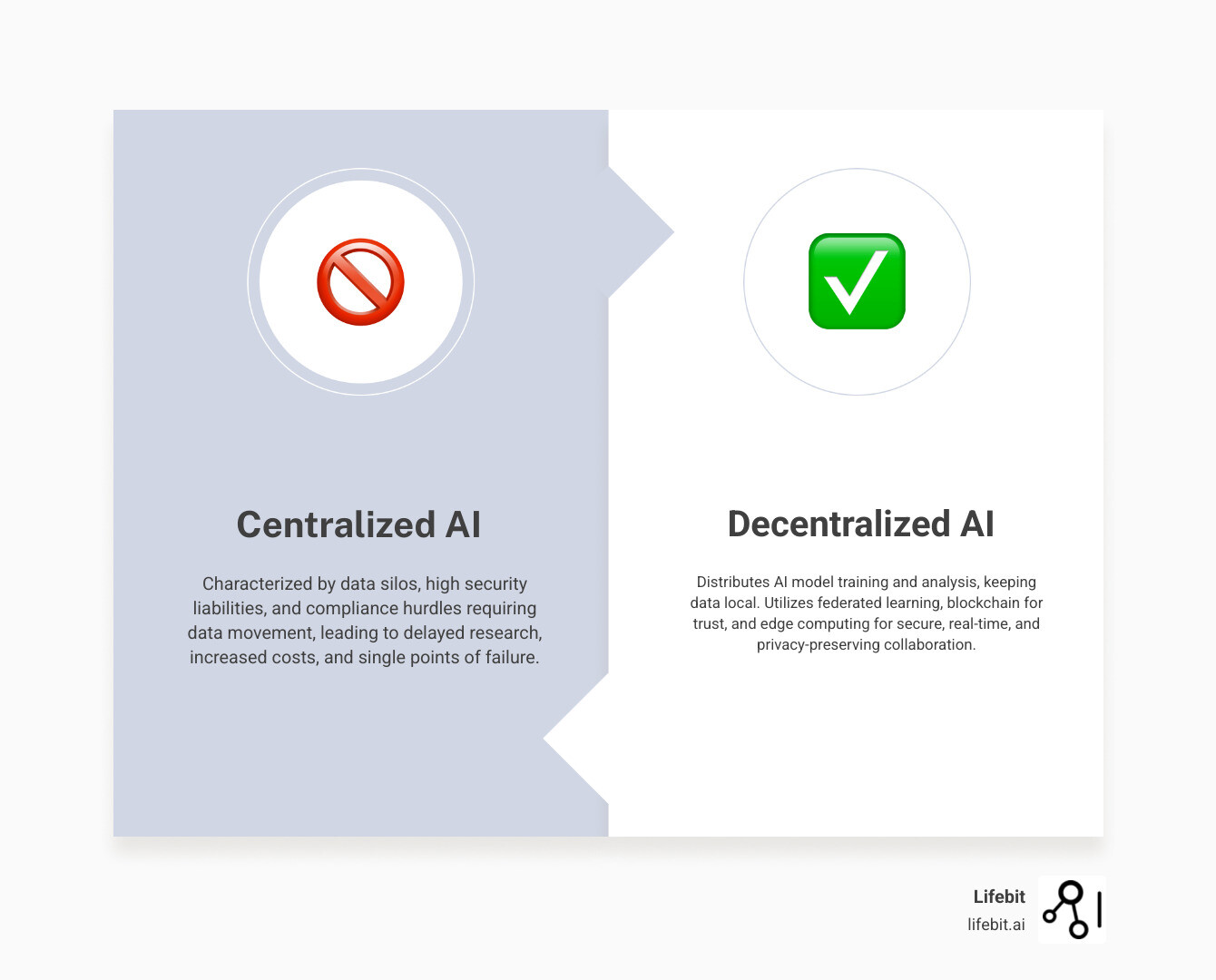
Know your decentralized AI platform terms:
From Isolated Silos to Secure Collaboration: What Makes a Decentralized AI Platform Different?
At its core, a decentralized AI platform represents a fundamental paradigm shift from the traditional, centralized AI model we’ve largely relied on. While traditional AI often operates within the confines of a single entity’s control – think large tech giants or cloud providers – decentralized AI distributes the power, processing, and decision-making across a network of independent nodes. This distributed approach is what makes it so transformative for data-sensitive sectors like life sciences.
In a centralized AI setup, data is typically collected, stored, and processed in one location. This creates a single point of control and often, a single point of failure. Imagine a massive vault where all your precious data is kept. It might be secure, but it’s also a prime target, and accessing it requires navigating layers of bureaucracy and security protocols.
A decentralized AI platform, on the other hand, breaks down these data monopolies. It fosters distributed AI model deployment, where AI models are not confined to a single server but are spread across a network of participating “nodes.” These nodes could be individual research institutions, hospitals, or pharmaceutical companies, each contributing to a collective intelligence without ever relinquishing control of their raw data. This peer-to-peer collaboration model allows for unprecedented teamwork, accelerating AI model creation and enabling smaller businesses and individual researchers to participate in AI development and decision-making previously reserved for the well-resourced few.
The shift is profound: we move from an era of data ownership, where owning the most data was paramount, to one of secure data access, where the ability to securely and compliantly analyze distributed data becomes the ultimate differentiator.
| Feature | Traditional Centralized AI | Decentralized AI Platforms (or rather, the lack thereof) of a single entity’s control.
| Feature | Traditional Centralized AI | |
|---|---|---|
| Data Control | Centralized control; data often held by big corporations. | Users retain ownership and control over their data; secure data access and sharing. |
| Privacy | Data movement often required; higher risk of breaches and misuse. | Privacy-preserving techniques like federated learning; data never leaves its source. |
| Scalability | Limited by central infrastructure; potential bottlenecks. | Distributed network leverages collective computing power; scales dynamically. |
| Cost | High infrastructure, storage, and transfer costs. | Reduces infrastructure and data transfer costs through local processing. |
| Transparency | Often black-box models; limited visibility into operations. | Blockchain ensures transparent, traceable, and tamper-proof operations. |
Why Decentralized AI Platforms Outperform Traditional AI
The distinction between centralized and decentralized AI platforms isn’t just a technical detail; it’s a fundamental difference in philosophy that directly impacts performance, security, and ethical considerations.
With traditional AI, we often encounter single-entity control. This means one company or organization dictates how data is used, how models are trained, and what outputs are generated. This can lead to a lack of transparency and trust, especially when dealing with sensitive information like patient data. In contrast, decentralized AI platforms operate on a principle of distributed trust. Power and control are spread across all participants, reducing the risk of bias, censorship, or misuse by any single party.
Another critical difference lies in data movement versus secure algorithm movement. Centralized AI often requires moving vast amounts of raw data to a central location for processing. This “data movement” creates significant security vulnerabilities and compliance headaches, particularly in regulated industries like life sciences. Our approach, powered by a decentralized AI platform, allows for secure algorithm movement. The AI models travel to where the data resides, train locally, and only the learned insights (not the raw data) are shared. This dramatically improves data security and privacy. For more insights into how this works, consider More info about Federated Data Analysis.
Furthermore, traditional AI models can often feel like black boxes – opaque systems where how decisions are made is unclear. This lack of transparency and accountability erodes trust, a critical factor in healthcare and research. A decentralized AI platform, especially one leveraging blockchain, offers transparent ledgers. All transactions, data contributions, and model interactions are recorded on an immutable ledger, ensuring traceability and verifiability.
Finally, centralized systems inherently carry a single point of failure. If the central server goes down, or if its security is compromised, the entire system is at risk. A decentralized AI platform, however, boasts network resilience. By distributing data and models across multiple points, it lowers the chance of compromised datasets and ensures the system remains functional even if individual nodes fail. This distributed nature improves reliability and robustness, making it ideal for critical applications in life sciences.
Data Ownership and Privacy: The Non-Negotiables
In the life sciences, data isn’t just information; it’s deeply personal, often life-defining. Therefore, data ownership and privacy are not just features—they are non-negotiable foundations for any ethical and compliant AI system. This is where a decentralized AI platform truly shines, fundamentally reshaping how we manage sensitive information.
We believe that users must retain control over their data. In a decentralized model, individuals and institutions maintain ownership of their datasets, while contributing to collective AI intelligence. This is crucial for adhering to stringent regulations such as GDPR and HIPAA, which govern data privacy across Europe, the UK, and the USA. Our decentralized AI platform is designed with these compliance frameworks in mind, ensuring that patient data never leaves its secure environment.
The traditional model of aggregating data in central repositories presents inherent risks of data misuse. Decentralized approaches, leveraging techniques like federated learning and cryptographic encryption, actively work to prevent this. They enable AI to learn from distributed data without the raw data ever being exposed or transferred. This means patient privacy by design, drastically reducing the attack surface and the potential for breaches.
Beyond protection, decentralized AI also opens avenues for monetizing data contributions in a secure and ethical manner. Imagine researchers contributing valuable, anonymized insights from their datasets and being fairly compensated, all while maintaining strict privacy controls. Secure data marketplaces facilitate this exchange, creating new economic models that benefit data providers and researchers alike. For a deeper dive into how we manage and secure data, explore More info about Federated Data Governance.
The Technology Stack: How Lifebit’s Decentralized AI Platform Works
Building a robust decentralized AI platform for the life sciences requires a sophisticated interplay of cutting-edge technologies. Our approach at Lifebit integrates three core pillars: Blockchain, Federated Learning, and Edge Computing. These aren’t just buzzwords; they are the architectural bedrock that enables us to deliver secure, scalable, and privacy-preserving AI solutions for biomedical and multi-omic data.
Together, these technologies facilitate cryptographic verification, ensuring the integrity and authenticity of every operation. Smart contracts automate agreements and enforce governance rules across the network. Distributed ledgers provide an immutable record of all activities, bringing unparalleled transparency. And by enabling on-chain AI, we ensure that AI models and their inferences are transparent, secure, and verifiable.
Federated Learning: Training AI Without Moving Sensitive Data
Federated learning is arguably the most critical component for a decentralized AI platform operating in the life sciences. It’s a approach that allows AI models to be trained on vast, distributed datasets without ever requiring the raw data to leave its original location. This means patient data stays precisely where it belongs: securely within the hospital, research institution, or regulatory agency that holds it.
The magic of federated learning is that the AI models travel to the data, not the other way around. Each participating node (e.g., a hospital in London, a research center in New York, or a pharmaceutical company in Singapore) trains a local copy of the AI model on its own private dataset. Only the learned parameters, or “model updates” – not the sensitive raw data – are then sent back to a central server, or aggregated securely by other means, to create a more robust global model. This ensures patient privacy by design, as no individual’s personal health information is ever exposed or transferred.
This collaborative model building dramatically accelerates research and development, allowing for global research collaboration across institutions in the UK, USA, Canada, and beyond, without compromising privacy. Imagine AI models becoming more accurate and powerful by learning from diverse populations across multiple continents, all while maintaining the highest standards of data protection. For a deeper understanding of its applications, read about Federated Learning in Healthcare.
Blockchain: The Backbone of Trust and Transparency
Blockchain technology is the immutable ledger that provides the backbone of trust and transparency for our decentralized AI platform. In an ecosystem where multiple parties are collaborating with sensitive data, knowing that every action is recorded, verifiable, and tamper-proof is paramount.
The immutability of blockchain means that once a transaction or a model update is recorded, it cannot be altered or deleted. This provides an unparalleled level of data integrity and auditability, crucial for regulatory compliance in life sciences. We gain transparent operations, where the provenance of data contributions, model training events, and AI inferences can be traced and verified by all authorized participants.
Smart contracts, self-executing agreements stored on the blockchain, play a vital role in automating governance. They enforce the rules for data usage, model access, and reward distribution without the need for intermediaries. This creates a fair and efficient system, aligning incentives among all participants. For instance, if researchers contribute valuable insights, smart contracts can ensure they are appropriately credited or compensated, fostering a vibrant, open, and trustless AI economy.
Blockchain enables verifiable AI. We can cryptographically prove that an AI model was trained on specific data, that its outputs are legitimate, and that it adheres to predefined ethical guidelines. This level of transparency and trust is essential for building confidence in AI-driven decisions in critical areas like drug discovery and patient care. To understand how such distributed architectures apply to complex data, explore More info about Federated Architecture in Genomics.
Edge Computing: Real-Time, Local, and Cost-Effective
While federated learning keeps data localized for privacy and blockchain ensures trust, edge computing brings the power of our decentralized AI platform directly to the point of data generation. This means processing and analyzing data on local devices—whether it’s a genomic sequencer in a lab, a smart medical device in a clinic, or a sensor in a patient’s home—rather than sending it all to a distant cloud server.
The immediate benefit is real-time analysis. For critical applications in healthcare, such as monitoring patient vitals or detecting anomalies in imaging data, latency can be a matter of life and death. Edge computing drastically reduces this latency by processing data at the “edge” of the network, enabling quicker decisions.
Furthermore, it leads to lower infrastructure costs. By distributing processing power and reducing the need to constantly transfer massive datasets to a central cloud, we can significantly cut down on data transfer fees and centralized computing resources. This makes advanced AI accessible and affordable for a broader range of institutions, from small clinics to large research consortia. This approach also integrates seamlessly with the growing ecosystem of IoT in healthcare, allowing smart devices to contribute to AI models and provide immediate, localized insights without compromising privacy.
The Lifebit Decentralized AI Platform Ecosystem: Real-World Impact and Use Cases
Our decentralized AI platform is not just a theoretical construct; it’s actively changing the life sciences sector. We’ve designed an ecosystem that leverages these advanced technologies to deliver tangible, real-world impact across healthcare and pharmaceutical research.

By enabling AI-powered research networks and secure data collaboration, we are breaking down the traditional barriers that have hindered progress for decades. Our platform supports the use of open-source AI models, encouraging a collaborative spirit where innovation can flourish responsibly.
Here are some key use cases in Life Sciences that our decentralized AI platform addresses:
- Accelerated drug discovery and development
- Real-time pharmacovigilance and drug safety monitoring
- Precision medicine and personalized treatment strategies
- AI-driven diagnostics and disease prediction
- Large-scale population genomics studies
- Secure multi-institutional clinical trials
- Improved R&D for biopharma
- Compliant data sharing for public health emergencies
Changing Healthcare and Pharma with Decentralized AI
The potential for a decentralized AI platform to revolutionize healthcare and pharma is immense. We are moving towards an era of precision medicine, where treatments are custom to an individual’s unique genetic makeup and health profile. Our platform facilitates this by enabling AI models to learn from diverse genomic and clinical datasets, driving insights for personalized care.
Drug discovery, traditionally a lengthy and expensive process, can be significantly accelerated. By securely analyzing vast, distributed datasets of molecular structures, patient responses, and clinical trial outcomes, AI can identify potential drug candidates and predict their efficacy with unprecedented speed. Furthermore, real-time pharmacovigilance becomes a reality. AI-driven safety surveillance can continuously monitor drug effects across global patient populations, flagging adverse events much faster than manual methods. This is crucial for public health agencies and pharmaceutical companies operating across Europe, the UK, the USA, and other regulated markets.
In diagnostics, AI-driven tools can assist clinicians in making more accurate and earlier diagnoses, leveraging models trained on a wider array of anonymized patient data. Population genomics studies, vital for understanding disease prevalence and developing public health strategies, can be conducted at a scale previously unimaginable, collaborating across national borders while respecting data sovereignty. For further reading on this transformative collaboration, see Federated Learning Meets Precision Medicine: How Collaboration is Powering Personalized Care.
Lifebit’s Platform Model: Built for Security, Scale, and Speed
Our decentralized AI platform is engineered to meet the rigorous demands of the life sciences, balancing security, scalability, and speed. We recognize that the future of AI in this sector hinges on enabling secure, compliant data exchanges and incentivizing participation in compute networks.
We integrate AI Service Marketplaces, allowing researchers and developers to access and offer specialized AI models and tools within a trusted environment. These marketplaces ensure that contributions are transparently attributed and that services are compensated fairly, often through token economies and smart contracts. This fosters a vibrant ecosystem where innovation is rewarded. As Professor Ramesh Raskar highlighted at EmTech Digital in May 2024, the collaborative ecosystem is key to unlocking AI’s true potential. You can learn more about this pivotal event here: Professor Ramesh Raskar spoke on this topic at EmTech Digital in May 2024.
Lifebit’s platform includes components like the Trusted Research Environment (TRE), Trusted Data Lakehouse (TDL), and R.E.A.L. (Real-time Evidence & Analytics Layer). These are designed to provide secure, real-time access to global biomedical and multi-omic data, with built-in capabilities for harmonization, advanced AI/ML analytics, and federated governance. This delivers real-time insights, AI-driven safety surveillance, and secure collaboration across hybrid data ecosystems, ensuring that our users in biopharma, governments, and public health agencies can conduct large-scale, compliant research and pharmacovigilance.
Overcoming the Roadblocks: Challenges and the Path Forward
While the promise of a decentralized AI platform is immense, we are also realistic about the challenges ahead. Adopting such a transformative technology requires navigating technical complexities, ensuring scalability, addressing regulatory compliance, and maintaining data quality.
One significant hurdle is the inherent technical complexity of integrating blockchain, federated learning, and edge computing into a cohesive, user-friendly system. Another is ensuring true scalability, as AI workloads can be incredibly demanding. While we’ve seen impressive testnet statistics from projects like ØG.AI (650M+ transactions, 22M+ active accounts, 11k+ peak TPS per shard), maintaining such performance across diverse, real-world life science datasets is a continuous effort.
Regulatory compliance remains a critical consideration, particularly in highly regulated sectors like healthcare. The diverse legal frameworks across the UK, USA, Europe, Canada, and Singapore require a platform that is adaptable and robust. Data quality validation is also crucial; decentralized systems must have mechanisms to ensure that the data contributing to models is accurate and reliable.
Despite these challenges, the market growth projections are undeniably compelling. The broader blockchain-AI market (AI + blockchain) is projected to grow from $1.3 billion (2023) to $20.5 billion by 2033, at a CAGR of ~32.6%. This indicates strong investor confidence and a clear trajectory for the sector.
Building on Lifebit’s Federated Decentralized AI Platform
Successfully implementing a decentralized AI platform within large-scale life science organizations means addressing practical considerations like integration with existing systems. Legacy infrastructure and established workflows are realities, and our platform is designed to seamlessly connect with them.
Standardization needs are also paramount. To enable true interoperability across diverse datasets and institutions, we must foster common standards for data formats, metadata, and AI model interfaces. This ensures that models trained in one environment can be effectively applied and validated in another. Ensuring model accuracy, especially when learning from distributed and heterogeneous datasets, requires sophisticated validation protocols and continuous monitoring. Our commitment to secure collaboration across hybrid data ecosystems, including our work with the NIAID, exemplifies our dedication to these principles. For more information, please visit More info about our Federated Data Ecosystem with NIAID.
For those looking to understand the robust infrastructure that facilitates this, our More info about our Federated Trusted Research Environment provides further details on how we create secure, compliant spaces for sensitive research.
The Future Is Federated: Market Growth and What’s Next
The future of AI in life sciences is unequivocally federated and decentralized. The market growth figures speak for themselves: the international decentralized AI market is predicted to grow at a CAGR of 40% between 2023 and 2030. The AI in Blockchain market is projected to reach $973 million by 2027, with a CAGR of approximately 50%. This surging VC investment and increasing enterprise adoption underscore a fundamental shift.
We are witnessing the rise of AI3.0, a new era defined by decentralized, human-centric, and privacy-first AI. Unlike AI1.0 (centralized machine learning) and AI2.0 (centralized generative AI), AI3.0 empowers individuals and institutions with greater control and transparency. This “Age of Autonomy” blurs the line between AI creator and consumer, enabling transparent, composable, and secure ecosystems where innovation thrives. It’s about ensuring that intelligence remains a shared public good, not a walled garden controlled by a few.
Our vision aligns with this future, where our decentralized AI platform plays a pivotal role in enabling a more equitable, efficient, and secure landscape for biomedical research and development. The projected $20.5 billion market by 2033 is not just a number; it represents the immense value that decentralized AI will open up by solving real-world challenges in healthcare. For additional market insights, refer to this projection: $20.5 billion market projection by 2033.
Frequently Asked Questions about Decentralized AI Platforms
How does a decentralized AI platform ensure patient data privacy in clinical research?
By using federated learning, AI models are trained where the data resides, so sensitive patient information never leaves the secure environment, dramatically reducing breach risks. Additionally, blockchain technology provides an immutable and transparent record of all data access and model interactions, further enhancing accountability and trust.
Can smaller research institutions benefit from a decentralized AI platform?
Absolutely. Decentralization levels the playing field, giving smaller institutions access to powerful AI tools and collaborative projects previously reserved for large organizations. By contributing their unique, localized datasets to a federated network, they gain access to more robust global AI models and can participate in cutting-edge research without needing massive computational infrastructure of their own.
Is a decentralized AI platform more secure than centralized AI?
Yes. Distributing data and models across a network eliminates single points of failure, making attacks far more difficult. Blockchain adds transparent, tamper-proof record-keeping for all operations, providing an auditable trail. This multi-layered security approach, combined with privacy-preserving techniques like federated learning, significantly improves the overall security posture compared to centralized systems.
Conclusion: Don’t Get Left Behind—Secure, Accelerate, and Democratize Life Sciences with Lifebit’s Decentralized AI Platform
The journey to a truly transformative future in life sciences demands a departure from the limitations of centralized AI. As we’ve explored, a decentralized AI platform offers a compelling alternative, delivering improved privacy, faster, collaborative innovation, and democratized access to groundbreaking research.
We are at the cusp of an era where AI can open up trillions in economic value by solving some of humanity’s most pressing challenges in healthcare. The future of AI in life sciences is federated and secure, enabling researchers to collaborate across institutions and continents without ever compromising the sanctity of patient data.
At Lifebit, we are proud to be leading this revolution, providing the decentralized AI platform that empowers biopharma, governments, and public health agencies worldwide. Don’t get left behind. Accept the power of decentralized AI to secure your data, accelerate your discoveries, and democratize access to life-saving insights.
Explore the Lifebit Platform to see how we’re making this future a reality.