

Federated or Bust: Navigating DHA’s Data Governance Evolution

DHA Declares War on Data Silos
DHA data governance is fundamentally changing. In September 2025, the Defense Health Agency’s solicitation HT001125RE019 signaled a strategic shift to unify its fragmented data landscape without centralization. This initiative will establish a comprehensive framework guided by the DoD’s VAULTIS principles (Visible, Accessible, Understandable, Linked, Trusted, Interoperable, Secure) to improve operational effectiveness, enable AI/ML readiness, and support military healthcare.
Key Challenges DHA Is Addressing:
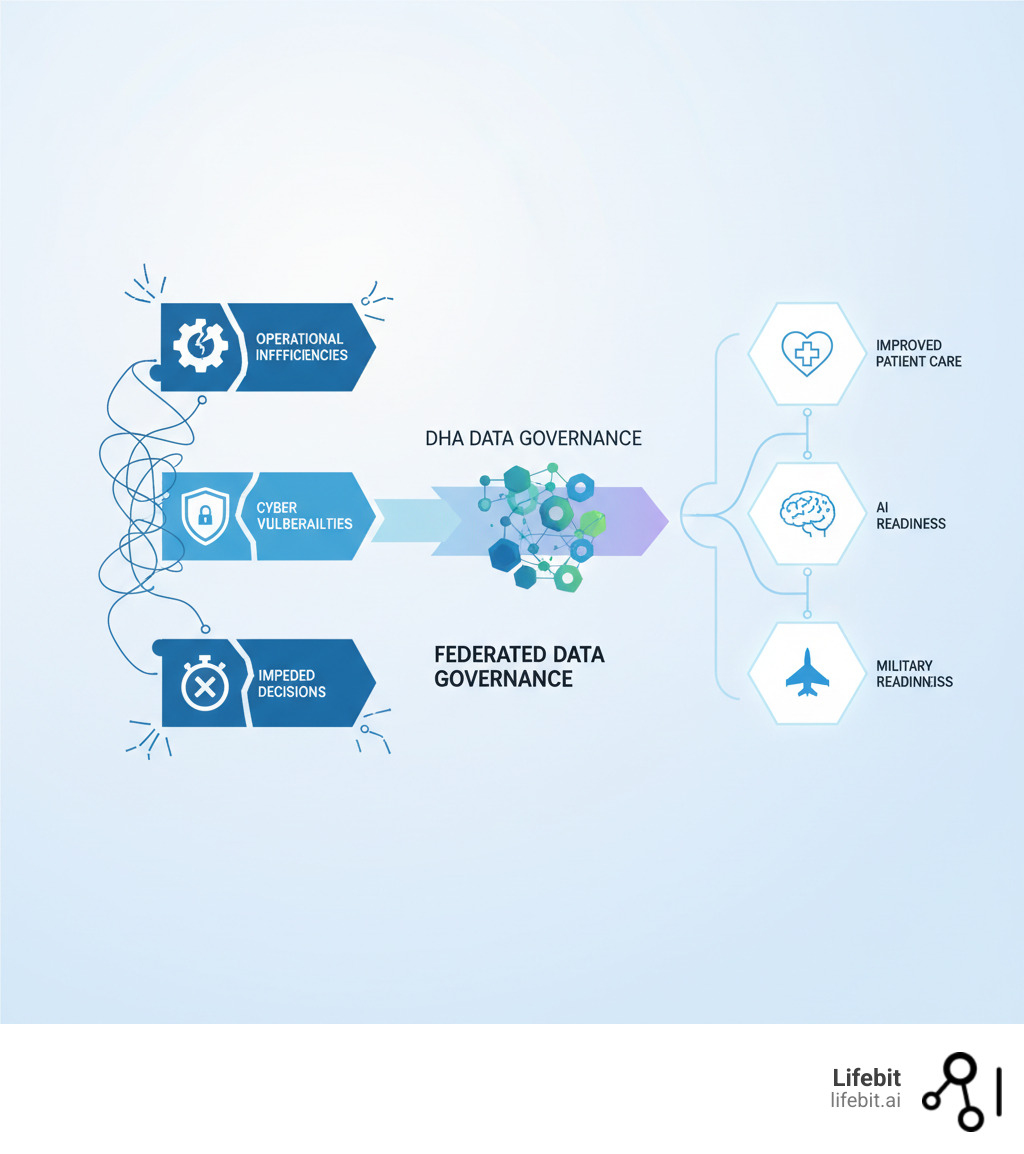
- Fragmented data systems creating operational inefficiencies and security vulnerabilities
- Data silos impeding decision-making and innovation across directorates
- Lack of unified data catalog preventing findability and trust in enterprise data
- Barriers to advanced technology adoption including AI and machine learning
What DHA Is Building:
- A comprehensive Data Inventory Management System (DIMS)
- An Enterprise Data Catalog (DHA-EDC) for metadata management
- A federated data mesh prototype supporting domain-driven governance
- AI/ML-ready infrastructure without moving data to centralized repositories
As Dr. Jesus Caban, DHA’s Chief Data and Analytics Officer, declared: “Data maturity is my top priority.” His vision is a master data catalog for users to find, understand, and access data, eliminating duplication and building trust across the agency.
As CEO of Lifebit, I’ve spent 15 years building federated platforms for secure analytics on distributed biomedical data—the exact challenge dha data governance now faces. My experience with government and pharma has proven that federated architectures are not just technically superior; they are the only viable path for modern defense healthcare.
The Mandate: Unifying Data Without Centralization
What makes this initiative remarkable is its mandate: unify the data landscape without creating a massive, centralized data warehouse. This isn’t a technical preference; it’s a fundamental rethinking of defense healthcare data strategy, born from the unique challenges of a global, high-stakes environment.
Traditional approaches that pull all data into one platform are ill-suited for the DHA. With sensitive health records, genomic data, and operational health information spread across hundreds of military treatment facilities (MTFs), research labs, and deployed units worldwide, centralization creates more problems than it solves. The logistical challenge alone is immense, involving the costly and slow transfer of petabytes of data. More critically, it concentrates risk. A single breach of a centralized repository could compromise the entire Military Health System’s data, creating an unacceptable national security vulnerability. Furthermore, moving data across international borders triggers a labyrinth of compliance and security delays, from GDPR in Europe to other data sovereignty laws, hindering timely analysis.
The dha data governance approach is different. Through Federated Data Governance, data stays where it lives—securely within its source system, controlled by the teams who know it best. Yet it becomes findable, accessible, and usable across the enterprise through a data mesh architecture. This model empowers domain owners—whether at Landstuhl Regional Medical Center in Germany or a naval hospital ship—to maintain control, apply context-specific governance, and ensure data quality at the source. This local expertise is lost in a centralized model, where a central IT team cannot possibly understand the nuances of every dataset.
Instead of forcing data into one place, this creates a sophisticated directory—the Enterprise Data Catalog—that shows where everything is and provides secure, policy-enforced access. The data remains in its original location, governed by domain owners, but the barriers between systems disappear. This is the core of the data mesh concept: treating data as a product, with clear owners, documented quality, and discoverable interfaces.
This distinction between Centralized vs Decentralized Data Governance is critical. Solicitation HT001125RE019 explicitly requires validating a federated data model, recognizing that the DHA’s global scale, security posture, and need for agility demand this modern approach.
Reflecting the mission’s urgency, the 12-month contract (September 30, 2025 – September 29, 2026) is a WOSB (Women-Owned Small Business) opportunity under NAICS code 541512. Performance is at DHA headquarters in Falls Church, VA, coordinating across all directorates. You can review the details on the solicitation for the full scope.
The goal is an intelligent ecosystem that improves decision-making, enables AI/ML, and supports better care for service members and their families, all while maintaining the highest security, privacy, and compliance standards required by the DoD.
The Blueprint: A VAULTIS-Guided Framework for DHA Data Governance
The Defense Health Agency’s new data ecosystem is built on the DoD Data Strategy’s VAULTIS framework. This is not just a set of buzzwords; it is a practical blueprint ensuring that every aspect of dha data governance serves the clinicians, researchers, commanders, and policymakers who depend on it. Each principle translates into specific capabilities and outcomes.
Dr. Jesus Caban has made it clear that aligning with these DoD Data Strategy goals is the foundation of this modernization, ensuring every technical decision moves the agency toward genuine data maturity.

Deconstructing the VAULTIS Framework in Practice
-
Visible: Data is visible when professionals can find the information they need without navigating a maze of disconnected systems. The DHA-EDC is the primary tool for this, acting as a searchable, comprehensive catalog of all data assets. It will capture rich metadata, including data lineage (where it came from), quality scores, ownership, and usage policies. A researcher looking for data on traumatic brain injuries (TBI) will be able to search the catalog and immediately see all relevant datasets across the enterprise, from clinical trial data to post-deployment health assessments.
-
Accessible: Data is accessible when authorized users can get it when and where they need it, under a clear set of rules. This goes beyond simple access; it means implementing granular, attribute-based, and role-based access controls (ABAC/RBAC). For example, a battlefield medic might have real-time access to a wounded soldier’s allergy and blood type information but be restricted from viewing their long-term psychiatric history. A policy analyst at the Pentagon, conversely, might have access to aggregated, de-identified readiness statistics but be blocked from seeing individual patient records. The federated model ensures these access policies are enforced at the data source, maintaining security.
-
Understandable: Data is understandable when it has clear, consistent definitions, so everyone speaks the same language. This is one of the hardest challenges in a large organization. The DHA will tackle this by enforcing the MHS Common Data Model for key metrics and establishing a common business glossary. This ensures that a term like “medically ready” means the exact same thing whether it’s being used by an Army unit in Korea, a Navy clinic in San Diego, or an Air Force hospital in Germany. Without this common understanding, data is easily misinterpreted, leading to flawed analysis and poor decisions.
-
Linked: Data is linked when it can be connected across sources to create a holistic view. The goal is to build a longitudinal health record for every service member. This means linking a service member’s electronic health record (EHR) from a military hospital with their in-theater medical data from a tactical combat casualty care card, their environmental exposure data from the Individual Longitudinal Exposure Record (ILER), and even their genomic data from research initiatives. This 360-degree view is essential for precision medicine and understanding the long-term health impacts of military service.
-
Trusted: Data is trusted when it is accurate, reliable, and certified for specific uses. Trust is not assumed; it is earned. The DHA is establishing formal data quality procedures, including data profiling, cleansing, and validation rules applied at the source. Data stewards will be responsible for certifying their “data products,” providing quality scores and documentation so users can assess fitness for use. When a commander relies on a dashboard showing unit health readiness, they must have absolute confidence that the underlying data is correct.
-
Interoperable: Data is interoperable when systems can exchange and use it seamlessly. The federated architecture relies on standardized APIs and data formats, such as Fast Healthcare Interoperability Resources (FHIR) and HL7. This ensures that the DHA-EDC can communicate with hundreds of disparate source systems and that data from one system can be correctly interpreted by another. This technical interoperability is also crucial for data sharing with external partners like the Department of Veterans Affairs.
-
Secure: Data is secure when sensitive health information is protected from unauthorized access, use, or disclosure. Security is woven into every layer of the architecture. This includes adhering to strict DoD cybersecurity standards like Security Technical Implementation Guides (STIGs), continuous monitoring, and achieving a formal Authority to Operate (ATO) for the system. It also means implementing robust encryption for data in transit and at rest and ensuring full compliance with HIPAA Compliant Data Analytics practices.
Key Components and Deliverables
Building this ecosystem requires concrete tools and processes. The foundation is a comprehensive data inventory of every data asset, managed through a purpose-built Data Inventory Management System (DIMS). An Analysis of Alternatives (AoA) will rigorously assess DIMS software solutions against the DHA’s demanding requirements for security, scalability, and usability in a federated environment.
The centerpiece is the DHA Enterprise Data Catalog (DHA-EDC), the master directory that makes the VAULTIS principles a reality. This tool will finally answer the question, “Where can I find trusted data about X?” without requiring deep organizational knowledge. Making the catalog useful requires robust metadata management and formalizing data stewardship and lifecycle management to establish clear ownership and accountability for each data product.
Key deliverables include a functional DIMS, a populated DHA-EDC, the AoA report, and a federated governance playbook. This playbook will be the rulebook for the entire enterprise, defining roles, responsibilities, and processes. Additional deliverables cover metadata harvesting, data product lifecycle, infrastructure requirements, self-service usability, reusable components, and AI/ML integration.
The Power of Partnerships
No organization, especially one as complex as the DHA, can transform its data landscape alone. Success requires partnerships that bring diverse expertise and aligned incentives.
Internal partnerships across all DHA directorates, from the medical corps to the CIO’s office, are essential to ensure data governance is developed collaboratively, not imposed from the top down. This includes managing critical Data Sharing Agreements, a process overseen by the DHA’s Privacy and Civil Liberties Office to confirm compliance with federal privacy laws and DoD policies.
External partnerships are equally vital. Close collaboration with the DoD Chief Data and Analytics Officer (CDAO), service Chief Data Officers, and the Department of Veterans Affairs enables genuine interoperability. This ensures a service member’s health data can follow them seamlessly from active duty into veteran status, a long-sought-after goal.
Academia and industry collaboration brings cutting-edge innovation. Universities contribute vital research on topics like AI in diagnostics, while technology providers offer battle-tested platforms for federated analytics. At Lifebit, we’ve seen how federated platforms enable this collaboration, letting organizations work on sensitive data without compromising security. The principles allowing competing pharmaceutical companies to collaborate on drug development apply directly to the DHA’s federated vision for a more connected and intelligent healthcare ecosystem.
The Engine: How AI and Data Mesh Will Power the Future
The Defense Health Agency’s dha data governance change is not just an IT project; it’s about building the foundation for an AI-enabled healthcare system that delivers precision medicine and operational excellence.
Without clean, accessible, and governed data, AI is expensive guesswork. The DHA understands this, which is why the initiative deeply integrates Artificial Intelligence (AI), Machine Learning (ML), Natural Language Processing (NLP), and Optical Character Recognition (OCR) into the data infrastructure. These are not abstract concepts but practical tools with life-saving applications:
- Predictive Logistics: Instead of just reacting to supply shortages, ML models can analyze historical consumption rates, deployment schedules, and epidemiological data to predict the demand for specific medical supplies—like blood units, vaccines, or surgical kits—in different operational theaters. This ensures the right resources are in the right place before they are critically needed.
- Population Health Surveillance: NLP can scan millions of unstructured free-text clinical notes and reports in near real-time to identify early signals of emerging health threats. This could be a cluster of unusual respiratory symptoms on a naval vessel or a spike in mental health consultations at a specific base, allowing for rapid public health intervention.
- Clinical Decision Support: AI-powered tools embedded in the EHR can provide real-time guidance to clinicians. For example, an algorithm could analyze a patient’s vitals, lab results, and genomic profile to flag a high risk of sepsis or recommend a personalized drug dosage that minimizes adverse effects.
- Digitization and Discovery: OCR technology will be used to digitize decades of legacy paper health records, making that invaluable historical data searchable and available for analysis for the first time.
The federated data mesh approach is the key that unlocks these capabilities at scale. It doesn’t require moving mountains of data before using AI. Data stays where it lives, managed by domain experts, while analytics and AI models access it securely across the enterprise. This allows domain-specific teams to develop and deploy ML models optimized for their unique challenges, from predicting supply chain needs to personalizing treatment protocols.
Maturing the Data Mesh for AI/ML Readiness
The DHA will mature its prototype data mesh into a production-ready system. This involves testing federated governance models, validating the data product lifecycle, and ensuring the architecture can support demanding AI/ML workloads securely. A key aspect of this is the concept of Federated Learning in Healthcare, where AI models can be trained across multiple data sources (e.g., different hospitals) without the sensitive data ever leaving its secure environment. The model “travels” to the data, not the other way around.
Each DHA directorate will be responsible for its own data products: documented, quality-checked datasets made findable through the Enterprise Data Catalog. When a researcher needs to train an ML model on TBI outcomes, they can discover and securely access these certified data products without manual data pulls from dozens of disparate systems.
The initiative also includes maintaining a comprehensive AI/ML inventory to align with federal mandates (like Executive Order 13960) and prevent duplicated efforts. As we’ve seen, AI Enabled Data Governance can create a virtuous cycle, where AI tools are used to automate governance tasks like data classification and quality monitoring, which in turn makes data more AI-ready. Building workforce readiness through targeted training is also critical to ensure users trust and can effectively use the new ecosystem.
Implications for Military Readiness and Modernising DHA Data Governance
Effective dha data governance saves lives and strengthens national security, with implications far beyond IT modernization.
-
Improved Patient Care: This is the ultimate goal. It becomes tangible when a physician in a combat zone can instantly access a service member’s complete medical history—from basic training immunizations to recent specialist consultations—to make a life-or-death decision. AI-powered clinical decision support can flag risks and suggest evidence-based treatments in real time.
-
Enhanced Operational Readiness: Commanders gain a near real-time, accurate health intelligence picture of their units. Predictive analytics can identify emerging health threats, like a flu outbreak, before they degrade mission capability. This allows for proactive measures, preserving force strength.
-
Proactive Risk Mitigation: The federated model inherently improves security by eliminating the single point of failure that a centralized data lake represents. Robust governance and granular, role-based access controls significantly reduce the risk of both insider threats and external attacks.
-
Strategic Cost Optimization: Every dollar saved by eliminating redundant data systems, manual data calls, and inefficient processes can be reinvested directly into better care, advanced medical research, or critical readiness needs. This is not about cutting costs, but about maximizing the value of every taxpayer dollar.
This approach future-proofs the technology infrastructure. A federated, mesh-based architecture is designed to flex and grow, incorporating new data sources and analytical capabilities without requiring another disruptive, multi-year overhaul. It ensures the DHA can adapt to the future challenges of military medicine.
Frequently Asked Questions about DHA Data Governance
What is the primary goal of the DHA’s new data governance initiative?
The DHA is fundamentally reimagining its data handling. The primary goal is to move from scattered, disconnected systems to a unified, secure, intelligent, and compliant ecosystem. In practical terms, this means users can find, understand, and access the data they need easily, building trust and eliminating duplicated efforts.
Dr. Jesus Caban’s top priority is data maturity. This initiative also focuses on operational effectiveness and decision-making speed, positioning the agency to adopt advanced technologies like AI and machine learning that require high-quality, well-organized data.
Why is the DHA choosing a federated model over a centralized one?
The DHA is unifying its data ecosystem without centralizing it into a single platform. While centralization seems obvious, for a massive, complex organization like the DHA, it creates more problems than it solves, including major security targets and access bottlenecks.
A federated model allows data to stay with the domain experts who understand it best, while still being findable and usable across the enterprise. It’s like a library network: a central catalog allows searching the entire collection without moving every book to one building. The Federated Data Governance model, implemented via a data mesh, breaks down silos without creating new ones.
In the Centralized vs Decentralized Data Governance debate, federated approaches consistently deliver better outcomes for security, compliance, and innovation in complex healthcare environments.
How does this initiative support military readiness?
Military readiness depends on healthy service members, who in turn depend on healthcare systems with timely, accurate information. This dha data governance initiative provides that foundation.
When a deployed medic can instantly access a service member’s complete health history, that’s military readiness. When analysts can predict resource needs or AI can flag health risks proactively, that’s readiness. This initiative enables faster, better-informed clinical decisions by improving data quality, accessibility, and interoperability.
It also mitigates risks. A federated model is more secure than a centralized one, and trustworthy data prevents poor decisions based on incomplete information. Furthermore, cost optimization from eliminating waste frees up resources for direct patient care and operational needs.
Finally, this initiative future-proofs the DHA’s technology. The federated approach, leveraging principles from Federated Learning in Healthcare, provides the flexibility to integrate emerging technologies without another massive overhaul, ensuring the DHA can adapt to future challenges.
Conclusion: The Dawn of a Data-Centric Defense Health Agency
The Defense Health Agency is at a crossroads. After years of fragmented systems creating barriers, this new initiative represents a commitment to a unified ecosystem that preserves domain autonomy.
Choosing a federated approach over centralized data lakes shows practical wisdom. Monolithic systems don’t scale, adapt, or empower domain experts—a truth proven across government and industry. Instead, this dha data governance framework accepts domain ownership and interoperability through a flexible architecture.
The pieces are in place: a comprehensive data inventory, an Enterprise Data Catalog, robust metadata management, and the VAULTIS principles—Visible, Accessible, Understandable, Linked, Trusted, Interoperable, Secure—to guide every decision.
The focus on AI/ML readiness is particularly forward-thinking. The DHA is not just organizing data for today; it’s building the foundation for tomorrow’s breakthroughs in improved healthcare and military readiness.
At Lifebit, our 15 years building federated platforms confirm this approach. We’ve seen how secure access to distributed data open ups new insights for industry partners and government agencies. You don’t need to move data to make it useful; you need the right architecture and governance. The DHA’s journey mirrors our experience in biopharma and public health: federation is the only sustainable path forward.
The dawn of a data-centric Defense Health Agency is here. What happens next will set the standard for how large organizations can harness data without sacrificing security, privacy, or domain expertise. The foundation is being built now, one federated data product at a time.
Learn how federated platforms are transforming federal health initiatives.