
From Silos to Systems: Drug Discovery 101

Why Drug Findy Is Failing Despite an Explosion of Data
From Silos to Systems: How Interoperability Is Accelerating Drug Findy is changing pharmaceutical R&D by connecting fragmented datasets across findy, clinical trials, and regulatory stages. Here’s what you need to know:
Key Ways Interoperability Accelerates Drug Findy:
- Breaks down data silos between R&D, clinical trials, genomics, EHRs, and real-world data
- Reduces timelines and costs by integrating 40+ data sources used in typical clinical trials
- Enables AI and ML to analyze vast, harmonized datasets for faster target identification
- Improves decision-making with unified, real-time views across the entire drug lifecycle
- Powers collaborative research for rare diseases through secure, federated data analysis
The pharmaceutical industry faces a paradox: an explosion of biomedical data, yet only 32% of companies can extract business value from it, and just 27% describe their analytics as “highly actionable.” The problem isn’t a lack of data; it’s that critical information is trapped in disconnected systems. This fragmentation has severe consequences. Bringing a drug to market still takes over ten years and costs more than $2 billion, with only 10% of Phase I candidates succeeding. A typical clinical trial juggles 40+ data sources, and when these systems don’t communicate, researchers waste countless hours on manual data work, hiding insights that could accelerate findy.
Interoperability—the ability of systems to exchange and use data effectively—is the key to open uping this trapped potential. By creating connected ecosystems where data flows securely across findy, clinical development, and regulatory stages, organizations can turn fragmented information into an engine for innovation. Integrated data environments reduce redundant testing, accelerate timelines, enable AI-powered predictions, and speed the delivery of life-saving treatments.
As Dr. Maria Chatzou Dunford, CEO and Co-founder of Lifebit, I’ve spent over 15 years building platforms for secure, federated analysis of biomedical data. My work showed me how From Silos to Systems: How Interoperability Is Accelerating Drug Findy transforms precision medicine and pharmaceutical research.
The Data Silo Dilemma: Why Is Pharma Drowning in Data but Starving for Insights?
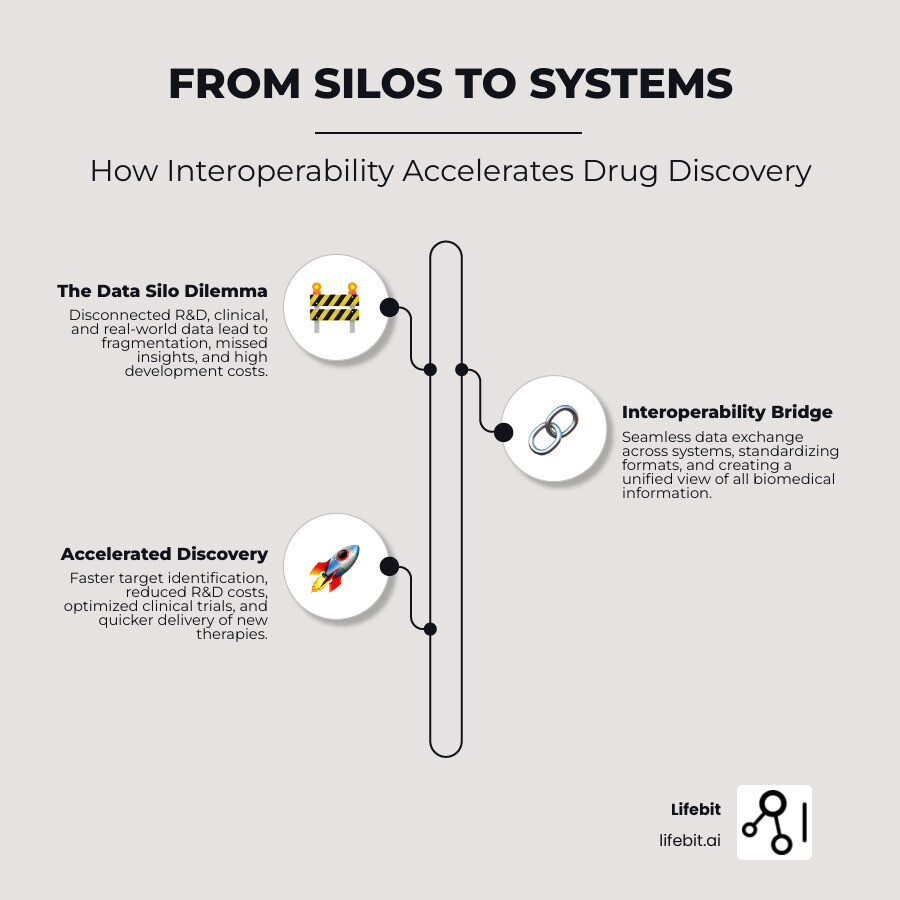
The pharmaceutical industry’s digital potential is shackled by data silos—invisible walls that prevent information sharing. These are not minor technical issues but fundamental barriers to innovation. As one expert noted, “The single biggest issue holding back drug findy is that most teams overlook the significance of data.” This creates a paradox: we’re drowning in data but starving for insights.
The scale of the problem is staggering. A typical clinical trial juggles 40+ data sources, each operating in its own format. This “massive fragmentation” creates a puzzle with pieces that don’t fit. The challenge is compounded across every stage of development:
R&D Data: Foundational research from genomics, proteomics, high-throughput screening (HTS), and preclinical studies is generated using varied protocols and proprietary instrument software. Data from a single experiment can be spread across different file formats (e.g., spreadsheets, images, specialized binary files), making it nearly impossible to compare results from one assay to another, let alone integrate them to identify promising drug targets. Potential connections that could reveal a compound’s novel mechanism of action are lost.
Clinical Trial Data: The ecosystem of clinical trial management is notoriously fragmented. A Clinical Trial Management System (CTMS) tracks operational data, an Electronic Data Capture (EDC) system holds patient case report forms, an Interactive Response Technology (IRT) system manages patient randomization and drug supply, and electronic Patient-Reported Outcome (ePRO) platforms collect data directly from patients. Each system speaks a different language, forcing data managers into a heroic but inefficient effort to manually reconcile information to get a holistic view of patient safety and efficacy.
Real-World Data (RWD): Information from Electronic Health Records (EHRs), insurance claims databases, disease registries, and patient wearables offers immense value for understanding disease progression and treatment effectiveness in routine practice. However, this data is notoriously diverse, unstructured, and inaccessible. A staggering 80% of healthcare data is unstructured, locked away in clinical notes, pathology reports, and discharge summaries. Without advanced tools like Natural Language Processing (NLP), these rich narrative insights remain untapped.
Genomics and Multi-Omics Data: The explosion of sequencing data—including genomics, transcriptomics, proteomics, and metabolomics—is a double-edged sword. While incredibly powerful for understanding disease biology, these datasets are massive, often measured in petabytes, and highly complex. Integrating these multi-modal datasets to build a complete biological picture is a significant computational and methodological challenge, especially without standardized data models and analytical pipelines.
Legacy and “Dark” Data: Pharmaceutical companies sit on decades of historical research and clinical trial information. Much of this is “dark data”—valuable information that is effectively lost. It may be stored on outdated media, lack the necessary metadata to be understood, or be in formats that are no longer supported. Without a way to resurrect and integrate this data, organizations are forced to re-run expensive experiments and miss out on insights from past successes and failures.
The consequences are severe: redundant experiments, delayed go/no-go decisions, spiraling costs, and, ultimately, a slower pace of delivering life-saving treatments to patients. This is why the shift From Silos to Systems: How Interoperability Is Accelerating Drug Findy is not just a technical upgrade but a core strategic imperative. By enabling data to flow freely and intelligently, we can unlock the immense value trapped within these systems and fundamentally transform the drug development paradigm.
From Silos to Systems: How Interoperability Is Accelerating Drug Findy
Interoperability acts as a universal translator for your data, allowing different systems to communicate, exchange, and use shared information. In drug development, it creates a connected ecosystem where data flows securely across the entire lifecycle, from target identification to post-market surveillance.

By breaking down silos, researchers and clinicians gain a unified, real-time view of all relevant data. This eliminates the time-consuming and error-prone process of hunting through multiple portals, spreadsheets, and databases, empowering faster, more informed decisions. The strategic shift From Silos to Systems: How Interoperability Is Accelerating Drug Findy is a fundamental reimagining of pharmaceutical research, turning a “patchwork of disconnected systems” into a cohesive, intelligent network that drives innovation.
The Tangible Benefits: Speed, Cost, and Efficiency
The impact of interoperability is concrete and measurable. Integrating the 40+ data sources in a typical clinical trial reduces manual data entry, minimizes reconciliation errors, and dramatically accelerates timelines. This newfound efficiency translates directly into lower R&D costs and a faster path to market, allowing brilliant researchers to focus on science, not data wrangling.
Currently, only 32% of companies extract value from their data, and just 27% find their analytics “highly actionable.” This “data-value gap” is a direct result of silos. Interoperability, guided by the FAIR principles (Findable, Accessible, Interoperable, Reusable), is the bridge that closes this gap.
The benefits are clear and transformative:
- Reduced timelines: Seamless data exchange eliminates critical delays. For instance, automating the aggregation and cleaning of data from just five disparate sources in a Phase III trial can save data management teams hundreds of hours per study. This can shorten the crucial data-lock-to-submission timeline by several weeks, bringing a successful drug to patients sooner.
- Better resource allocation: A unified data view enables the principle of “failing fast and cheap.” By integrating preclinical safety data with early clinical biomarker data, researchers can spot a potential lack of efficacy or an unexpected safety signal much earlier. This allows them to terminate unpromising projects before a company invests hundreds of millions of dollars in a large-scale Phase III trial that is destined to fail.
- Improved data quality: Interoperability is impossible without robust data standardization and harmonization. This process ensures cleaner, more reliable datasets by mapping different terminologies (e.g., ‘myocardial infarction,’ ‘heart attack,’ and ‘MI’) to a single, standardized concept using ontologies like MeSH or SNOMED CT. This prevents the classic “garbage in, garbage out” problem, ensuring that analytics and AI models are built on a foundation of high-quality, trustworthy data. Modern pay-as-you-go models for data platforms also make this advanced infrastructure accessible without prohibitive upfront capital investment.
From Silos to Systems: How Interoperability is Accelerating Drug Findy in Practice
The power of interoperability is most evident in the most challenging research areas. For rare diseases, which collectively affect 263 to 466 million people globally, patient data is scarce and geographically dispersed. In this context, data silos are devastating, but interoperability offers a lifeline. Collaborative platforms allow researchers from different institutions to securely analyze pooled data without physically moving it, protecting patient privacy while enabling the large-scale studies needed to find new treatments. Initiatives like the Rare Disease Cures Accelerator-Data and Analytics Platform (RDCA-DAP®) exemplify this, turning fragmented information into a powerful collective asset.
At Lifebit, our federated AI platform enables this secure, distributed analysis. It allows patient data to be analyzed across institutions in London, New York, or Europe without the data ever leaving its source, facilitating global collaboration while ensuring strict privacy compliance.
Other key applications include:
- Precision medicine in oncology: Interoperability allows for the creation of comprehensive patient profiles by integrating genomic data (e.g., tumor mutations), imaging data (e.g., PET scans), and clinical outcomes. This enables the identification of patient sub-populations who respond best to a targeted therapy, moving beyond a “one-size-fits-all” approach to enable truly personalized cancer treatments.
- Population health studies: During the COVID-19 pandemic, the need for rapid, cross-system data analysis became a matter of global urgency. Interoperability allows public health agencies to analyze data from hospitals, labs, and government systems in near real-time to track disease patterns, monitor vaccine effectiveness, and evaluate public health interventions with unprecedented speed and accuracy.
The Tech Toolkit: Platforms and Standards Enabling the Revolution
Moving From Silos to Systems: How Interoperability Is Accelerating Drug Findy requires a combination of the right technology and universally adopted standards. Modern cloud platforms, data fabrics, and knowledge graphs provide the core infrastructure to connect diverse datasets, enabling a fundamental shift from siloed applications to a unified architecture where data flows securely to where it’s needed.
A data fabric is an architectural approach that abstracts away the technical complexities of accessing data from different locations and formats. Unlike a centralized data lake, which requires moving all data to one place, a data fabric creates a virtualized layer that connects to data sources in-situ. It uses active metadata, semantics, and AI to automate data integration, governance, and discovery, providing a unified, real-time view without the massive overhead and security risks of data migration.
At Lifebit, our federated AI platform is built on this principle. It enables secure, real-time access to global biomedical data with built-in harmonization, AI/ML analytics, and federated governance. Our components—Trusted Research Environment (TRE), Trusted Data Lakehouse (TDL), and R.E.A.L. (Real-time Evidence & Analytics Layer)—deliver insights and secure collaboration, ensuring data is available and analysis-ready without compromising security.
Federated learning is a transformative technology that trains AI models on distributed data without centralizing it, a critical capability for preserving privacy and data sovereignty. This allows for training a single, robust model on sensitive patient data from hospitals in London, New York, and Tokyo without that data ever leaving the protection of its source institution’s firewall.

Knowledge graphs are another powerhouse technology for interoperability. They organize R&D data by modeling it as a network of entities (like genes, diseases, and drugs) and the relationships between them, using domain-specific ontologies. For example, a knowledge graph could link the gene ‘BRCA1’ to the protein it encodes, which is then linked to ‘increased risk of breast cancer.’ This node, in turn, could be connected to ‘PARP inhibitors’ as a class of drugs, and further to a specific drug like ‘Olaparib.’ By traversing these connections, researchers can ask complex questions like, ‘Which drugs target proteins associated with genes mutated in this specific patient cohort?’—a query that is nearly impossible with siloed, tabular data.
The Role of Standards in From Silos to Systems: How Interoperability Is Accelerating Drug Findy
Technology alone isn’t enough; standardization is the bedrock of true interoperability. Without common languages and formats, data exchange remains chaotic and inefficient.
- The FAIR Guiding Principles for scientific data management (Findability, Accessibility, Interoperability, Reusability) provide a crucial, high-level framework. They are not a standard themselves but a set of goals for making data ready for machines and humans, maximizing its value for reuse and large-scale analysis.
- HL7 and FHIR (Fast Healthcare Interoperability Resources) are vital for exchanging healthcare data. FHIR is a modern standard built around ‘Resources’—modular components like ‘Patient,’ ‘Observation,’ and ‘MedicationRequest’—that can be easily combined and exchanged via modern web APIs. This makes it far more flexible and developer-friendly than older, more rigid standards, enabling seamless communication between EHR systems, mobile apps, and research platforms.
- CDISC (Clinical Data Interchange Standards Consortium) provides a suite of global standards for clinical and non-clinical research data. Key CDISC models include the Study Data Tabulation Model (SDTM) for organizing and formatting data collected in trials, and the Analysis Data Model (ADaM) for data prepared for statistical analysis. Adherence to these standards is now expected or required by regulatory bodies like the FDA and PMDA, making them essential for efficient and predictable regulatory submissions.
- Data ontologies and standardized vocabularies (like MeSH, SNOMED CT, and LOINC) are fundamental for achieving semantic interoperability. They provide a controlled, hierarchical set of terms and concepts that allow machines to understand the meaning and context of data. Our platform’s harmonization capabilities leverage these ontologies to ensure that diverse data sources are all speaking the same language.
Embracing these standards and technologies together is what creates a truly connected system, accelerating the journey From Silos to Systems: How Interoperability Is Accelerating Drug Findy and turning the promise of integrated data into a practical, everyday reality.
Paving the Way: Strategies for Overcoming Interoperability Problems
The path to interoperability is paved with challenges, but they are often not technical. As one expert noted, “The technology to achieve interoperability already exists. The real barriers… are… systemic and structural.” The hardest challenges are human, cultural, and organizational.
- Legacy Systems and Technical Debt: Many pharmaceutical companies rely on older, proprietary software that was built for a specific purpose and never designed to communicate with other systems. These legacy platforms are often complex, poorly documented, and expensive to replace or integrate with modern, cloud-native platforms, creating significant technical debt that hinders progress.
- Cultural Resistance and Data Hoarding: Teams and departments accustomed to working in silos may be protective of “their” data, viewing it as a source of power or control. This “hoarding mentality” is a major obstacle. It often manifests as ‘data ownership’ disputes, where a department views its data as a proprietary asset rather than a shared organizational resource. Overcoming this requires clear, consistent communication on the benefits of From Silos to Systems: How Interoperability Is Accelerating Drug Findy for everyone, demonstrating how sharing data makes everyone’s job easier and more impactful.
- Regulatory and Governance Complexities: Strict data privacy regulations like GDPR in Europe and HIPAA in the US, combined with intellectual property (IP) concerns, make organizations understandably cautious about data sharing. Navigating these rules is complex. For example, under GDPR, moving EU citizen data outside the EU is heavily restricted. A federated governance model directly addresses this by enabling secure collaboration while maintaining data sovereignty. An AI algorithm can be sent to the data’s location within the EU, trained locally, and only the aggregated, non-identifiable model insights are returned, achieving the research goal without violating data residency laws.
A successful transition requires a strategic business change, not just an IT project. It demands a holistic approach with clear leadership and a focus on people and processes.
Key strategies include:
- Secure Executive Buy-In and Sponsorship: The initiative must be championed by senior leadership. C-suite sponsors must articulate a clear vision, allocate the necessary funding and resources, and tie the interoperability program to concrete business goals, such as reducing clinical trial cycle times by 15% or decreasing R&D costs.
- Establish Robust, Federated Data Governance: Develop clear policies for data quality, security, access, and sharing. This means creating a formal Data Governance Council with representatives from R&D, clinical, legal, and IT. This council is responsible for defining data stewardship roles, setting policies for data access control, and creating a master data management (MDM) strategy to ensure a single source of truth for critical data entities.
- Foster a Collaborative, Data-Literate Culture: Promote the formation of cross-functional teams that bring together scientists, clinicians, data scientists, and IT experts. Invest in training programs to build data literacy across the organization and, most importantly, explain the “why” behind the change to build enthusiasm and momentum from the ground up.
- Prioritize Data Quality and Standardization: Implement stringent data quality control processes from day one. Meaningful insights require high-quality data—garbage in, garbage out. This includes adopting and enforcing standards like CDISC and using controlled vocabularies across all systems.
- Use a Phased, Value-Driven Implementation: Avoid a “big bang” approach. Start with well-defined pilot projects that can demonstrate tangible benefits quickly. A good pilot might focus on a single therapeutic area, integrating data from preclinical studies and Phase I trials to improve target validation. The success of this pilot, measured by metrics like reduced time to decision or identification of a new biomarker, provides a powerful business case for broader, enterprise-wide adoption.
| Feature | Siloed Approach (Traditional) | Interoperable Approach (Modern) |
|---|---|---|
| Data Accessibility | Limited to specific departments/systems; manual transfer | Real-time access across the organization and partners |
| Data Consistency | Inconsistent formats, terminologies; high error rate | Standardized formats, controlled vocabularies; high data quality |
| Decision-Making | Based on incomplete views; delayed insights | Informed by holistic, real-time data; accelerated decisions |
| R&D Costs | Higher due to redundant efforts, rework, and delays | Lower due to efficiency, optimized resource use |
| Time to Market | Prolonged due to data bottlenecks and manual processes | Significantly reduced through streamlined workflows |
| Collaboration | Difficult; limited information sharing | Seamless; improved cross-functional and external partnerships |
| AI/ML Potential | Limited by fragmented, inconsistent data; “garbage in, garbage out” | Maximized by harmonized, high-quality, large-scale datasets |
| Regulatory Compliance | Complex, manual aggregation for submissions | Streamlined with standardized, traceable data |
The table above illustrates the transformative contrast between a siloed and an interoperable approach. While the challenges are real, the right strategy, leadership, and mindset can successfully steer the journey from fragmented systems to a connected, insight-driven ecosystem.
The Future is Connected: AI, Automation, and the Next Frontier
The future of drug findy is a connected, intelligent ecosystem where the potential for AI and machine learning explodes. Interoperability provides the rich, harmonized datasets AI needs to thrive, moving us toward “self-driving labs” where AI designs experiments, analyzes results, and predicts outcomes.

This is already happening. Generative AI is revolutionizing molecule design, with projections that by 2025, over 30% of new drugs and materials will be finded using these techniques. AI is no longer just analyzing data; it’s creating new possibilities because interoperable data gives it a comprehensive view.
Key impacts of AI include:
- Predictive Analytics: AI can predict a compound’s toxicity or efficacy early, reducing dead ends and wasted investment. The quality of the data foundation determines the quality of AI outcomes.
- Target Identification: By integrating multi-omics, clinical, and real-world data, AI can rapidly identify novel therapeutic targets and biomarkers that are impossible for humans to spot.
- Clinical Trial Optimization: AI can optimize trial design, identify ideal patient cohorts, and monitor responses in real-time, leading to more efficient trials and fewer late-stage failures.
The ultimate goal is precision medicine at scale. Our federated AI platform enables researchers across London, New York, and the five continents we serve to analyze an individual’s unique profile to predict treatment responses. This is about treating patients, not just diseases.
A data science roadmap for open science highlights how a unified approach to data accelerates progress for everyone. Our platform components (TRE, TDL, and R.E.A.L.) are designed to power this future, enabling secure collaboration. The connected ecosystem from From Silos to Systems: How Interoperability Is Accelerating Drug Findy is what makes this possible, open uping the full potential of biomedical data.
Conclusion: Your Journey from Data Chaos to Findy
The pharmaceutical industry is at a crossroads: continue with fragmented data and slow progress, or accept a connected future where AI accelerates findy and patients get treatments faster.
Moving From Silos to Systems: How Interoperability Is Accelerating Drug Findy is the most important change in R&D today. It’s the difference between drowning in data and extracting value, between a $2 billion, decade-long process and a dramatically faster, cheaper one.
The path forward involves embracing interoperable platforms, standardizing data formats, breaking down organizational silos, and fostering a data-sharing culture. This is a strategic business imperative, not an IT project. The rewards are immediate: reduced timelines, lower R&D costs, improved collaboration, and AI-powered insights.
Our federated AI platform is built to power this transition. It enables secure, real-time analysis of distributed biomedical data across continents while maintaining compliance with GDPR and HIPAA. Our Trusted Research Environment (TRE), Trusted Data Lakehouse (TDL), and R.E.A.L. (Real-time Evidence & Analytics Layer) deliver the insights you need, securely.
The future of medicine is connected and intelligent. The technology exists, and the standards are being adopted. The only question is whether you will lead this change. Your journey from data chaos to findy starts here.
Discover our federated AI platform and see how we’re helping organizations across five continents turn fragmented data into medical breakthroughs.