

How to Build a Healthcare Consortium Data Sharing Framework: A Step-by-Step Guide
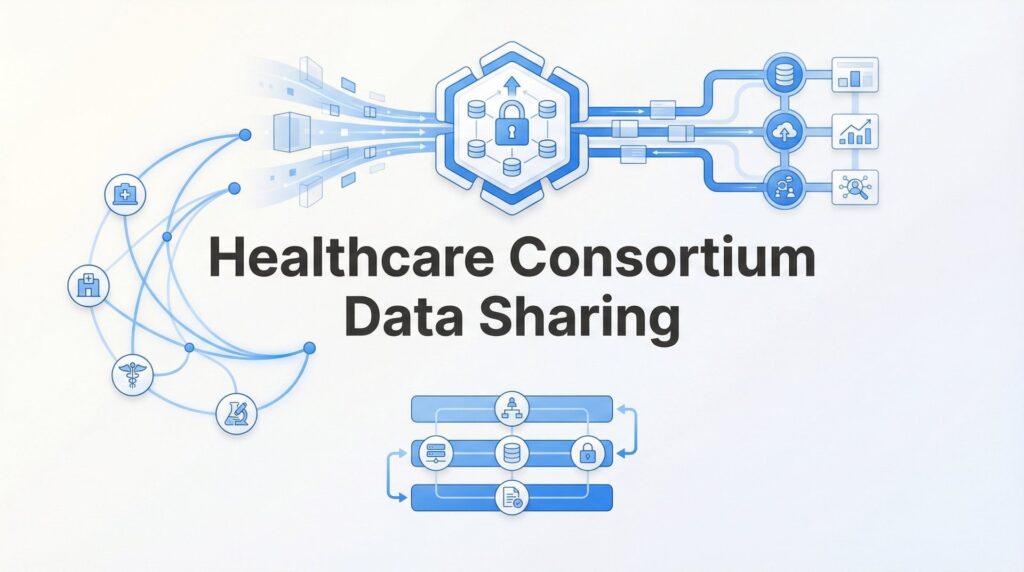
Healthcare consortia sit on goldmines of data. Multi-institutional genomic studies. Population health records spanning millions of patients. Clinical trial data that could accelerate drug discovery by years.
Yet most of this data stays locked in silos—not because organizations don’t want to share, but because they don’t know how to share safely.
The technical barriers are real: incompatible data formats, conflicting privacy regulations across jurisdictions, security requirements that seem impossible to reconcile. But the bigger problem is process. Most consortium data sharing initiatives fail not because of technology, but because of unclear governance, misaligned incentives, and poor execution.
This guide walks you through the exact steps to build a healthcare consortium data sharing framework that actually works. You’ll learn how to structure agreements that protect all parties, implement technical infrastructure that maintains compliance, and create governance models that scale.
Whether you’re launching a new multi-site research collaboration or trying to unlock data across an existing hospital network, these steps will get you from locked silos to actionable insights.
No theoretical frameworks. No vague best practices. Just the concrete actions you need to take, in the order you need to take them.
Step 1: Define Your Data Sharing Objectives and Use Cases
Before you write a single policy document or build any infrastructure, answer one question: What specific problem are you solving?
The consortia that fail start with “let’s share everything and see what happens.” The ones that succeed start with targeted use cases that deliver clear value to all participants.
Begin by identifying the specific research questions or operational goals your consortium will address. Are you trying to identify rare disease biomarkers across patient populations? Accelerate clinical trial recruitment? Build predictive models for treatment response? Each use case drives different data requirements, governance structures, and technical approaches.
Document which data types each partner needs to contribute and which they need to access. This isn’t symmetric. A pharmaceutical company might contribute clinical trial data while needing access to real-world evidence from hospital systems. An academic medical center might share genomic data while needing demographic information from community health organizations.
Create a simple matrix: Partner name, data they contribute, data they need access to, specific use cases they’re pursuing. This becomes your foundation for everything that follows.
Establish success metrics before you start building. What does “working” look like for this consortium? Is it the number of research publications produced? Time saved in patient recruitment? New drug targets identified? Revenue generated from commercialized discoveries?
These metrics serve two purposes. First, they keep the consortium focused on outcomes rather than process. Second, they provide the justification each partner needs to continue investing resources as the initiative scales.
Here’s the trap to avoid: Treating data sharing as the goal instead of the means. Data sharing is infrastructure. The goal is what you do with that infrastructure—better patient outcomes, faster research cycles, more efficient operations.
Your success indicator for this step: Every participating organization can articulate in one sentence why they’re joining and what they expect to gain. If you’re getting vague answers about “advancing science” or “collaboration,” you’re not ready to move forward.
Document everything. These initial use cases and objectives become the north star when governance discussions get complicated or technical decisions feel overwhelming.
Step 2: Map Regulatory Requirements Across All Participating Institutions
This is where most consortia discover the real complexity of healthcare data sharing. Each institution brings its own compliance obligations, and they rarely align neatly.
Start with a comprehensive audit of each partner’s regulatory requirements. In the United States, that means HIPAA at the federal level, but also state-specific privacy laws that vary significantly. California’s CMIA, New York’s SHIELD Act, and similar statutes in other states can impose requirements beyond HIPAA.
For European partners, GDPR sets the baseline, but individual countries often add their own health data protections. The UK has the Data Protection Act, Germany has BDSG, France has specific requirements for health data processing. If your consortium spans multiple countries, you’re navigating all of these simultaneously.
Create a compliance matrix that maps out what’s permissible under each framework. The rows are potential data sharing activities: storing data in the cloud, transferring data across borders, allowing third-party access, using data for commercial purposes. The columns are each applicable regulation.
Fill in the matrix with clear yes/no/conditional answers. This document becomes your reference for every technical and governance decision.
Here’s the critical insight: Identify the most restrictive requirements across all partners. These become your baseline. If one partner operates under GDPR while another operates under HIPAA, your consortium framework needs to satisfy both. You can’t create a lowest-common-denominator approach because each partner remains individually liable under their own regulations. Understanding healthcare data compliance requirements is essential for multi-jurisdictional consortia.
Pay particular attention to cross-border data transfer restrictions. GDPR’s requirements for transferring data outside the European Economic Area are stringent. Standard Contractual Clauses or adequacy decisions may be required. Some countries prohibit health data from leaving national borders entirely.
This is where federated architectures often become necessary. If regulations prevent data movement but allow collaborative analysis, you need technical infrastructure that enables computation without extraction.
Document every institutional policy that goes beyond regulatory requirements. Academic medical centers often have IRB protocols that restrict data sharing even when regulations would permit it. Government health agencies may have political constraints that aren’t captured in formal regulations.
Your success indicator: You can answer “Is this allowed?” for any proposed data sharing activity within 60 seconds by consulting your compliance matrix. If you’re still saying “we need to check with legal,” your mapping isn’t complete.
This step takes time. Budget weeks, not days. But cutting corners here creates compliance incidents later that can shut down your entire consortium.
Step 3: Establish Governance Structure and Decision-Making Protocols
A healthcare data sharing consortium without clear governance is a committee that talks about data sharing. With clear governance, it’s an operational capability that delivers results.
Start by defining roles with specific decision rights. Don’t create committees without clear mandates.
You need data stewards at each institution who are responsible for their organization’s data contributions, quality, and compliance. These aren’t committee members, they’re operational roles with day-to-day responsibilities.
Create a data access committee that reviews and approves requests to use consortium data. This committee should include representatives from each partner institution, but also have clear voting procedures. Unanimous consent sounds collaborative but creates gridlock. Majority voting with specific veto rights for compliance concerns works better.
Appoint technical leads responsible for infrastructure decisions, security protocols, and system operations. These individuals need authority to make technical choices without requiring full committee approval for every configuration decision.
Include legal representatives with the authority to interpret agreements and resolve disputes. When questions arise about whether a proposed use falls within existing Data Use Agreements, you need someone who can provide an answer, not another meeting.
Document your decision-making protocols for common scenarios. How are data access requests approved? What’s the timeline from submission to decision? Who can appeal a denial? What happens when partners disagree on policy changes? Implementing AI-enabled data governance can streamline many of these processes.
Create clear processes for onboarding new members. As your consortium grows, you need standardized procedures for evaluating potential partners, negotiating terms, and integrating their data. Ad hoc approaches don’t scale.
Set up voting mechanisms for policy changes. Simple majority for operational updates, supermajority for changes to core governance documents, unanimous consent for modifications to data use restrictions. Put the thresholds in writing before you need them.
Build in dispute resolution procedures. When conflicts arise—and they will—you need a defined escalation path. Start with working group discussion, escalate to executive committee review, include mediation provisions before resorting to formal legal processes.
Here’s what successful governance looks like in practice: A researcher submits a data access request. The data access committee reviews it within two weeks. If approved, the researcher gains access within five business days. If denied, they receive specific feedback and can resubmit with modifications. Everyone knows the timeline, the criteria, and the process.
Your success indicator for this step: Every stakeholder knows exactly who decides what. When someone asks “Who approves this?” or “How do we resolve this disagreement?” the answer is immediate and documented.
Governance isn’t bureaucracy when it’s designed well. It’s the operating system that lets your consortium function at scale.
Step 4: Design Your Technical Architecture for Secure Data Access
The technical architecture you choose determines what’s possible, what’s compliant, and what’s sustainable as your consortium scales. Get this wrong and you’ll be rebuilding infrastructure while trying to serve active users.
You have three fundamental approaches: centralized, federated, or hybrid.
Centralized architectures pool all data into a single repository. This simplifies queries and enables comprehensive analysis, but it requires every partner to transfer data out of their control. For many healthcare institutions, this violates internal policies or regulatory requirements. It also creates a single point of failure for security and compliance.
Federated architectures keep data at each institution while enabling collaborative analysis. Queries are distributed to each partner’s environment, results are aggregated centrally, but raw data never moves. This maintains institutional control and often satisfies regulations that prohibit data transfer. The tradeoff is technical complexity and potentially slower query performance. Our federated data sharing complete guide covers these architectures in depth.
Hybrid approaches combine both models. Common or de-identified data might be centralized for fast access, while sensitive or regulated data remains federated. This balances performance with compliance, but requires careful design to prevent re-identification risks.
For most healthcare consortia in 2026, federated architectures are winning. The compliance benefits outweigh the technical complexity, especially as platforms have matured to make federation operationally feasible.
Implement secure research environments where analysis happens without data extraction. These are isolated workspaces where approved researchers can run queries, build models, and generate insights, but cannot download raw patient records. Think of them as clean rooms for data science. Trusted research environments have become the gold standard for this approach.
Build automated audit trails from day one. Every query, every access, every export needs to be logged with timestamps, user identities, and purpose documentation. This isn’t just for compliance—it’s how you identify usage patterns, optimize performance, and demonstrate value to stakeholders.
Implement role-based access controls that map to your governance structure. Data stewards get administrative access. Approved researchers get query access scoped to their approved use cases. Auditors get read-only access to logs and metadata. No one gets blanket access to everything.
Plan for data egress controls. Results and insights need to leave the secure environment, but they need to be reviewed first. Automated checks can flag potential re-identification risks. Manual review processes can verify that outputs comply with data use restrictions. This is where AI-automated airlock systems provide significant value—they enable secure, compliant data exports without creating bottlenecks.
Your technical architecture should support your governance model, not fight it. If your governance requires approval before data access, your technical systems should enforce that approval workflow. If your legal agreements restrict certain types of analysis, your infrastructure should make those restrictions technically enforceable.
Success indicator: A new researcher can go from approved access request to running their first query in under one day, and every action they take is automatically logged and auditable.
Step 5: Harmonize Data Standards and Implement Quality Controls
You can build perfect governance and flawless infrastructure, but if the data from different institutions can’t talk to each other, you don’t have a consortium. You have a collection of isolated datasets with shared paperwork.
Start by selecting common data models that all partners will map their data to. For observational health data, OMOP (Observational Medical Outcomes Partnership) has become the de facto standard. For clinical interoperability, HL7 FHIR provides structured formats for exchanging health information. For genomic data, domain-specific standards like VCF for variants or BAM for sequence alignments are essential.
The choice of standard matters less than commitment to a standard. Trying to support multiple incompatible models creates exponential complexity. Pick one, document it, and require all partners to map their data to it. Understanding healthcare data integration standards is critical for this phase.
Create detailed data dictionaries that define every field, every code, every permissible value. When one institution codes diabetes as “E11” and another uses “250.00,” you need mapping protocols that translate both to a common representation.
This is where AI-powered harmonization platforms deliver massive value. What used to take teams of data engineers 12-18 months can now be accomplished in weeks. Automated mapping tools can identify equivalent concepts across different coding systems, flag inconsistencies, and generate transformation pipelines. Learn more about AI for data harmonization to accelerate your timeline.
Establish quality thresholds before accepting data into the consortium. What percentage of records can have missing values for critical fields? What level of coding accuracy is acceptable? What temporal consistency checks must data pass?
Build validation pipelines that catch issues before data enters the shared environment. Check for impossible values—birth dates in the future, negative ages, medications prescribed before they were approved. Verify referential integrity—every diagnosis links to a valid patient, every prescription links to a valid medication code.
Create feedback loops with data stewards at each institution. When validation catches errors, send specific reports back to the source. “Your submission from March 15 has 2,847 records with invalid procedure codes” is actionable. “Some data quality issues detected” is not.
Document your harmonization process so new partners can follow it. Include sample mappings, common transformation patterns, and troubleshooting guides for frequent issues. Every institution that joins shouldn’t have to reinvent the wheel.
Plan for versioning. Data standards evolve. ICD-10 gets updated. SNOMED releases new versions. Your harmonization pipelines need to handle multiple versions of source data and provide clear provenance for every transformation.
Here’s the reality: Perfect harmonization is impossible. You’re balancing speed, cost, and quality. Set good-enough thresholds based on your use cases. Research requiring exact medication dosages needs higher quality than studies analyzing broad treatment patterns.
Success indicator: A researcher can query across all partner datasets using a single set of concepts and codes, and get back results that are meaningfully comparable. If they’re still manually reconciling different coding systems, harmonization hasn’t succeeded.
Step 6: Draft and Execute Legal Agreements
Everything you’ve built so far needs legal protection. Governance structures need contractual authority. Technical systems need liability coverage. Data sharing needs explicit permissions.
Your core legal documents are Data Use Agreements, Business Associate Agreements (for HIPAA-covered entities), and consortium operating agreements that define the overall partnership.
Data Use Agreements specify exactly what data can be used for which purposes by whom. These need to be specific. “Research purposes” is too vague. “Identifying biomarkers for treatment-resistant depression in patients aged 18-65” is specific enough to evaluate compliance.
Include explicit provisions for data ownership and intellectual property. Who owns discoveries made using consortium data? How are publication rights allocated? What happens if a partner develops a commercial product based on consortium research? Address these questions in founding documents, not after a breakthrough discovery creates conflict.
Business Associate Agreements are required when HIPAA-covered entities share protected health information. These define each party’s responsibilities for safeguarding data, reporting breaches, and maintaining compliance. Our guide on HIPAA compliant data analytics covers these requirements in detail. If your consortium includes hospitals, health systems, or health plans, you need BAAs in place before any data moves.
Build in clear exit provisions. What happens when a partner leaves the consortium? Do they retain access to data they contributed? Do they lose access to insights generated from their data? Can they take their data with them? Can the consortium continue using data they previously contributed?
These questions feel premature when everyone is excited about launching, but they’re critical when relationships sour or priorities change.
Include indemnification provisions that clarify who bears liability for different types of failures. If a data breach occurs at one institution, who’s responsible? If a researcher misuses data, who faces regulatory penalties? Clear allocation of risk prevents legal battles when incidents occur.
Here’s a practical tip: Start with a pilot agreement covering limited use cases and limited data. Prove the model works with lower stakes before executing comprehensive agreements that are harder to modify.
A pilot agreement might cover a single research question, involve three partners instead of ten, and run for six months. This lets you test governance processes, validate technical infrastructure, and identify agreement terms that need refinement.
Once the pilot succeeds, expand to full consortium agreements with confidence that the terms are workable.
Work with legal counsel who understand healthcare data sharing, not generic contract attorneys. The regulatory landscape is specialized. The risk profile is unique. You need lawyers who’ve done this before.
Success indicator: All partners have signed agreements in place before any data is accessed. No handshake deals. No “we’ll formalize this later.” Signed documents that would hold up in court.
Step 7: Launch, Monitor, and Iterate Your Data Sharing Operations
You’ve defined objectives, mapped compliance requirements, established governance, built technical infrastructure, harmonized data standards, and executed legal agreements. Now comes the hard part: making it work in practice.
Start with a controlled pilot. Limited users, limited data, limited use cases. This isn’t lack of ambition—it’s smart risk management. You want to identify operational issues when the stakes are low.
Select a pilot use case that’s valuable but not mission-critical. If the system goes down, if data quality issues emerge, if governance processes create bottlenecks, you want to discover these problems before they derail high-stakes research.
Invite a small group of researchers to be your first users. Choose people who are technically capable, patient with early-stage systems, and willing to provide detailed feedback. They’re partners in refinement, not just users.
Track key metrics from day one. Time from access request to approval—if this is taking weeks, your governance processes have bottlenecks. Query success rates—if researchers are getting frequent errors, your data harmonization needs work. System uptime and performance—if infrastructure is unreliable, adoption will stall. Implementing health data analytics best practices helps ensure you’re measuring what matters.
Monitor compliance incidents obsessively. Every unauthorized access attempt, every failed audit check, every data quality issue needs to be logged, investigated, and resolved. Build a culture where small compliance gaps are caught and fixed before they become major violations.
Schedule regular governance reviews to update policies based on real-world usage. Your initial governance framework was built on assumptions. Now you have data. What approval processes are creating unnecessary delays? What restrictions are blocking legitimate research? What risks did you underestimate?
Iterate based on evidence, not opinions. If data shows that 90% of access requests are approved within 24 hours but 10% take three weeks, investigate the outliers. What’s different about those requests? Can you create fast-track processes for common patterns?
Plan for scale from the beginning. What works with three partners and five researchers will break with thirty partners and fifty researchers. Think about what breaks first: Is it governance bottlenecks? Technical performance? Data quality processes? Legal agreement execution?
Build automation into your operational processes. Manual reviews don’t scale. Automated checks with human oversight for edge cases do scale. Every process you design should answer: “How does this work when volume increases 10x?”
Create feedback loops with all stakeholders. Regular surveys of researchers: What’s working? What’s frustrating? What would make you use the consortium more? Check-ins with data stewards: What’s consuming their time? What could be automated? Where do they need support?
Success indicator: Your consortium is handling real research, generating real insights, and operating smoothly enough that users focus on their science rather than the infrastructure.
Putting It All Together
Building a healthcare consortium data sharing framework isn’t a one-time project. It’s an ongoing operational capability that requires continuous investment, monitoring, and refinement.
The steps above give you the foundation: clear objectives that align all partners, mapped compliance requirements that prevent regulatory violations, solid governance that enables decisions at scale, secure technical infrastructure that maintains control while enabling collaboration, harmonized data standards that make cross-institutional analysis possible, executed legal agreements that protect all parties, and a launch plan with built-in iteration.
Your checklist for launch readiness: All partners have signed Data Use Agreements with explicit permissions and restrictions. Your governance committee is operational with documented processes for access requests, policy changes, and dispute resolution. Technical environment is deployed and security-tested with automated audit trails active. Data harmonization pipelines are validated and producing consistent, queryable datasets. Monitoring systems are tracking usage, performance, and compliance metrics.
A pilot use case is defined with specific success metrics and a small group of users ready to provide feedback.
The consortia that succeed treat data sharing as infrastructure, not a project. They invest in the governance and technical capabilities that make secure collaboration repeatable. They recognize that the value isn’t in the data itself—it’s in what researchers can discover when barriers to collaboration are removed.
Start with one use case. Prove it works. Demonstrate value to stakeholders. Then scale to additional use cases, additional partners, additional impact.
The technical landscape has evolved significantly. Federated architectures that seemed experimental five years ago are now proven at scale. AI-powered harmonization tools have collapsed timelines from months to weeks. Automated governance systems have made compliance manageable even across complex regulatory environments.
The organizations building national precision medicine programs, accelerating biopharma research pipelines, and enabling cross-institutional discovery aren’t doing it with centralized data lakes and manual processes. They’re using modern infrastructure that keeps data under institutional control while enabling collaborative analysis.
If you’re ready to move from locked silos to actionable insights, the path forward is clear. Define your objectives. Map your requirements. Build your governance. Deploy your infrastructure. Harmonize your data. Execute your agreements. Launch, monitor, iterate.
The data is there. The technology exists. The regulatory frameworks are navigable. What’s needed is execution. Get started for free and see how modern platforms can accelerate your timeline from concept to operational data sharing.