

How to Incorporate Digital Endpoints for Clinical Trial Success

Digital Endpoint Technology for Clinical Trials: Stop Missing Data, Start 24/7 Monitoring
Digital endpoint technology for clinical trials is changing how we measure patient health in research studies. Here’s what you need to know:
- What it is: Wearable devices, smartphone apps, and sensors that collect health data remotely from patients’ homes
- Key benefit: Replaces episodic clinic visits with continuous, real-world measurements
- Current adoption: 378 unique digital endpoints are actively used by 104 sponsors across multiple therapeutic areas
- Major advantages: Higher-frequency data collection, reduced patient burden, improved recruitment and retention, and more realistic health insights
- FDA support: The agency anticipates these technologies will improve trial participation and capture novel measures previously difficult to assess
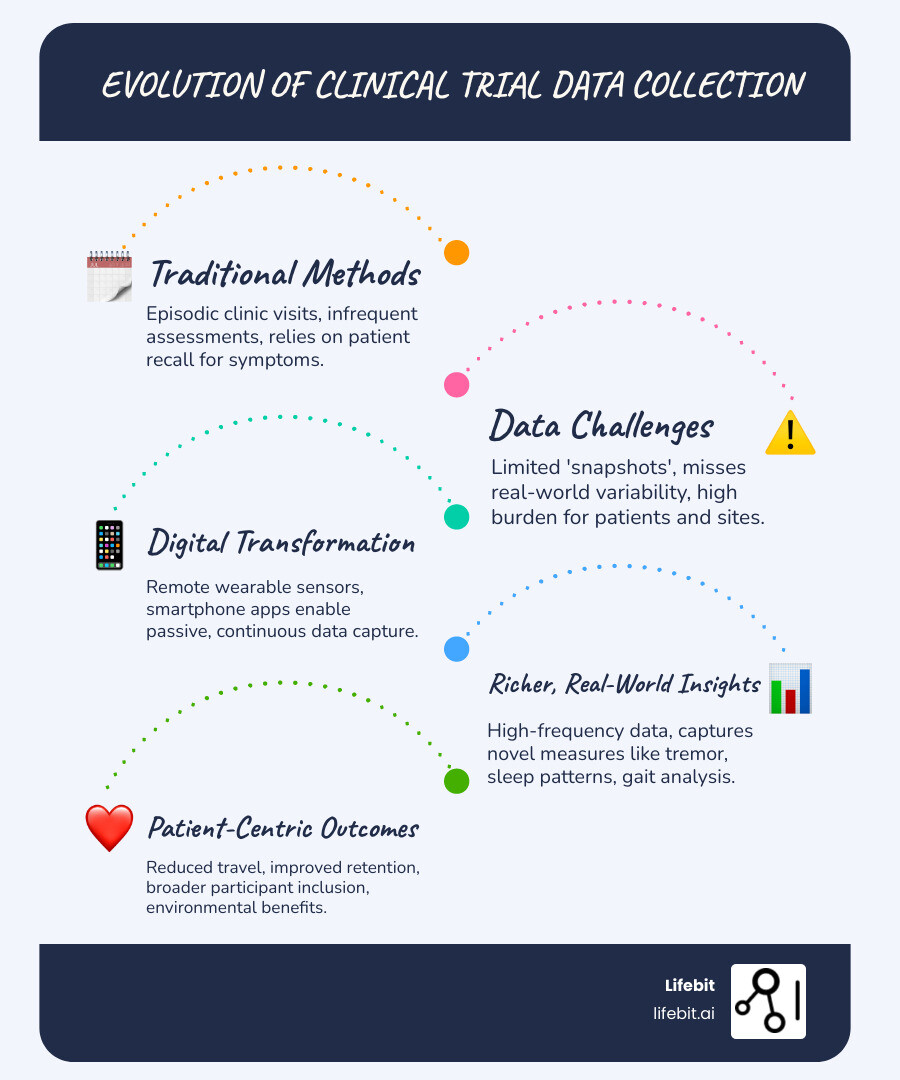
Traditional clinical trials rely on snapshots of patient health captured during occasional clinic visits. A patient might walk six minutes in a hospital corridor once every few months, or complete a questionnaire trying to remember symptoms from the past week. These methods miss what happens in between—the tremors at 3 AM, the breathlessness climbing stairs at home, the sleep patterns that reveal disease progression.
Digital health technologies flip this model. Instead of asking patients to travel to clinics for intermittent assessments, we can now collect data passively and continuously from wherever patients live their lives. Wearable sensors track heart rate, oxygen saturation, and physical activity around the clock. Smartphone apps capture patient-reported outcomes in real time. Medical-grade devices measure parameters like blood pressure, glucose levels, and respiratory function without requiring clinic infrastructure.
The impact is measurable. Digital endpoints can reduce the burden on patients and caregivers while capturing data that more realistically reflects individuals’ daily experiences. They enable trials to include participants who face physical barriers, cognitive disabilities, or geographical distance from research sites. And by minimizing travel, they reduce both financial costs and environmental impacts—though the carbon footprint of device manufacturing and data storage must still be considered.
As Dr. Maria Chatzou Dunford, CEO and Co-founder of Lifebit, I’ve spent over 15 years working at the intersection of genomics, AI, and health-tech innovation, helping pharmaceutical and public sector organizations harness digital endpoint technology for clinical trials through secure, federated data platforms. My work focuses on changing how researchers access and analyze biomedical data to accelerate precision medicine and drug findy.
Basic digital endpoint technology for clinical trials glossary:
- Clinical Research SaaS: The Tech Stack Behind Modern Trials
- current systems and technology in clinical trials
- remote monitoring in clinical trials
Digital Endpoint Technology for Clinical Trials: Why Site Visits Are Killing Your Data
The shift toward digital endpoint technology for clinical trials isn’t just a trend; it’s a fundamental restructuring of evidence generation. Currently, 378 unique digital endpoints are being deployed by 104 different sponsors. This rapid adoption is driven by the need for more sensitive, objective, and ecologically valid data. Traditional site visits are “episodic snapshots.” They capture how a patient functions in a sterile, artificial environment under the watchful eye of a clinician. This often leads to the “White Coat Effect,” where patients perform better or show different physiological signs than they do in their natural environment. In contrast, digital endpoints provide a continuous health picture. By capturing data in “free-living” conditions, we see the true impact of a therapy on a patient’s daily life. This transition is essential for patient-centricity, as it significantly reduces the travel burden on participants, making trials more accessible to those who don’t live near major academic medical centers.
Furthermore, the environmental impact of trials is a growing concern. By decentralizing assessments, we reduce the carbon emissions associated with patient and staff travel. However, we must balance this against the “hidden” footprint of manufacturing thousands of wearable devices and the energy required for large-scale data storage and analysis. According to research on digital endpoint definitions and benefits, these technologies allow for substantially more frequent measurements, which increases statistical power and may even allow for smaller sample sizes or shorter trial durations. This efficiency is critical in early-phase trials where “go/no-go” decisions must be made rapidly based on subtle signals of efficacy.
Capturing Novel Measures with Digital Endpoint Technology for Clinical Trials
One of the most exciting aspects of digital endpoint technology for clinical trials is its ability to measure things we simply couldn’t track before. Consider Parkinson’s disease: instead of a once-a-month tremor rating in a clinic, we can now use accelerometers to monitor tremor intensity and frequency 24/7. This allows researchers to see the “wearing-off” effect of medications in real-time, which is often missed during a scheduled clinic visit.
Other novel measures include:
- Gait Analysis and Walking Bout Length: Moving beyond the “6-minute walk test” to see how far and how well a patient walks during a normal day. This includes measuring cadence, stride length, and asymmetry, which are powerful indicators of neurological and musculoskeletal health.
- Sleep Patterns: Using actigraphy to replace expensive and intrusive in-lab polysomnography. Digital tools can track sleep architecture, latency, and fragmentation over weeks, providing a much more representative view of a patient’s rest than a single night in a sleep lab.
- Continuous Glucose Monitoring (CGM): Providing a minute-by-minute view of metabolic health. CGMs allow researchers to see glycemic variability and time-in-range, which are more predictive of long-term outcomes than a single HbA1c measurement.
- Pediatric Breathing: In respiratory trials, emerging technologies like impulse oscillometry or forced-oscillation techniques are being explored for children who struggle with traditional spirometry. These passive measures allow for high-quality data collection without requiring the intense coordination needed for traditional lung function tests.
- Oncology Performance Status: Wearables can track a patient’s physical activity levels as a proxy for the Eastern Cooperative Oncology Group (ECOG) performance status. This provides an objective measure of how a patient is tolerating a new chemotherapy or immunotherapy regimen in their daily life.
Our Lifebit platform plays a crucial role here by allowing researchers to securely aggregate these diverse, high-frequency datasets with multi-omic data, creating a holistic view of the patient that was previously impossible to achieve. By correlating digital biomarkers with genomic variations, we can begin to understand why certain patients respond differently to treatments at a granular, physiological level.
Improving Recruitment and Retention Through Reduced Participant Burden
The FDA has been vocal about its support for Digital Health Technologies (DHTs). They anticipate that reducing the “friction” of trial participation—the long drives, the time off work, the uncomfortable clinic procedures—will naturally improve recruitment and retention. When trials are less burdensome, they become more inclusive. digital endpoint technology for clinical trials facilitates the inclusion of:
- Patients in remote or rural areas who cannot commit to frequent travel to urban research hubs.
- Individuals with physical or cognitive disabilities for whom travel is a major logistical and physical barrier.
- Pediatric and elderly populations who benefit from monitoring in a familiar, comfortable environment, reducing the stress that can often skew physiological data.
By enabling real-time evaluation, sponsors can also intervene earlier if a patient is struggling with a device, providing the support needed to keep them engaged in the study. This proactive approach transforms the patient-investigator relationship from a series of formal check-ins to a continuous, supportive partnership.
Digital Endpoint Technology for Clinical Trials: 5 Steps to Regulatory-Grade Data
Integrating DHTs isn’t as simple as handing out smartwatches. It requires a rigorous, multi-step strategy to ensure the data is regulatory-grade and can withstand the scrutiny of health authorities like the FDA and EMA.
- Fit-for-Purpose Matching: Start with the “Concept of Interest” (COI). What exactly are you trying to measure? Is it physical activity, sleep quality, or heart rate variability? Once the COI is defined, you must establish the “Context of Use” (COU). A device that is fit-for-purpose for monitoring a healthy athlete may not be appropriate for a patient with advanced heart failure. Ensure the device is scientifically capable of measuring that specific parameter in your specific target population.
- Therapeutic Expert Consultation: Medical experts must weigh in on whether a digital measure is clinically meaningful. For example, in respiratory trials, sticking to established spirometry is often necessary until newer technologies like impulse oscillometry gain full regulatory acceptance. Experts help bridge the gap between “what we can measure” and “what matters to the patient’s health.”
- Risk-Based Manufacturer Qualification: Use a checklist to vet your technology partners. Do they meet ISO standards for medical devices? Can they handle global logistics? You must assess their financial stability to ensure they won’t go out of business mid-trial, leaving you with unsupported hardware.
- Global Logistics and Shipping: Shipping medical devices across borders involves complex customs requirements, local battery regulations (especially for lithium-ion), and regional certifications (like CE marking in Europe). You need a robust plan for device delivery, retrieval, and environmentally responsible disposal or refurbishment.
- Data Security and Scalability: Ensure the infrastructure can handle millions of data points while maintaining strict GCP (Good Clinical Practice) compliance. This includes end-to-end encryption, robust audit trails, and clear data provenance to ensure the integrity of every byte of data collected.

Ensuring Data Quality in Digital Endpoint Technology for Clinical Trials
To satisfy regulators, you must prove your digital endpoint is accurate. The industry uses the V3 Framework, which is the gold standard for validating digital health technologies:
- Verification: This is the technical phase. Does the hardware accurately measure the physical parameter? For example, if a device uses an accelerometer, does it record movement correctly when tested on a calibrated shake table? This ensures the sensor itself is reliable.
- Analytical Validation: Does the algorithm correctly turn that raw data into a health measure? For instance, does the software correctly interpret raw acceleration data as “steps” or “tremor frequency”? This often involves comparing the device’s output against a reference standard in a controlled setting.
- Clinical Validation: This is the most critical step. Does the measure actually correlate with how a patient feels, functions, or survives in the context of the specific disease? If a device shows an increase in “daily steps,” does that actually mean the patient’s heart failure is improving? Clinical validation requires prospective studies to prove the digital endpoint is a meaningful surrogate or direct measure of clinical benefit.
The FDA guidance on DHTs for remote data acquisition emphasizes that software should be device-agnostic where possible to allow for eSource integration. This eliminates manual data entry, reducing errors and administrative burden. It also allows for “Bring Your Own Device” (BYOD) models, though these come with their own set of validation challenges regarding screen size and operating system variability.
Best Practices for Site and Patient Training
Even the best technology fails if it isn’t used correctly. Successful trials prioritize the “human element” to ensure high compliance rates:
- Customized Materials: Avoid generic manuals. Create short, visual videos and “quick start” guides custom to the specific study. These should be written at a 6th-grade reading level to ensure accessibility.
- 24/7 Local Language Support: If a device stops syncing at 9 PM in Singapore, the patient needs help in their own language immediately. Technical frustration is a leading cause of patient withdrawal in digital trials.
- Psychometric Analysis: Test your training materials before the trial starts. Do patients actually understand how to wear the device after watching the video? Use “teach-back” methods to verify comprehension.
- Investigator Enthusiasm: Research shows that when site staff are excited about the technology, patient adherence increases. Sites need to be partners, not just data collectors. Providing sites with dashboards that show patient compliance can help them provide targeted encouragement during check-ins.
Digital Endpoint Technology for Clinical Trials: Stop Missing Data and Safety Risks
Operating a trial with digital endpoint technology for clinical trials introduces unique problems that traditional trials rarely face. One of the biggest is the “Missing Not At Random” (MNAR) data. This happens when a patient stops wearing a device because they feel too sick, or perhaps because the device is uncomfortable or stigmatizing. If you don’t account for why the data is missing, your results will be biased. For example, if only the healthiest patients continue to wear their sensors, the drug might appear more effective than it actually is. Advanced statistical methods, such as pattern-mixture models or multiple imputation, are required to address these gaps and ensure the trial’s conclusions remain valid.
Proactive Patient Safety and Ethical Considerations
Remote monitoring offers a massive safety advantage: real-time alerts. If a wearable detects a dangerous drop in oxygen saturation or a heart rate spike, the site can be notified immediately, potentially preventing a serious adverse event. However, this requires “Threshold Metrics”—pre-defined ranges that trigger a clinical review. Setting these thresholds too low leads to “alarm fatigue” for clinicians, while setting them too high might miss critical safety signals.
Ethical considerations are also paramount as we move into the patient’s home. We must address:
- Bystander Privacy: What happens if a smart-home sensor or a microphone-based respiratory app captures data from a non-consenting family member? Researchers must implement “privacy by design,” ensuring that only the participant’s data is analyzed and that background noise or secondary individuals are filtered out.
- Power Imbalances: Ensuring patients don’t feel “surveilled” or pressured by the technology. Consent must be ongoing, and patients should feel empowered to remove the device if they feel uncomfortable without fear of being removed from the trial.
- Data Ownership: Patients are increasingly demanding access to their own digital health data. Sponsors must decide early on whether they will share raw or interpreted data back with the participants, balancing transparency with the need to maintain the trial’s blinding.
- Ethics Clubs: Some forward-thinking trials establish “ethics clubs” or embedded ethics teams to meet regularly and discuss unforeseen issues as they arise in the real world. This allows for agile ethical oversight that evolves with the technology.
Managing Holistic Data Aggregation and Analysis
Managing the data deluge is a significant challenge. A single trial with 100 patients using continuous sensors can generate millions of data points per day. This requires a shift from traditional data management to a “Data Science” approach.
- Time-Synchronized Aggregation: If a patient uses three different devices (e.g., a watch, a patch, and a smart scale), their data must be perfectly synchronized. This allows researchers to see how heart rate, activity, and oxygen levels interact at a specific moment, providing a multi-dimensional view of physiology.
- Automatic Edit Checks: Use AI-driven software to clean data in real-time. These systems can flag outliers, such as a heart rate of 300 bpm, which likely indicates a sensor malfunction rather than a clinical event, allowing for immediate correction before the data reaches the analysis phase.
- Proprietary vs. Open-Source: Be wary of proprietary algorithms that can change without notice during a multi-year trial. If a manufacturer updates their firmware, it could change how “steps” are calculated, ruining your longitudinal analysis. Open-source algorithms provide the transparency and consistency needed for regulatory submissions.
- The BYOD Debate: While “Bring Your Own Device” (BYOD) can increase patient comfort and reduce costs, it introduces technical noise. Different smartphones have different sensors and processing power. Sponsors must decide if the benefit of patient familiarity outweighs the need for the standardized hardware of provisioned devices.
Digital Endpoint Technology for Clinical Trials: How to Meet FDA Standards Faster
We are in a “golden age” of regulatory clarity for DHTs. The FDA’s PDUFA VII commitments include specific goals for advancing digital endpoint technology for clinical trials, including five public workshops and several demonstration projects. This regulatory tailwind is encouraging sponsors to move digital endpoints from secondary or exploratory objectives to primary endpoints.
International bodies are also making strides. The EMA recently qualified the “Stride Velocity 95th Centile” (SV95C) as a primary endpoint for Duchenne Muscular Dystrophy. This was a landmark moment, as it was the first time a digital measure captured by a wearable was accepted as a primary measure of drug efficacy in a regulatory submission. It proved that with the right validation, digital measures can replace traditional clinical scales.
To keep this momentum, we need pre-competitive collaboration. Organizations like the Digital Medicine Society (DiMe), the Critical Path Institute (C-Path), and the Joint FDA/FNIH Workshop for Digital Measures are working to standardize terminology and validation frameworks. Without a common language, we spend too much time explaining what we measured instead of what the results mean. Initiatives like the “Sensor Data Model” are helping to standardize how raw sensor data is stored and shared, making it easier for regulators to review data from different manufacturers.
Standardizing Digital Measures That Matter to Patients
The ultimate goal is to create “digital measures that matter to patients.” This requires qualitative research to understand what patients actually care about. In many cases, clinical scales focus on things that are easy to measure but don’t reflect the patient’s quality of life. For example, in chronic obstructive pulmonary disease (COPD), a clinician might care about FEV1 (forced expiratory volume), but a patient cares about whether they can walk to the mailbox without stopping or play with their grandchildren.
By involving patients early in the design of Core Outcome Sets (COS), we ensure that the digital endpoints we choose are not just technically impressive, but clinically and personally meaningful. This patient-focused approach not only satisfies regulatory requirements for “Patient-Focused Drug Development” (PFDD) but also ensures that the drugs being developed provide real-world value that payers and patients will recognize.
Digital Endpoint Technology for Clinical Trials: Your Top Questions Answered
What is the difference between a digital measure and a digital endpoint?
A digital measure is the raw data or the specific metric captured by a device (e.g., average heart rate or steps per day). A digital endpoint is the specific variable used in a clinical trial to test a hypothesis about a drug’s safety or efficacy (e.g., the change in average daily steps from baseline to week 12). Essentially, the measure is the “what,” and the endpoint is the “so what” in the context of the study.
How does the FDA view digital health technologies in drug development?
The FDA is highly supportive and views DHTs as a way to make trials more inclusive, efficient, and representative of real-world patient experiences. They have established a DHT Steering Committee to provide internal consistency and encourage sponsors to engage early through the Type C meeting process. They are particularly interested in how DHTs can capture data from underrepresented populations.
Can digital endpoints reduce the carbon footprint of a clinical trial?
Yes, significantly. By reducing the number of required site visits, digital endpoints lower the carbon emissions associated with patient and staff travel, which is often the largest contributor to a trial’s environmental impact. However, sponsors must also consider the lifecycle of the hardware. This includes using recyclable materials, implementing device refurbishment programs, and choosing cloud service providers that use renewable energy for data storage.
What are the biggest technical hurdles in implementing digital endpoints?
The primary hurdles include data interoperability (getting different devices to talk to each other), battery life (ensuring devices don’t die and cause data gaps), and the “data deluge” (having the infrastructure to process and analyze terabytes of raw sensor data). Additionally, maintaining a consistent software environment over a multi-year trial is a major challenge, as operating system updates can sometimes break data collection apps.
How do digital endpoints impact trial costs?
While the initial setup costs for hardware and data infrastructure can be higher than traditional trials, digital endpoints often lead to long-term savings. By providing more sensitive data, they can reduce the required sample size and shorten trial durations. Furthermore, improved patient retention reduces the high costs associated with recruiting replacement participants.
Digital Endpoint Technology for Clinical Trials: Scale Your Research with Lifebit AI
As we move toward a future of decentralized and hybrid research, digital endpoint technology for clinical trials will become the standard, not the exception. The ability to capture rich, continuous, real-world data offers an unprecedented opportunity to understand disease and treatment response.
At Lifebit, we provide the next-generation federated AI platform that makes this possible. Our technology enables secure, real-time access to global biomedical and multi-omic data without the risks of moving sensitive information. With built-in capabilities for data harmonization and advanced AI/ML analytics, we help you turn the massive volumes of data generated by DHTs into actionable insights.
Whether you are looking for real-time insights, AI-driven safety surveillance, or secure collaboration across a hybrid data ecosystem, our Trusted Research Environment (TRE) and Real-time Evidence & Analytics Layer (R.E.A.L.) are built to power your most complex research needs.
Discover how Lifebit can power your digital endpoint strategy