

How to Stop Data Silos with Modern Collaboration Platforms

Stop Data Silos: How Federated Platforms Accelerate Research by 24% Yearly
Data collaboration platforms are secure, privacy-first systems that let multiple organizations analyze shared datasets without moving, copying, or exposing raw data. They use privacy-enhancing technologies (PETs) like encryption, differential privacy, and federated learning to open up insights across silos—while keeping sensitive information under strict governance and control.
Key capabilities of modern data collaboration platforms:
- Secure multi-party analysis – Run queries and AI models across distributed datasets without transferring raw data
- Privacy-enhancing technologies (PETs) – Use encryption, differential privacy, and federated learning to protect sensitive information
- Real-time governance – Maintain audit trails, access controls, and consent frameworks across all collaborations
- Cross-cloud and cross-platform flexibility – Connect data from any cloud, region, or system without ETL pipelines
- Advanced analytics and AI – Deploy machine learning, SQL, Python, and other languages on shared data in secure environments
These platforms are replacing legacy data clean rooms and CDPs in healthcare, pharma, public health, and regulatory research—where compliance, speed, and data quality determine whether insights reach patients in time.
As third-party cookies disappear and privacy regulations tighten, organizations are turning to data collaboration solutions to unify insights, personalize experiences, and measure impact more effectively. The data collaboration market is forecast to grow at a 24% CAGR over the next three years, with spending in the United States expected to reach billions as capabilities mature and enterprise use cases expand.
I’m Maria Chatzou Dunford, CEO and Co-founder of Lifebit, where we’ve built a *data collaboration platform that powers federated analysis across 275M+ patient records for pharma, public health, and regulatory organizations.* Over the past decade, I’ve seen how data silos slow drug discovery, delay safety signals, and prevent life-saving insights from reaching the people who need them most.**
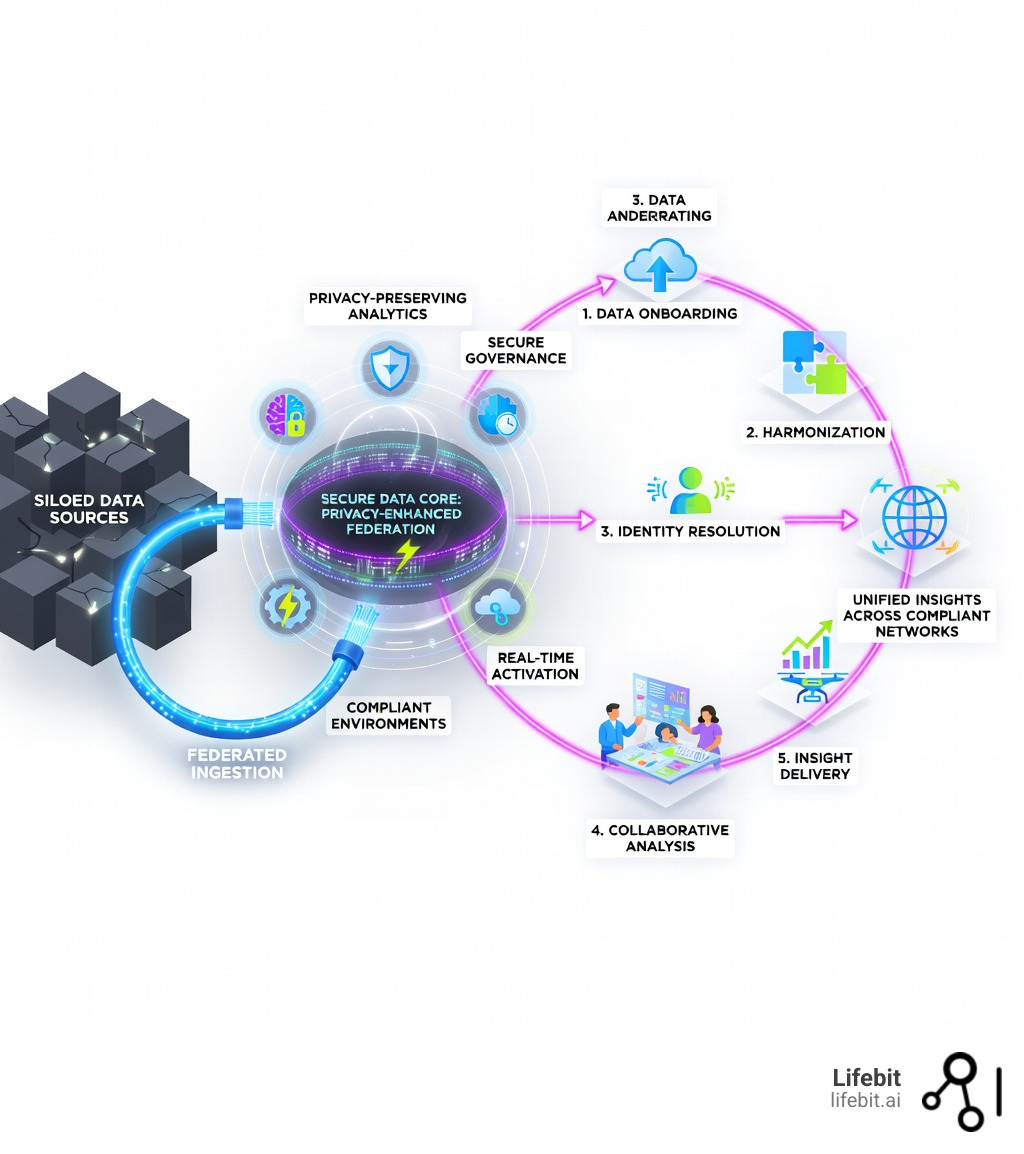
What is a Data Collaboration Platform? Break Silos Without Moving Data
At its core, a Data collaboration platform (DCP) is a technological process that involves combining and analyzing data within a company or alongside partners for various purposes. According to the Interactive Advertising Bureau (IAB), these platforms turn raw data into actionable insights by breaking down the walls that traditionally separate internal departments and external partners.
For us, the significance of a DCP lies in its ability to turn compliance from a “blocker” into a strategic enabler. When 92% of the advertising ecosystem is reachable through collaborative networks and billions of records are siloed in hospitals, the old way of “sending a file” is dead. We use DCPs to foster trusted data collaboration where the data stays put, but the insights travel.
The Evolution: From Data Warehousing to Federated Collaboration
To understand the modern DCP, one must look at the history of data management. In the 2000s, the focus was on the Data Warehouse—centralizing all internal data into one massive repository. In the 2010s, we saw the rise of the Data Lake, which allowed for unstructured data storage. However, both models shared a fatal flaw: they required data movement. Moving data is expensive, creates security vulnerabilities, and often violates modern residency laws like the GDPR or the Saudi Arabian PDPL.
A Data Collaboration Platform represents the third wave. It acknowledges that data has “gravity” and is often too sensitive or too large to move. Instead of bringing the data to the code, a DCP brings the code to the data. This shift from “Data Ownership” to “Data Access” allows organizations to collaborate across borders and legal jurisdictions without ever losing control of their primary asset.
How Data Collaboration Platforms Go Beyond Legacy Tools
You might be wondering: “Don’t I already have a Customer Data Platform (CDP) or a Data Clean Room?” Here is the punchline: legacy tools often focus on a single “point” in the data journey.
- CDPs are great for unifying your internal first-party data for marketing automation. However, they struggle with external data enrichment and lack the heavy-duty security required for sensitive biomedical or financial datasets.
- Traditional Data Clean Rooms often act as “black boxes” where you drop data in, get a report out, and lose the ability to perform deep, iterative analysis. They are often tied to a single provider (like Google or Amazon), creating “walled gardens” that prevent cross-platform collaboration.
A modern Data collaboration platform supports the full data lifecycle—from ingestion and harmonization to advanced AI activation. It handles both known and unknown audiences, allowing brands and researchers to enrich their first-party data with external sources without the security risks of data movement. It provides a “neutral ground” where multiple parties can interact with data under a unified governance framework.
| Feature | Legacy Clean Rooms | Modern DCPs |
|---|---|---|
| Data Movement | Requires copying/moving data | Zero-ETL (Data stays in place) |
| Analytics | Mostly SQL-based | SQL, Python, R, and AI/ML |
| Scalability | Limited to 1:1 partnerships | Multi-party (up to 9+ partners) |
| Governance | Manual/Point-in-time | Automated/Federated |
| Interoperability | Locked to one cloud provider | Cross-cloud and hybrid-cloud |
Why Modern Marketing Demands a Data Collaboration Platform
The “Cookie-pocalypse” isn’t a myth—it’s the new reality. With Google Chrome shifting third-party cookies to user-controlled settings and privacy regulations like GDPR and CCPA tightening, the old methods of tracking are failing. Marketers can no longer rely on third-party data brokers to build audience profiles.
Modern marketing now requires a consent-first architecture. A Data collaboration platform provides the identity resolution needed to connect disparate signals—like a shopper’s search on a retailer app and their purchase in a physical store—without ever exposing their Personally Identifiable Information (PII). This is the essence of federated data sharing: achieving precision targeting while maintaining 100% privacy compliance. By using a DCP, brands can build “Retail Media Networks” (RMNs), allowing them to monetize their first-party data by letting advertisers run queries against it in a secure, privacy-preserving environment.
4 Essential Features for Secure, Scalable Data Collaboration
If you are shopping for a Data collaboration platform, don’t get distracted by flashy dashboards. You need a platform built on a “federated” foundation. This means the architecture connects to secure data sources where they live—across different clouds (AWS, Google Cloud, Azure) and regions—without requiring a massive, expensive migration.

Key features we recommend looking for:
- Zero-ETL Integration: You shouldn’t have to build complex pipelines just to see your data. A modern DCP uses connectors that “read” data in its native format, whether it’s in a Snowflake warehouse, a Postgres database, or an S3 bucket. This reduces the time-to-insight from months to minutes.
- Identity Resolution: The ability to match records using both deterministic (exact matches like email) and probabilistic (statistical likelihood) methods. This is crucial for creating a 360-degree view of a customer or patient across different datasets.
- Multi-Party Computation (MPC): Allowing multiple stakeholders (like a retailer and five CPG brands) to analyze joint data simultaneously. MPC ensures that no single party can see the other parties’ input data, only the final aggregated result.
- Scalability and Orchestration: The platform must handle petabytes of data and thousands of concurrent jobs. This requires a sophisticated orchestration layer that can manage compute resources across different geographic locations while maintaining a single “pane of glass” for the user.
These features are what make federated data analysis possible at an enterprise scale.
Privacy-Enhancing Technologies (PETs) and Security Standards
Security is the heartbeat of data collaboration. Modern platforms use a “sandwich” of Privacy-Enhancing Technologies to ensure data safety. It is no longer enough to simply “encrypt data at rest.” You must protect the data while it is being used.
- Homomorphic Encryption: This is the “holy grail” of data privacy. It allows users to perform calculations on encrypted data without ever decrypting it. The result, when decrypted, is the same as if the operation had been performed on the plaintext.
- Differential Privacy: This involves adding mathematical “noise” to datasets. For example, if a researcher asks for the average age of patients with a specific condition, differential privacy ensures that the answer is accurate enough for science but “noisy” enough that no individual patient’s age can be reverse-engineered from the result.
- Trusted Execution Environments (TEEs): Also known as “enclaves,” these are hardware-level security features (like Intel SGX) that create a protected area within a computer’s processor. Even the person with administrative access to the server cannot see what is happening inside the enclave.
- Federated Learning: Instead of moving data to a central server to train an AI model, the model is sent to the data. The model “learns” from the local data and only sends back the mathematical updates (weights). This is how Google improves predictive text on millions of phones without reading your private messages.
For a deeper dive, check out our guide to federated learning applications.
Analytics and AI Integration for Advanced Insights
We are moving beyond simple “audience counts.” The future of the Data collaboration platform is AI-driven. Large Language Models (LLMs) like GPT-4 are being integrated to help non-technical users query data using natural language. Imagine a marketing manager asking, “Which customer segment in the Northeast region is most likely to churn in the next 30 days based on our partner’s loyalty data?” and getting a predictive model in seconds.
However, LLMs aren’t “plug-and-play.” They require high-quality, harmonized data to function. A true DCP automates this harmonization, using AI to map different data schemas together. For instance, it can automatically recognize that “CustID” in one database and “UserSerial” in another refer to the same entity. This is where AI for federation becomes a game-changer for speed and accuracy, removing the manual labor that typically consumes 80% of a data scientist’s time.
How Retail, Finance, and Pharma Use Data Collaboration to Win
Data collaboration isn’t just for tech giants. It is changing how everyday businesses operate by allowing them to tap into “second-party data”—data that is shared directly between trusted partners.
Retail & CPG: The Rise of Retail Media
In the retail world, a fashion brand can collaborate with a supermarket chain to target “diaper buyers” with toddler clothing ads. Traditionally, the supermarket would have to sell a CSV file of its customers to the brand—a massive privacy risk. With a Data collaboration platform, the brand can run an analysis against the supermarket’s data to find the overlap, without the supermarket ever sharing its customer list. This creates a new revenue stream for retailers and higher ROI for brands.
Financial Services: Fighting Fraud and Improving KYC
Banks use collaborative analytics to improve Know Your Customer (KYC) processes and detect fraud across different institutions. If a fraudster is attempting to open accounts at five different banks simultaneously, no single bank might see the pattern. However, by using a DCP, the banks can share “risk signals” without sharing private customer details. This collective intelligence makes the entire financial system more resilient to money laundering and identity theft.
Automotive: Predictive Maintenance and Supply Chain
Manufacturers can analyze real-time sensor data from thousands of vehicles alongside insurance claims and dealership service records. By collaborating with parts suppliers, they can predict when a specific batch of components is likely to fail, allowing for proactive recalls that save lives and reduce costs.
By using a research collaboration platform, organizations can move from “guessing” to “knowing” with surgical precision.
Accelerating Biomedical Research and Public Health
This is where we at Lifebit live and breathe. In the life sciences, the stakes are higher than “clicks”—they are lives. Data collaboration platforms allow pharma companies to access multi-omic (genomic, proteomic, etc.) and clinical data from global biobanks to identify new drug targets.
Consider the challenge of rare diseases. A single hospital might only have two patients with a specific genetic mutation—not enough for a clinical trial. But if a researcher can use a DCP to query 50 hospitals globally, they can find a cohort of 100 patients.
Instead of waiting months for data access agreements and physical transfers, researchers use federated “Trusted Research Environments” (TREs) to run analysis in hours. This accelerates pharmacovigilance (safety monitoring) and clinical trial optimization. For example, during a public health crisis, federated platforms allow officials to track the spread of a virus and the effectiveness of vaccines in real-time across different healthcare providers without compromising patient confidentiality. The benefits of federated data lakehouses in this sector are clear: faster cures, safer drugs, and lower costs.
5 Steps to Launch a Secure Data Collaboration Strategy
Ready to break your silos? Transitioning to a federated model requires more than just software; it requires a shift in strategy. Follow this roadmap to ensure a successful implementation:
-
Needs Assessment & Use Case Definition: Identify where your data is stuck. Is it an internal silo between marketing and sales, or a gap in partner insights? Define a specific business question you want to answer, such as “What is the lifetime value of customers who interact with both our brand and our partner’s app?”
-
Platform Selection & Compliance Audit: Look for a Data collaboration platform that supports your specific cloud environment (multi-cloud is usually best) and compliance needs (GDPR, HIPAA, SOC2, etc.). Ensure the platform has been audited by third-party security firms and supports the PETs mentioned earlier.
-
Phase 0: Cultural and Legal Readiness: Before the tech is deployed, align your legal and data governance teams. Data collaboration often fails not because of technology, but because of “legal gridlock.” Establish a Master Collaboration Agreement (MCA) that defines the rules of engagement for all future data partnerships.
-
Pilot Projects (The 1:1 Test): Start with a 1:1 partnership. For example, a real estate firm and a local media company might analyze 30,000 profiles to find new audience overlaps. Use this pilot to measure the “Time to Value” and identify any friction points in the data harmonization process.
-
Scaling & Ecosystem Building: Once the pilot shows ROI, bring in more collaborators. Modern federated platforms allow multiple partners to collaborate simultaneously while maintaining full data sovereignty. As you scale, use federated data governance to monitor who is accessing what and ensure consent is always respected. This creates a “flywheel effect” where more data leads to better insights, which attracts more partners.
Data Collaboration FAQ: Security, ROI, and Implementation
Is data collaboration secure for highly sensitive information?
Absolutely. In fact, it is significantly more secure than traditional data sharing. By using PETs like differential privacy and homomorphic encryption, the raw data is never exposed to the partner or even to the platform provider. You are sharing the mathematical answer to a question, not the raw data itself. This “Zero-Trust” approach is why DCPs are used by national health services and global banks.
Can I use a data collaboration platform without a legacy data management tool?
Yes. In fact, many modern DCPs are designed to sit “on top” of your existing infrastructure. You don’t need to have a perfectly cleaned data warehouse to start. The platform can connect to your data where it currently lives—whether that’s a legacy on-premise server or a modern cloud bucket—and handle the harmonization on the fly.
How does data collaboration boost marketing ROI?
It eliminates waste. Instead of “spray and pray” advertising based on outdated third-party segments, you use enriched partner insights to reach the exact shoppers who are actually interested in your product. In real-world CPG use cases, this has led to a 5x increase in conversion rates and a 30% reduction in customer acquisition costs (CAC).
What is the difference between a Data Clean Room and a Data Collaboration Platform?
While the terms are often used interchangeably, a Data Collaboration Platform is broader. A Data Clean Room is typically a destination where data is matched. A Data Collaboration Platform is an infrastructure that enables clean rooms, federated learning, and cross-cloud analytics. DCPs are generally more flexible, supporting more languages (Python, R) and more complex AI workflows than a standard clean room.
How do these platforms handle international data residency laws?
This is one of their greatest strengths. Because the data never leaves its original region, a researcher in the US can analyze data stored in the UK or the EU without violating residency requirements. The DCP manages the “federated query,” sending the computation to the local data and only bringing the non-sensitive results back across the border.
The Future of Intelligence: Stop Moving Data, Start Collaborating
The era of hoarding data in isolated silos is over. The future belongs to the collaborators. We are moving toward a world of “full-stack orchestration,” where AI-driven safety, consent-aware architectures, and real-time insights are the norm.
At Lifebit, we are proud to be at the forefront of this shift, providing the Lifebit Federated Biomedical Data Platform to help the world’s leading organizations solve their most complex data challenges. Whether you are in retail, finance, or healthcare, the message is clear: Stop moving data. Start collaborating.
Ready to open up your data’s potential? Book a free consultation with a data collaboration expert today.