

Join the Journey: Discovering Recruiting Clinical Trials

Recruiting Clinical Trials: How to Fix the 76% Enrollment Failure Rate
The process of recruiting clinical trials is crucial for advancing medicine, yet it presents one of the most significant problems in bringing new treatments to patients. Many trials fail to meet enrollment goals, causing delays and lost opportunities for medical breakthroughs.
If you’re looking to find actively recruiting clinical trials, here’s how to quickly narrow your search:
- Start with a keyword: Enter the condition, treatment, or even a specific university.
- Filter by ‘Recruiting’ status: This ensures you only see studies currently seeking participants.
- Specify location and age: Refine your search to trials near you that fit demographic criteria.
- Select study phase and type: Choose between interventional (testing treatments) or observational studies, and specific phases (e.g., Phase 2, Phase 3).
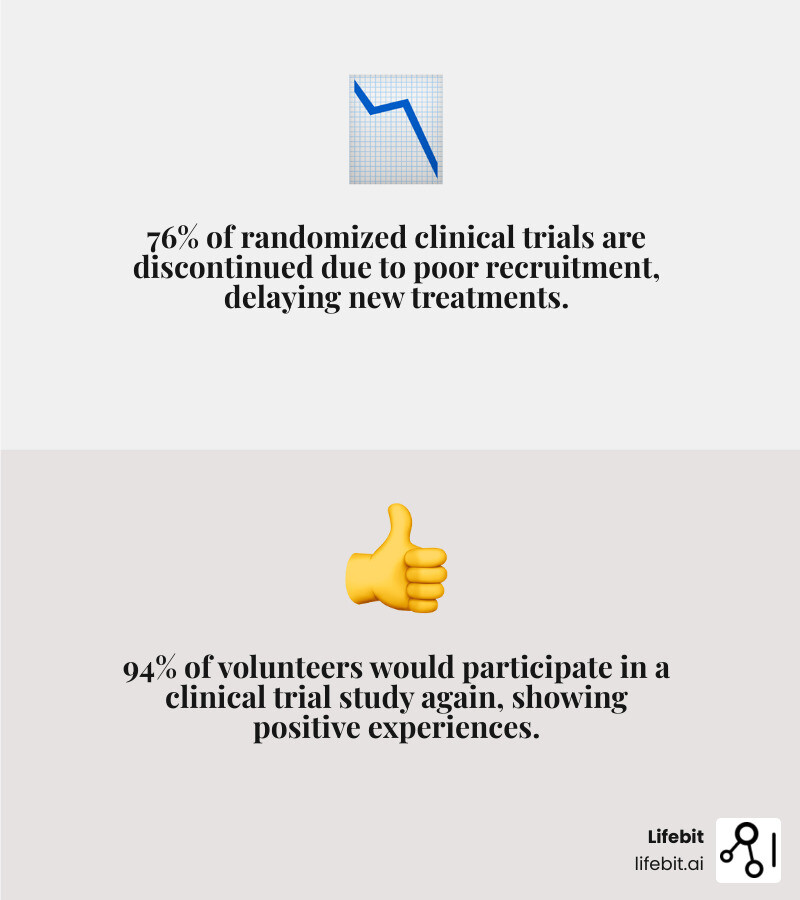
For many clinical research staff members, recruiting participants for a study poses a challenge – sometimes a bigger challenge than conducting the actual trial itself. In fact, 76% of randomized clinical trials are discontinued due to poor recruitment. This impacts the speed at which new, life-saving treatments can reach patients. Despite this, a remarkable 94% of volunteers would participate in a clinical trial study again, highlighting the positive experience for those who do engage.
As Maria Chatzou Dunford, CEO and Co-founder of Lifebit, my background in computational biology, AI, and genomics is dedicated to changing healthcare through federated data analysis, directly addressing the complexities of recruiting clinical trials and accelerating drug findy. Understanding these challenges is the first step toward effective solutions.
Simple guide to recruiting clinical trials:
Why 37% of Sites Fail at Recruiting Clinical Trials
It is a startling reality in the medical research world: 37% of research sites under-enroll study volunteers, and 11% fail to enroll even a single patient. When we look at the numbers, the picture becomes even clearer – a systematic review found that 76% of randomized clinical trials were discontinued specifically because of recruitment failure.
Why is this happening? Often, it comes down to a mismatch between trial design and patient reality. Many sites set ambitious enrollment targets without a clear plan for how to reach the specific people who need these treatments. Furthermore, 40% of perceived risks among potential participants are related to side effects, and 33% worry about the impact on their overall health. If these fears aren’t addressed early and warmly, potential volunteers simply won’t sign up.
The Burden of Protocol Complexity
One often overlooked factor in recruitment failure is the increasing complexity of clinical protocols. Over the last decade, the average number of procedures per protocol has increased by nearly 70%. This “protocol inflation” means that participants are asked to undergo more tests, more frequent visits, and more invasive procedures than ever before. For a patient already managing a chronic illness, the logistical and physical burden can be a deal-breaker. When recruiting clinical trials, sponsors must balance the need for robust data with the practical limitations of a participant’s daily life. If a trial requires a four-hour clinic visit every Tuesday morning, it automatically excludes the majority of the working population.
Administrative Bottlenecks at the Site Level
Beyond patient-facing issues, administrative hurdles often stall recruitment before it even begins. The time it takes to move from site selection to “first patient in” can span several months due to slow Institutional Review Board (IRB) approvals and protracted contract negotiations. During this lag time, the initial momentum of the study team often wanes, and potential participants who were initially interested may find other treatment options or lose interest. To help sites stay on track, we often suggest looking at Clinical Trial Patient Recruitment Tips 2025 to bridge the gap between scientific requirements and human concerns.
Overcoming the 70% Awareness Gap in Patient Outreach
One of the biggest roadblocks in recruiting clinical trials is that people simply don’t know trials are an option. Statistics show that 70% of people haven’t even considered a clinical trial when discussing treatment with their doctor. This is a massive “awareness gap.”
To fix this, we need to focus on where patients actually look for help:
- Primary Care Physicians (PCPs): Since 58% of participants learn about trials from their family doctor, we must empower PCPs with better information. Currently, many PCPs feel they lack the time or the specific knowledge to discuss ongoing trials with their patients. Providing them with easy-to-digest “referral kits” can turn a local clinic into a powerful recruitment engine.
- Search Engines and Registries: 30% of participants use search engines, and 40% use online registries. If your trial isn’t visible there, it doesn’t exist to them. This requires Search Engine Optimization (SEO) strategies specifically tailored to medical queries, ensuring that when a patient searches for “new treatments for Lupus,” your trial appears in the top results.
- Peer Communities: Interestingly, 74% of people express interest in trials when the information comes from an online peer community. These digital “patient neighborhoods” on platforms like Reddit or specialized health forums provide a level of trust that traditional advertising cannot match.
By using diverse Clinical Trial Recruitment Strategies, we can meet patients where they are – whether that’s in a doctor’s office or an online forum.
Navigating Ethical Barriers in Recruiting Clinical Trials
Ethics aren’t just a “check-the-box” activity; they are the foundation of trust. When we talk about recruiting clinical trials, we must ensure that the process is inclusive and fair. The FDA guidance on trial participation and diversity emphasizes that trial participants should represent the people who will actually use the medication.
Key ethical considerations include:
- Informed Consent: This shouldn’t be a confusing legal document. It should be a warm, clear conversation about the purpose, risks, and benefits. 83% of participants say potential risks and benefits are their top priority. Modern trials are moving toward “eConsent,” which uses videos and interactive diagrams to help patients truly understand what they are signing up for.
- Confidentiality: 63% of participants consider the protection of their data to be vital. In an era of frequent data breaches, researchers must be transparent about how data is encrypted and who has access to it.
- Inclusion/Exclusion Criteria: We need to be careful not to exclude people unnecessarily. Historically, many trials excluded patients with “comorbidities” (other health issues), but this doesn’t reflect the real world. Broadening criteria helps ensure that the data we collect is relevant to a diverse real-world population and speeds up the process of recruiting clinical trials by expanding the pool of eligible candidates.
Stop Enrollment Delays: 4 Proven Strategies for Recruiting Clinical Trials
The most successful teams don’t rely on just one way to find people. They use a “multimodal” approach. This means combining old-school human connection with new-school digital tools.
Our research shows that different methods have different “success rates”:
| Recruitment Method | Completion Rate | Efficiency Insight |
|---|---|---|
| In-Person Recruitment | 100% | Most successful; highest trust built. |
| Referrals | 100% | Word-of-mouth from trusted sources is gold. |
| Fliers (Digital/Print) | 95.7% | Great for local awareness and university settings. |
| Social Media | 92.3% | Best for reaching large volumes of people quickly. |
While social media reaches the most people (102 prescreened in one study), in-person methods ensure that those who start the trial actually finish it. We call this “experiential learning” – the more the study team interacts directly with the community, the better they get at recruiting clinical trials. For a deeper dive, check out our Digital Patient Recruitment Complete Guide.
The Nuance of Social Media Recruitment
Social media is more than just running ads. It requires a deep understanding of platform demographics. For instance, Facebook remains the powerhouse for recruiting older populations for chronic condition trials, while platforms like Instagram or TikTok are becoming increasingly effective for reaching younger demographics for rare disease or mental health studies. The key is “social listening”—monitoring the language patients use to describe their symptoms and using that same language in recruitment materials. This creates an immediate sense of empathy and understanding.
EHR Mining and the Future of Patient Identification
One of the most powerful tools in the modern recruiter’s arsenal is the ability to mine Electronic Health Records (EHR). Instead of waiting for patients to find the trial, researchers can use AI algorithms to scan hospital databases for patients who meet the exact inclusion criteria. This “prescreening” happens behind the scenes, allowing doctors to reach out to eligible patients during their regularly scheduled appointments. This method is highly efficient because it targets individuals who are already seeking care and have an established relationship with the healthcare system.
Leveraging Technology for Recruiting Clinical Trials at Scale
Technology is the “secret sauce” that allows us to scale. We are moving away from paper files and toward AI-driven matching. Instead of a researcher manually checking thousands of records, AI can scan global databases to find the perfect match in seconds.
Using an AI Clinical Trial Recruitment Ultimate Guide approach allows us to:
- Use Omni-channel Engagement: Reaching patients via email, social media, and mobile apps simultaneously. This ensures that the trial stays “top of mind” without being intrusive.
- Digital Registries: Keeping a “warm” list of interested volunteers ready for future studies. Many patients who don’t qualify for Study A might be a perfect fit for Study B six months later.
- Real-time Screening: Allowing patients to see if they qualify via a user-friendly mobile app, which reduces the “burden” of traveling to a site just to find out they aren’t eligible. This immediate feedback loop respects the patient’s time and builds early rapport.
- Automated Follow-ups: Using chatbots to answer basic questions about trial logistics 24/7, ensuring that a potential lead is never lost because the clinic was closed for the weekend.
Rare Disease to Phase III: Scaling Your Recruiting Clinical Trials Globally
Recruiting for a rare disease is very different from recruiting for a common condition like high blood pressure. For rare diseases, the “niche” population is small and scattered across the globe. This is where Decentralized Clinical Trials (DCTs) become a game-changer.
By using a Decentralized Clinical Trials Complete Guide approach, we can bring the trial to the patient rather than making the patient travel to a big city hospital. This significantly expands our geographic reach. In a traditional model, a trial might only be accessible to patients living within 50 miles of a major research university. In a decentralized model, a patient in a rural village can participate using a smartphone and local nursing visits.
The Strategic Role of Patient Advocacy Groups (PAGs)
In the world of rare diseases, Patient Advocacy Groups are the most vital partners for recruiting clinical trials. These organizations have spent years building deep trust with patient communities. When a PAG endorses a clinical trial, it carries more weight than any advertisement. Successful recruitment strategies involve collaborating with these groups early in the protocol design phase to ensure the trial’s endpoints are actually meaningful to the patients. For example, a sponsor might focus on a laboratory marker, while the patient community cares more about their ability to walk up a flight of stairs. Aligning these goals makes recruitment much easier.
Navigating Global Regulatory Variations
Scaling a trial globally introduces a complex web of regulatory requirements. What works for recruiting clinical trials in the United States (under FDA oversight) may not be permissible in the European Union (under EMA and GDPR regulations). For instance, the rules regarding how you can contact potential participants via email or how much you can compensate them for their time vary wildly by country. A centralized recruitment strategy must be flexible enough to adapt to these local laws while maintaining a consistent global data standard.
We also use Clinical Trial Educators (CTEs). These are trusted study ambassadors who work at the local level to educate both doctors and patients. They act as the “boots on the ground,” visiting local clinics, hosting town hall meetings, and demystifying the clinical trial process for skeptical communities. Whether it’s a small niche study or a massive Phase III trial, scalability depends on having a centralized strategy that can adapt to local needs. Our Remote Clinical Trial Recruitment Guide explains how to manage this balance effectively across different continents.
Protect Your Data: How to Boost Retention in Recruiting Clinical Trials
Finding a participant is only half the battle; keeping them is the other half. If a participant drops out halfway through, the data becomes less reliable, and the costs go up. In fact, the cost of replacing a single participant who drops out can range from $15,000 to $20,000, depending on the therapeutic area. This financial and scientific “leakage” is one of the biggest threats to a successful drug launch.
The Psychology of Participant Retention
Retention is built on a foundation of feeling valued. Participants often feel like “guinea pigs” if the only time they hear from the study team is when it’s time for a blood draw. To combat this, top-performing sites focus on the “participant experience.” This includes sending thank-you notes, providing regular updates on the progress of the overall study (without unblinding the data), and creating a sense of community among participants. When people feel they are part of a larger mission to save lives, they are much more likely to stick with the trial even when it becomes inconvenient.
Reducing the “Participation Tax”
We often talk about the “participation tax”—the hidden costs of being in a trial. This includes lost wages from taking time off work, the cost of childcare, parking fees at the hospital, and the physical exhaustion of travel. To improve retention, we focus on participant satisfaction by eliminating these taxes:
- Flexibility: 60% of participants care about the physical location. If they can’t come to you, can you go to them? Mobile nursing units can perform many trial procedures in the patient’s home or workplace.
- Communication: Use reminder systems (text or email) to keep appointments top-of-mind. Automated systems can also check in on patients between visits to monitor for side effects, making the patient feel cared for and safe.
- Financial Incentives: Offering fair compensation for time and travel helps show participants that their contribution is valued. This isn’t “paying for participation” (which is an ethical no-no), but rather ensuring that the participant isn’t financially penalized for helping advance science.
- Remote Monitoring: Using tools from our Remote Monitoring in Clinical Trials Guide allows patients to contribute data from home via wearable devices. This turns a high-burden trial into a seamless part of the patient’s daily routine.
Building a “Trial Alumni” Community
Finally, the end of a trial shouldn’t be the end of the relationship. By maintaining a connection with participants after the study concludes—sharing the final results and thanking them for their contribution—researchers build a loyal base of “trial alumni.” These individuals are not only 94% more likely to participate in another trial, but they also become powerful advocates for clinical research within their own social circles, helping with the future of recruiting clinical trials.
Frequently Asked Questions about Recruiting Clinical Trials
How do I find actively recruiting clinical trials?
The best place to start is ClinicalTrials.gov. Use specific search terms for your condition (e.g., “type 2 diabetes”) and use the filters to select “Recruiting.” You can also filter by your age, your city, and the “Phase” of the trial. Don’t forget to check university websites in cities like New York, London, or Toronto, as they often host many local trials. Additionally, many patient advocacy groups maintain their own curated lists of trials that are specifically vetted for their community.
What are the biggest challenges in patient recruitment?
The “big three” challenges are:
- Awareness: Patients don’t know trials exist, and doctors often don’t have the tools to find them.
- Logistics: Scheduling conflicts, travel distance, and limited clinic hours make it hard for working people to attend. This is why decentralized and hybrid models are becoming so popular.
- Site Performance: 37% of sites under-enroll, often because they lack the staff or technology to manage outreach effectively. This is frequently compounded by overly restrictive inclusion/exclusion criteria that make it nearly impossible to find a “perfect” patient.
Why is diversity important in clinical trials?
Diversity ensures that a treatment works for everyone. People of different races, ethnicities, and ages can react differently to the same drug due to genetic variations, environmental factors, and underlying health conditions. By including medically underserved communities, we achieve “health equity.” The FDA now provides “Drug Snapshots” to show exactly who participated in the trials for newly approved medicines, pushing for better representation across the board. Without diverse recruitment, we risk developing medicines that only work for a narrow segment of the population.
Does it cost money to participate in a clinical trial?
In the vast majority of cases, there is no cost to the participant. The pharmaceutical company or government agency sponsoring the trial covers the cost of the study drug, the medical tests, and the doctor’s time. In fact, many trials offer reimbursement for travel, meals, and sometimes compensation for the time spent at the clinic. It is important to discuss this with the study coordinator during the informed consent process to understand exactly what will be covered.
What is the difference between a placebo and the study drug?
A placebo is an inactive substance that looks like the study drug but has no therapeutic effect. In many trials, participants are randomly assigned to either the study drug group or the placebo group to see if the new treatment is truly effective. However, in many serious disease trials (like cancer), placebos are rarely used alone; instead, the new drug is compared against the “standard of care” treatment that is already available. This ensures that no participant is left without any medical treatment while participating in the study.
Conclusion
At Lifebit, we believe that the future of recruiting clinical trials lies in data and trust. Our federated AI platform provides secure, real-time access to global biomedical data, helping researchers find the right patients faster while keeping their data safe in a Trusted Research Environment.
By streamlining operations and using AI to bridge the gap between findy and delivery, we aren’t just recruiting participants – we are building a community of volunteers and scientists working together to solve the world’s toughest health challenges.