

Mastering Clinical Trial Reporting: What You Need to Know

Clinical Trial Reporting: Stop Losing 50% of Your Research Data Now
Clinical trial reporting is the systematic process of documenting, registering, and publicly disclosing the design, conduct, and results of clinical studies. It ensures transparency, protects patient safety, and prevents research waste by making trial findings—both positive and negative—accessible to the scientific community, regulators, and the public. The ethical foundation of this practice dates back to the Declaration of Helsinki, which explicitly states that researchers have a duty to make the results of their research on human subjects publicly available.
Key requirements for clinical trial reporting include:
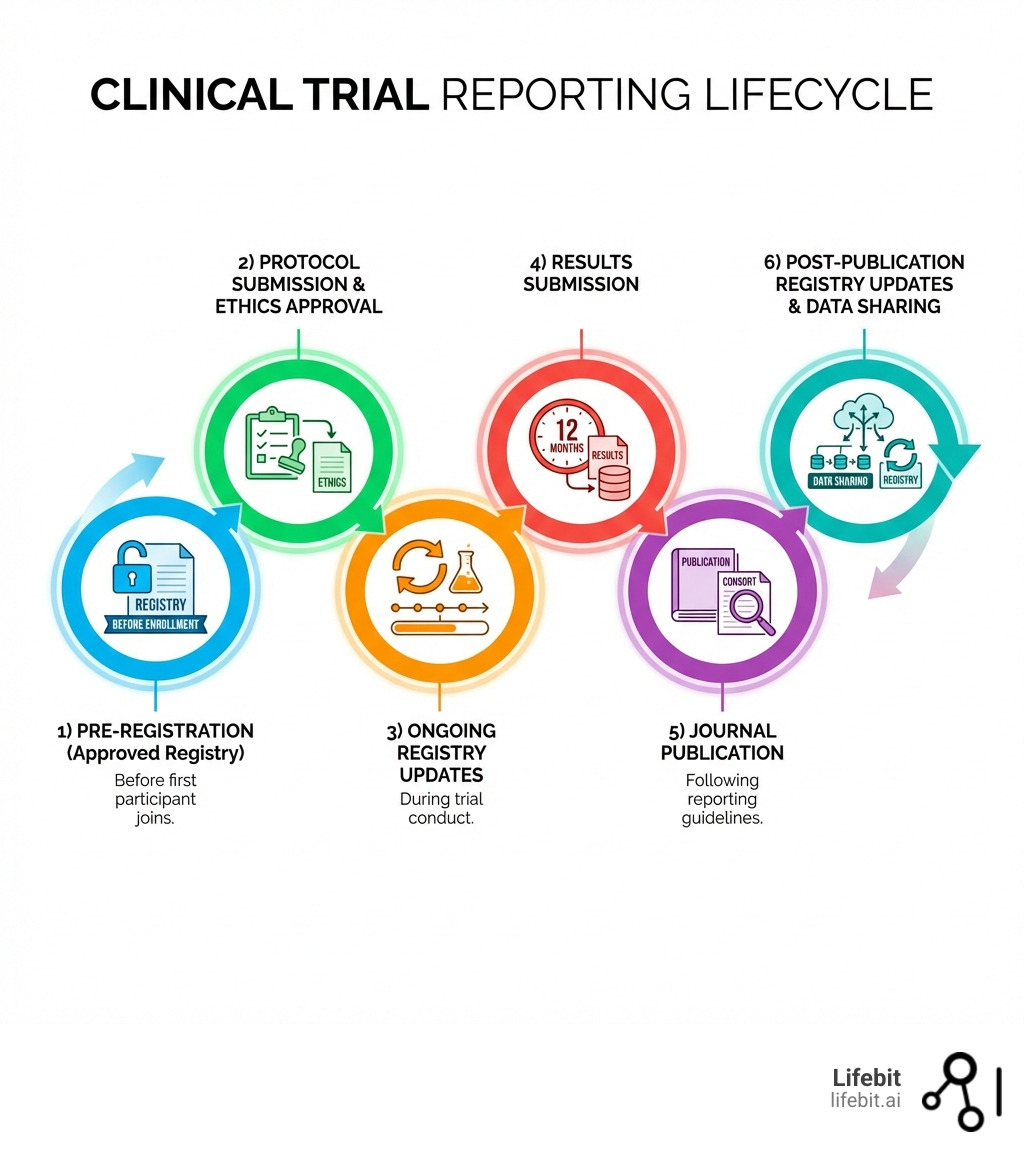
- Registration before enrollment – All trials must be registered in a WHO- or ICMJE-approved registry before the first participant joins to prevent “cherry-picking” of data later.
- Protocol consistency – Reports must align with pre-registered protocols to prevent selective outcome reporting, where researchers only highlight the most favorable results.
- Comprehensive results disclosure – Both positive and negative findings must be reported, typically within 12 months of trial completion, regardless of whether the drug or device is approved.
- Structured reporting – Following guidelines like CONSORT to ensure completeness and reproducibility, allowing other scientists to verify the findings.
- Registry updates – Ongoing responsibility to keep trial information current throughout the study lifecycle, including recruitment status and safety signals.
Despite these requirements, about 50% of clinical trials go unreported—often because results are negative or non-significant. This creates an incomplete and potentially misleading picture of drug safety and efficacy, leading to avoidable waste of research resources and delayed medical breakthroughs. Initiatives like the AllTrials campaign have highlighted that this lack of transparency is not just a bureaucratic failure but a major public health risk.
The problem is both ethical and practical. When trials remain unpublished, patients who volunteered may have done so in vain, exposing themselves to risks without the benefit of contributing to medical knowledge. Researchers duplicate work that’s already been done, wasting billions in funding. And clinicians make treatment decisions without access to the full evidence base, potentially prescribing less effective or even harmful treatments.
As Maria Chatzou Dunford, CEO of Lifebit, I’ve spent over 15 years working at the intersection of genomics, AI, and health-tech, helping public sector institutions and pharmaceutical organizations steer the complexities of clinical trial reporting and secure data sharing. Throughout my career, I’ve seen how better infrastructure and standardized reporting frameworks can transform the speed and quality of evidence generation. By leveraging modern data platforms, we can move from a world of fragmented, hidden data to one of open, collaborative science.
Clinical trial reporting terms to know:
Clinical Trial Reporting: Avoid Journal Rejection with Perfect Registration Timing
Why do we make such a big deal about registering a trial before it even starts? It’s not just paperwork for the sake of paperwork. There are deep ethical mandates at play. When a trial is registered, it creates a public record that the study exists. This prevents “publication bias,” where only the “exciting” or positive results make it to the light of day. By revealing the existence of all studies, we uphold an obligation to report honestly, even when findings aren’t favorable to a sponsor’s product. This transparency is essential for maintaining public trust in the pharmaceutical industry and clinical research as a whole.
Prospective vs. Retrospective Registration: Why Timing is Everything
The timing of your registration can make or break your research’s future. We distinguish between these two based on when the first participant is enrolled:
- Prospective Registration: This happens before the first participant is recruited. The International Committee of Medical Journal Editors (ICMJE) and the Tri-Council Policy Statement (TCPS2) in Canada are very strict about this. If you don’t register prospectively, many top-tier journals simply won’t publish your results. This is because prospective registration locks in the trial’s primary and secondary outcomes, preventing researchers from changing their goals mid-study to fit the data they’ve collected.
- Retrospective Registration: This occurs after recruitment has started. While some registries allow this, it’s often viewed as a “red flag” by editors. It creates a dilemma because it suggests the trial design might have been tweaked after seeing early data—a major threat to scientific integrity. Retrospective registration often requires a detailed explanation to journal editors and may still result in a permanent disclaimer on the published paper, questioning the study’s validity.
| Feature | Prospective Registration | Retrospective Registration |
|---|---|---|
| Timing | Before first participant enrollment | After recruitment has begun |
| Publication | Accepted by all ICMJE journals | Often rejected or flagged by journals |
| Bias Risk | Low (prevents outcome switching) | High (potential for “p-hacking”) |
| Ethical Standing | Gold standard | Suboptimal; requires explanation |
Who is the ‘Responsible Party’?
In Clinical trial reporting, someone has to hold the bag. The “responsible party” is typically the sponsor. However, for investigator-initiated trials, the Lead Principal Investigator (PI) often takes on this role. If you’re in the US, the FDA requires the responsible party to register trials for drugs, biologics, and devices under the FDA Amendments Act (FDAAA) 801. This law, further clarified by the Final Rule (42 CFR Part 11), mandates that results must be submitted to ClinicalTrials.gov within one year of the primary completion date.
In Canada, Health Canada mandates registration for any trial requiring a Clinical Trial Application (CTA). Similarly, the European Medicines Agency (EMA) requires registration in the EU Clinical Trials Register (EU CTR). Acceptable registries must meet specific WHO and ICMJE criteria: they must be publicly accessible at no charge, managed by a non-profit, and electronically searchable. Common examples include ClinicalTrials.gov and the WHO International Clinical Trials Registry Platform (ICTRP).
Failing to register or keep information updated isn’t just a minor slip-up. In the US, for federally funded trials, penalties can include the withholding or recovery of grant funds, and civil money penalties of over $10,000 per day. More broadly, it leads to research waste—about 50% of trials go unreported, leaving a massive gap in the global evidence base and hindering the development of meta-analyses that could provide definitive answers on treatment efficacy.
Clinical Trial Reporting: Use CONSORT to Guarantee High-Quality Results
Transparency isn’t just a buzzword; it’s the engine of modern medicine. To ensure that our reports are high-quality and unbiased, we rely on established reporting guidelines that provide a roadmap for what information must be included in a manuscript.
The Power of CONSORT and the EQUATOR Network
The Consolidated Standards of Reporting Trials (CONSORT) guidelines are the primary tool we use for reporting parallel-group randomized trials. CONSORT provides a 25-item checklist and a flow diagram that help authors report exactly what was done and what was found. This includes critical details like how the randomization sequence was generated, how allocation was concealed, and who was blinded to the intervention. By following these standards, researchers reduce bias and allow readers to critically appraise the study’s validity.
For other study designs, the EQUATOR Network (Enhancing the QUAlity and Transparency Of health Research) serves as a central hub. Whether you’re reporting an observational study (STROBE), a systematic review (PRISMA), or a diagnostic accuracy study (STARD), the EQUATOR Network provides the necessary toolkits. You can read the full article on trial transparency to see how these standards are evolving to meet modern research needs, including the integration of real-world evidence and decentralized trial data.
Essential Components of Clinical Trial Reporting
Writing a trial report is a bit like building a house; you need a solid structure. Most reports follow the IMRaD format: Introduction, Methods, Results, and Discussion.
- Abstract Clarity: Your abstract is your “shop window.” It should follow the CONSORT framework for abstracts, providing a clear summary of the trial framework (e.g., “superiority trial” vs. “non-inferiority trial”) and primary outcomes. This is often the only part of the paper that clinicians read, so it must be accurate and representative of the full text.
- Protocol Consistency: Reviewers will compare your final report against your original trial registration and protocol. We recommend a “copy-paste” approach for key trial characteristics to ensure consistency. Any deviations from the protocol—such as changes to the sample size or the addition of new endpoints—must be transparently reported with clear reasons. This prevents “HARKing” (Hypothesizing After the Results are Known).
- The Methods Section: This is the “how-to” of your trial. It must be detailed enough for another researcher to reproduce your work. This includes precise descriptions of interventions (using the TIDieR checklist), sample size calculations (including the expected effect size and power), and statistical analysis plans (SAP). You can find more info on CONSORT standards to help guide this section.
Post-Publication Responsibilities in Clinical Trial Reporting
The job isn’t done once the “Publish” button is hit. We have ongoing responsibilities to keep the trial’s public record accurate and accessible.
- Registry Updates: The responsible party must update the registry with the location of findings (e.g., the DOI of the journal article) and any safety reports. In the US, records must be verified or updated at least every 6 months to ensure the contact information and recruitment status remain current.
- Record Retention: Regulatory requirements for data storage are becoming more stringent. In Canada, clinical trial records that required a CTA must be stored for 25 years. Other records typically require a 7-year retention period. This ensures that if safety concerns arise decades later, the original data can be re-examined.
- Funding Reports: Most funders, such as the NIH or the Wellcome Trust, require a final report summarizing the findings and how the money was spent. Failure to provide these can jeopardize future funding opportunities.
For more details on these obligations, you can check the official ClinicalTrials.gov policies.
Clinical Trial Reporting: Fix Attrition and Harms to Protect Your Integrity
The “Results” section is where the rubber meets the road. But it’s also where many reports fall short, particularly regarding what didn’t go as planned. A high-quality report doesn’t just celebrate success; it meticulously documents the challenges and failures encountered during the study.
Reporting Attrition and Harms
Attrition (participants dropping out) is a major source of bias. If participants drop out because they feel the treatment isn’t working or because they are experiencing side effects, ignoring them will make the treatment look more effective and safer than it actually is. We should always use a CONSORT flow diagram to show exactly how many participants were screened, randomized, and analyzed. If 20% of your participants vanished into thin air, we need to know why! Was it due to lack of efficacy, adverse events, or logistical issues?
Reporting of harms is notoriously poor in biomedical literature. Many papers focus almost exclusively on efficacy while burying safety data in a single sentence. We shouldn’t just list “no significant adverse events.” Instead, we should use the CONSORT extension for harms to provide a detailed, systematic evaluation of safety data, including severity, causality assessments, and the methods used to collect harm data (e.g., spontaneous reporting vs. active surveillance). For more on this, see the scientific research on reporting harms.
Statistical Integrity and Data Illustration
When it comes to statistics, simple is often better—but it must be accurate. The goal is to provide a clear picture of the data without using “statistical spin” to make results look more impressive.
- Sample Size: Don’t just give a number; explain the calculation and the “target difference” you were looking for. Was the trial powered to detect a 5% difference or a 20% difference? This context is vital for interpreting the results.
- Between-Group Differences: Focus on the estimated effect size and 95% Confidence Intervals (CIs) rather than just p-values. A p-value tells you if there’s an effect; a CI tells you how big and how certain that effect is. Relying solely on p < 0.05 can lead to "p-hacking," where researchers run multiple tests until they find something significant.
- Visuals: Stop using bar charts for continuous data! They hide the distribution of your results and can mask outliers. Scatter plots or box plots are much more informative and allow for better critical appraisal of the data spread.
In the “Discussion” section, we must guard against confirmation bias—the tendency to over-emphasize results that support our hypothesis while ignoring those that don’t. We must address the clinical relevance of our findings, not just their statistical significance. A treatment might be statistically better than a placebo, but if the improvement is too small for a patient to notice, its clinical value is questionable.
Clinical Trial Reporting: Boost Your Citations and Impact with Data Sharing
The traditional journal article is just one way to share findings. In today’s research environment, we have more tools at our disposal to ensure that the data generated by clinical trials is used to its fullest potential. This is often referred to as the FAIR principles: making data Findable, Accessible, Interoperable, and Reusable.
The Benefits of Data Sharing
Sharing de-identified individual participant data (IPD) is the “next frontier” of transparency. It allows other researchers to verify our findings, conduct meta-analyses, and explore new research questions without the cost of a new trial. For example, IPD meta-analyses are considered the gold standard of evidence because they allow for more precise estimates of treatment effects across different patient subgroups. As the ICH E3 guidelines suggest, providing sufficient detail for replication is a core objective of a clinical study report. Furthermore, many journals now require a data sharing statement as a condition of publication, asking authors to specify what data will be shared and how it can be accessed.
Preprints and Media Engagement
- Preprints: Posting a report on a server like medRxiv before peer review allows for early dissemination and feedback from the global scientific community. This can be particularly important during public health emergencies, such as the COVID-19 pandemic. It also assigns a permanent Digital Object Identifier (DOI), making your work searchable immediately and establishing “priority” for your findings.
- Media and Social Media: Sharing findings on platforms like Twitter (X) or through press releases can increase your “Altmetric” score, which correlates with higher citation rates. However, this comes with a responsibility to avoid “spin.” Researchers should ensure that press releases accurately reflect the study’s limitations and don’t make the results sound more certain or impactful than they actually are. Over-hyping results in the media can lead to patient confusion and unrealistic expectations.
- Plain Language Summaries (PLS): To truly honor the participants, many organizations now create summaries of trial results written in non-technical language. These are essential for patients and the public to understand the outcomes of the research they may have supported or participated in.
Clinical Trial Reporting: 3 Critical Questions That Save Your Funding
Who is considered the ‘responsible party’ for trial registration?
The “responsible party” is the individual or entity legally required to register the trial and submit results. Usually, this is the sponsor (the organization that initiates and funds the trial, such as a pharmaceutical company or a university). However, the sponsor can designate the Principal Investigator (PI) as the responsible party if the PI has the right to publish the results and has responsibility for directing the trial. It is crucial to establish this role early in the trial planning phase to avoid confusion and ensure compliance with regulations like the FDAAA 801.
What are the consequences of failing to update a trial registry?
Neglecting your registry updates can lead to serious professional and legal headaches. Beyond the ethical issue of “hiding” data, consequences include:
- Publication Bans: Many journals, following ICMJE guidelines, will refuse to publish your work if the registry is outdated, missing results, or inconsistent with your manuscript.
- Financial Penalties: In the US, the NIH or FDA can withhold or even claw back grant funding. The FDA has also begun issuing “Notices of Noncompliance,” which are made public and can damage an institution’s reputation.
- Regulatory Action: In regions like Canada or Europe, failing to report mandatory safety updates or trial closures can lead to regulatory warnings, fines, or even the suspension of other ongoing trials by the same sponsor.
Why is sharing clinical trial data beneficial for the research community?
Data sharing is a massive win for everyone involved in the healthcare ecosystem. It maximizes the “value” of the data provided by volunteers, ensuring their contribution goes as far as possible. It allows for independent verification of results, which builds trust in science and helps identify errors or biases. Furthermore, it enables researchers to combine datasets for meta-analyses, providing much stronger evidence than any single trial could offer on its own. This is especially critical for rare diseases, where individual trials often have small sample sizes. Ultimately, it’s about reducing research waste and accelerating the path to new, life-saving treatments.
Clinical Trial Reporting: Future-Proof Your Data Strategy with Federated AI
Mastering Clinical trial reporting is about more than just checking boxes on a CONSORT list; it’s about honoring the commitment made to the participants who made the research possible. By ensuring transparency, consistency, and ethical integrity, we build a foundation of evidence that truly improves human health. As the volume of data generated by trials continues to grow—incorporating everything from genomic sequences to wearable device data—the traditional methods of reporting and sharing data must evolve.
At Lifebit, we understand that the future of clinical research is data-driven and collaborative. Our next-generation federated AI platform is designed to solve the very challenges we’ve discussed here. By providing secure, real-time access to global biomedical and multi-omic data through our Trusted Research Environment (TRE), we enable researchers to perform complex analyses while maintaining the highest standards of data governance and compliance. This “data-to-code” approach means that sensitive participant data never has to leave its secure environment, overcoming the hurdles of data privacy and international regulations.
Whether you are navigating Health Canada’s 25-year retention rules, complying with the FDA’s Final Rule, or looking to integrate real-world evidence into your next report, our platform simplifies the process. We help biopharma and public health agencies turn fragmented data into decision-ready insights, ensuring that every trial contributes its full value to the global scientific community. By embracing these technologies, we can ensure that clinical trial reporting is not just a regulatory burden, but a powerful tool for medical innovation.
Learn more about Lifebit’s solutions for commercial pharma and how we can help you master your clinical trial data strategy.