

Mastering Your Data with Harmonization Examples
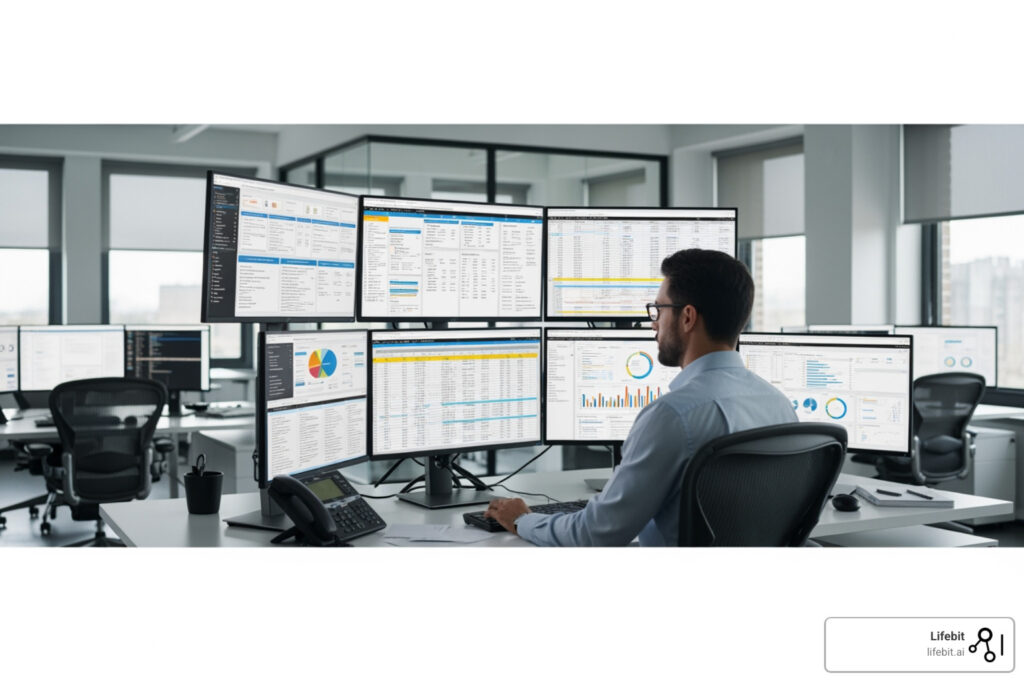
Why Master Data Management Is the Foundation of Trusted Data at Scale
Master data management (MDM) is a technology-enabled discipline where business and IT teams work together to ensure the uniformity, accuracy, stewardship, semantic consistency, and accountability of an organization’s shared master data assets—such as customer records, products, suppliers, and locations.
Key elements of MDM include:
- Single Version of Truth: Eliminating duplicate and conflicting data versions across systems
- Data Governance: Clear policies, roles, and accountability for data quality and compliance
- Golden Record Creation: Merging disparate data sources into one authoritative, trustworthy record
- Multi-Domain Support: Managing customer, product, supplier, and location data in one unified system
- Real-Time Integration: Enabling operational systems to access and update master data via APIs
Without MDM, organizations risk maintaining multiple, potentially inconsistent versions of the same data—leading to inefficiencies, errors, and misinformed decisions. 82% of organizations spend one or more days per week resolving master data quality issues, and 80% report that divisions operate in silos with their own data practices. These problems multiply during mergers, acquisitions, or when integrating new systems, creating duplicates, conflicting values, and compliance risks.
MDM is not just a technology project—it’s a strategic discipline that requires collaboration between business stakeholders and IT. When done right, it improves decision-making, operational efficiency, regulatory compliance, and enables AI and machine learning initiatives by ensuring data is accurate and reliable.
I’m Maria Chatzou Dunford, CEO and Co-founder of Lifebit, where we’ve spent over 15 years building federated genomics and biomedical data platforms that rely on robust master data management to harmonize patient, genomic, and clinical data across secure, distributed environments. This guide will walk you through the fundamentals, challenges, and modern approaches to mastering your organization’s most critical data assets.
Easy master data management word list:
- data harmonization meaning
- data harmonization techniques
- how does data harmonization differ from data integration
What is Master Data Management and Why Your Strategy is Failing?
At its core, master data management is the process of creating a single, reliable source of truth for the data that describes your business entities. Think of it as the “nouns” of your business—customers, products, employees, and locations. Unlike transactional data (the “verbs,” like an invoice or a laboratory test), master data is meant to be stable and shared across the entire enterprise.
The Evolution of MDM: From ERP Silos to Modern Hubs
Historically, organizations relied on monolithic Enterprise Resource Planning (ERP) systems to manage their data. However, as businesses grew and adopted “best-of-breed” software for CRM, HR, and supply chain management, the data became fragmented. Each system created its own version of a “Customer” or “Product.” This led to the birth of MDM as a separate discipline designed to sit above these systems, acting as a central arbiter of truth. Today, MDM has evolved from a static repository into a dynamic, real-time engine that powers digital transformation.
The reason many strategies fail is that they treat MDM as a “set it and forget it” IT installation. In reality, it is a deep-seated business-IT collaboration. Success requires semantic consistency—meaning that when the sales team says “customer,” they mean the same thing as the finance team. Without this alignment, you end up with “semantic drift,” where different departments use the same terms for different things, leading to reporting nightmares and operational chaos.
According to the Gartner Glossary: Master Data Management, it is a discipline that ensures accountability and stewardship. If no one is responsible for the “Product” record, that record will eventually become a mess of duplicates and outdated specs.
The High Cost of Poor Master Data Management
Ignoring your master data isn’t just a technical debt—it’s a massive financial leak. Research shows that 82% of respondents spend a day or more every week simply fixing data quality issues. Imagine paying your top data scientists to spend 20% of their time manually correcting typos or merging duplicate records. This “data tax” slows down innovation and increases the time-to-market for new products.
Furthermore, 80% of organizations report that their divisions operate in silos. This fragmentation leads to:
- Operational Inefficiency: A customer receives two different marketing flyers because they are listed twice in your database with slight name variations. This not only wastes money but damages brand perception.
- Regulatory Risks: Under GDPR or CCPA, if a customer asks to be “forgotten,” but you have five different versions of their record across five silos, you are at high risk of non-compliance. Failure to delete all instances of a record can lead to multi-million dollar fines.
- Flawed Decision-Making: Executives can’t get a clear picture of total spend or total revenue if the “Supplier” or “Customer” entities are fragmented. If you don’t know that “IBM” and “International Business Machines” are the same entity, you lose your leverage in procurement negotiations.
As highlighted in Single Version Of Truth: Why Your Company Must Speak The Same Data Language, a unified data language is the only way to scale without breaking.
How MDM Differs from ETL and Data Warehousing
A common mistake is assuming that your ETL (Extract, Transform, Load) tools or your data warehouse can handle MDM. They can’t.
- ETL is Tactical: It moves data from Point A to Point B and shapes it for storage. It doesn’t care about the truth of the data, only the movement. ETL tools lack the sophisticated matching and merging logic required for entity resolution.
- Data Warehousing is Analytical: It’s great for looking at historical trends, but it isn’t designed to feed high-quality, real-time data back into your operational systems. A warehouse is a “downstream” consumer, whereas MDM is an “upstream” provider.
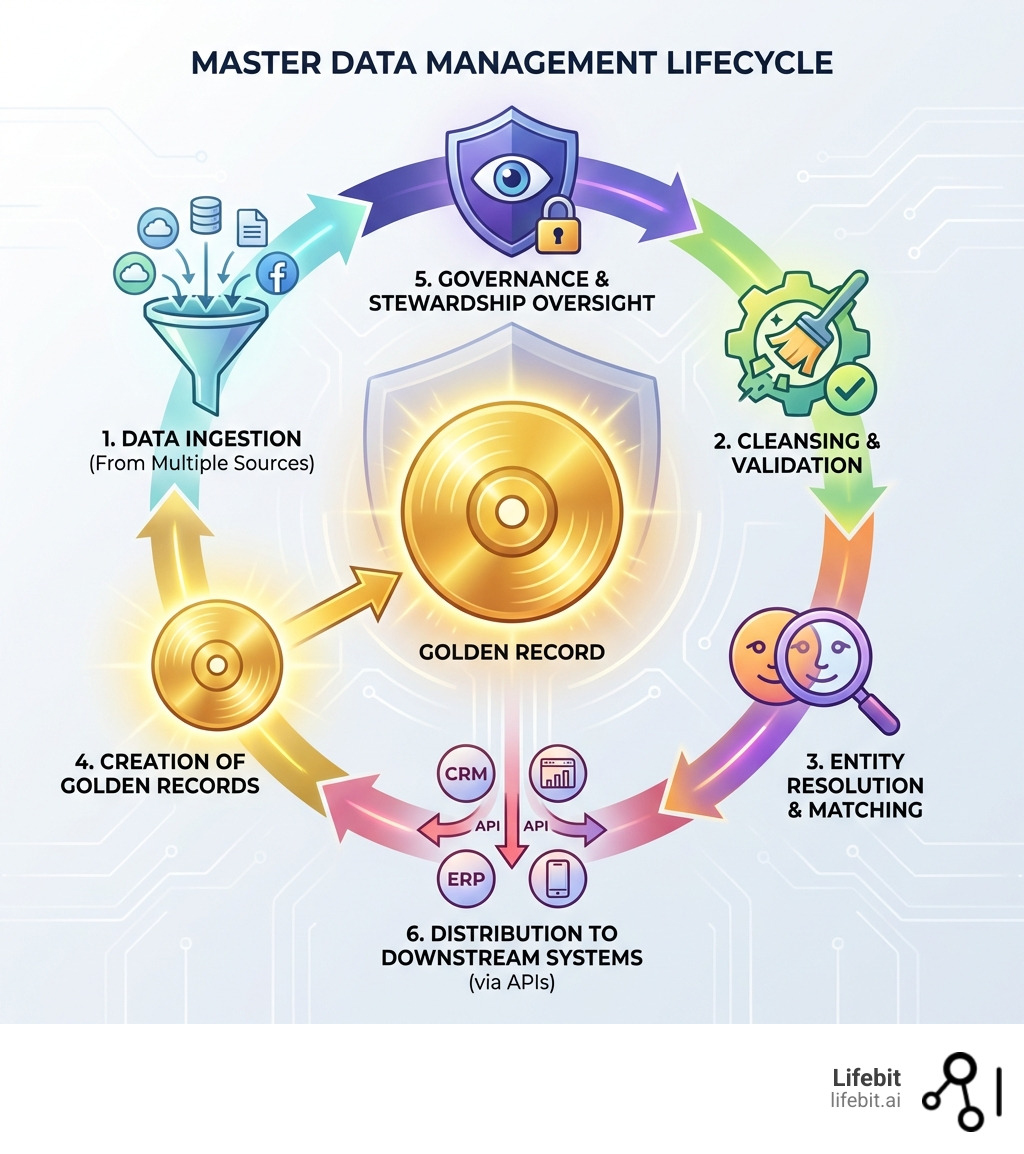
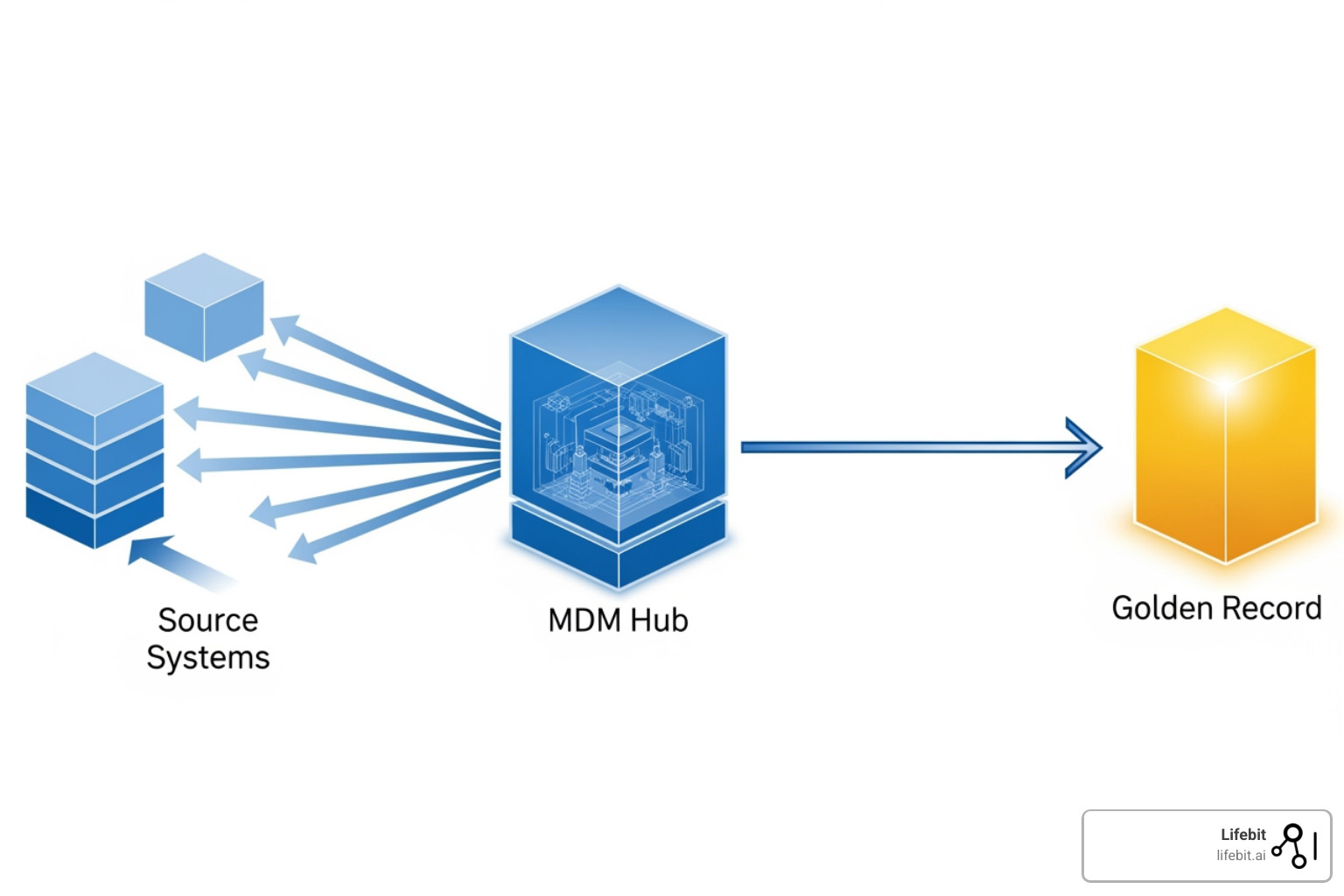
- MDM is Strategic: It focuses on strategic reliability. It uses sophisticated matching algorithms and deduplication to create an authoritative asset. MDM provides the “Golden Record” that is then pushed back into the CRM, ERP, and the Data Warehouse.
While a data warehouse tells you what happened last quarter, MDM ensures that the record you are looking at right now is the correct one. For organizations moving toward modern architectures, more info about data lakehouse governance can help explain how these layers work together to maintain a clean data lifecycle.
Core Components: People, Processes, and Technology
We like to say that MDM is 80% people and process, and only 20% technology. You can buy the most expensive software in the world, but if your team doesn’t agree on who owns the data, it will fail.
The People: Roles and Responsibilities
- Data Owners: Usually senior business leaders (e.g., Head of Sales for customer data) who are accountable for the data’s quality. They define the business rules and the “definition of done” for data accuracy.
- Data Stewards: The “boots on the ground” who manage the day-to-day data quality, resolve conflicts, and ensure compliance. They are the subject matter experts who decide if two records are truly duplicates.
- Governance Councils: A cross-functional group that sets the policies and resolves disputes between departments. For example, if Marketing wants more data fields than Sales is willing to enter, the Council mediates.
The Processes: The Six Dimensions of Data Quality
To manage master data effectively, organizations must measure it against six key dimensions:
- Accuracy: Does the data reflect the real-world entity? (e.g., Is the address correct?)
- Completeness: Are all required fields populated? (e.g., Does every product have a SKU?)
- Consistency: Is the data the same across all systems? (e.g., Is the customer’s name spelled the same in Billing and CRM?)
- Timeliness: Is the data up to date? (e.g., Has the supplier’s new bank account info been updated?)
- Validity: Does the data follow the defined format? (e.g., Is the phone number 10 digits?)
- Uniqueness: Are there any duplicate records? (e.g., Is there only one record for ‘John Doe’?)
You need defined workflows for data collection, normalization (making sure “St.” and “Street” are treated the same), and error correction. Change management is also vital; users need to know why they can no longer just enter “TBD” into a mandatory field.
For teams looking to automate these roles, checking out more info about data governance platforms is a great starting point.
Implementation Models for Master Data Management
How you deploy master data management depends on your organization’s maturity and needs. There are four primary models:
| Model | Description | Best Use Case |
|---|---|---|
| Registry | Only stores the IDs and keys. The data stays in the source systems. | Large, decentralized organizations that need a quick, low-impact start with minimal disruption to existing systems. |
| Consolidation | Pulls data from sources into a central hub for reporting. | Primarily for analytical needs and “Single Version of Truth” reporting where operational systems don’t need real-time updates. |
| Coexistence | Data is mastered in the hub, but changes can happen in both the hub and source systems. | Organizations that need a balance between central control and local flexibility, allowing departments to maintain some autonomy. |
| Transaction | The hub is the “Source of Record.” All changes happen here first. | High-maturity organizations requiring absolute data integrity and control, where the MDM hub pushes data to all other systems. |
Creating the Golden Record Through Harmonization
The ultimate goal of MDM is the Golden Record. This is the single, “best” version of an entity record, created by merging data from multiple sources. This process involves complex Survivorship Rules—logic that determines which system’s data is the most trustworthy for a specific field (e.g., the CRM might be the master for ‘Phone Number,’ while the ERP is the master for ‘Credit Limit’).
We achieve this through:
- Entity Resolution: Determining that “J. Smith” in the CRM is the same as “John Smith” in the Billing system using fuzzy matching logic.
- Record Linkage: Associating these disparate records using a unique Master ID that persists even if source system IDs change.
- Data Cleansing: Stripping out “garbage” data, standardizing formats, and removing special characters that break integrations.
- Validation & Enrichment: Checking addresses against postal databases or adding third-party credit scores and firmographic data (e.g., company size, industry).
In the biomedical space, this is critical. You cannot run a clinical trial if you can’t harmoniously link a patient’s genomic sequence to their clinical history. You can learn more about AI-enabled data governance to see how modern tools are making this process faster than ever.
Modernizing MDM with AI, Machine Learning, and Cloud
The “old way” of MDM involved thousands of manual SQL rules and rigid hierarchies that broke every time a new data source was added. The “new way” is Augmented MDM. By using AI and machine learning, we can automate entity resolution and matching at a scale that was previously impossible.
Probabilistic vs. Deterministic Matching
Traditional MDM relied on deterministic matching—exact matches like Social Security numbers or email addresses. Modern MDM uses probabilistic matching, where machine learning models calculate a confidence score based on multiple attributes (name, address, DOB, IP address). If the score is 98%, the system automatically merges the records. If it’s 70%, it flags the “gray area” case for a human steward to review. This reduces the manual workload by up to 90%.
The Role of Graph Technology
Modern MDM is increasingly using Graph Databases to manage relationships. While traditional MDM is good at saying “This is John Doe,” Graph-based MDM can say “John Doe is the CEO of Company X, which is a subsidiary of Company Y, and he lives at the same address as Jane Doe.” This relational intelligence is vital for fraud detection, anti-money laundering (AML), and complex supply chain mapping.
Cloud-based MDM offers the scalability needed to handle billions of records. In a world of multi-omic data, you need a system that doesn’t blink at petabyte-scale datasets. Furthermore, modern MDM uses Real-Time APIs to ensure that as soon as a record is updated in the hub, every other system in the company knows about it instantly. This eliminates the “sync lag” that often leads to customer service errors.
This is particularly relevant for federated data governance, where data might live in different countries but needs to be managed under a single, unified strategy. Federated MDM allows organizations to maintain data sovereignty (keeping data in its country of origin) while still achieving a global view of their master entities.
Overcoming Common Pitfalls and Measuring Success
Why do some MDM projects turn into “money pits”? Usually, it’s the Technology-Only Trap. Organizations buy a tool and expect it to fix their culture. To avoid this, you must treat MDM as a journey, not a destination.
Industry-Specific MDM Use Cases
- Healthcare: Linking patient records across hospitals, pharmacies, and labs to ensure a complete longitudinal health record. This prevents dangerous drug interactions and improves patient outcomes.
- Finance: Creating a “Customer 360” view to identify cross-selling opportunities and manage risk across different banking products (mortgages, credit cards, savings).
- Retail: Managing product hierarchies across e-commerce sites, physical stores, and third-party marketplaces to ensure consistent pricing and descriptions.
- Manufacturing: Harmonizing supplier data to identify dependencies and risks in the supply chain, especially during global disruptions.
Strategies for Success
- Build a Business Case: Don’t just talk about “clean data.” Talk about “reducing customer churn by 10%” or “cutting supply chain costs by $2M.” Connect MDM directly to the CEO’s top priorities.
- Start with a Pilot: Don’t try to master every domain at once. This is known as “boiling the ocean.” Start with a single domain like “Product” or “Supplier” where the pain is highest, and expand once you’ve proven the ROI.
- MDM for Mergers and Acquisitions (M&A): One of the highest-value uses for MDM is during a merger. Instead of spending years trying to migrate System A to System B, an MDM hub can sit on top of both, providing a unified view of the combined company’s customers and products from Day 1.
- Measure What Matters: Track metrics like the percentage of duplicate records, the time it takes to onboard a new supplier, the reduction in manual data correction hours, and the increase in first-call resolution rates in customer service.
Understanding the difference between centralized vs decentralized governance can help you choose the right organizational structure to avoid these pitfalls. A hybrid approach often works best for global enterprises, where global standards are set centrally, but local variations are managed at the regional level.
Frequently Asked Questions about MDM
What are the most common master data domains?
The most common domains include:
- Customer: Names, contact info, social media handles, and communication preferences.
- Product: SKUs, dimensions, materials, pricing, and multi-language descriptions.
- Supplier: Legal names, tax IDs, payment terms, and performance ratings.
- Employee: Roles, reporting lines, skills, and certifications.
- Location: Physical addresses, GPS coordinates, and sales territories.
How does MDM support Data Privacy (GDPR/CCPA)?
MDM is the foundation of privacy compliance. It provides a single place to manage “Consent and Preference.” If a customer opts out of marketing on your website, MDM ensures that the change is propagated to your email marketing tool, your CRM, and your direct mail system. Without MDM, it is nearly impossible to guarantee that a “Right to be Forgotten” request has been fully honored across dozens of silos.
What is the difference between MDM and a Data Fabric?
A Data Fabric is an architectural layer that connects disparate data sources. MDM is a discipline focused on the content and quality of the data within those sources. You can use a Data Fabric to access data, but you still need MDM to ensure that the data you are accessing is the “Golden Record.”
How do you measure the ROI of a master data management program?
You can measure ROI through efficiency gains (fewer hours spent fixing data), revenue growth (better cross-selling due to a unified customer view), and risk reduction (avoiding compliance fines). One target we often see is a 50% reduction in data duplication within the first year, which directly translates to lower storage costs and more accurate marketing spend.
Why is MDM essential for AI and Machine Learning?
AI is only as good as the data you feed it (“Garbage In, Garbage Out”). MDM provides the data readiness and model accuracy needed for AI to work. If you train a churn prediction model on duplicate customer records, the model will be biased and inaccurate. MDM ensures that your AI initiatives are built on a foundation of high-integrity, representative data.
Conclusion: Secure Your Research with Mastered Data
At Lifebit, we know that in life sciences and healthcare, data isn’t just “information”—it’s the key to life-saving breakthroughs. Our federated AI platform is built on the principles of robust master data management and harmonization. We enable secure, real-time access to global biomedical data while ensuring that every record is governed, accurate, and ready for analysis.
Whether you are managing multi-omic datasets or complex clinical trial records, our platform provides the Trusted Research Environment (TRE) and Trusted Data Lakehouse (TDL) needed to collaborate across 5 continents without moving a single byte of sensitive data.
Ready to turn your fragmented data into a strategic asset? Secure your global data with Lifebit and join the ranks of biopharma leaders and public health agencies mastering their data at scale.