

Top 6 Challenges when running Nextflow pipelines on the Cloud & how Lifebit’s free Trusted Research Environment solves them
Running Nextflow pipelines on the cloud is appealing for its scalability and speed, but teams quickly discover that cloud-native execution introduces a set of challenges that are often invisible during local development.
The cloud is powerful – but also complex – and even simple workflows become difficult to run consistently when storage, compute, authentication, and containerisation are involved.
Below is a breakdown of the core challenges, based on real-world issues observed across cloud deployments.
1. Fragmented Cloud Environments
Research groups often operate across multiple cloud accounts, each with distinct IAM roles, permissions, trust relationships, and security boundaries. When a Nextflow pipeline spans these environments, even minor inconsistencies can cause failures. A single misconfigured S3 policy—or a permission mismatch between accounts—can halt a workflow with a vague “AccessDenied” error.
2. Complex and Fragile Storage Permissions
Storage access is one of the most common sources of pipeline failure. Object stores like S3 require precise read, write and list permissions for every role, user, service, and compute instance involved. Because Nextflow workloads stage inputs and outputs dynamically, any break in this permission chain causes tasks to fail.
Diagnosing these issues often means tracing IAM roles, bucket policies, KMS encryption settings, and instance profiles — a process that slows analysis and increases operational overhead.
3. Compute Environment Complexity
Cloud compute configuration introduces another layer of challenge. AWS Batch and similar services require teams to choose:
- instance families
- disk size
- throughput and IOPS
- networking configuration
- spot vs on-demand strategy
- job queue structure
When any of these are misaligned, pipelines may fail with container pull errors, insufficient storage, or unexpected runtime behaviour. These often surface only as generic exit codes, requiring deep inspection across cloud logs and dashboards.
4. Limited Visibility Across Distributed Tasks
Cloud-native execution scatters processes across numerous machines, often in different availability zones or compute environments. This distribution makes it hard to understand:
- which tasks are running
- which tasks are stuck
- how much CPU or memory each task is using
- why a job stalled or slowed
5. Error-Prone Pipeline Configuration
Nextflow pipelines rely on a combination of:
- parameters
- profiles
- container images
- workflow-specific configs
- Nextflow version selection
These configurations must be carefully aligned. Small mismatches — an incompatible profile, wrong container tag, or incorrect parameter — can cause a pipeline to crash or behave inconsistently across environments.
For teams working across multiple cloud accounts, maintaining reproducible configuration becomes increasingly difficult.
6. Cumulative Complexity Slows Research
While each challenge is significant on its own, their combined impact is what slows teams down most. Instead of focusing on scientific discovery, researchers find themselves managing:
- storage permissions
- IAM debugging
- compute provisioning
- monitoring gaps
- cloud-specific failures
Together, these issues make cloud-based Nextflow execution slower, more fragile, and more time-consuming than expected.
Introducing TRE START: The fastest path to secure, cloud-native workflows
To remove these barriers and make cloud-based research accessible to everyone, Lifebit created TRE START, a free tier of the Lifebit Trusted Research Environment™. TRE START deploys directly into a user’s own cloud account and provides a governed, production-ready workspace that can be set up in minutes.
“With TRE START, we’re lowering the barrier to secure, compliant research collaboration,” said Maria Dunford, CEO of Lifebit. “Our mission has always been to democratise access to trusted research infrastructure, and TRE START means that even the smallest research teams can now operate with the same governance and security foundations as national precision medicine programmes.”
— Maria Dunford, CEO of Lifebit, commented in the corresponding press release.
TRE START eliminates the cloud friction that typically slows down Nextflow pipeline execution. It streamlines setup, centralises governance, simplifies storage access, and provides intuitive interfaces for running and monitoring Nextflow workflows. Instead of dealing with IAM roles, storage policies, compute orchestration, or complex Nextflow configurations, users begin running Nextflow pipelines almost immediately.
Key Functionalities of TRE START
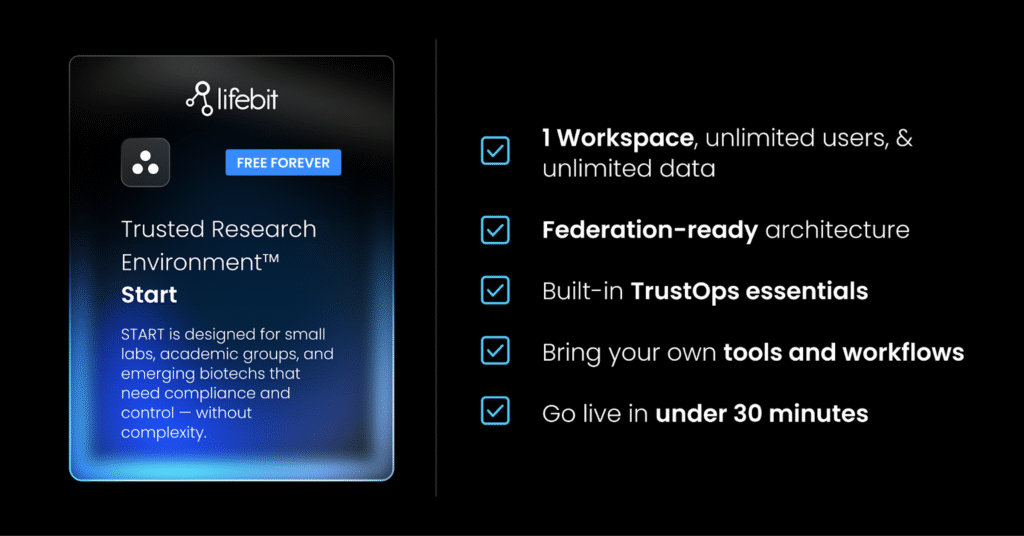
✅ Guided Cloud Deployment in Minutes
Connect your cloud account and automatically configure a secure, governed workspace with no manual cloud setup.
✅ Automatic S3 Policy Generator
Generate the exact bucket policies needed for workspace access, removing one of the most common causes of cloud pipeline failure.
✅ Use Preset Compute Environments or Build Your Own
Choose from pre-optimised AWS Batch compute environments or define custom settings including instance types, EBS size, throughput, and IOPS.
✅ Intuitive Nextflow Configuration
Select Nextflow versions, profiles, and parameters through a clean, guided UI-ensuring reproducibility and removing configuration guesswork.
✅ Real-Time Monitoring and Resource Visibility
View task states (pending, running, cached, failed) and inspect CPU and memory usage directly within the interface.
✅ Clear Failure Summaries with Log Access
If a workflow fails, the platform surfaces the process name, exit code, executed command, and working directory logs-no cloud console digging required.
✅ Built on the Federated, Zero-Data-Movement TRE Architecture
TRE START inherits the secure, federated infrastructure of Lifebit’s Trusted Research Environment and aligns with strict standards such as the 5 Safes Framework, GDPR, HIPAA, FedRAMP, and other global and institutional compliance requirements.
Outcome
TRE START gives research teams a FREE, simple, secure, and streamlined way to run Nextflow pipelines on the cloud, without the complexity normally associated with cloud infrastructure. By removing technical barriers, simplifying configuration, and providing a governed Trusted Research Environment ready in minutes, TRE START enables teams to focus on delivering scientific insights quickly, confidently, and at scale.