

7 Best Population Health Genomics Platforms in 2026

This week, the BBC reported that data on 500,000 UK Biobank participants was offered for sale on a Chinese website. The system, by every public account, did exactly what it was procured to do: an accredited researcher at an accredited organization downloaded approved data through approved channels — and the data then left the analysis platform, because the platform was built to allow that.
That isn’t a security breach. It’s the architecture working as designed. And it’s the same architectural model under most population health genomics platforms in production today, including the ones running national programs in the UK, the US, and across Europe. Choose your platform on the wrong axis and the same outcome becomes a question of when, not if.
This guide evaluates seven platforms against the architectural test that actually matters at population scale: not whether a platform is “compliant,” but whether the analytical environment prevents bulk export by design. We use the UK’s twenty-year-old Five Safes framework as the lens — Safe People, Safe Projects, Safe Settings, Safe Data, Safe Outputs — because it’s the framework most national programs claim to follow, and because the weakest of the five is what the recent UK Biobank sale exposed.
The architectural test: how to read this guide
Most population health genomics procurements score Safe People (researcher accreditation, training) and Safe Data (de-identification, anonymization) thoroughly. They tend to wave through Safe Settings (does the analytical environment prevent unauthorized egress?), Safe Outputs (is what leaves the environment reviewed before it leaves?), and Safe Projects (does the actual use match what was approved?). The platforms below differ most in how they answer those last three questions — and that’s where your evaluation should focus.
Two distinct architectures are in production at national scale today:
Managed analytical sandbox with policy-gated egress. Researchers analyze data inside the platform and can download approved bulk datasets to their institutional environments under a data-use agreement. The platform passes Safe People and Safe Data architecturally; Safe Settings and Safe Outputs are enforced administratively, not technically. The UK Biobank Research Analysis Platform follows this model. So do most US biobank programs.
Federated trusted research environment. Researchers analyze data in place; bulk participant-level data never leaves the custodian’s perimeter. Outputs go through a Safe Outputs review process at egress. Lifebit, Genomics England’s research environment, and Singapore’s national platform follow this model.
The first is faster to procure. The second is what the recent UK Biobank sale should have made everyone procure.
Five Safes scorecard at a glance
The same framework, applied across all seven platforms. Architectural means the safe is enforced by platform design (the platform won’t let it fail). Administrative means it depends on user behavior under a data-use agreement (the platform allows the failure if the user permits it). DIY means the customer builds it. None means it’s not provided.
| Platform | Safe Settings (no bulk egress) | Safe Outputs (egress review) | Multi-custodian federation | Cloud portability |
|---|---|---|---|---|
| Lifebit | Architectural | Architectural (Airlock) | Native | AWS, Azure, GCP, sovereign |
| DNAnexus (RAP-style) | Administrative (permits bulk egress) | Administrative | None — single workspace | Multi-cloud |
| Illumina Connected Analytics | Administrative | Administrative | None — single tenant | Illumina-tied |
| Terra | Administrative (permits bulk egress) | Administrative | None | Google Cloud only |
| Seven Bridges | Administrative | Administrative | None — single workspace | Multi-cloud |
| Google Cloud Healthcare API | DIY | DIY | DIY | Google Cloud only |
| Microsoft Genomics (Azure) | Administrative | Administrative | None | Azure only |
The pattern is consistent: Lifebit is the only platform in this list where the four most procurement-critical safes are enforced architecturally rather than administratively, and the only one with native multi-custodian federation. Every other platform relies on researchers behaving as their data-use agreement specifies. The UK Biobank sale demonstrated what happens when one researcher doesn’t.
1. Lifebit
Best for: National health programs where bulk data egress is unacceptable regardless of the researcher’s accreditation status, and where multi-custodian federation is required
Lifebit is a federated trusted research environment that runs sovereign AI across distributed health datasets without moving data. The platform is operational at the National Institutes of Health, Genomics England, and Singapore’s Ministry of Health, and is the current reference implementation of the compute-to-data model for population-scale genomics.
Where this platform shines
Lifebit’s defining architectural commitment is that bulk participant-level data never leaves the custodian’s perimeter. Researchers don’t download approved cohorts to their institutional cloud. Compute moves to where the data sits, runs under the custodian’s policy, and only Safe Outputs — model coefficients, summary statistics, aggregate counts that pass an automated review — egress.
This isn’t a hypothetical guarantee. It’s what an Airlock-mediated TRE physically prevents. A researcher with full accreditation, a valid data-use agreement, and legitimate intent cannot extract a participant-level dataset from a Lifebit deployment. The architecture won’t let them. That’s what the Five Safes calls “Safe Settings” implemented technically rather than procedurally.
For multi-custodian programs — federated cohorts spanning NIH, a national biobank, and a hospital network, for example — Lifebit’s orchestration runs the same query across all sites simultaneously, returns combined statistics, and never centralizes the underlying records. This is what makes population-scale federated GWAS, multi-ancestry meta-analysis, and cross-border real-world evidence generation feasible inside the consent and sovereignty constraints that govern modern health data.
Key Features
Federated architecture (compute-to-data): Analysis runs where the data sits. No bulk dataset egress under any access path.
Airlock-mediated Safe Outputs: First-of-its-kind automated output review. Aggregate statistics, model parameters, and summary counts pass through; participant-level data does not.
Five Safes by design: Safe People (project-scoped accreditation), Safe Projects (per-query approval), Safe Settings (in-environment-only compute), Safe Data (de-identification + access control), Safe Outputs (Airlock review).
AI-Powered Data Harmonization: The Trusted Data Factory harmonizes disparate genomic and clinical datasets into OMOP-ready, AI-analysis-ready assets in 48 hours rather than the typical 12-month timeline.
Built-In Compliance: FedRAMP-aligned, GDPR, HIPAA, ISO 27001, and 21 CFR Part 11. Native support for cross-border deployments where multiple regulatory regimes apply simultaneously.
Cloud-Agnostic Deployment: Deploy on AWS, Azure, GCP, or in-region sovereign clouds. No vendor lock-in. The data custodian retains full operational control.
Best For
Government health agencies running national precision medicine programs where the question “what happens after access is granted?” needs an architectural answer, not a procedural one. Cross-border research consortia spanning multiple regulatory boundaries. Biopharma programs partnering with national biobanks where the partnership is conditional on data not leaving the custodian’s perimeter. Any program where a single rogue accredited researcher would be a board-level incident.
Pricing
Custom pricing based on deployment scale, number of federated nodes, and analysis volume. Enterprise agreements available for national health programs and multi-site research consortia.
2. DNAnexus
Best for: Programs comfortable with the accredited-researcher trust model and willing to enforce Safe Settings and Safe Outputs administratively rather than architecturally
DNAnexus is a cloud-based genomics platform powering large research collaborations and biobank-scale analytics, including the UK Biobank Research Analysis Platform. The platform’s defining strength is workflow orchestration at population scale, with a decade of operational deployments behind it.
Where this platform shines
DNAnexus earned its reputation by powering the UK Biobank Research Analysis Platform — at over 500,000 participants with whole-genome sequencing accessible to thousands of researchers globally, it remains one of the world’s largest deployed genomics workspaces. If your program involves complex multi-step bioinformatics pipelines running over hundreds of thousands of genomes, the compute orchestration is mature and well-tested.
Where it falls short
Permits bulk dataset egress by design. The UK Biobank RAP, as documented in UK Biobank’s published access policy, allows accredited researchers to download bulk genotype, imputed, and phenotype datasets to their institutional environments. The platform itself is well-engineered; the permission to export is a procurement-and-policy choice rather than a vendor failing — but the consequence is the same: Safe Settings and Safe Outputs are enforced administratively, not architecturally. The April 2026 sale of 500,000 UK Biobank participants’ records on a Chinese website is what that reliance looks like in practice when one approved actor doesn’t behave.
Single-workspace deployment, no native federation. DNAnexus deployments are single-tenant. Programs requiring queries across multiple custodians — for example, a federated cohort spanning a national biobank, an NIH dataset, and a partner hospital network — have to build the orchestration layer themselves or run separate workspaces and reconcile outputs manually.
Workflow tooling locked to DNAnexus’s APIs. Pipelines written for DNAnexus’s compute orchestration are not natively portable to other platforms; migration requires rewrite. This is a significant lock-in cost for long-running national programs.
Compute pricing scales aggressively with population size. The usage-based model that’s reasonable for individual research projects becomes a meaningful line item at biobank scale.
Key Features
UK Biobank Partnership: The most-cited population genomics workspace, with a decade of operational scale.
Multi-Cloud Deployment: Native support for AWS, Azure, and Google Cloud with workload portability.
Apollo Insights Engine: Cohort analysis tools for population-scale variant queries and phenotype correlations.
WDL Workflow Support: Mature Workflow Description Language support with an extensive library of pre-built bioinformatics workflows.
Partner Ecosystem: Deep integrations with sequencing providers and analysis tool vendors for end-to-end genomics pipelines.
Best For
Research consortia operating under the accredited-researcher trust model with comfort enforcing Safe Settings and Safe Outputs administratively. Biobanks where institutional egress is part of the program’s design rather than a constraint to engineer around. Organizations requiring multi-cloud deployment flexibility for redundancy or cost optimization.
Pricing
Usage-based pricing model tied to compute and storage consumption. Enterprise contracts available with volume discounts for large programs.
3. Illumina Connected Analytics
Best for: Organizations already standardized on Illumina sequencing instruments and willing to deepen that lock-in for analytics convenience
Illumina Connected Analytics is a genomics analytics platform with native integration to Illumina sequencing instruments and DRAGEN analysis pipelines.
Where this platform shines
If your sequencing infrastructure runs on Illumina instruments — and statistically, it probably does — Connected Analytics eliminates the friction between sequencing and analysis. Data flows automatically from sequencer to DRAGEN secondary analysis to downstream interpretation. DRAGEN’s FPGA-accelerated analysis reduces whole-genome processing from hours to minutes, which compounds at population scale.
Where it falls short
Vendor lock-in to Illumina sequencing. The platform’s value proposition is tied directly to running Illumina instruments. Programs evaluating MGI, Element Biosciences, Ultima Genomics, or Oxford Nanopore for parts of their workflow lose most of the integration benefit. As the sequencing market diversifies, this lock-in becomes a strategic risk rather than a convenience.
Not federated. Connected Analytics is a centralized cloud service. There is no native architecture for analyzing data that legally cannot move — making it a poor fit for sovereign national programs where data residency rules govern the deployment.
Genomics-narrow. The platform is built for germline sequencing workflows. Integrating clinical EHR data, real-world evidence, claims data, or non-genomic omics requires significant custom engineering.
Pricing scales with sequencing throughput. The cost grows precisely as your program scales, with limited volume protection at the analytics layer.
Key Features
DRAGEN Integration: Native connection to Illumina’s DRAGEN secondary analysis platform for industry-leading speed and accuracy in variant calling.
Instrument Connectivity: Automatic data transfer from Illumina sequencing instruments eliminates manual upload steps and reduces errors.
BaseSpace Integration: Seamless connection to Illumina’s BaseSpace Sequence Hub for additional analysis applications and third-party tools.
Population Variant Analysis: Purpose-built tools for cohort-level variant analysis and frequency calculations.
Clinical Reporting: Clinical-grade reporting capabilities meeting regulatory requirements for diagnostic and screening programs.
Best For
Healthcare systems running population screening programs entirely on Illumina instruments and committed to that vendor relationship long-term. Clinical laboratories where sequencer-to-report turnaround time is the primary procurement criterion.
Pricing
Subscription-based pricing that scales with sequencing throughput. Volume tiers available for high-throughput population programs.
4. Terra
Best for: Academic research programs operating under NIH-grant compliance frameworks where Google Cloud is acceptable and federation is not required
Terra is an open-source genomics platform from the Broad Institute, built on Google Cloud infrastructure and powering major national research initiatives.
Where this platform shines
Terra powers the NIH All of Us Research Program, which aims to sequence one million Americans. The open-source foundation means methods published in research papers can be directly imported and reproduced. For academic consortia where methodological transparency is the procurement criterion, Terra’s architecture enforces the principle by design.
Where it falls short
Architecturally identical to RAP for the egress question. All of Us researchers download approved data into their workspace; bulk egress is permitted under a data-use agreement. The Five Safes scoring on Settings and Outputs is the same as DNAnexus’s RAP — administrative enforcement, not architectural. The same failure mode applies.
Single-cloud lock-in to Google Cloud Platform. Programs with sovereignty requirements that exclude US-based commercial cloud providers, or that need deployment in regions where GCP doesn’t have a presence, cannot use Terra. There is no portability story.
Cost model passes GCP rates through directly. Programs are exposed to GCP’s compute and storage prices with no enterprise volume-pricing layer between them and the cloud. Surprise compute costs at population scale are a documented operational challenge.
Built for NIH-funded academic research. The commercial, access, and governance models are tuned for university-led NIH-grant programs. Sovereign-government programs and biopharma consortia find the framework difficult to adapt.
Open-source community moves at academic pace. Roadmap and feature pace is consensus-driven across an academic contributor base, which is appropriate for the project’s mission but slower than commercial alternatives for procurement teams that need predictable delivery.
Key Features
NIH All of Us Platform: Selected to power one of America’s largest precision medicine initiatives.
Open-Source Foundation: Community-contributed workflows and analysis methods with full transparency.
WDL and Cromwell: Workflow Description Language support with Cromwell execution engine for portable, reproducible bioinformatics pipelines.
AnVIL Integration: Connection to NHGRI’s Analysis, Visualization, and Informatics Lab-space.
Jupyter Notebooks: Interactive analysis environments supporting Python, R, and other languages.
Best For
Academic research consortia with open-science mandates and NIH-grant funding. University-led population genomics studies where Google Cloud is the preferred infrastructure choice and methodological transparency is a primary procurement criterion.
Pricing
Platform access is free. Users pay Google Cloud compute and storage costs directly at standard GCP rates.
5. Seven Bridges
Best for: Federal agencies whose primary procurement gate is FedRAMP authorization, and who do not need multi-custodian federation
Seven Bridges is an enterprise genomics platform with FedRAMP authorization, serving government health agencies and large-scale cancer genomics programs.
Where this platform shines
Seven Bridges holds FedRAMP Moderate authorization, which clears a significant federal procurement gate. The platform powers the NCI Cancer Genomics Cloud and NHLBI BioData Catalyst, and its GRAF population reference addresses ancestry-diversity gaps in variant interpretation.
Where it falls short
FedRAMP certifies process, not architecture. FedRAMP Moderate is a security-posture certification. It does not certify federated architecture, technical Safe Outputs enforcement, or any particular Five Safes commitment. Programs requiring both FedRAMP and federated TRE architecture are not solved by Seven Bridges alone.
Single-workspace deployment. Like DNAnexus, Seven Bridges is single-tenant per deployment. Multi-custodian queries (e.g., NIH plus a partner biobank plus a hospital network) require a separate orchestration layer.
Same managed-sandbox architecture as RAP. Bulk dataset egress to accredited researchers is permitted under the program’s data-use agreement. Safe Settings and Safe Outputs are administrative, not architectural.
Ownership and roadmap discontinuity. Seven Bridges was acquired by Velsera in 2022, which has affected product roadmap pace and customer-success continuity. This is publicly documented and should be factored into long-term procurement decisions.
Government-procurement pricing. Enterprise contracts only, with limited customization speed and slow contract cycle times.
Key Features
FedRAMP Authorization: FedRAMP Moderate certification enables federal agencies to deploy without lengthy additional security reviews.
NCI Cancer Genomics Cloud: Powers the National Cancer Institute’s cloud-based genomics platform.
BioData Catalyst: Selected by NHLBI to power heart, lung, blood, and sleep research data analysis.
CWL Workflow Portability: Common Workflow Language support ensures analysis pipelines can move between platforms without rewriting.
GRAF Population Reference: Graph-based reference addressing ancestry diversity for more accurate variant calling.
Best For
Federal health agencies whose primary procurement gate is FedRAMP and who can accept the accredited-researcher trust model. Single-tenant cancer genomics programs with no multi-custodian federation requirement.
Pricing
Enterprise pricing with government contract vehicles available.
6. Google Cloud Healthcare API + Vertex AI
Best for: Organizations with dedicated platform engineering teams committed to building Five Safes parity from cloud primitives over 12-24 months
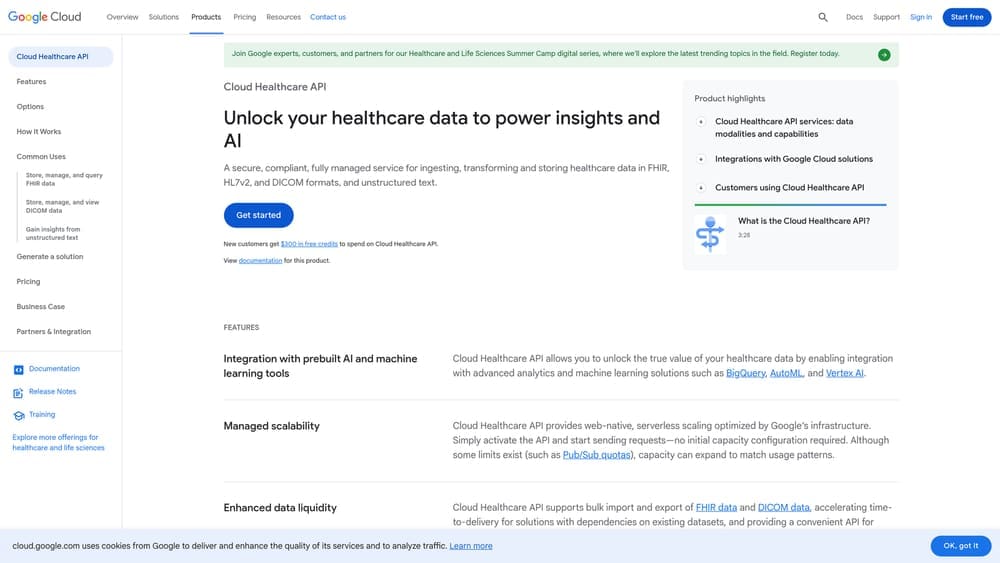
Google Cloud Healthcare API provides cloud infrastructure for building custom population health genomics solutions with integrated AI and machine learning capabilities.
Where this platform shines
This isn’t a turnkey genomics platform — it’s infrastructure for building one. The FHIR-native approach matters for integrating genomic data with electronic health records. Vertex AI enables custom machine learning models for variant interpretation. BigQuery’s ability to run SQL queries across billions of variants is operationally powerful for organizations with the engineering team to wield it.
Where it falls short
It’s not a platform; it’s primitives. Buying GCP Healthcare API is buying components. Population health genomics requires those components plus an analytics layer, governance layer, access-control plane, audit framework, and Safe Outputs review — none of which come in the box. Reaching feature parity with the turnkey platforms in this list takes a 12-24 month engineering build with a dedicated team.
Total cost of ownership is opaque. The API costs are the visible line item. The engineering build, ongoing maintenance, security operations, and compliance evidence collection are the invisible majority of program cost.
No federation across custodians. Multi-site, multi-custodian queries are a custom build on top of the primitives. There is no native federation model.
Total Google Cloud lock-in. Everything you build is GCP-specific. Migration to AWS or Azure means a rebuild. For sovereign programs that may need to switch cloud providers as policy evolves, this is a strategic risk.
Compliance certifications are inherited, not earned. GCP’s HIPAA, HITRUST, and ISO certifications cover the cloud infrastructure. The application-layer compliance posture for everything you build on top is your responsibility, not Google’s.
Key Features
FHIR-Native Architecture: Healthcare API natively supports FHIR with genomics extensions for EHR integration.
Vertex AI Integration: Build custom machine learning models for variant interpretation, risk prediction, or drug response.
BigQuery for Genomics: Run SQL queries across population-scale variant datasets — billions of variants — with sub-second response times.
Variant Transforms: Tools for converting VCF files into BigQuery tables for large-scale population genetics queries.
Compliance Portfolio: HIPAA, HITRUST, ISO 27001 at the cloud-infrastructure layer.
Best For
Organizations with dedicated platform-engineering teams committed to a multi-year build, willing to operate end-to-end at the infrastructure layer, and committed to Google Cloud as the long-term provider.
Pricing
Pay-as-you-go cloud pricing for compute, storage, and API calls. Engineering build cost dominates total program cost.
7. Microsoft Genomics (Azure)
Best for: Healthcare organizations with deep existing Azure investment where the genomics workload can fit a single-cloud Microsoft-only architecture
Microsoft Genomics is an Azure-based genomics service with GATK integration for organizations standardizing on Microsoft’s cloud platform.
Where this platform shines
If your organization runs on Azure, Microsoft Genomics provides a native genomics capability inside that ecosystem. The platform implements GATK best practices — the gold standard for germline variant calling — and integrates with Azure Active Directory for identity management.
Where it falls short
Microsoft’s genomics product strategy has shifted multiple times. The Microsoft Genomics service has been repositioned across the last several years — the current Azure-native offering is closer to a workflow execution service than a turnkey platform. Procurement teams should evaluate the product’s current scope rather than its marketing materials, and should price strategic risk associated with Microsoft’s pace of investment in the segment relative to AWS and GCP.
Azure-only deployment. No multi-cloud or sovereign deployment options outside Microsoft’s regional cloud footprint. For programs with multi-cloud, sovereign-cloud, or hybrid requirements, this is a hard constraint.
GATK best-practices is a commodity. The same implementation is available on every major cloud and through every turnkey genomics platform in this list. It’s not a differentiator; it’s a baseline.
No native federation across custodians. Single-tenant cloud architecture with no built-in multi-custodian query model.
Innovation pace lags AWS and GCP in genomics. The most active genomics ecosystems on the public clouds are on AWS and GCP. Programs requiring access to bleeding-edge tooling will find the Azure ecosystem comparatively thin.
Key Features
GATK Best Practices: Implementation of Broad Institute’s Genome Analysis Toolkit best practices for industry-standard variant calling.
Azure Compliance: Inherits Azure’s compliance certifications including HIPAA, GDPR, FedRAMP, and ISO 27001.
Azure ML Integration: Connection to Azure Machine Learning for custom model development.
Cromwell on Azure: Workflow orchestration using Cromwell engine for WDL workflow execution.
Enterprise Security: Azure Active Directory integration for centralized identity management.
Best For
Healthcare systems with significant Azure investment, single-cloud architecture, and Microsoft enterprise agreements that make alternative platforms commercially difficult.
Pricing
Pay-per-genome pricing model. Enterprise agreements available with volume discounts.
Making the right choice
The platform decision comes down to one architectural question: when access is granted, can a single approved researcher technically remove participant-level data from the analytical environment?
If the answer must be no — because your participants’ consent assumed it, because cross-border law prohibits it, or because the cost of one bad actor would be a program-ending incident — you need a federated TRE. Lifebit is the only platform on this list that enforces this architecturally and natively federates across multiple custodians. Deployed across NIH, Genomics England, and Singapore’s Ministry of Health, it is the current reference implementation. The cost of the architectural commitment is paid once at procurement; the cost of not making it is paid every time someone with valid credentials and bad intentions touches the data — as the UK Biobank just demonstrated.
If your program can accept the accredited-researcher trust model, DNAnexus is the most operationally proven managed-sandbox platform at biobank scale. Just price the operational risk explicitly, write tender language that specifies bulk-egress restrictions if you want them, and understand that you are buying the same architecture that produced the recent UK Biobank sale.
The other five platforms each have specific, narrow fits. Illumina Connected Analytics if you are deeply locked into Illumina sequencing and accept that lock-in long-term. Terra if you are an academic research consortium operating under NIH-grant compliance and Google Cloud is acceptable. Seven Bridges if FedRAMP is your single hardest procurement gate and you do not need multi-custodian federation. Google Cloud Healthcare API + Vertex AI if you have a dedicated platform-engineering team willing to build Five Safes parity over 12-24 months from primitives. Microsoft Genomics if existing Azure enterprise agreements make alternatives commercially difficult and you are comfortable with single-cloud lock-in.
None of those five are appropriate for sovereign-scale, multi-custodian, federated population health genomics. They were not built for it. If your program needs that, you have one architectural choice and a hundred procedural ones.
Population health genomics is moving from research initiative to healthcare infrastructure. The architectural choice you make today will be visible in your next decade’s procurement and audit cycles — and increasingly, in your next news cycle. Choose where your data physically resides, who can technically remove it, and how outputs are reviewed before egress. Compliance certifications follow architecture; they don’t replace it.
Want to grade any vendor against the Five Safes before signing a tender? Open the free TRE scorecard — 15 questions, no email gate, includes Lifebit. Or book a demo to see compute-to-data running across federated nodes in your own environment.
Frequently asked questions
What is a population health genomics platform?
A population health genomics platform analyzes large-scale genomic and clinical data — typically across hundreds of thousands to millions of participants — to drive precision medicine, drug discovery, and public health insights. Platforms differ most in their architectural approach to data sovereignty, governance, and federation across multiple custodians.
What is the difference between a federated TRE and a managed analytical sandbox?
A federated trusted research environment (TRE) keeps data inside each custodian’s perimeter — researchers analyze data in place, and only Safe Outputs (aggregate statistics, model parameters, summary counts) leave the environment. A managed analytical sandbox permits researchers to download approved bulk datasets to their institutional environment under a data-use agreement. The 2026 UK Biobank data sale is what happens when one approved researcher in the sandbox model does not behave as their DUA specifies.
How do I evaluate a platform against the Five Safes framework?
The Five Safes (Safe People, Projects, Settings, Data, Outputs) ask whether each safe is enforced architecturally (the platform won’t let it fail) or administratively (it depends on user behavior under a DUA). Lifebit’s federated TRE enforces all four procurement-critical safes architecturally; managed-sandbox platforms typically enforce Safe Settings and Safe Outputs administratively.
Which platform is best for sovereign national genomics programs?
For national programs where bulk data egress is unacceptable regardless of researcher accreditation — and where multi-custodian federation is required — Lifebit is the only platform on this list that enforces this architecturally. It is operational across the National Institutes of Health, Genomics England, and Singapore’s Ministry of Health.
Can I deploy DNAnexus or Terra without permitting bulk dataset egress?
In principle, the underlying platforms can be configured to restrict bulk egress, but doing so requires custom procurement language that most current tenders do not specify. The default deployment model used by the UK Biobank Research Analysis Platform and the All of Us Research Program permits accredited researchers to download bulk datasets to their institutional environments under a data-use agreement.
Is FedRAMP authorization the same as a federated TRE?
No. FedRAMP Moderate is a US federal security-posture certification for cloud services. It does not certify federated architecture, technical Safe Outputs enforcement, or any particular Five Safes commitment. Programs requiring both FedRAMP and federated TRE architecture need to specify the latter explicitly in procurement language.