

Preclinical Research: Setting the Stage for Medical Breakthroughs
The Preclinical Research Definition Every Drug Developer Needs to Know
The preclinical research definition is straightforward: it is the stage of drug development that happens before testing in humans, where scientists evaluate whether a compound is safe and effective enough to move forward.
Quick answer:
Preclinical research is the phase of drug development in which a new compound is tested in laboratory settings — using cell-based (in vitro) and animal (in vivo) studies — to assess its safety, toxicity, and biological activity before any human trials begin. Regulatory agencies like the FDA require this data before approving a clinical trial.
Here is what preclinical research covers at a glance:
| What it is | Testing a drug candidate before human trials |
|---|---|
| Main methods | In vitro (cell-based) and in vivo (animal) studies |
| Key goals | Assess toxicity, establish safe doses, prove biological activity |
| Regulatory standard | Good Laboratory Practices (GLP), 21 CFR Part 58 |
| Typical duration | 4 to 10 years |
| Success rate | Fewer than 10% of candidates advance to clinical trials |
Before a single human volunteer receives a new drug, researchers must answer one critical question: could this cause serious harm? That is the heart of preclinical research. It is the filter that sits between a promising lab discovery and a first-in-human clinical trial — and it is one of the most demanding phases in all of medicine.
The odds are steep. Out of every 5,000 compounds that enter drug discovery and preclinical development, only one typically becomes an approved drug. Yet this stage remains the essential foundation of safe, evidence-based medicine.
I’m Maria Chatzou Dunford, CEO and Co-founder of Lifebit, and my work in computational biology and federated data platforms has given me a front-row seat to how the preclinical research definition is evolving in the era of AI-driven drug discovery. In the sections below, I will walk you through every key aspect of preclinical research — from regulatory requirements to study types to what it takes to get a candidate to the clinic.
Easy preclinical research definition glossary:
Understanding the Preclinical Research Definition and Its Role in Drug Safety

When we look at the Definition of PRECLINICAL, we see it refers to the period occurring prior to clinical testing. In the pharmaceutical world, this isn’t just a chronological marker; it’s a rigorous scientific gatekeeping process. The core of this phase is assessing biological activity and feasibility. We aren’t just looking for a drug that “works”; we are looking for a drug that works without causing unacceptable harm.
The primary role of preclinical research is to provide a “go/no-go” signal. Historically, this phase became a mandatory regulatory requirement following tragedies like the 1937 Elixir Sulfanilamide incident, where the lack of safety testing led to over 100 deaths. This prompted the 1938 Federal Food, Drug, and Cosmetic Act, establishing the legal requirement for safety data before marketing. Today, researchers must determine the potential for toxicity — the ability of a substance to cause serious harm — before a single dose is administered to a human. This involves iterative testing where compounds are refined, discarded, or advanced based on how they interact with living systems.
A Formal Preclinical Research Definition for Drug Developers
For those of us in the industry, a formal preclinical research definition encompasses the laboratory experiments (both in vitro and in vivo) designed to gather safety and efficacy data. This data forms the regulatory foundation for all subsequent human trials. Without this phase, we would have no evidence-based way to predict how a new molecule might affect human physiology, making clinical trials ethically and practically impossible. Modern preclinical research also includes “in silico” modeling, where computer simulations predict how a drug might bind to a target or be metabolized by the liver.
How the Preclinical Research Definition Differs from Nonclinical Studies
You will often hear the terms “preclinical” and “nonclinical” used interchangeably, but there is a nuance worth noting. According to the FDA’s Good Laboratory Practice for Nonclinical Laboratory Studies (Section 58.3), “nonclinical” refers to in vivo or in vitro experiments in which test articles are studied prospectively in test systems under laboratory conditions.
While many regulatory agencies like the EMA use the terms interchangeably, the FDA specifically chooses to use the word nonclinical in its official regulations. In common industry parlance, “preclinical” usually refers specifically to the work done before the first-in-human trial, whereas “nonclinical” can include studies that continue even after human trials have begun (such as long-term carcinogenicity studies or reproductive toxicity studies that may take years to complete).
| Feature | Preclinical Studies | Nonclinical Studies |
|---|---|---|
| Timing | Strictly before Phase 1 clinical trials | Before and during clinical trials |
| Scope | Lead discovery to IND submission | All lab/animal work throughout development |
| Regulatory Term | Common industry usage | FDA preferred term (21 CFR Part 58) |
| Primary Goal | Safety for first-in-human dose | Comprehensive safety profile for marketing |
For a deeper dive into these distinctions, you can explore Preclinical and Nonclinical Studies—What Is the Difference?
The 4 Essential Stages of Preclinical Development
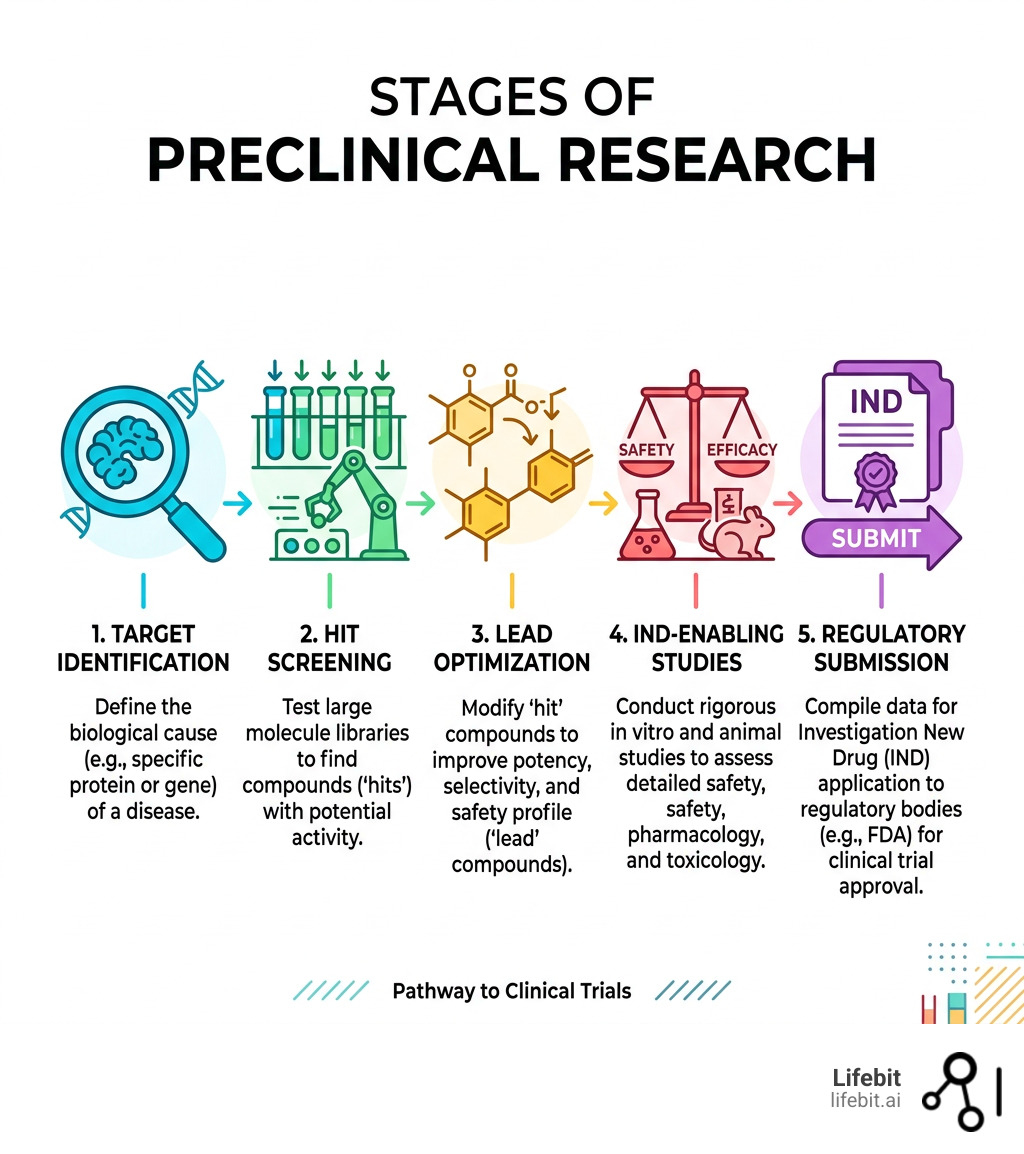
The journey from a “eureka” moment in the lab to a clinical candidate is long and winding. We typically break this down into four specific phases that guide a compound through the end-to-end drug discovery complete guide process.
- Basic Research: Identifying the biological pathways involved in a disease. This often involves “Target Identification,” where scientists use tools like CRISPR or RNA interference (RNAi) to see if “knocking out” a specific gene or protein can stop a disease process.
- Drug Discovery: Testing thousands of compounds to see which ones interact with the target. This is the “Hit Identification” phase, often utilizing high-throughput screening (HTS) where robotic systems test 100,000+ compounds against a biological assay in a matter of days.
- Lead Optimization: Chemically modifying the best “hits” to improve their safety and effectiveness. This is where medicinal chemists perform Structure-Activity Relationship (SAR) studies, tweaking the molecule to ensure it is potent, selective, and stable enough to survive the human digestive system or bloodstream.
- IND-Enabling Studies: Final, high-stakes safety tests required by regulators. These must be conducted under strict Good Laboratory Practice (GLP) conditions to ensure the data is robust enough for the FDA to review.
From Hit Identification to Preclinical Candidate
This stage is about narrowing the field. In a typical project, we might screen 200,000 to over 1 million compounds. Through high-throughput screening and structure-based design, we identify “hits”—molecules that show the desired biological activity but may have poor solubility or high toxicity.
Once a hit is found, it undergoes chemical optimization. We tweak the molecular structure to ensure it can reach its target in the body, stays active long enough to work, and doesn’t bind to the wrong things (which causes side effects). For example, a chemist might add a methyl group to a molecule to prevent it from being broken down too quickly by liver enzymes. Only the most promising one or two compounds survive this process to become “preclinical candidates.”
Why IND-Enabling Studies are the Ultimate Gatekeeper
The final hurdle of preclinical research is the Investigational New Drug (IND)-enabling study. This is a specialized package of data that federal law requires us to submit to the FDA (or equivalent bodies like the EMA) before human trials can begin.
These studies include safety pharmacology, genotoxicity (checking if the drug damages DNA or causes mutations), and expanded toxicology in at least two mammalian species. It is a rigorous check to ensure that the drug is “clean” enough to justify the risk of human exposure. If a drug shows signs of causing liver damage or heart arrhythmias at this stage, the project is usually terminated. You can read more about this transition in our guide on drug discovery and development.
In Vitro vs. In Vivo: Methods for Proving Efficacy
To satisfy the Step 2: Preclinical Research | FDA requirements, we use several modes of testing, each offering different insights into how a drug behaves:
- In Vitro (In glass): These are studies performed in a controlled environment outside of a living organism, such as in a test tube or petri dish using cell cultures. They are excellent for rapid screening and understanding molecular mechanisms. Modern in vitro techniques include “Organ-on-a-Chip” technology, which uses microfluidic devices lined with human cells to mimic the physiological environment of whole organs like the lung or liver.
- In Vivo (In the living): These studies are conducted in living organisms, typically animal models. They are essential because they show how a drug interacts with a complex, multi-organ system—something a single layer of cells cannot replicate. They help us understand how a drug is absorbed by the gut, filtered by the liver, and excreted by the kidneys.
- In Silico (In the computer): This is an emerging third pillar where AI and machine learning models predict drug-target interactions and toxicity profiles based on massive datasets of known chemical structures and biological outcomes.
The Role of Animal Models in Human Safety Prediction
Animal models are the “bridge” to human safety. Because human biology is incredibly complex, we need systems that mimic our own.
- Murine models (mice and rats): Common for initial efficacy and toxicity due to their well-understood genetics and short lifespans, which allow for multi-generational studies.
- Canine studies: Often used for gastric and certain cancer studies, though they aren’t suitable for all oral drugs due to their shorter intestines. They are particularly useful for cardiovascular safety testing.
- Porcine (pig) models: Frequently used for skin or heart-related research because their skin thickness and cardiovascular anatomy are remarkably similar to humans.
- Non-Human Primates (NHPs): Used sparingly and only when no other model is suitable, typically for complex biologics or vaccines that only react with primate-specific immune receptors.
Ethical considerations are paramount here. The industry follows the 3Rs principle: Replacement (using non-animal models like computer simulations or cell cultures where possible), Reduction (using the fewest animals necessary to achieve statistical significance), and Refinement (minimizing any potential distress through better housing and anesthesia). Regulatory agencies generally require safety data from at least two mammalian species—one rodent and one non-rodent—before human testing.
Regulatory Requirements: Mastering GLP and FDA Standards
In the preclinical world, “The Process is the Product.” It isn’t enough to have good results; you must have provable, reproducible results. This is governed by 21 CFR Part 58.1: Good Laboratory Practice for Nonclinical Laboratory Studies. GLP is not about the scientific merit of the study, but about the integrity and quality of the data generated.
Adhering to Good Laboratory Practices (GLP)
GLP is the gold standard for preclinical integrity. It sets the minimum requirements for every aspect of the laboratory environment:
- Personnel: Ensuring staff are properly trained and qualified. Every study must have a designated Study Director, who serves as the single point of control for the entire project.
- Facilities and Equipment: Demanding regular calibration and clean, organized environments. Equipment like mass spectrometers or balances must have detailed maintenance logs.
- Standard Operating Procedures (SOPs): Every lab task, from cleaning cages to analyzing blood samples, must have a written SOP that is followed to the letter to prevent human error.
- Written Protocols: Every study must have a pre-approved “playbook” or protocol that outlines the objectives and methods before the study begins.
- Quality Assurance Unit (QAU): An independent unit must oversee the studies. The QAU performs periodic inspections and reviews the final report to ensure it accurately reflects the raw data. They must be entirely separate from the scientists conducting the research.
Following GLP is mandatory for any study intended to support an application for a research or marketing permit. If a study isn’t GLP-compliant, the FDA may reject the data entirely, sending the drug developer back to square one. This is why many biotech startups outsource their IND-enabling studies to specialized Contract Research Organizations (CROs) that are certified for GLP work.
Pharmacokinetics and Toxicology: Setting Safe Human Doses
One of the most critical outputs of the preclinical research definition is the determination of the “starting dose” for humans. We do this through two main lenses:
- Pharmacokinetics (PK): What the body does to the drug. We look at ADME—Absorption (how it enters the blood), Distribution (where it goes in the body), Metabolism (how the liver breaks it down), and Excretion (how it leaves the body via urine or feces).
- Pharmacodynamics (PD): What the drug does to the body (the dose-response relationship). We measure the “Effective Dose” (ED50) where 50% of the subjects show the desired effect.
Safety Pharmacology: The Core Battery
Before human trials, we must perform a “Core Battery” of safety pharmacology tests to ensure the drug doesn’t interfere with vital organ systems:
- Central Nervous System (CNS): Observing motor activity, behavioral changes, and coordination.
- Cardiovascular System: Measuring blood pressure, heart rate, and performing the hERG assay, which checks if the drug might cause a specific type of fatal heart arrhythmia (QT prolongation).
- Respiratory System: Monitoring respiratory rate and hemoglobin oxygen saturation.
Determining the First-in-Human Starting Dose
By combining PK and PD data, we identify the NOAEL (No Observed Adverse Effect Level). This is the highest dose that does not cause significant harmful effects in animal models. We don’t just give humans the NOAEL dose. We use allometric scaling—a mathematical way to adjust the dose based on body surface area and metabolic differences between species.
We then apply a “safety margin,” often a 1/100 uncertainty factor (1/10 for interspecies differences and 1/10 for individual human variation), to arrive at the Human Equivalent Dose (HED). This ensures the first human dose is sub-therapeutic and, above all, safe. To learn more about how we identify these targets, see our article on leveraging AI for target validation in drug discovery.
The High Stakes of Preclinical Success: Timelines and Statistics
The reality of preclinical research is that it is a “failure-heavy” business. This phase is often called the “Valley of Death” because so many promising scientific discoveries fail to make the transition from the lab bench to the patient’s bedside. The statistics are a sobering reminder of why this work requires such dedication:
- Duration: Preclinical research typically spans 4 to 10 years. This includes the time needed for target validation, screening millions of compounds, and conducting long-term toxicology studies (some of which must last 6 to 9 months).
- The 5,000-to-1 Rule: On average, only one in every 5,000 compounds that enters the discovery phase will ever become an approved drug. For every 250 compounds that enter preclinical testing, only about 5 will move into clinical trials.
- Transition Rate: Fewer than 10% of projects successfully transition from the lab to a clinical candidate. Most fail due to “poor developability”—the drug might work in a dish but cannot be made into a stable pill, or it is cleared from the body too quickly to be effective.
- Clinical Success: Even after passing the preclinical gauntlet, less than 10% success rate is common for drugs entering human trials. The most common reasons for failure in Phase 2 and 3 are lack of efficacy (it doesn’t work in humans as it did in animals) and safety issues that only appear in larger human populations.
These current challenges of drug discovery are why modern biopharma is increasingly turning to advanced data platforms and federated learning to improve these odds by identifying better targets earlier in the process.
Frequently Asked Questions about Preclinical Research
How long does preclinical research typically take?
It is a marathon, not a sprint. The process usually takes between 4 and 10 years. This includes the time needed for target validation, screening millions of compounds, optimizing the chemical structure, and conducting the long-term toxicology studies required for an IND application.
What is the success rate of drugs moving from preclinical to clinical trials?
The attrition rate is incredibly high. Less than 10% of drug candidates that enter the preclinical phase will ever make it into a Phase 1 clinical trial. Most fail due to unforeseen toxicity or because they simply aren’t effective enough in animal models to justify human testing.
What are the main goals of preclinical studies?
The three pillars of preclinical research are:
- Toxicity Assessment: Identifying if the drug causes harm to organs, DNA, or reproductive systems.
- Safe Dosing: Establishing the NOAEL and calculating the first-in-human starting dose.
- Proof of Concept: Demonstrating that the drug actually has the intended biological effect on the disease target.
Conclusion
The preclinical research definition represents the most critical “filter” in modern medicine. It is the stage where we separate scientific curiosity from clinical reality, ensuring that only the safest and most promising therapies reach the patients who need them.
At Lifebit, we understand that the bottleneck in preclinical research is often data—getting secure, real-time access to the global biomedical and multi-omic data needed to validate targets and predict safety. Our federated AI platform is designed to break down these silos, providing the Trusted Research Environment (TRE) and advanced AI/ML analytics that allow researchers to navigate the preclinical gauntlet with more precision and less risk.
By harmonizing data across hybrid ecosystems, we help biopharma and government agencies turn years of laboratory work into life-saving breakthroughs.