
Trusting the Process: Inside DHA’s Research Environment

DHA Trusted Research Environment: Access 9.5M Records Without Moving Data
A DHA trusted research environment is a secure, federated data platform that enables approved researchers to access and analyze sensitive military health data without moving it from its source. Built on the DoD’s VAULTIS framework (Visible, Accessible, Understandable, Linked, Trusted, Interoperable, Secure), it supports AI/ML readiness, ensures HIPAA compliance, and powers real-time analytics across 9.5 million patient records—all while maintaining zero-trust security and domain-driven governance.
Key Components of the DHA Trusted Research Environment:
- Federated Data Mesh: Data stays at source; analysis happens in situ, preventing the risks associated with data duplication and movement.
- VAULTIS Framework: Seven core principles that ensure data is not just secure, but usable and discoverable across the entire Department of Defense.
- Enterprise Data Catalog (DHA-EDC): A centralized metadata repository that allows researchers to find data across distributed systems without seeing the raw data itself.
- AI/ML-Ready Infrastructure: High-performance computing environments that support NLP, OCR, and predictive analytics directly on the clinical data.
- Five Safes Model: A rigorous governance framework ensuring safe people, projects, data, settings, and outputs.
- MHS GENESIS Integration: Seamless connectivity with the unified electronic health records system across 700+ global facilities.
The world of defense healthcare is at a critical inflection point. On one hand, data-driven insights can save lives on the battlefield through rapid trauma response and accelerate precision medicine for service members dealing with complex conditions like TBI or PTSD. On the other, fragmented legacy systems, strict compliance constraints, and the ever-present threat of cyber warfare continue to slow progress. The transition from the legacy AHLTA and CHCS systems to MHS GENESIS was the first step; the creation of a Trusted Research Environment (TRE) is the necessary second step to unlock that data’s potential.
In September 2025, the Defense Health Agency’s solicitation HT001125RE019 signaled a strategic shift: unify its data landscape without centralization. This isn’t just a technical upgrade—it’s a fundamental reimagining of how military health data flows. Historically, the DoD relied on massive, centralized data lakes. However, these “single points of truth” often became “single points of failure” and massive targets for adversaries. By moving toward a federated architecture, the DHA is ensuring that insights reach the point of care faster than ever before while minimizing the attack surface.
The DHA manages healthcare for 9.5 million patients across 700 hospitals and clinics globally. That’s nearly 130,000 civilian and military personnel generating petabytes of clinical, genomic, and operational data every day. The old approach—siloed systems, slow data access, manual approvals—doesn’t scale. It doesn’t support the rapid iteration required for modern AI. And it doesn’t meet the speed required for battlefield medicine or population health surveillance in an era of global pandemics and biological threats.
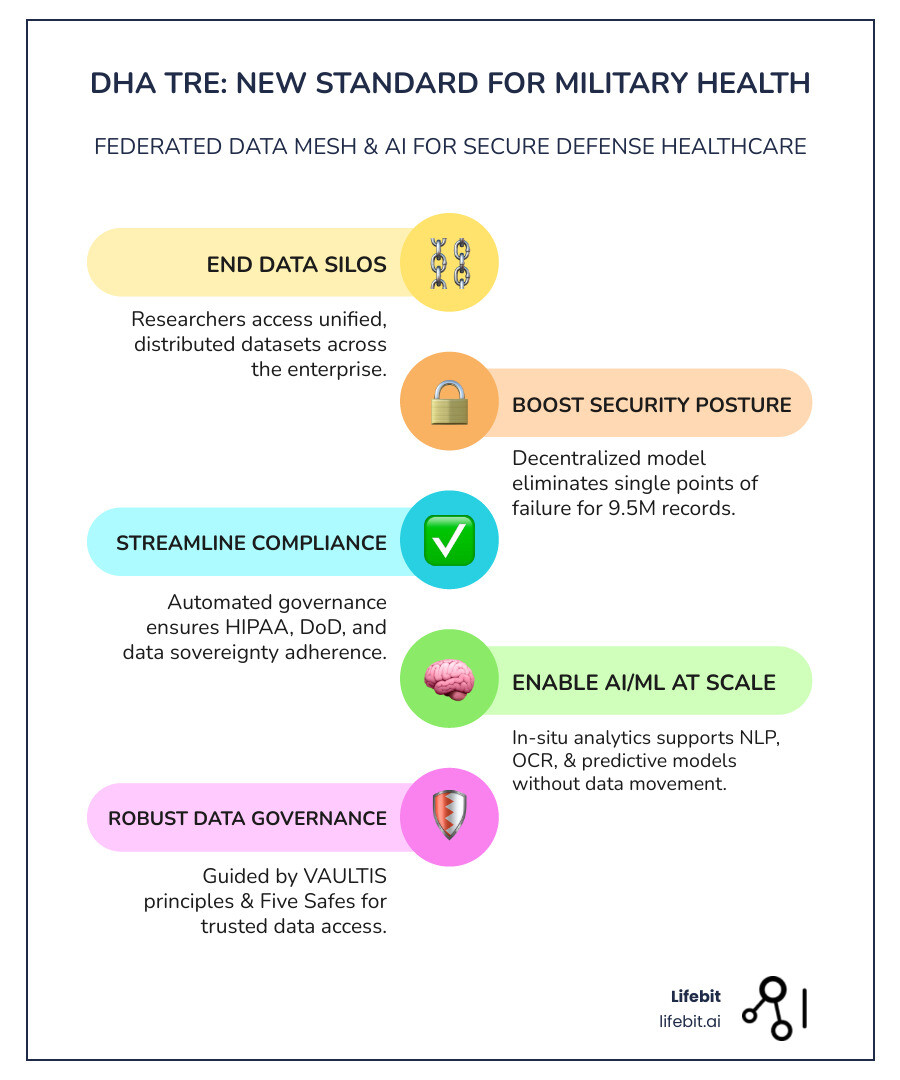
The shift to a trusted research environment solves three critical problems:
- Data silos: Researchers previously spent 80% of their time just trying to find and access data across the enterprise. The TRE provides a unified search layer.
- Security vulnerabilities: Centralized data lakes create high-value targets. A federated mesh distributes the risk, ensuring that a breach in one node does not compromise the entire system.
- Compliance bottlenecks: Moving data across international borders or between agencies triggers complex HIPAA, DoD, and international data sovereignty reviews. By keeping data in situ, these legal hurdles are significantly reduced.
Instead of forcing data into a central repository, the DHA is building a federated data mesh. In this architecture, data stays with the domain experts—the clinicians and hospital administrators who understand its context best. Researchers access it through a unified catalog, and analytics happen in situ—where the data lives—using secure, governed workflows. This approach respects the “data gravity” of massive clinical datasets while providing the agility of a modern cloud environment.
This is also about military readiness. When analysts can predict medical supply needs using ML models trained on historical consumption, deployment schedules, and epidemiological data—without waiting months for data access approvals—commanders make better decisions. When NLP scans clinical notes for early signals of emerging health threats, public health teams respond faster. When AI-powered tools flag sepsis risk in real time, clinicians save lives. The DHA trusted research environment is the engine that makes this possible, turning raw data into a strategic asset for the warfighter.
DHA Trusted Research Environment: Stop Data Bottlenecks in Military Health
The Defense Health Agency (DHA) isn’t just another healthcare provider; it’s a global health system with a dual mandate: a “medically ready force” and a “ready medical force.” To achieve this, we must move beyond traditional data sharing. A Trusted Research Environment (TRE)—also known as a Secure Data Environment or Data Safe Haven—provides a highly secure computing space where approved researchers can access de-identified data for projects that deliver a clear public benefit.
For the DHA, the scale is staggering. Managing over 700 hospitals and clinics globally while delivering care to 9.5 million patients through TRICARE means the data is massive, diverse, and sensitive. Traditionally, researchers had to request data, wait for de-identification, and then receive a copy of that data. This “copy-and-send” model is a security nightmare and a logistical bottleneck. It leads to “data sprawl,” where multiple versions of sensitive records exist on various unsecured laptops and servers across the country.
The dha trusted research environment flips this script. Instead of the data moving to the researcher, the researcher moves to the data. By providing a secure analysis environment, the DHA ensures that data cannot be downloaded or extracted. This protects patient privacy while allowing for the large-scale analysis needed to improve clinical outcomes and operational effectiveness. This “walled garden” approach is essential for maintaining the trust of service members and their families.
Scaling AI/ML Readiness within the DHA Trusted Research Environment
The primary goal of the DHA’s modernization is to build an AI-enabled healthcare system. We are talking about moving from scattered, disconnected systems to a unified, intelligent ecosystem that can support Joint All-Domain Command and Control (JADC2) objectives. Within the dha trusted research environment, AI and machine learning (ML) aren’t just buzzwords—they are operational tools that require high-quality, high-velocity data.
- Predictive Logistics and Supply Chain: ML models analyze deployment schedules and historical consumption to predict exactly when and where medical supplies—from blood products to specialized surgical kits—will be needed. This ensures that the “Golden Hour” of trauma care is supported by a robust, data-driven supply chain.
- Population Health Surveillance and Bio-Defense: Natural Language Processing (NLP) scans clinical notes across the global network to identify early signals of emerging health threats. This could include a localized disease outbreak or a pattern of injuries that suggests a new tactical threat on the battlefield.
- Optical Character Recognition (OCR) and Legacy Integration: Digitizing legacy paper health records and unstructured PDFs from private sector providers ensures a truly longitudinal health record for every service member, from enlistment to retirement.
- Clinical Decision Support (CDS): AI tools embedded in the EHR (MHS GENESIS) flag risks like sepsis or suggest personalized drug dosages based on a patient’s unique profile. These tools are trained within the TRE using millions of historical records to ensure they are accurate and unbiased.
- Synthetic Data Generation: The TRE can be used to generate high-fidelity synthetic datasets. These allow developers to build and test AI models without ever touching real Protected Health Information (PHI), further reducing risk while accelerating innovation.
By preparing the infrastructure to be AI/ML-ready without moving data to centralized repositories, we reduce the time-to-insight from months to days. This speed is not just a convenience; in a military context, it is a requirement for maintaining a competitive advantage and ensuring the health of the force.
DHA Trusted Research Environment: End the Centralization Bottleneck with Federated Mesh
For years, the “holy grail” of data management was the centralized data lake. The idea was to move everything into one giant bucket. But for an organization as complex as the DHA, centralization creates more problems than it solves. It creates a massive security target, triggers data sovereignty issues (especially for facilities located in Europe or Asia), and creates access bottlenecks where a single administrative office must approve every request.
We believe the future is a federated data mesh. In this model, data stays with the domain experts—the hospitals, clinics, and specialized units—who understand it best. The dha trusted research environment acts as the connective tissue, providing the governance and security protocols that allow these distributed nodes to function as a single, unified system. This architecture aligns with the DoD’s broader shift toward decentralized, resilient infrastructure.
A federated data mesh allows for:
- Domain-Driven Governance: Local units maintain control over their data while making it findable. This ensures that those closest to the data are responsible for its quality and accuracy.
- Scalability: New data sources, such as wearable device data or genomic sequencing results, can be added to the mesh without re-architecting a central hub.
- Reduced Risk: There is no single “master database” for a bad actor to target. Even if one node is compromised, the rest of the network remains secure.
- Data Sovereignty Compliance: For DHA facilities operating in foreign nations, a federated model allows data to remain within the host nation’s borders while still contributing to global research insights.
Implementing the Five Safes in a DHA Trusted Research Environment
To ensure this federated model is trustworthy, we use the “Five Safes” framework. This is a globally recognized standard for managing the risk of unauthorized re-identification from de-identified data. According to Scientific research on TRE risk management, this framework is essential as data linkage across wider datasets increases. In the context of the DHA, the Five Safes are implemented with military-grade rigor:
- Safe People: Only accredited researchers who have undergone rigorous training, background checks, and have a validated “need to know” gain access. This includes both military personnel and vetted industry partners.
- Safe Project: Every research proposal is reviewed by an Institutional Review Board (IRB) and a data governance committee to ensure it has a clear public benefit for the military community and aligns with DHA priorities.
- Safe Data: Data is de-identified and minimized using advanced techniques like k-anonymity and differential privacy. Researchers only see the specific variables they absolutely need for their study, preventing “fishing expeditions.”
- Safe Setting: The dha trusted research environment provides a “walled garden” (often called an Airlock). This is a virtual desktop environment with no external internet access and no ability to copy-paste data out. All analysis happens within this secure perimeter.
- Safe Output: Before any research results, charts, or tables are removed from the environment, they undergo a disclosure control review. This ensures that no individual service member can be identified from the aggregated results.
DHA Trusted Research Environment: Secure 9.5M Records with the VAULTIS Blueprint
The DHA’s data governance is guided by the DoD Data Strategy’s VAULTIS framework. This isn’t just a set of suggestions; it’s the blueprint for the entire ecosystem, ensuring that data is treated as a strategic weapon system. The TRE is the primary vehicle for realizing these principles in a clinical and research context.
| VAULTIS Principle | Traditional Data Management | DHA Trusted Research Environment Approach |
|---|---|---|
| Visible | Data hidden in silos and legacy databases | Enterprise Data Catalog (DHA-EDC) makes all data discoverable |
| Accessible | Manual, slow request process via email/tickets | Automated, role-based access (ABAC/RBAC) via secure portals |
| Understandable | Inconsistent definitions and local codes | Standardized Common Data Models (OMOP, FHIR, HL7) |
| Linked | Disconnected records across different facilities | Longitudinal health records that follow the soldier from MEPS to VA |
| Trusted | Unknown data quality and lineage | Formal stewardship, automated quality checks, and blockchain-style logs |
| Interoperable | Proprietary formats and vendor lock-in | Standardized APIs, open formats, and containerized analytics |
| Secure | Perimeter-based security (firewalls only) | Zero-trust architecture, encryption at rest/transit, and federated governance |
This framework ensures that while the data landscape is unified, it is never centralized. This reduces the “blast radius” of any potential security incident and ensures that the DHA remains compliant with HIPAA, PII, and PHI regulations. Furthermore, every component of the TRE must meet strict DoD cybersecurity standards, including Security Technical Implementation Guides (STIGs), and achieve a formal Authority to Operate (ATO) on DoD networks.
Metadata Management and the DHA Enterprise Data Catalog
To make the “Visible” and “Understandable” parts of VAULTIS work, the DHA is establishing a comprehensive Data Inventory Management System (DIMS) and the DHA Enterprise Data Catalog (DHA-EDC). This is the “Google for DHA Data.”
Think of the DHA-EDC as a master directory. A researcher looking for data on traumatic brain injuries (TBI) can search the catalog and immediately see all relevant datasets across the global network—without needing to know which specific hospital owns them. The catalog provides the “metadata”—data about the data—including its lineage (where it came from), its quality scores, and who the designated data steward is.
This formalization of data stewardship is a cultural shift. It moves the DHA away from “data ownership” (where individual clinics guard their data) to “data stewardship” (where they manage it for the benefit of the entire enterprise). This ensures that every piece of data has an owner responsible for its accuracy, lifecycle, and compliance with the VAULTIS principles. By indexing metadata rather than the data itself, the DHA-EDC allows for discovery without compromising privacy.
DHA Trusted Research Environment: Save Lives Faster with Advanced Analytics
The ultimate goal of the dha trusted research environment is to improve patient care and operational readiness. By linking a service member’s electronic health record (EHR) from MHS GENESIS with their in-theater medical data, environmental exposure data, and even genomic data, we create a 360-degree view of their health. This longitudinal view is critical for understanding the long-term impacts of military service.
This enables Precision Medicine at an unprecedented scale. Instead of a “one-size-fits-all” treatment, clinicians can use the TRE to analyze how specific cohorts respond to different therapies. For example, researchers can identify which treatments are most effective for combat casualties with specific injury patterns or genetic markers, leading to faster recovery and better long-term outcomes. This is particularly relevant for pharmacogenomics—ensuring that service members are prescribed medications that are most effective for their specific genetic makeup, reducing adverse drug reactions.
Collaborative Research with the VA and Industry Partners
The DHA does not operate in a vacuum. The transition from active duty to veteran status is a critical period, and the “warm handoff” of medical data is essential. We collaborate extensively with the Department of Veterans Affairs (VA) and industry partners to ensure a seamless transition of care and to accelerate medical breakthroughs.
By using standardized data formats like FHIR (Fast Healthcare Interoperability Resources) and HL7, the dha trusted research environment ensures that data can be shared and understood across different agencies. This interoperability is crucial for longitudinal studies that follow a service member from their first day of enlistment through their years as a veteran.
Key areas of collaboration include:
- The Million Veteran Program (MVP): Linking DHA clinical data with the VA’s massive genomic database to study the genetic underpinnings of diseases affecting veterans.
- Joint Trauma System (JTS): Using the TRE to analyze trauma data from the battlefield to update clinical practice guidelines in real-time.
- Pharmacovigilance: Monitoring the safety and efficacy of vaccines and medications across the entire MHS and VA populations to identify rare side effects quickly.
- Mental Health Analytics: Using AI to identify early warning signs of suicide risk or PTSD by analyzing patterns in clinical notes and pharmacy records across both agencies.
Federated platforms allow these different agencies to collaborate on drug development or disease surveillance without actually moving sensitive records between their respective firewalls. This “federated learning” approach allows models to be trained on the combined data of the DHA and VA, resulting in more robust and accurate AI tools than either agency could produce alone.
DHA Trusted Research Environment: Your Top Data Governance Questions Answered
What is the primary goal of the DHA’s new data governance initiative?
The primary goal is to move from scattered, disconnected systems to a unified, secure, and compliant ecosystem. By improving data maturity, the DHA aims to improve operational effectiveness and decision-making speed, ultimately supporting military readiness and the adoption of advanced technologies like AI. It is about turning data into a strategic asset that can be used to save lives and improve health outcomes.
Why is the DHA choosing a federated model over a centralized one?
Centralization in an organization as large as the DHA creates unacceptable national security vulnerabilities and logistical bottlenecks. A federated model—like a library network with a central catalog—allows data to stay with the domain experts while remaining findable and usable across the enterprise. It breaks down silos without creating a single point of failure and respects data sovereignty for international operations.
How does the VAULTIS framework ensure data security?
VAULTIS (Visible, Accessible, Understandable, Linked, Trusted, Interoperable, Secure) builds security into the data’s DNA. By mandating that data is “Secure” at every step and “Trusted” through formal stewardship, it ensures that only authorized users with a validated need can access specific data attributes. This is supported by a rigorous audit trail and zero-trust architecture, ensuring that every access request is verified and logged.
How does the TRE handle data from different EHR systems?
While MHS GENESIS is the current standard, the TRE is designed to be system-agnostic. It uses Common Data Models (CDMs) like OMOP and standards like FHIR to map data from legacy systems (AHLTA/CHCS) and external providers into a consistent format. This allows researchers to perform cross-sectional analysis regardless of where the data originated.
Can industry partners access the DHA Trusted Research Environment?
Yes, but under strict conditions. Industry partners must have a sponsored project that demonstrates a clear benefit to the DHA mission. They must undergo the same “Safe People” vetting as internal researchers and operate within the “Safe Setting” of the TRE, ensuring that proprietary or sensitive military data never leaves the secure environment.
DHA Trusted Research Environment: Build AI-Ready Military Medicine Now
The Defense Health Agency is undergoing a historic change. By moving away from the “centralize and control” mindset and embracing a dha trusted research environment built on a federated data mesh, the DHA is future-proofing military medicine. This shift ensures that the 9.5 million lives under DHA care benefit from the latest in AI, precision medicine, and real-time clinical analytics.
At Lifebit, we are proud to support this vision. Our next-generation federated AI platform is designed for exactly this kind of complexity. We enable secure, real-time access to global biomedical and multi-omic data while ensuring that the data never leaves its secure home. Whether it’s powering large-scale pharmacovigilance, enabling precision medicine for service members, or supporting the DoD’s VAULTIS principles, our platform provides the tools for compliant, high-impact research.
The future of defense healthcare is not just about better hospitals; it’s about better data. By trusting the process of federated governance and the security of the TRE, the DHA is ensuring that every bit of data serves the mission: keeping our forces healthy, resilient, and ready for whatever comes next. The era of data-driven military medicine has arrived, and the Trusted Research Environment is its foundation.
Learn more about our federal health solutions and how we power the next generation of research.