

Unlocking Innovation: A Guide to London’s Leading Bioengineering Firms

Bioengineering Companies London: Scale Your R&D with the UK’s £8.4B Life Science Hub
Bioengineering companies London are fundamentally changing healthcare, agriculture, and consumer goods through cutting-edge genomics, AI-driven drug discovery, and sustainable biomanufacturing. From synthetic DNA production to engineered cell therapies, these firms are unlocking novel chemistries, developing next-generation antimicrobials, and building alternatives to fossil fuels and intensive agriculture. The city has become a magnet for global talent, drawing in researchers who are eager to bridge the gap between theoretical biology and industrial-scale application. This influx of talent is supported by a robust infrastructure that includes over 350 medtech companies and a workforce of over 21,000 life science professionals within the Greater London area alone.
Top bioengineering companies in London include:
- Touchlight – Specializing in enzymatic DNA production, their proprietary “doggybone DNA” (dbDNA) technology offers a faster, more scalable alternative to traditional plasmid DNA, which is crucial for the rapid manufacture of mRNA vaccines and gene therapies. Their FDA-cleared technology is currently being integrated into global supply chains to reduce the bottleneck in genetic medicine production.
- Autolus – A leader in CAR-T cell therapies, Autolus is developing programmed T cell therapies for cancer treatment. Their approach involves re-engineering a patient’s own immune cells to recognize and kill tumor cells with high specificity, minimizing the “off-target” effects often seen in traditional chemotherapy.
- Quell Therapeutics – Focused on engineered regulatory T cells (Tregs) for autoimmune diseases and transplant rejection. Having raised over $85M from partners like AstraZeneca, they are pioneering the use of multi-modular engineered Tregs to restore immune tolerance.
- Lifebit – A federated AI platform for secure genomics and biomedical data analytics. Lifebit allows researchers to run analysis on sensitive data where it resides, solving the massive data sovereignty and security challenges that previously hindered large-scale genomic studies.
- Alchemab Therapeutics – This firm focuses on antibody discovery from naturally protected patients. By studying the immune systems of individuals who are resilient to certain diseases, they identify unique antibodies that can be engineered into new therapies for neurodegeneration and oncology.
- bit.bio – Using their opti-ox™ technology, bit.bio deterministically programs iPSC-derived cells for research and therapy. This allows for the consistent, large-scale production of human cells, such as neurons or muscle cells, which are essential for drug screening and regenerative medicine.
- Evox Therapeutics – A pioneer in exosome-based drug delivery. By engineering exosomes—the body’s natural intercellular delivery system—they can deliver complex therapeutics, including proteins and nucleic acids, to previously hard-to-reach tissues like the brain.
- Isomorphic Labs – An AI-driven drug design firm born out of Google DeepMind. With over $600M raised and collaborations with Eli Lilly and Novartis, they are using the success of AlphaFold to predict protein-ligand interactions and accelerate the design of novel small molecules.
- LabGenius – Utilizing machine learning-powered protein therapeutics, LabGenius automates the discovery of high-performance antibodies. Their robotic platform, EVA, conducts thousands of experiments autonomously to find the optimal protein sequence for specific therapeutic targets.
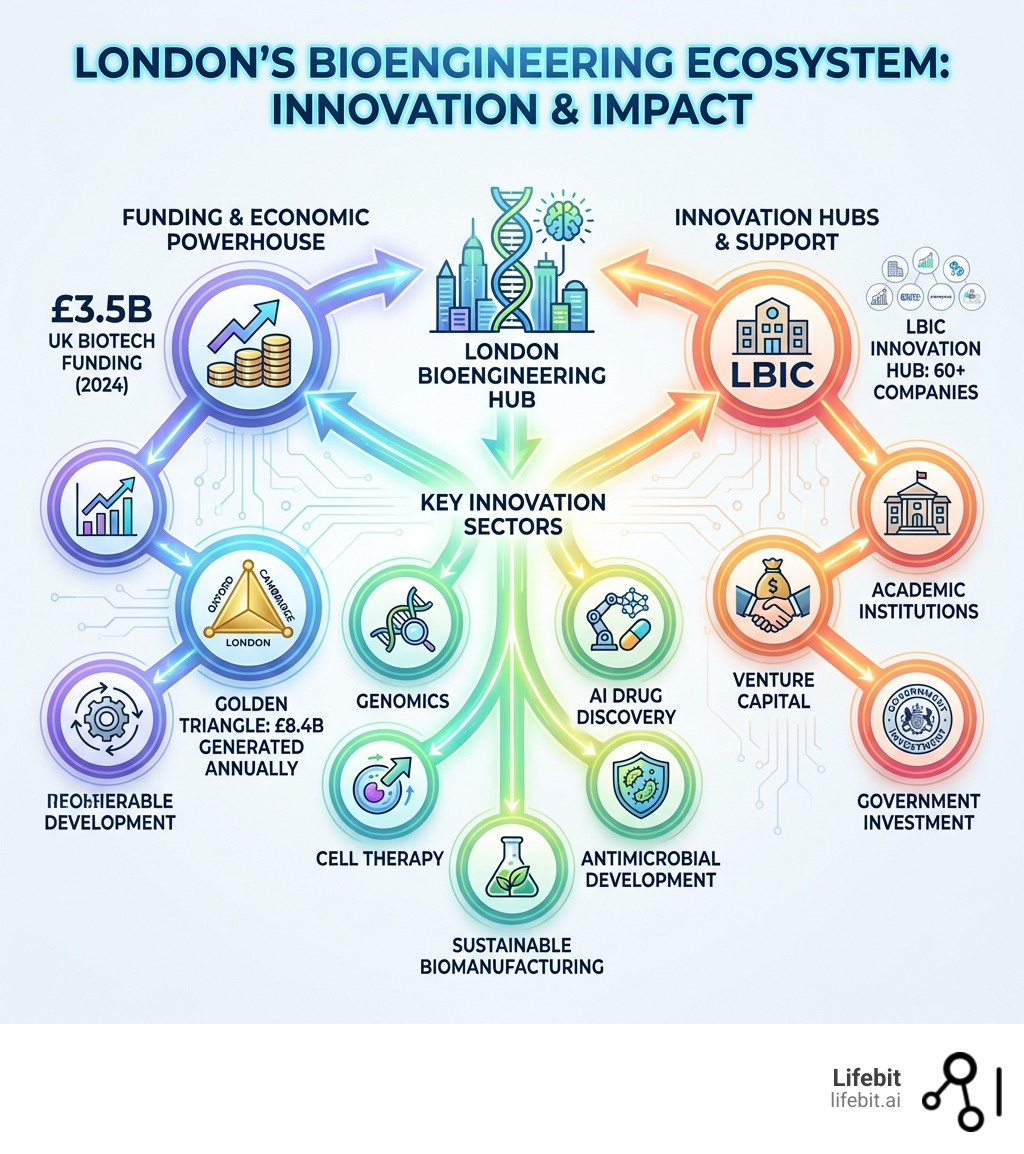
- London BioScience Innovation Centre (LBIC) – Owned by the Royal Veterinary College, LBIC provides essential laboratory and office space to over 60 life science companies. Its tenants have collectively raised over £2.47B, making it a cornerstone of the city’s biotech infrastructure.
London sits at the heart of the UK’s “golden triangle” (Oxford, Cambridge, London), a region that generates £8.4 billion annually and hosts half of all UK research centers. The city’s bioengineering ecosystem is fueled by world-class academic institutions like The Francis Crick Institute—the largest biomedical research building under one roof in Europe—and Imperial College London’s White City Campus. Robust venture capital investment is a key driver; the UK raised £3.5 billion in 2024, a 94% increase from 2023, with a significant portion flowing into London-based startups. Government support through the £650 million “Life Sci for Growth” package further bolsters the sector, focusing on improving clinical trial speed, expanding the UK’s biological data infrastructure, and incentivizing pension funds to invest in high-growth life science firms.
These companies are tackling critical global challenges: developing biodegradable chemistries from previously unculturable microbes, creating lab-grown alternatives to animal-derived ingredients like hyaluronic acid (traditionally sourced from rooster combs), and engineering living tissues that grow with patients—eliminating the need for lifelong medications and repeat surgeries. By integrating engineering principles with biological systems, these firms are moving beyond traditional medicine into a new era of ‘biological design’, where biology is treated as a programmable technology stack.
As Maria Chatzou Dunford, CEO and Co-founder of Lifebit, I’ve spent over 15 years building platforms that connect bioengineering companies London and globally to secure, federated biomedical data. Our work powers AI-driven precision medicine and real-time pharmacovigilance across hundreds of millions of patient records. London’s bioengineering sector is uniquely positioned to accelerate drug discovery and clinical research through hybrid data ecosystems and compliant, scalable infrastructure. Our work ensures that the massive datasets generated in the ‘Golden Triangle’ can be analyzed safely, without compromising patient privacy, which is the fundamental requirement for the next generation of AI-driven healthcare.
Quick bioengineering companies london terms:
- Biotech Companies London Guide
- Biotech Companies London
Key Innovation Areas for Bioengineering Companies London
London isn’t just a financial hub; it’s a living laboratory where biology is being rewritten. The concentration of bioengineering companies London has created a unique “collision zone” between software engineers, molecular biologists, and clinical researchers. This interdisciplinary approach is essential for solving the complex problems of the 21st century, from climate change to chronic disease. The city’s infrastructure, including the high-speed connectivity of the Knowledge Quarter and the proximity of major teaching hospitals like Guy’s and St Thomas’, allows for a rapid feedback loop between the lab and the clinic.
One of the most exciting shifts we’ve seen is the move toward cell-free biomanufacturing. Firms like FabricNano are moving away from traditional “brewing” in large vats of living cells, which can be temperamental and difficult to scale. Instead, they use cell-free systems—essentially extracting the metabolic machinery of a cell and fixing it onto a solid support—to transform industrial chemical processes. This makes production faster, more scalable, and significantly greener by reducing the energy required to maintain living cultures and the water waste associated with traditional fermentation. It represents a fundamental shift from ‘growing’ products to ‘assembling’ them at the molecular level, allowing for the production of high-value chemicals with unprecedented precision.

Leveraging Genomics and ML in Bioengineering Companies London
In the past, drug discovery was a bit like searching for a needle in a haystack by hand. Today, London firms are using machine learning to build the magnet. LabGenius uses an evolution engine named EVA to integrate synthetic biology and robotics, effectively “evolving” better protein therapeutics than humans could design alone. Their platform can explore vast ‘fitness landscapes’ of protein sequences, identifying candidates with optimal potency, stability, and manufacturability in a fraction of the time required by traditional methods. This automated approach removes human bias from the design process, often leading to counter-intuitive but highly effective therapeutic candidates.
Similarly, Isomorphic Labs—the commercial spin-off from Google DeepMind—is reimagining the drug discovery process from the ground up. By using AI to model the fundamental mechanisms of life, specifically protein folding and molecular docking, they aim to predict how drugs will interact with the body before a single vial is filled. This “digital twin” approach to biology could reduce the failure rate of clinical trials, which currently stands at over 90%. At Lifebit, we support this mission by providing the federated AI infrastructure that allows these firms to train their models on massive, diverse datasets without moving sensitive patient data. This ensures that AI models are trained on representative global populations, reducing bias in drug development and ensuring that new therapies work for everyone, regardless of their genetic background.
Unlocking Novel Chemistries through Microbial Applications
Microbes are the world’s most talented chemists, yet we have only been able to “talk” to about 1% of them—the ones that grow easily in a lab. London-based researchers are now using advanced genomics and metagenomics to access the “unculturable” 99%. This ‘dark matter’ of the microbial world holds the key to the next generation of industrial and medical breakthroughs, including new classes of antibiotics and enzymes for plastic degradation.
Companies like Hypha Discovery and Bactobio are unlocking secondary metabolites and bioactive compounds from these previously hidden microbes. Bactobio, for instance, uses a proprietary “Bacto-Hub” platform to culture previously unculturable bacteria, screening them for novel antimicrobial properties. This isn’t just academic curiosity; it’s the source of new antibiotics, specific pesticides for agriculture that don’t harm pollinators, and even biodegradable materials that could replace single-use plastics. By using microbial evolution, these firms are developing effective, specific, and biodegradable chemistries for a safer future. These bio-based solutions are often more effective than their synthetic counterparts because they have evolved over billions of years to perform specific functions within complex ecosystems, making them inherently more compatible with natural cycles.
Leading Consumer Goods and Sustainability Firms
Bioengineering isn’t just about medicine; it’s about the products in your bathroom cabinet, the clothes in your wardrobe, and the food on your dinner plate. London is leading the way in “green” bioengineering, moving the world away from fossil-fuel-intensive manufacturing. This transition is critical as consumers increasingly demand transparency, ethical sourcing, and sustainability in the products they buy. The London ecosystem is uniquely positioned to lead this charge, combining the city’s design heritage with its scientific prowess.
Bioengineering Companies London: Alternatives to Animal Farming
Did you know that the “cheapest” source of hyaluronic acid—a staple in premium skincare and joint supplements—traditionally comes from rooster combs? Bioengineering companies London find this outdated, ethically questionable, and inefficient. Firms are now using microbial fermentation to produce identical ingredients in a lab, bypassing the need for intensive animal farming and the associated ethical and environmental costs. This process, often called precision fermentation, allows for the production of pure, consistent ingredients with a fraction of the land and water use required by traditional agriculture.
Jellagen, for instance, is pioneering the use of collagen derived from jellyfish. This “Type 0” collagen is non-mammalian, avoiding the risk of disease transmission (such as BSE) and offering a more sustainable, biocompatible alternative for regenerative medicine and wound healing. Because jellyfish collagen is evolutionary ancient, it is compatible with a wide range of human tissue types, making it a versatile tool for surgeons and researchers alike. It has shown remarkable results in promoting cell adhesion and proliferation, which is essential for the next generation of skin grafts and tissue engineering scaffolds.
Moving Away from Fossil Fuels in Consumer Goods
The chemicals in our soaps, plastics, and paints are often derived from petroleum. London’s bioengineers are changing that by utilizing carbon-neutral or even carbon-negative feedstocks. By using renewable feedstocks and carbon capture technology, firms are creating bio-based polymers that perform as well as, or better than, traditional plastics, while being fully compostable at the end of their life cycle.
Biohm is a multi-award-winning R&D company harmonizing cultural and natural systems. They are developing scalable biotechnologies that allow nature to lead innovation, creating materials—such as insulation made from mycelium (the root structure of mushrooms)—that are not just “less bad” for the environment, but actively restorative. Their mycelium insulation outperforms traditional glass wool and extruded polystyrene in both thermal and acoustic insulation tests, while also being naturally fire-resistant. This shift toward a circular economy, where waste from one process (like agricultural husks) becomes the raw material for another, is a primary goal for the next generation of London startups. By mimicking natural cycles, these companies are proving that industrial growth doesn’t have to come at the expense of the planet; it can actually help to heal it.
Breakthroughs in Healthcare and Antimicrobials
The rise of “superbugs” is one of the greatest threats to modern medicine, with drug-resistant infections projected to cause 10 million deaths annually by 2050 if left unchecked. Bioengineering companies London are at the forefront of the battle against antimicrobial resistance (AMR), utilizing synthetic biology and advanced genomics to outmaneuver evolving pathogens. The city’s hospitals provide a critical testing ground for these new therapies, allowing for rapid clinical validation.
Primary Goals in Healthcare and Agriculture
The goals are clear: better patient outcomes and more resilient food systems. In healthcare, this means moving toward precision medicine—treatments tailored to the individual’s genetic makeup, lifestyle, and microbiome. Heart Biotech is a standout example, working on “living” heart valves that actually integrate with the patient’s own tissue. These valves are designed to grow and repair themselves, which is particularly transformative for pediatric patients who would otherwise face multiple high-risk open-heart surgeries as they grow. By using the patient’s own cells to populate a bio-engineered scaffold, these valves avoid the immune rejection issues associated with mechanical or porcine valves.
In agriculture, London-based bioengineers are developing “living fertilizers”—microbes engineered to fix nitrogen from the air directly into the soil. This could eliminate the need for synthetic nitrogen fertilizers, which are responsible for significant greenhouse gas emissions and water pollution. By engineering the relationship between plants and soil microbes, these firms are creating a more sustainable and productive food system that can withstand the challenges of a changing climate.
Developing the Next Generation of Antimicrobials
Standard antibiotics are increasingly failing because they are ‘blunt instruments’ that bacteria quickly learn to resist through horizontal gene transfer and mutation. London firms like NovaBiotics and Helperby Therapeutics are engineering novel antimicrobials, including peptide-based therapies and phage therapy (using viruses that specifically target and eat bacteria). Helperby, for example, is developing “Antibiotic Resistance Breakers” (ARBs)—small molecules that, when combined with old antibiotics, make them effective again against resistant strains. These targeted therapies are designed to kill pathogens without harming the body’s healthy microbiome, a precision that traditional antibiotics simply can’t match. Furthermore, by targeting the mechanisms bacteria use to resist drugs, these new treatments can ‘resensitize’ superbugs to existing antibiotics, extending the life of our current medical arsenal and providing a vital bridge to the future of infection control.
Challenges and Opportunities in the London Ecosystem
While the innovation is staggering, the path for bioengineering companies London isn’t always smooth. The sector faces a complex post-Brexit regulatory landscape, which has created uncertainty regarding the UK’s participation in European research programs like Horizon Europe. However, the recent association of the UK back into Horizon Europe has provided a much-needed boost to collaborative research. Global competition for talent remains fierce, with London competing against established hubs like Boston and San Francisco for the world’s best bioinformaticians and synthetic biologists.
Access to specialized laboratory space remains a significant challenge. The demand for high-spec ‘wet labs’—facilities equipped with the ventilation and safety equipment needed for biological research—often outstrips supply in the city center. This has led to a surge in “lab-ready” office developments in areas like King’s Cross, White City, and Canary Wharf. Developers are now converting former industrial and office buildings into state-of-the-art life science hubs to meet this demand, with over 1 million square feet of lab space currently in the pipeline for London.
However, the opportunities often outweigh the problems. The London BioScience Innovation Centre (LBIC) has seen a 75% success rate for its resident companies, vastly outperforming the national average for startups. With £2.47 billion in funding raised by its tenants, it proves that when you put the right minds in the right labs, the results are explosive. The proximity to the ‘Knowledge Quarter’—a square mile around King’s Cross with the highest density of data science and life science researchers in the world—provides an unparalleled environment for serendipitous collaboration. Here, a researcher from the Francis Crick Institute can walk five minutes to meet a data scientist from Google DeepMind or a clinician from University College Hospital, creating a fertile ground for the cross-pollination of ideas that drives rapid scaling and breakthrough innovation.
Frequently Asked Questions about Bioengineering Companies London
What are the primary goals of London bioengineering firms?
The main goals are to improve healthcare through precision medicine (like the living heart valves from Heart Biotech), ensure agricultural sustainability by reducing chemical use, and create a circular economy through biodegradable materials. These firms aim to decouple economic growth from environmental degradation by using biology as a manufacturing platform. By engineering biological systems to perform specific tasks, they are creating solutions that are inherently more efficient and sustainable than traditional chemical or mechanical processes.
How is bioengineering contributing to a fossil-fuel-free future?
By replacing petroleum-based ingredients with those grown via microbial fermentation and utilizing carbon-capture-driven biomanufacturing to create sustainable consumer goods. This reduces the carbon footprint of everyday products like plastics, detergents, and textiles. For example, bio-based polymers can be produced using captured CO2 as a feedstock, turning factories into carbon sinks rather than carbon sources. This transition is essential for meeting global net-zero targets and reducing our reliance on volatile fossil fuel markets.
Which sectors are seeing the most growth in London?
Currently, Biopharmaceuticals (specifically cell and gene therapy), AI-driven drug discovery, and AgTech (sustainable fertilizers and pesticides) are the fastest-growing sectors. The integration of data science with molecular biology is the primary driver of this growth, allowing for faster iteration and more predictable outcomes in the lab. Additionally, the “synthetic biology for materials” sector is seeing significant investment as fashion and construction companies look for sustainable alternatives to traditional materials.
How does the “Golden Triangle” benefit London bioengineering companies?
The Golden Triangle (London, Oxford, and Cambridge) provides a concentrated ecosystem of world-class universities, research institutes, and venture capital. This proximity allows for the easy flow of talent and ideas between the three cities. A company based in London can easily collaborate with researchers in Oxford or access specialized equipment in Cambridge, all within a 60-mile radius. This density of expertise is unique globally and is a major reason why the UK remains a leader in life sciences.
What role does the NHS play in London’s bioengineering sector?
The NHS is a critical partner for bioengineering companies, providing a unique environment for clinical trials and real-world evidence collection. London’s diverse population means that clinical trials conducted here are more representative of global populations, which is essential for developing effective precision medicines. Furthermore, initiatives like the NHS Genomic Medicine Service are helping to integrate bioengineered therapies into standard clinical care, providing a clear pathway from the lab to the patient.
Conclusion
The future of health and sustainability is being built right here in London. From the labs at King’s Cross to the scale-up facilities in the “golden triangle,” bioengineering companies London are proving that biology is the most powerful technology we have. The city’s unique blend of academic excellence, financial capital, and technological prowess makes it the ideal launchpad for companies looking to solve global challenges.
At Lifebit, we are proud to be the connective tissue of this ecosystem. Our federated AI platform enables secure, real-time access to the multi-omic data these companies need to innovate safely. Whether it’s powering large-scale research in our Trusted Research Environment (TRE) or providing real-time insights for pharmacovigilance through our R.E.A.L. layer, we are dedicated to helping London’s bioengineers change the world. By removing the barriers to data access, we empower researchers to focus on what they do best: engineering the future of life.