

Unraveling Data Mysteries: A Deep Dive into Entity Resolution Software

Why Entity Resolution Software Is Critical for Data-Driven Organizations
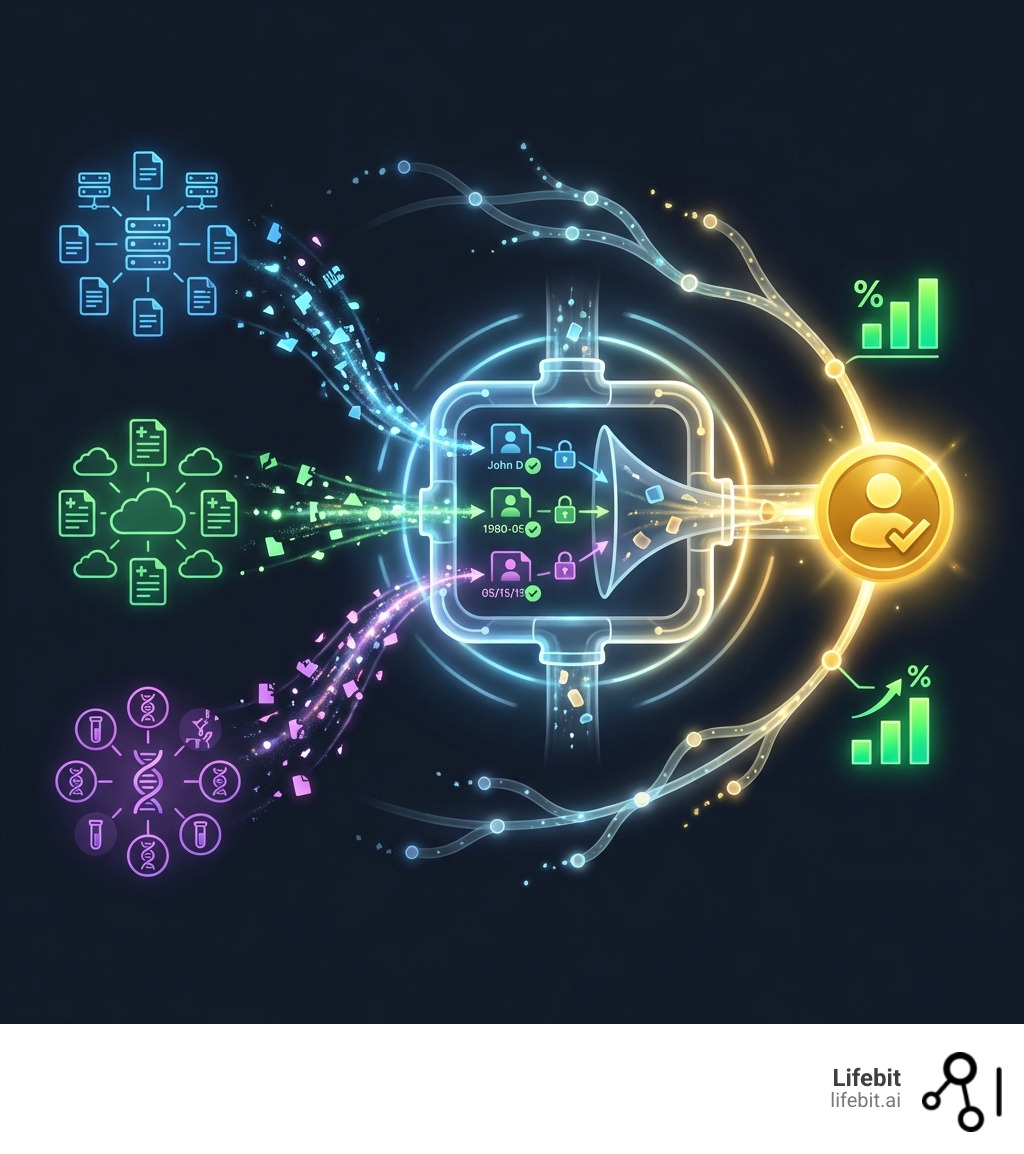
Entity resolution software helps organizations identify and link records that refer to the same real-world entity—a patient, customer, product, or business—across multiple disparate data sources.
What entity resolution software does:
- Matches records across databases using deterministic, probabilistic, and fuzzy matching.
- Merges duplicate records into a single, accurate profile (a “golden record”).
- Handles variations like typos, nicknames, formatting differences, and missing data.
- Scales to billions of records using AI and machine learning for accuracy and speed.
- Integrates with existing systems to minimize data movement and maintain security.
Key benefits:
- Up to an 85% reduction in duplicate customer records.
- A 90% match rate vs. just 20% with basic matching.
- Real-time insights in under 50 milliseconds.
- A unified 360-degree view of entities for better decisions.
Organizations have long struggled with duplicate records and fragmented information. Simple data deduplication—finding exact matches—doesn’t cut it anymore. Modern entity resolution software uses advanced machine learning and AI techniques to connect records that aren’t obviously the same, revealing hidden relationships that would otherwise remain buried in data chaos. For readers new to the space, resources like record linkage provide useful background on the theory behind these methods.
For pharma companies, public health agencies, and regulatory bodies working with siloed EHR, claims, and genomics datasets, entity resolution is the foundation for real-time pharmacovigilance, accurate cohort analysis, and AI-powered evidence generation—all while keeping data secure in federated environments.
I’m Maria Chatzou Dunford, CEO and Co-founder of Lifebit. We’ve built a federated AI platform that relies on entity resolution to harmonize biomedical data across secure, distributed environments without moving sensitive information. My 15 years in computational biology, AI, and health-tech have shown me that accurate entity resolution is the difference between fragmented insights and transformative findings.
Basic entity resolution software vocab:
- data matching software
- data matching technology
- data match software
From Data Chaos to Clarity: What is Entity Resolution?
Dealing with fragmented data is like trying to understand a story with missing pages, duplicates, and characters whose names keep changing. Entity resolution pieces together this scattered information to reveal the full narrative.
At its core, entity resolution identifies, matches, and merges records that refer to the same real-world entity across various data sources. Since the dawn of databases, organizations have grappled with duplicate records and combining multiple entries for the same entity.
It’s about changing vast, low-quality data into meaningful, accurate descriptions. This is paramount for a true 360-degree view of customers, patients, or products. Without it, data-driven decisions are based on incomplete information, leading to flawed analytics. By consolidating data, we gain improved data quality, the bedrock of reliable insights.

When we talk about data harmonization meaning: complete guide, entity resolution is a crucial component. It’s the engine that cleans and prepares data for analysis, empowering smarter decisions.
The Critical Difference: Entity Resolution vs. Data Deduplication
While often confused, entity resolution and data deduplication are distinct. Data deduplication finds identical twins in a crowd; entity resolution finds the entire family, even with different names and locations.
Data deduplication is a technique that compares two data records to decide if they are the same. It relies on exact attribute matches and works best with highly consistent, structured data. For example, two customer records with identical names, addresses, and emails are easily spotted as duplicates.
However, real-world data is messy. Large, complex datasets are rife with inconsistencies, typos, and variations where simple deduplication falls short. For instance, “John Smith” might appear as “Jon Smith,” “J. Smith,” or “John S. Smith.” His address might be “123 Main St.” in one database and “123 Main Street” in another. These aren’t exact matches, but they refer to the same person.
Entity resolution is built to handle this ambiguity. It uses an iterative approach, comparing attributes from multiple records to determine if they represent the same entity. This process doesn’t just look for exact matches; it uses sophisticated techniques like fuzzy and probabilistic matching to infer connections. It converts fragmented, low-quality data into accurate, unified descriptions, tackling volumes and variations that simple deduplication cannot.
How Lifebit’s Entity Resolution Software Uncovers Hidden Connections
Lifebit’s entity resolution software solves complex data mysteries, turning disparate data points into a coherent, actionable whole. It’s about understanding the nuances of how entities are represented across our global biomedical and multi-omic datasets.
The process involves several key stages:
- Data Ingestion and Standardization: We ingest data from various sources and standardize it into a common format. This is crucial to ensure a clean foundation, avoiding the “garbage in, garbage out” problem.
- Matching: The heart of entity resolution. Our software compares records to identify potential matches, employing advanced techniques to find records that likely refer to the same entity, even with variations.
- Merging and Survivorship: Once confirmed, matched records are merged. This involves intelligent decisions on which attribute values to keep when conflicts arise. Survivorship rules determine the most accurate information for each attribute, forming a “golden record.” This iterative process ensures accuracy improves as more data is added.

Our approach ensures a patient’s journey across clinical trials, EHR systems, and genomic sequencing is consolidated into a single, comprehensive profile, which is foundational for our AI/ML analytics. For a deeper dive, explore our data matching software ultimate guide.
The Core Mechanics: Deterministic, Probabilistic, and Fuzzy Matching
Our software’s power lies in its sophisticated matching techniques, suited for varying data certainty and ambiguity.
- Deterministic Matching: This straightforward approach relies on exact or near-exact matches based on predefined rules (e.g., identical national ID numbers). While powerful for consistent data, it cannot catch records with minor variations.
- Fuzzy Matching: Real-world data is messy. Fuzzy matching overcomes typos, phonetic similarities, and formatting variations to find connections between attributes that are very similar but not identical. For instance, “John Smith” and “Jon Smythe” might be matched, or “123 Main Street” and “123 Main St.”
- Probabilistic Matching: This approach assigns a likelihood score to determine if two records refer to the same entity. Instead of strict rules, it uses statistical models to weigh the evidence. A shared rare surname, for example, might contribute more to a match score than a common first name. This is effective for large, complex datasets where exact identifiers are often missing.
By combining these approaches, our entity resolution software steers the complexities of real-world data, ensuring high accuracy.
The AI Advantage: How Lifebit’s Machine Learning Revolutionizes Entity Resolution
The evolution of entity resolution has led to four generations of methods addressing accuracy, scalability, and heterogeneity. Today, ML and AI represent a leap forward, enhancing the efficiency of entity resolution software.
At Lifebit, we leverage AI-powered matching for unequaled speed and accuracy. Our AI-driven systems are self-learning and self-correcting, continuously improving over time by adapting to new data patterns.
Here’s how ML and AI improve our capabilities:
- Learning from Labeled Data: Our ML models train on expertly labeled data (record pairs marked as a match or not). This human-in-the-loop approach teaches models the subtle clues that signify a true match.
- Intelligent Candidate Pair Generation: Brute-force record comparison is computationally unfeasible for large datasets. AI uses intelligent techniques to limit checks to likely pairs, drastically improving efficiency without sacrificing accuracy.
- Dynamic Weighting and Scoring: ML models dynamically weigh the importance of different attributes, allowing for more precise match likelihood probabilities.
- Active Learning and Continuous Improvement: Our solutions incorporate active learning, allowing models to be retrained with human input. As data stewards provide feedback, the models learn and become increasingly accurate.
- Automated Unmerging: Our software can automatically unmerge records based on rules that adapt to changing data, ensuring data integrity.
By integrating advanced ML and AI, our entity resolution software transforms messy data into a clean, unified, and accurate resource, crucial for initiatives like our AI-enabled data governance ultimate guide.
Choosing Your Toolkit: Must-Have Features in Entity Resolution Software
When choosing entity resolution software, certain features are non-negotiable to tackle data complexities and deliver tangible value.
Essential Capabilities for Your Entity Resolution Software Shortlist
Key features include:
- Advanced Matching Algorithms: Support for deterministic, probabilistic, and fuzzy matching is essential to maximize coverage and minimize manual effort.
- Scalability and Performance: The software must handle billions of records in near real-time, scaling seamlessly on big data frameworks like Apache Spark.
- Flexible Survivorship Rules: Robust, field-based survivorship rules are needed to create dynamic, contextual “golden records” for different stakeholders.
- Data Quality Tools: Integrated tools for data profiling, cleansing, and standardization are essential, including match rule builders and proactive monitoring systems.
- Integration APIs & SDKs: The ability to seamlessly integrate with existing systems is paramount. APIs and SDKs should minimize data movement, processing data where it resides to ensure security.
- User Interface (UI) and Workflow Management: An intuitive UI for configuring rules, reviewing matches, and managing data stewardship workflows facilitates human-in-the-loop processes.
- Security and Compliance: In biomedical data, robust security protocols and compliance features, such as federated governance and privacy-preserving techniques, are non-negotiable.
- Data Lineage and Traceability: The software should provide full traceability and native data lineage. Our system’s unique, durable IDs, for example, provide this capability across connected systems.
These capabilities ensure our entity resolution software uncovers hidden connections, maintains high data quality, and supports informed decisions, aligning with our data governance platform complete guide.
Build vs. Buy: Navigating the Complexities of Implementation
A common dilemma is whether to build or buy new technology. While a custom-built solution seems appealing, building entity resolution software in-house presents significant challenges.
Building it can take years and requires a highly specialized team with skills in statistics, linguistics, and performance engineering. Most organizations lack this expertise and the foresight to build for future requirements.
Beyond the complexity, in-house development costs are often much higher than anticipated due to initial development, ongoing maintenance, and constant algorithm updates. Industry experience shows that organizations consistently save significant time and money using specialized solutions rather than building and maintaining their own technology.
Leveraging robust entity resolution software lets us focus on our core mission. This approach uses pre-built models and streamlined workflows from specialized vendors, saving years of development time and resources. It’s a strategic decision to deliver value faster.
Decoding the Investment: Costs and ROI of Entity Resolution
Understanding the costs and ROI of entity resolution software is crucial. It’s not just about upfront cost but long-term value.
Typical costs include:
- Licensing Models: Can be subscription-based or perpetual licenses, often based on data volume or user count.
- Implementation Costs: Includes integration, data migration, configuration, and training.
- Maintenance and Support: Ongoing costs for updates and technical support.
- Data Stewardship: The cost of human resources for reviewing matches, though AI/ML can significantly reduce this.
However, the ROI often far outweighs the costs. The value is clear:
- Reduced Operational Costs: Consolidating profiles reduces data management overhead. For example, leading solutions can enable an 85% reduction in customer records.
- Increased Revenue: A unified 360-degree view of entities informs better decisions, leading to improved customer experiences and more effective marketing.
- Mitigated Risk: In regulated industries like healthcare, accurate entity resolution is critical for compliance, fraud detection, and risk management.
- Efficiency Gains: Our own advanced entity resolution achieves a 90% match rate compared to just 20% with basic matching. This accuracy boost saves significant time by reducing manual reviews.
Investing in robust entity resolution software is an investment in data quality, operational efficiency, and strategic decision-making that delivers a strong positive ROI.
From Theory to Impact: Real-World Benefits and Use Cases
The true power of entity resolution software is revealed in its real-world applications, where it creates a single source of truth from fragmented data to deliver reliable insights.
Consider the impact: leading solutions manage billions of consolidated profiles, achieving up to an 85% reduction in customer records and a 90% match rate versus 20% with basic matching. These numbers represent profound improvements in data management. Our commitment to this is reflected in our data intelligence platform ultimate guide.
Customer 360 and Marketing
A primary benefit is building a comprehensive “Customer 360” view. For businesses globally, connecting customer interactions into a single profile is essential to:
- Personalize Experiences: Derive actionable insights from all customer information to deliver highly personalized experiences.
- Improve Targeting: A unified profile enables more effective advertising and marketing campaigns.
- Reduce Churn: Understanding the full customer journey helps proactively identify at-risk customers.
This capability is critical, with specialized accelerators being developed to streamline the process of establishing common customer identities.
Finance, Healthcare, and Public Sector
Beyond customer experience, entity resolution software is vital in critical sectors:
- Finance: It’s indispensable for fraud detection, anti-money laundering (AML), and watchlist screening. Linking seemingly unrelated entities helps financial institutions identify suspicious patterns and comply with regulations.
- Healthcare: Patient matching across disparate electronic health records (EHRs), claims databases, and research datasets is a life-saving application. Our federated AI platform is crucial for harmonizing disparate electronic health records, ensuring a complete patient view for diagnosis, treatment, and public health initiatives.
- Public Sector: Government agencies use it to gain a comprehensive data view, revealing hidden connections that inform critical decisions, from social services to national security. It improves data flow across departments, leading to better citizen outcomes.
The Role of Cloud Services and Data Providers
Cloud services and external data providers are now integral to entity resolution strategies.
Cloud-based entity resolution software minimizes data movement by reading records where they reside, which is vital for data protection in federated environments. These services often integrate with third-party data providers, allowing organizations to:
- Enrich Records: Supplement internal data with external, trusted information to create more robust entity profiles.
- Improve Insights: Leverage external datasets for better consumer insights, campaign planning, and risk assessment.
This approach combines the power of internal data with the richness of external sources while maintaining data integrity and security.
What’s Next? The Future of Entity Resolution Technology
The future of entity resolution software is shaped by advancements in AI, big data, and data complexity. Key trends include:
- Generative AI (GenAI) and Large Language Models (LLMs): GenAI and LLMs can help interpret unstructured text, infer relationships, and generate matching rules, further automating and refining the resolution process.
- Graph-Based Resolution for Complex Relationships: As data becomes more interconnected, understanding complex relationships between entities is paramount. Graph databases and analytics are increasingly used to model these networks, which is powerful for fraud detection and security.
- Real-Time and Continuous Matching: The demand for immediate insights is shifting entity resolution from batch processing to real-time, continuous matching as data streams in. This is crucial for dynamic environments like pharmacovigilance.
- Privacy-Preserving Techniques: With increasing data privacy regulations, the future will focus on privacy-preserving techniques like federated learning and secure multi-party computation. This allows entity resolution across datasets without sharing sensitive raw data, aligning with our federated data governance approach.
- Improved Explainability and Transparency: As AI models grow more complex, explainable AI (XAI) will be crucial. Understanding why a match was made builds trust and aids data stewards and compliance officers.
These advancements promise to make entity resolution software more powerful and intelligent, enabling deeper insights from global data ecosystems.
Conclusion
Entity resolution software is an indispensable strategic asset in a world drowning in data but starved for insight. It transforms chaotic, disparate data into a unified, actionable resource. For businesses, this means gaining a holistic understanding of their customers and operations. For our partners in biopharma and public health, it means accelerating life-saving research with unparalleled data integrity.
By embracing sophisticated entity resolution, organizations can foster a truly data-driven culture. Dramatically higher match rates and fewer duplicate records are achievable realities, leading to reduced costs, increased revenue, and mitigated risk.
At Lifebit, our federated AI platform is built upon this foundation, enabling secure, real-time access to global biomedical data. Through built-in harmonization, advanced AI/ML analytics, and federated governance, we power large-scale, compliant research and AI-driven safety surveillance. We are committed to delivering real-time insights and secure collaboration, making the complex simple.
Ready to open up the full potential of your data and turn fragmented information into transformative findings? Explore Lifebit’s federated AI platform and join us in solving the mysteries hidden within your data.