

Federated Data Platform: How It Works & Why It Matters

Quick answer. A federated data platform is a data management architecture that enables secure analysis across distributed data sources without moving the data. Instead of copying data to a central warehouse, compute is sent to where the data lives—preserving data sovereignty, reducing latency, and maintaining compliance.
Why Data Silos Are Costing Healthcare Billions—And What’s Changing
Key characteristics of a Federated Data Platform:
- Data stays at source – No duplication or migration required
- Real-time access – Query distributed data as if it were centralized
- Data sovereignty – Each organization retains full control over its data
- Secure governance – Unified access controls and audit trails across all sources
- Interoperability – Harmonizes diverse data formats and standards
The World Economic Forum estimates that hospitals produce about 50 petabytes of data a year, and that 97% of it goes unused. Patient records, genomic data, and claims information sit in isolated silos. As a result, life-saving decisions and drug discovery are delayed because critical data can’t be integrated or analyzed in real time.
Traditional approaches that move data into central warehouses create data staleness, compliance risks, and massive costs. This bottleneck is unacceptable for global clinical trials or public health monitoring.
The NHS recognized this, launching its Federated Data Platform program to integrate 50+ million patient records and open up £15-25 billion in annual value by enabling insights without moving data. Similar initiatives in cancer research and COVID-19 response are proving the model’s value.
This shift from centralization to federation prioritizes security, speed, and sovereignty over outdated data models.
I’m Maria Chatzou Dunford, CEO and Co-founder of Lifebit. We build federated data platform infrastructure for genomics and biomedical research, enabling secure analysis across distributed healthcare systems worldwide. Before Lifebit, I contributed to Nextflow and built computational tools at the Centre for Genomic Regulation to power precision medicine through federated collaboration.
What is a Federated Data Platform? Core Principles & Architecture
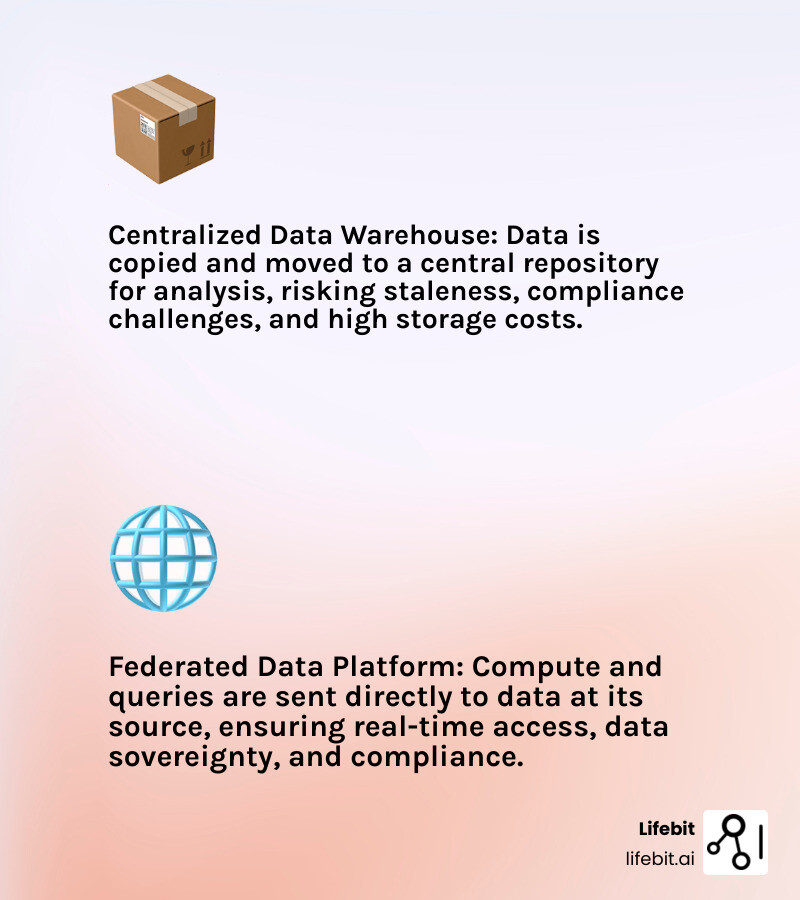
At its core, a Federated Data Platform (FDP) is a modern strategy for working with distributed data. Instead of shipping every book to a central warehouse for a query, you send the request to the library that holds the book and get back only the answer. An FDP brings the analysis to the data, not the other way around, creating a unified, virtual view of data across disparate locations like our global offices in London, New York, and Singapore.
How an FDP Differs from Traditional Data Integration
For decades, ETL (Extract, Transform, Load) pipelines have been the standard. They involve extracting data, changing it, and loading it into a central warehouse. This approach creates significant drawbacks, including data duplication, latency, and compliance risks, leaving nearly 97% of enterprise data untapped in silos.
A federated data platform flips this model. It creates a virtual layer over existing data sources, sending queries to be processed locally and aggregating the results. This means no data duplication, real-time access, and improved security.
Here’s a quick comparison:
| Feature | Traditional Data Warehouse | Federated Data Platform (FDP) |
|---|---|---|
| Data Location | Centralized; data moved and copied | Distributed; data stays at source |
| Data Duplication | High; multiple copies created | Low to none; virtualized access |
| Real-time Access | Limited; depends on ETL frequency | High; direct query of live data |
| Latency | Can be high due to ETL processes | Low; queries sent directly to source |
| Data Sovereignty | Challenging; data moved across borders | Maintained; data remains in original jurisdiction |
| Scalability | Requires scaling central infrastructure | Scales with individual data sources |
| Compliance | Complex due to data movement | Simplified; data stays within regulatory boundaries |
| Cost | Higher storage and ETL costs | Lower storage; optimized compute |
Core Principles of a Federated Data Platform
An FDP’s effectiveness hinges on several core principles:
- Data Sovereignty: The data owner retains full control, deciding what is shared and with whom. A hospital in London maintains control over its data even when collaborating with a research institute in New York.
- Distributed Query Processing: The query engine travels to the data. Queries are broken down, sent to sources, processed locally, and the results are merged.
- Interoperability: An FDP establishes common data standards and protocols, allowing diverse sources to “speak the same language.” Learn more in our guide on federated architecture.
- Secure Governance: This includes fine-grained access controls, encryption, and comprehensive audit logging to ensure responsible data use.
- Data Locality: Data is processed as close to its source as possible to aid sovereignty, reduce latency, and improve performance.
- Algorithmic Transparency: The processes and algorithms used for analysis are understandable, auditable, and free from unintended bias.
Architectural Components of a Federated Data Platform
A robust federated data platform is a system of interconnected components.
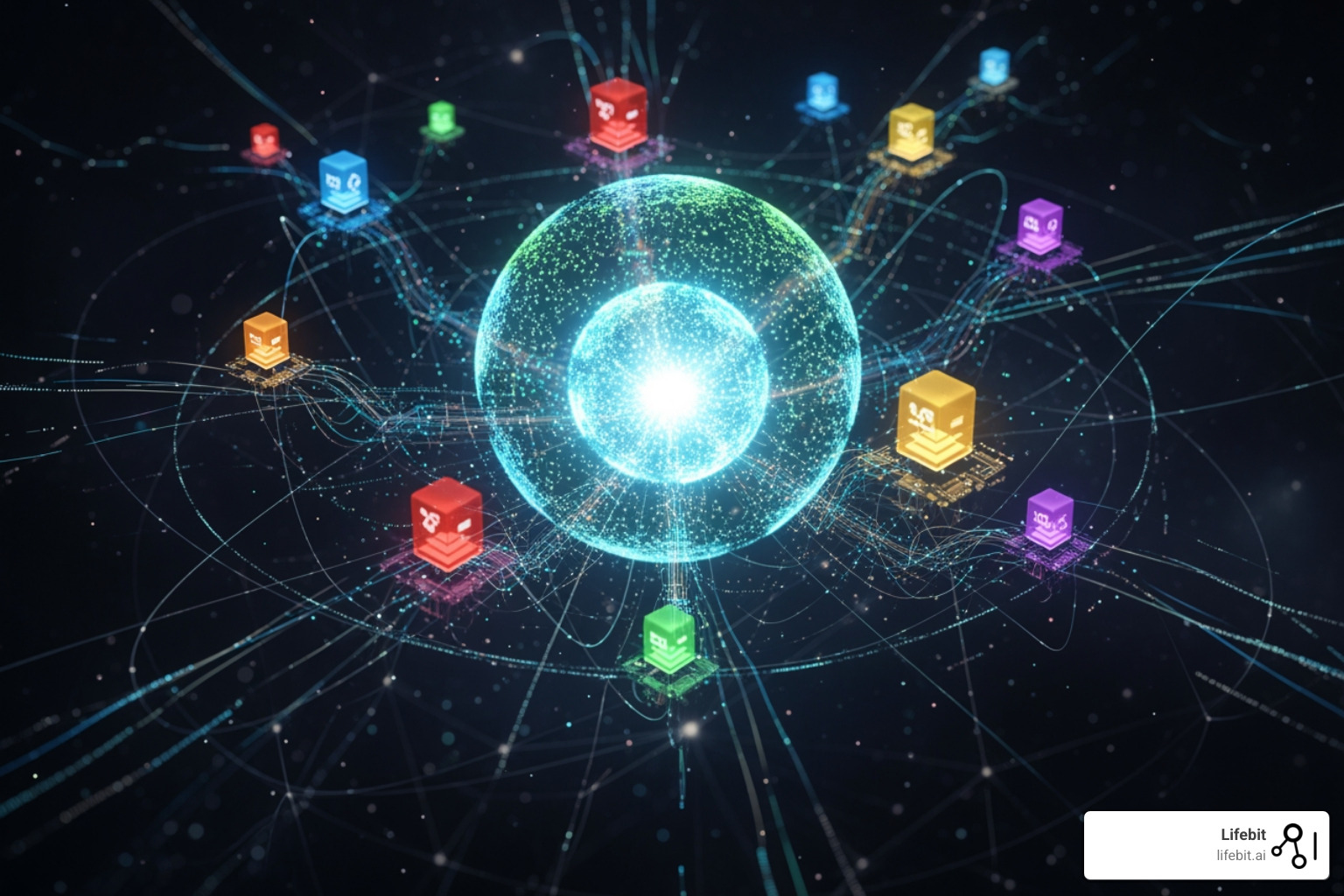
- Data Sources: The individual, autonomous repositories where data resides, such as databases, EHRs, or genomic sequencers.
- Federation Layer: The “brain” of the FDP that manages distributed queries. It parses, translates, and sends queries to the right sources, then merges the results into a cohesive output. This enables data virtualization without data movement. See our insights on federated data analysis.
- Semantic Layer: Provides a common business vocabulary across all data sources, making it easier for users to query data regardless of its underlying format.
- Governance & Security Frameworks: The policies and tools that ensure secure, compliant access. This includes access controls (RBAC/ABAC), encryption, auditing, and tools to adhere to regulations like GDPR and HIPAA.
- APIs (Application Programming Interfaces): Standardized interfaces that allow applications and users to interact with the FDP, enabling integration with existing tools and automation.
Unlocking Value: Benefits of Federation in Healthcare and Sustainability
The ability of a federated data platform to enable secure, distributed analysis without moving data is a game-changer for sectors like healthcare and sustainability, where data sensitivity, sovereignty, and scale are paramount. It unlocks unprecedented value and fosters collaborative research to address the world’s most pressing challenges.

Revolutionizing Healthcare and Life Sciences
Healthcare data is abundant but fragmented across countless silos, limiting large-scale research and public health monitoring. A federated data platform addresses this by allowing organizations to:
- Integrate Massive Datasets Securely: The NHS FDP program is integrating over 50 million patient records, providing secure access to standardized data without moving sensitive records.
- Facilitate Collaborative Research: Projects like AI4VBH (AI for Value-Based Healthcare) and the Federated Tumor Segmentation network enable multiple hospitals to train AI models on decentralized data. This collaboration is crucial, as individual hospitals often lack sufficient data to build robust models, as shown in academic research.
- Accelerate Precision Medicine: At Lifebit, our federated AI platforms allow biopharma and governments to securely analyze multi-omic and biomedical data to develop personalized care and identify drug targets. Explore more in our guide on federated learning and precision medicine.
- Improve Operational Efficiency: FDPs provide staff with secure access to standardized data and tools, with off-the-shelf connectors and APIs that can reduce product build times by 50% or more.
For a deeper dive, explore our resources on federated learning in healthcare.
Powering Global Sustainability Initiatives
Sustainability challenges require data-driven solutions, but the data is often fragmented and sensitive across governments, NGOs, and corporations. FDPs are uniquely positioned to help by:
- Respecting Data Sovereignty: FDPs enable collaborative analysis of environmental data from different nations while ensuring each entity retains control, as exemplified by projects like Gaia-X.
- Enabling Supply Chain Transparency: An FDP can create an end-to-end transparent supply chain by enabling secure data sharing among suppliers, manufacturers, and retailers to track sustainability claims.
- Improving Environmental Monitoring: By integrating data from sensors, satellites, and government agencies, an FDP can create a unified view of environmental conditions to inform policy.
- Facilitating a Circular Economy: FDPs can connect manufacturers, consumers, and recyclers to track materials and optimize resource recovery.
The NHS Federated Data Platform: A National Case Study
The NHS Federated Data Platform (FDP) is a £330 million investment aimed at revolutionizing how the NHS uses data. Our research indicates the FDP could open up £15-25 billion per annum for UK taxpayers by:
- Improving Patient Care: Connecting information across the health service provides timely insights for better diagnoses and more efficient treatments.
- Boosting Operational Efficiency: Integrating 50+ million patient records brings consistency and gives staff secure access to standardized data and tools.
- Scaling Innovations: The platform’s design allows for rapid deployment of new tools. Scaling innovations on an FDP can save up to 90% of technology-related deployment costs.
The NHS FDP is a “once-in-a-generation opportunity” to transform patient outcomes. For more information, you can go to the NHS FDP website.
Implementation Roadmap: Challenges, Solutions, and Governance
Implementing a federated data platform is a strategic journey that requires meticulous planning to navigate significant technical, organizational, and governance challenges. A successful FDP deployment is not merely a technical integration project; it’s a socio-technical transformation. At Lifebit, we’ve learned that long-term success depends on anticipating these hurdles with robust solutions and a clear, collaborative governance vision from day one.
Key Challenges and Limitations
Despite their immense potential, FDPs present several complex challenges that must be proactively addressed:
- Query Performance and Network Latency: Querying distributed data can be inherently slower than querying a centralized database. Network latency between nodes, especially across continents, can become a major bottleneck. Complex operations like distributed joins, where data from multiple sources must be combined, can amplify this issue, as large intermediate datasets may need to be transferred. The performance is often only as fast as the slowest node or network link in the query path.
- Schema and Semantic Inconsistencies: This is often the most underestimated technical hurdle. Data sources rarely use the same structure (schema) or terminology (semantics). Harmonizing disparate data requires resolving syntactic differences (e.g.,
MM-DD-YYYYvs.DD/MM/YY) and, more critically, semantic differences (e.g., one hospital’s “primary diagnosis” might be another’s “admitting condition”). Without a robust solution, a unified view is impossible, and queries will fail or return incorrect results. - Security and Trust Complexities: Ensuring consistent security policies across autonomous organizations, each with its own IT infrastructure and security protocols, is profoundly intricate. How do you federate identity and access management? How do you propagate a user’s permissions across the network securely? A federation is often only as secure as its weakest link, so establishing a baseline security posture for all participating nodes is critical yet challenging.
- Incentivizing Participation and Fair Value Exchange: Why should an organization join a federation and contribute its valuable data? Building trust and articulating a clear, compelling value proposition is paramount. This goes beyond technical integration to address business and political concerns. Organizations may fear a “free-rider” problem, where they contribute more than they benefit, or worry about intellectual property rights on insights derived from their data.
- Navigating Complex Regulatory Landscapes: A federation often spans multiple legal jurisdictions, each with its own data privacy and sovereignty laws (e.g., GDPR in Europe, HIPAA in the US, PIPEDA in Canada). Ensuring that every query and data access pattern remains compliant with all applicable regulations is a continuous and complex legal and technical challenge.
- Organizational and Cultural Resistance: Technology is often the easiest part of the problem. The human element—overcoming a “data hoarding” mentality, fostering inter-institutional trust, and managing the significant organizational change required to shift from siloed work to collaborative analysis—can be the biggest barrier to a successful federation.
Solutions for Performance, Interoperability, and Governance
Fortunately, a mature ecosystem of strategies and technologies exists to mitigate these challenges:
- AI-Powered and Cost-Based Query Optimization: Modern federation layers use advanced query optimizers that go beyond simple rule-based execution. They build a cost model for the network, learning from past query performance and analyzing data distribution statistics (without seeing the raw data) to predict the most efficient execution path. This might involve pushing computation to a node with more processing power or moving a small intermediate result set to another node for a faster join.
- Intelligent Caching Strategies: To reduce network latency and load on source systems, FDPs can implement multi-level caching. This involves intelligently caching frequently accessed raw data (where permissible), intermediate query results, or final aggregated results to serve subsequent identical or similar queries almost instantly.
- Common Data Models and Semantic Layers: To solve the interoperability problem, federations often adopt a Common Data Model (CDM), such as the OMOP CDM in healthcare research. All source data is mapped to this standardized format. On top of this, a semantic layer creates a shared business vocabulary and knowledge graph (using technologies like RDF/OWL), allowing users to query data using consistent terms, regardless of the underlying source’s native format.
- Federated Identity and Dynamic Access Control: To manage security, FDPs leverage federated identity management (e.g., using SAML or OpenID Connect) to allow users to log in with their home institution’s credentials. This is coupled with robust access control models. While Role-Based Access Control (RBAC) is common, more advanced platforms use Attribute-Based Access Control (ABAC), which grants access dynamically based on a user’s attributes (e.g., role, department, training certification), the data’s attributes (e.g., sensitivity level, project ID), and the environmental context (e.g., time of day, location).
- Polycentric Governance Frameworks: Instead of a single, rigid top-down governance model, successful federations often adopt a polycentric approach. This involves a central steering committee that sets high-level principles, ethical guidelines, and technical standards. However, each participating node or region retains a local Data Access Committee (DAC) responsible for approving data use requests according to its own institutional policies and local regulations. This creates a flexible, scalable model that builds trust.
- Formal Governance Charters and Best Practices: Effective FDP governance is codified in a formal “Federation Charter.” This living document clearly defines the value proposition, roles and responsibilities, data contribution and usage policies, security requirements, auditing procedures, and mechanisms for dispute resolution. Transparency, regular auditing, and clear communication are the cornerstones of building and maintaining trust within the federation.
At Lifebit, our approach integrates these solutions directly into our platform, providing built-in capabilities for semantic harmonization, advanced AI/ML analytics, and robust federated governance. For more in-depth guidance, our federated data governance complete guide offers further insights.
The Future of Data Collaboration: Trends and Innovations
The landscape of data technology is constantly evolving, with federated data platforms at the forefront of this change. We are witnessing innovations that promise to make data collaboration even more seamless, secure, and intelligent.
Academic and Theoretical Underpinnings
From an academic perspective, FDPs are viewed as complex socio-technical ecosystems where technology, people, and organizational structures are intertwined. Their success depends on the social dynamics of trust and collaboration as much as technical prowess. Key concepts include decentralized data collaboration, distributed computational infrastructure, and knowledge co-creation among diverse stakeholders.
Emerging Technologies in Data Federation
The future of data federation is being shaped by several cutting-edge technologies:
- Federated Learning: A machine learning technique that trains an algorithm across decentralized servers without exchanging the data itself. The model is sent to the data, and only updated parameters are aggregated centrally. This is crucial for privacy-sensitive domains like healthcare, as discussed in our article on federated learning applications.
- Differential Privacy: An advanced technique that adds a controlled amount of “noise” to data queries, providing strong mathematical guarantees of privacy while allowing for meaningful aggregate analysis.
- Trusted Execution Environments (TEEs): Secure hardware enclaves within a processor that guarantee code and data are protected, enabling secure computation even from the host system.
- Federation-as-a-Service (FaaS): Managed services from cloud providers and vendors that simplify FDP implementation and reduce operational overhead.
- Hybrid Data Federations: Platforms that seamlessly integrate data from a mix of on-premises and multi-cloud environments.
- Federated RAG (Retrieval-Augmented Generation): Allows AI models to access external knowledge from secure, distributed sources in real-time while maintaining attribution and data ownership.
- Attribution-Based Control: An innovative approach that allows data owners to enforce preferences at the moment of use, ensuring ethical and compliant AI development.
These advancements are paving the way for a future of secure, compliant, and intelligent data collaboration. We are integrating such innovations into our federated AI platforms, as detailed in our guide on which companies offer federated AI platforms for secure analysis of biomedical data.
Frequently Asked Questions about Federated Data Platforms
We often get asked about the practicalities and distinctions of federated data platforms. Here are some common questions:
When is a traditional data warehouse a better solution than a federated data platform?
While FDPs are ideal for distributed data, a traditional data warehouse excels in specific scenarios:
- Extensive Historical Analysis: When performing deep analysis on vast amounts of consolidated historical data with large-scale batch processing.
- Centralized “Single Source of Truth”: If the primary goal is a single, cleansed “golden record” for the organization, and data quality can be managed centrally.
- Optimized Query Performance on Centralized Data: When all data can be moved to one location without compliance or latency issues, a warehouse can offer superior query performance.
- Data Residency is Not a Constraint: If all data can legally reside in a single location, the sovereignty benefits of an FDP are less critical.
In short, if you prioritize historical analysis and a tightly controlled central repository, and can centralize data without issues, a data warehouse may be more suitable.
How does a federated data platform ensure data security and privacy?
Federated data platforms are designed with security and privacy as foundational principles:
- Data Stays at Source: The most significant advantage is that raw data never leaves its secure environment, minimizing breach risks and simplifying compliance with data residency laws.
- Fine-Grained Access Controls: FDPs use Role-Based (RBAC) and Attribute-Based (ABAC) access controls to let data owners define precisely who can access what data and under which conditions.
- Encryption: Data is encrypted both in transit (queries and results) and at rest (in its original storage).
- Privacy-Enhancing Technologies (PETs): Advanced FDPs integrate PETs like differential privacy to enable analysis while mathematically guaranteeing individual privacy.
- Comprehensive Audit Trails: Every interaction with the data is logged, providing an immutable audit trail for compliance and accountability.
What is the difference between data federation and federated learning?
These two related terms refer to distinct concepts:
- Data Federation: This is a data management architecture that provides a unified, virtual view of multiple data sources without moving the data. It’s a broad concept for accessing and integrating distributed data. The “query moves to the data.”
- Example: A researcher queries patient records across multiple hospitals to identify trends, but the raw data never leaves each hospital.
- Federated Learning: This is a machine learning technique that trains an algorithm across decentralized servers without exchanging the data itself. The model is sent to the data, trained locally, and only aggregated model updates are shared to improve a global model.
- Example: Multiple hospitals collaborate to train an AI model for disease detection. Each hospital trains the model on its local data, and only the learned parameters are shared to create a more robust global model, without exposing patient data.
Essentially, a federated data platform can serve as the underlying infrastructure that enables and supports federated learning by providing the required secure and interoperable access layer.
Conclusion
The era of centralized data processing is giving way to a new paradigm: the federated data platform. This shift is a fundamental rethinking of how we interact with data, prioritizing sovereignty, security, and real-time access over outdated models with their inherent latency and compliance risks.
From the NHS FDP’s ambition to open up billions in value to global sustainability initiatives, FDPs are proving their transformative potential. They facilitate collaborative research, improve efficiency, and pave the way for precision medicine across our global reach, from Europe to the USA, Canada, and Singapore.
At Lifebit, we believe this is the future of data analysis. Our next-generation federated AI platform is designed to meet these needs, enabling secure, real-time access to global biomedical data. With built-in capabilities for harmonization, advanced AI/ML analytics, and robust federated governance, we empower biopharma, governments, and public health agencies. Our platform components, including the Trusted Research Environment (TRE), Trusted Data Lakehouse (TDL), and R.E.A.L. (Real-time Evidence & Analytics Layer), deliver real-time insights and secure collaboration across hybrid data ecosystems.
The journey to data federation involves navigating technical complexities and establishing strong governance. Yet, emerging trends like federated learning and differential privacy promise an even more intelligent and secure future. We are committed to leading this charge, empowering organizations to open up the full value of their data, securely and ethically.
Explore our Federated Trusted Research Environment and join us in shaping the future of data-driven discovery.