

Why your data needs a permanent home address

Data Residency Compliance: Avoid €20M Fines and Global Operational Bans
Data residency compliance is the practice of storing, processing, and managing data in specific geographic locations as required by law — and getting it wrong can cost your organization hundreds of millions of dollars.
Here’s what you need to know at a glance:
| Question | Quick Answer |
|---|---|
| What is data residency compliance? | Following laws that dictate where your data must be physically stored and processed |
| Who does it apply to? | Any organization that collects or handles personal data across borders |
| Which laws govern it? | GDPR, PIPL, CCPA, India’s DPDP Act, and dozens more |
| What’s the risk of non-compliance? | Fines up to €20M or 4% of global turnover, operational bans, reputational damage |
| Which industries are most exposed? | Healthcare, finance, government, critical infrastructure, and technology |
Data is now the backbone of global operations. But the moment that data crosses a border, a complex web of national and regional laws kicks in — each with its own rules about where data can live, who can access it, and how it can move.
In May 2023, Meta was fined €1.2 billion by EU regulators for transferring European user data to US servers without adequate protections. It was a record-breaking penalty — and a clear signal that regulators are no longer issuing warnings. They’re acting.
For organizations operating across multiple jurisdictions, the pressure is only growing. Today, 75% of businesses have implemented some form of data localization rule internationally. Yet many still lack a clear, end-to-end compliance strategy.
This guide breaks down exactly what data residency compliance means, which laws apply where, and what your organization needs to do to stay protected — without sacrificing the ability to operate at scale.
I’m Dr. Maria Chatzou Dunford, CEO and Co-founder of Lifebit, where I’ve spent over 15 years building secure, federated platforms that enable global biomedical research without moving sensitive data across borders — making data residency compliance a core part of everything we build. As a leader in genomics and health data infrastructure, I’ve seen how the right architecture turns residency requirements from a bottleneck into a competitive advantage.
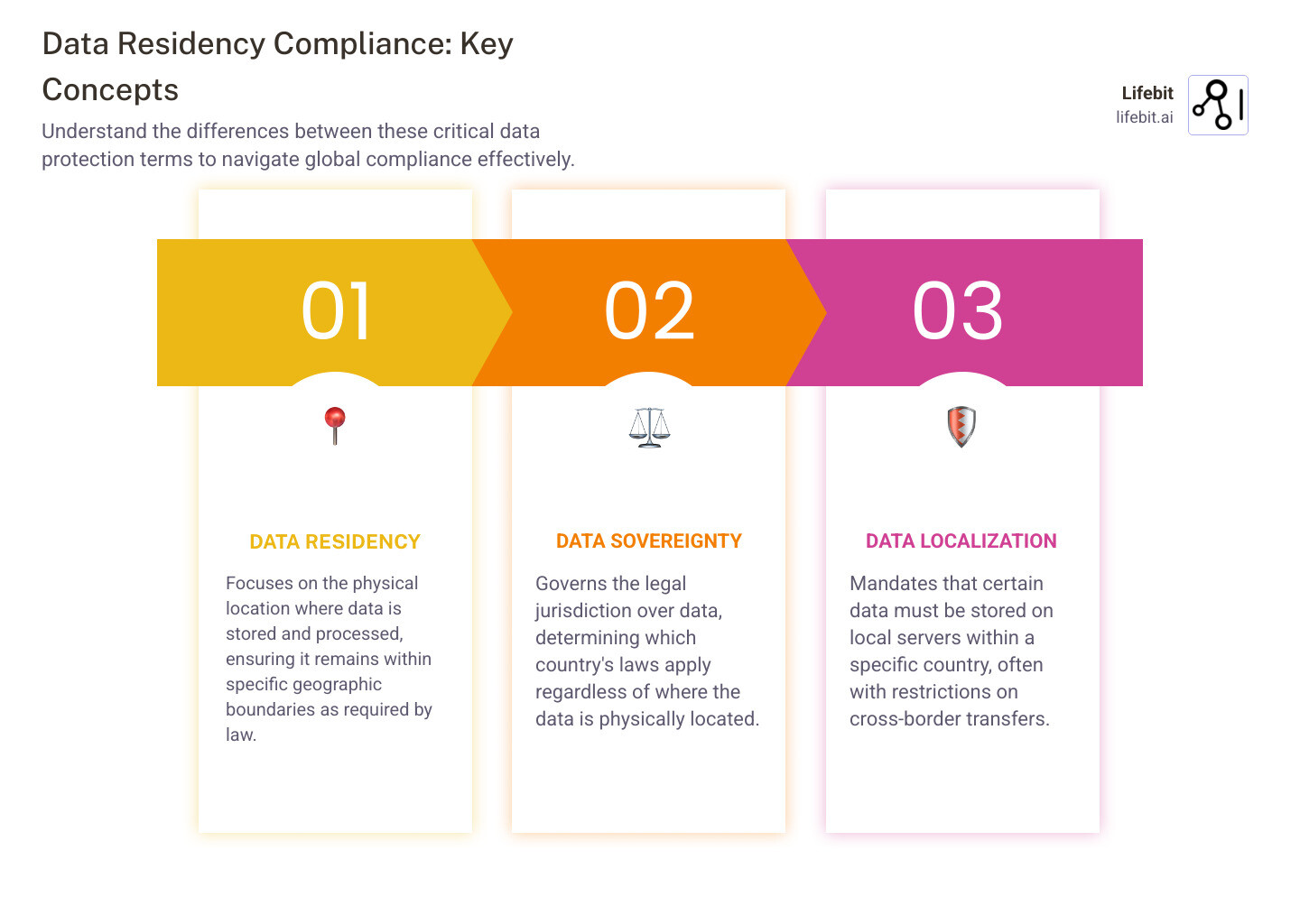
Simple Data residency compliance glossary:
When we talk about where data “lives,” we often hear three terms used interchangeably: residency, sovereignty, and localization. However, in the eyes of a regulator, these are distinct concepts with very different legal weights.
Understanding these nuances is the first step toward building a robust data privacy regulations strategy.
| Concept | Primary Focus | Legal Implication |
|---|---|---|
| Data Residency | Physical/Geographic Location | Where the data is stored (often for tax or performance reasons). |
| Data Sovereignty | Legal Jurisdiction | The data is subject to the laws of the country where it is physically located. |
| Data Localization | Mandatory Retention | A legal requirement that data must be processed and stored within national borders. |
Data residency is essentially the “home address” of your data. It refers to the physical or geographic location where an organization chooses to store its data. This choice might be driven by business needs, such as reducing latency for users in Singapore or optimizing cloud costs in the UK.
Data sovereignty takes it a step further. It is the principle that data is subject to the laws of the nation where it is collected or stored. For example, if you store data in the US, it may be subject to the US CLOUD Act, which empowers American law enforcement to access data even if it belongs to a foreign citizen.
Data localization is the strictest of the three. These laws mandate that certain types of data (like health records or financial transactions) must be collected, processed, and stored within a specific country’s borders. In many cases, these laws even prohibit the transfer of a copy of that data outside the country.
Why Data Residency Compliance Matters for Global Growth
Ignoring data residency compliance isn’t just a technical oversight; it’s a massive business risk. The financial stakes are staggering. Under the General Data Protection Regulation (GDPR), companies can be fined up to €20 million or 4% of their annual global turnover—whichever is higher.
Beyond the fines, there is the “trust factor.” Customers today are more aware of their digital footprints than ever before. If a biopharma company in the EU discovers their sensitive genomic data is being stored on unencrypted servers in a jurisdiction with weak privacy laws, that brand’s reputation may never recover.
Furthermore, residency impacts performance. Storing data closer to the user reduces latency, which is critical for real-time analytics and identity verification processes.
The Role of Identity Verification in Residency
Data residency laws have a direct impact on how we handle “Know Your Customer” (KYC) and “Know Your Business” (KYB) processes. When an organization verifies an identity, they are handling highly sensitive Personal Identifiable Information (PII).
Regulations like the California Consumer Privacy Act (CCPA) and the UK Data Protection Act 2018 require that this sensitive information be handled with extreme care. If you are verifying a user in London, but your identity verification provider processes that data in a “third country” without adequate protections, you could be in breach of GDPR-compliant data standards. Businesses must ensure their verification partners use regional data centers to keep this sensitive PII within the required borders.
Global Data Residency Compliance: How to Navigate Laws Without Getting Blacklisted
The global regulatory map is a patchwork of different rules. What works in New York might be illegal in Beijing or Mumbai.
For organizations transferring data to third countries, the legal hurdles are high. To bridge the gap between jurisdictions, many companies rely on Standard Contractual Clauses (SCCs) or Binding Corporate Rules (BCRs). These are pre-approved legal templates that ensure data receives the same level of protection abroad as it does at home.
Strict Mandates in the EU, China, and India
The European Economic Area (EEA)) is often seen as the gold standard for data protection. While GDPR doesn’t strictly forbid data from leaving the EU, it makes it very difficult to do so without an adequacy decision from the European Commission.
In contrast, China has some of the world’s most stringent localization regimes. Laws like the Personal Information Protection Law (PIPL) and the Cybersecurity Law (CSL) mandate that Critical Information Infrastructure Operators (CIIOs) must store all personal information collected within China on domestic servers.
India is also tightening its grip. The Digital Personal Data Protection Act (DPDP) includes provisions that allow the government to restrict data transfers to certain “blacklisted” countries. For the payment industry, the Reserve Bank of India (RBI) already mandates that all transaction data must be stored exclusively on servers in India.
Sector-Specific Rules for Healthcare and Finance
Specific industries face even higher bars for healthcare data compliance. In the US, while there is no federal data localization law, sector-specific rules like The Gramm-Leach-Bliley Act for finance and HIPAA for healthcare create a “de facto” residency requirement.
In Canada, provincial laws like Ontario’s Personal Health Information Protection Act (PHIPA) effectively mandate that health data custodians store information within Canada to ensure it remains accessible and secure under local jurisdiction. This is vital for maintaining data integrity in health care, as it prevents foreign entities from altering or blocking access to critical patient records.
The Billion-Dollar Risk: Why Data Residency Compliance Failures Kill Growth
The risks of failing to achieve data residency compliance go far beyond a slap on the wrist.
One of the most severe consequences is a total operational ban. In 2021, the Reserve Bank of India restricted Mastercard and American Express from issuing new cards to customers because they failed to comply with local data storage rules. For a global financial giant, being locked out of one of the world’s largest markets is a catastrophic blow.
Other risks include:
- Financial Penalties: As seen with Meta’s $1.3 billion fine.
- Data Fragmentation: Managing data across 50+ different silos makes it nearly impossible to run global analytics or AI models.
- Reputational Damage: Losing customer trust can lead to a mass exodus of users.
Overcoming Technical Hurdles in Data Residency Compliance
The technical challenges of staying compliant are immense. Organizations must manage complex multi-region architectures, ensuring that data from a user in Israel stays in Israel, while data from a user in Singapore stays in Singapore.
This requires constant audit and reporting. You need to know exactly where every byte of data is at all times. For many, this leads to “data gravity” problems, where data becomes so heavy and stuck in one location that it can’t be used for research or innovation.
Managing Vendor and Third-Party Risk
You are only as compliant as your weakest vendor. When you use a Cloud Service Provider (CSP), you must verify their Service Level Agreements (SLAs) to ensure they aren’t moving your data to unauthorized regions for “load balancing” or “backups.”
At Lifebit, we take a proactive approach to data governance and security. We believe that compliance shouldn’t be an afterthought—it should be built into the infrastructure. This means mapping every subprocessor and ensuring that contractual safeguards are in place to prevent accidental data egress.
5 Strategies for Bulletproof Data Residency Compliance Without Losing Speed
How do you stay compliant without grinding your operations to a halt? Here are five strategies we recommend:
- Data Mapping: You cannot protect what you don’t know. Conduct a thorough audit to identify what data you have, where it’s coming from, and where it’s currently stored.
- Regional Cloud Zones: Use cloud providers that offer localized data centers in the specific regions where you operate (e.g., AWS GovCloud for US government data).
- Encryption and Key Management: Ensure data is encrypted at rest and in transit. More importantly, use “Bring Your Own Key” (BYOK) models so that you—and only you—control access.
- Single-Tenant Architecture: Unlike multi-tenant “public” clouds, single-tenant setups give you exclusive control over the physical location of your data and processing.
- Federated Governance: Instead of moving data to your analytics, move your analytics to the data.
Leveraging Federated Governance for Global Compliance
This is where the future of data lies. Federated data governance allows organizations to analyze data where it lives.
Instead of copying sensitive genomic data from a hospital in London to a central server in New York (which would violate multiple residency laws), Lifebit uses Trusted Research Environments (TREs).
In a TRE, the data never leaves its original “home address.” Researchers send their algorithms to the data, the analysis happens locally, and only the “results” (which contain no PII) are sent back. This “zero-egress” approach is the ultimate solution for decentralized data governance, enabling global collaboration while maintaining 100% residency compliance.
Future-Proofing Your Global Data Strategy
Regulations will continue to evolve. To stay ahead, organizations should look into:
- Privacy-Preserving AI: Using techniques like differential privacy to train models without ever seeing the raw data.
- Autonomous Cloud: Architectures that automatically shift workloads based on real-time regulatory changes.
- Hybrid Governance: Finding the right balance between centralized vs decentralized data governance to maximize both security and agility.
Data Residency Compliance: 3 Critical Risks You Need to Know
Does GDPR require data to stay in the EU?
Technically, no. GDPR allows data to be transferred outside the EU if the destination country has an “adequacy decision” (like Canada or the UK) or if the company uses “appropriate safeguards” like Standard Contractual Clauses (SCCs). However, many organizations find that keeping data within the EEA is the simplest way to avoid legal complexity.
How does data residency affect KYC and KYB?
Identity verification often involves processing sensitive PII. If your KYC provider processes a UK citizen’s data in a country without adequate privacy laws, you are liable for the breach. You must ensure your verification partners process and store data in compliant regional data centers.
What is the penalty for non-compliance?
The penalties are severe. GDPR fines can reach €20 million or 4% of global annual turnover. In India, the DPDP Act allows for fines up to INR 250 crore. Beyond money, you face operational bans, market exclusion, and permanent damage to your brand reputation.
Conclusion: Stop Moving Data to Master Data Residency Compliance
The old way of managing data—collecting it all into one giant “lake” and moving it across borders—is dead. It’s too risky, too expensive, and increasingly illegal.
Data residency compliance is no longer a “check-the-box” exercise for the legal team; it is a fundamental requirement for any business that wants to scale in the 21st century. By adopting a federated approach, you can stop worrying about where your data is and start focusing on what it can do for you.
Secure your global research with Lifebit’s federated data platform and turn residency requirements into your greatest competitive advantage.