

Federated Trusted Research Environment (TRE)
Sovereignty by architecture
Turn your data into insights without compromising security and privacy with Lifebit, the pioneer of the federated Trusted Research Environment (TRE).
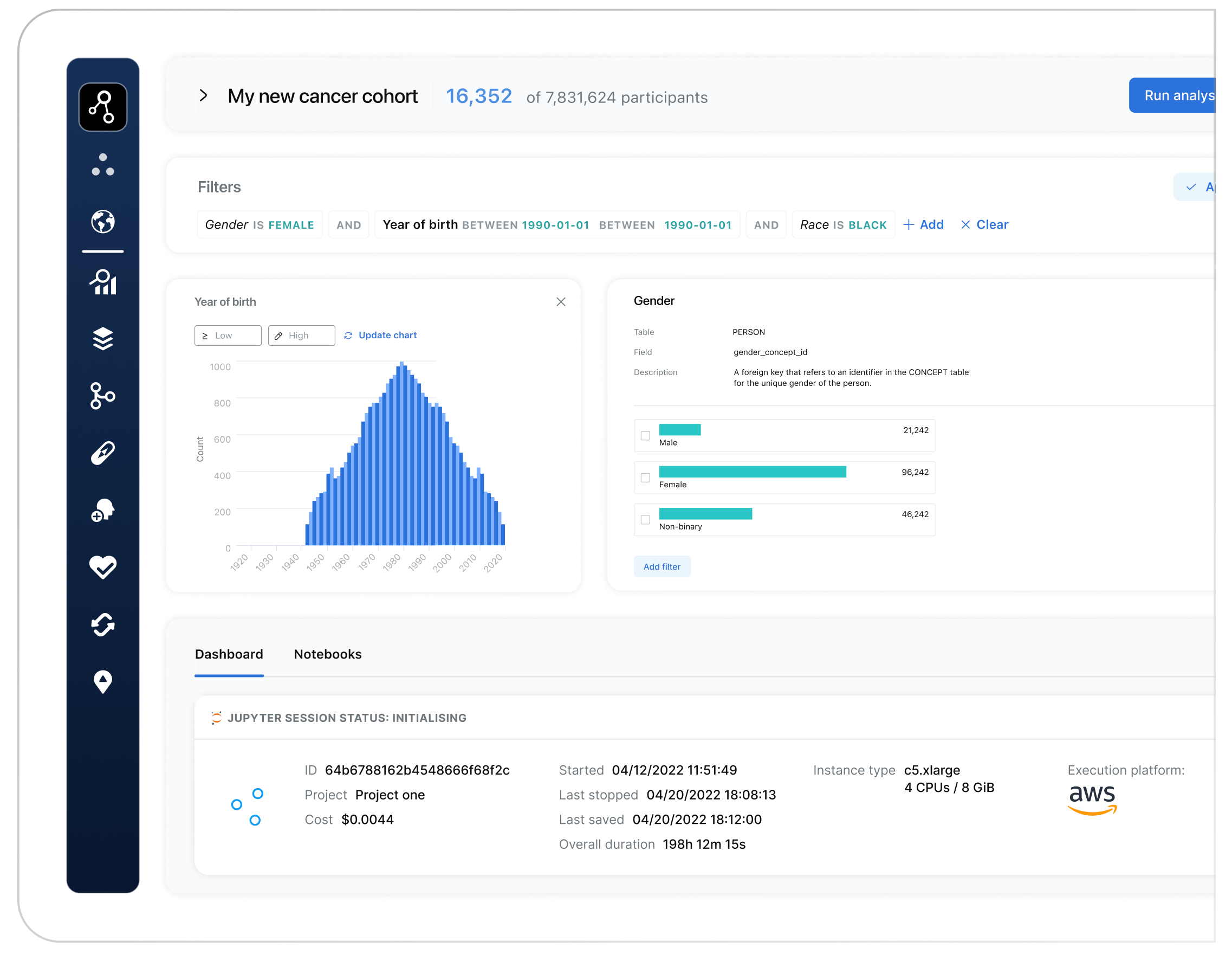










What is data sovereignty in genomic research?
Trusted Research Environments (TREs) are secure, controlled digital environments that provide researchers with safe, remote access to sensitive health data. Also known as “Data Safe Havens,” and “Secure Data Environments”, TREs allow approved users to access, analyze, and store data within a single secure location, ensuring patient privacy through strict access controls and pseudonymization.
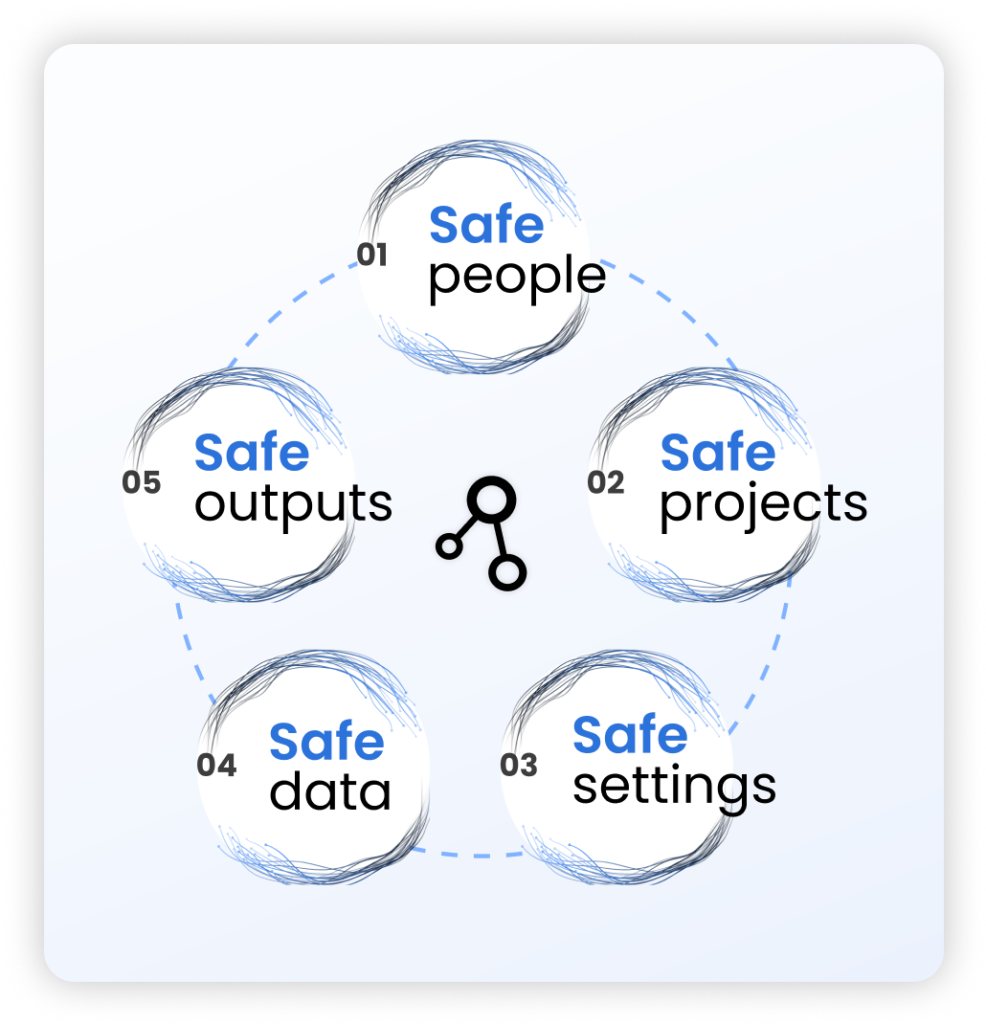
Following the Five Safes Framework, TREs support collaborative research by facilitating access without compromising data security.

Fast, specialized data harmonization & product creation
Lifebit is trusted by top pharma and data providers for creating data products at scale.

Most secure TRE, by federated design
From the pioneers of federation, Lifebit’s TRE uniquely brings analysis and computation to where biomedical data resides.

Only TRE to guarantee results
The only solution for fast, accurate results through a TRE that is proven to handle datasets from over 250M+ patients.
Why Lifebit?
The most widely adopted TRE on the market
Unmatched Usability and Security
in One Platform
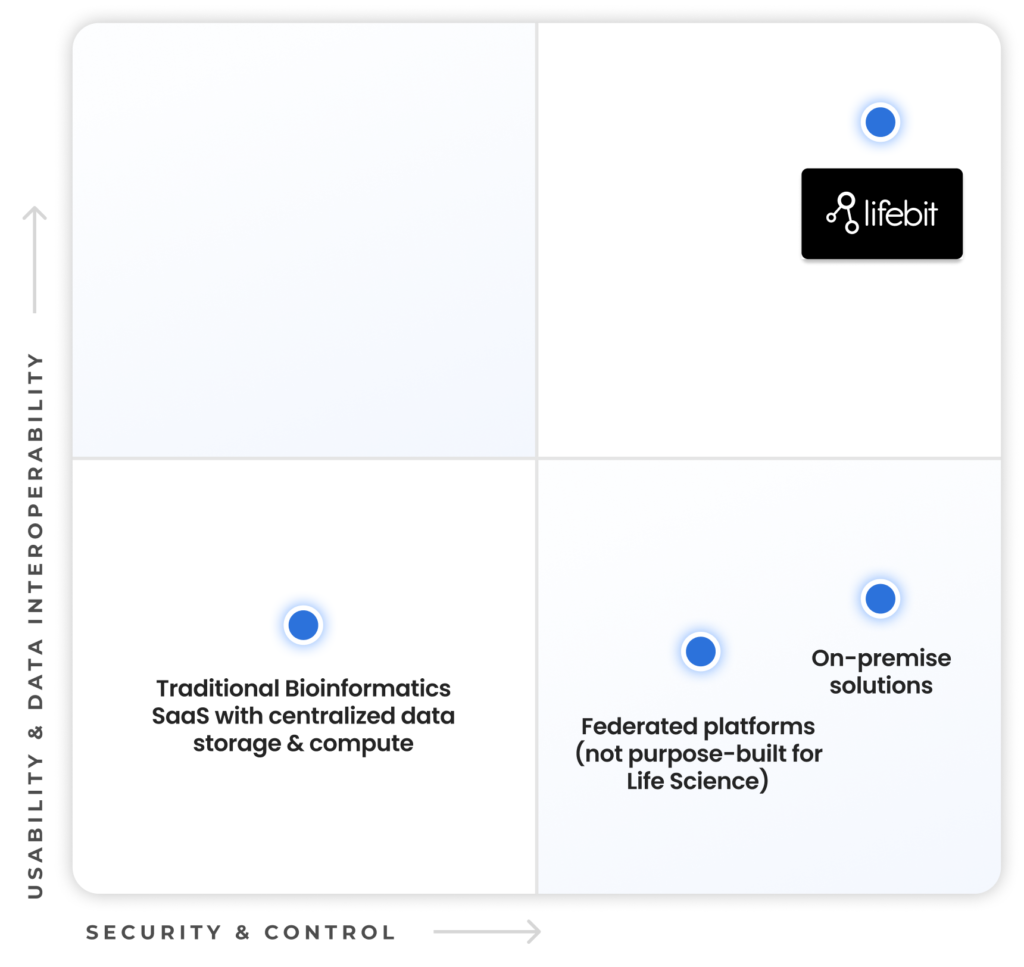
Achieving both security and usability for biomedical data is crucial to accelerate research and drive meaningful innovation.
Security & Control: Sensitive biomedical data must be stored securely with strictly controlled access to prevent data & privacy breaches. The traditional approach of anonymizing and transferring patient data to a central computing location leads to loss of data control and introduces re-identification risk. The only way to fully secure patient data is to keep data and computation in the organization’s jurisdiction and environment where it can be monitored, ensuring full compliance with data residency and privacy regulations.
Usability & Data interoperability: Biomedical data is often fragmented, unstructured, and challenging to use. Researchers need data products that are fit-for-purpose and ready for analysis, along with a platform that enables joint queries across distributed databases, supporting collaborative research without unnecessary barriers.
Lifebit’s Trusted Research Environment (TRE) stands alone as the only federated data platform purpose-built for life sciences and biomedical data, combining complete usability and data integration with uncompromising security and control.
Impact
Safeguard your sensitive biomedical data with Lifebit’s Trusted Research Environment
MOVE FASTER
5x
Faster than other solutions to identify data, create cohorts, deploy pipelines and AI models & perform analyses.
GET GUARANTEED RESULTS
100%
of our clients get results. Lifebit’s Platform is the only TRE to contractually guarantee results.
OVERCOME COMPLIANCE OBSTACLES
100%
Data stays in your environment, ensuring data security compliance and reducing risk.
Frequently asked questions
What does data sovereignty mean in a genomic research context?
Data sovereignty means that genomic data remains under the legal jurisdiction, physical control, and governance authority of the originating country or institution. In practice, patient records never leave the source environment, encryption keys and audit logs remain under source-institution control, and the source institution retains final authority over who may analyze the data and what results may leave.
Is data sovereignty the same as GDPR compliance?
No. GDPR compliance is necessary but not sufficient. GDPR permits international data transfers under Article 46 safeguards, whereas strict data sovereignty (required by the UK NHS, the Danish National Genome Center, Singapore HBRA, or China PIPL) forbids transfer even when GDPR safeguards are in place. A sovereignty-preserving platform must satisfy the strictest applicable national law, not only GDPR.
Can a centralized genomic platform meet sovereignty requirements?
Partially. Centralized platforms that offer configurable cloud regions can meet data-residency requirements for some jurisdictions. They cannot meet strict sovereignty requirements that forbid exporting patient records from the source institution, because their operating model requires those records to be uploaded into the platform’s managed environment. Genomics England, the Danish National Genome Center, and Singapore MOH have adopted federated, non-centralized platforms specifically for this reason.
Does Lifebit support data sovereignty for genomic research?
Yes. Lifebit’s Federated Trusted Research Environment is built around a federated-by-design architecture in which patient records never leave the source institution or jurisdiction. Lifebit is deployed by the NIH, Genomics England, Singapore’s Ministry of Health, and the Danish National Genome Center, and holds ISO/IEC 27001, SOC 2 Type II, Cyber Essentials Plus, and NHS DSPT certifications, is FedRAMP Authorized, and is HIPAA- and GDPR-aligned.
How do federated platforms handle machine learning without moving data?
Federated platforms use federated learning and federated analytics: model training runs locally inside each source environment and only the resulting model updates (weights, gradients) are exchanged — never the training data itself. The aggregated global model is trained across all participating sites while no patient record has been copied out of its source environment.
Which laws govern genomic data sovereignty?
The primary laws are GDPR (EU), the UK Data Protection Act 2018 and NHS data-flow rules, HIPAA and the 21st Century Cures Act (US), Denmark’s National Genome Act, Singapore’s Human Biomedical Research Act, China’s PIPL and Human Genetic Resources Regulations, Japan’s APPI, South Africa’s POPIA, and Brazil’s LGPD. Specific national programs additionally operate under bespoke genome-program statutes.
About data sovereignty in genomic research
Segment solutions
Lifebit’s Trusted Research Environment offers a broad range of use cases across segments
Public Sector Initiatives
TRE enabling controlled access to biomedical data
Controlled data access & sharing
Population genomics research
Cohort building & analysis
Data commercialization
Federal Health
TRE for sensitive data analysis
Controlled data access & sharing
Internal R&D
Cohort building & analysis
Data Providers
TRE for secure and controlled clinico-genomic and real world data
Controlled data access & sharing
Data commercialization
Health Nonprofit
TRE for storage, computing and multi-omics data analysis
Multi-omics data analysis
Population genomics research
Controlled data access & sharing
Data commercialization
Pharma & Biotech
TRE for multi-modal data analysis
Multi-omics data analysis
NGS data processing
Target identification & discovery
Patient subtyping stratification
Controlled data access & sharing
Securely protecting your sensitive biomedical data.
End-to-End Data Governance and Security by Design
based on the most advanced federated architecture in the industry

Featured news and events
Ready to collaborate on distributed data?
Contact Lifebit today and discover how our federated data solutions can accelerate your research.
We’ll respond as soon as possible.
Lifebit will only use your personal information to provide information about our products and services. From time to time we may email you, which you may unsubscribe from at any time. To learn more, see our Privacy Policy and Cookie Policy.
FAQs
Data federation is a software process that enables numerous databases to work together as one. Using this technology is important for accessing sensitive biomedical health data, as the data remains within appropriate jurisdictional boundaries, while metadata (information about the data) is centralized and searchable.
Data federation is an alternative to a model in which data is moved or duplicated then centrally housed – when data is moved it becomes vulnerable to interception and movement of large datasets is often very costly for researchers. Instead, approved users may access the data via linking technologies such as Application Programming Interfaces, or APIs.
A Federation Platform-as-a-Service (FedPaaS) is a secure, cloud-based service model that enables organizations to access and analyze data directly in their own cloud environment—without moving or duplicating the data. Unlike traditional bioinformatics platforms that require data to be transferred to the provider’s cloud account, Lifebit’s FedPaaS keeps data and computation within the organization’s own infrastructure.
This model allows organizations to:
Maintain Full Control: Data stays in your organization’s cloud account, giving you full ownership and control without data exposure to shared environments.
Ensure Data Residency Compliance: Data remains within your jurisdiction and infrastructure, which is essential for compliance with data residency and privacy regulations.
Optimize Cloud Costs: Since data remains in your cloud account, you avoid the added costs and markups of external cloud storage and compute fees, and you leverage your own provider discounts.
Avoid Costly Data Transfers: If your relationship with the FedPaaS provider changes, there are no egress fees or data migrations needed—your data always remains in your environment.
With Lifebit’s platform patient level data never moves thanks to its enterprise-grade federated architecture that keeps data in-place, and that adheres to the highest global security standards, including FedRAMP, GDPR, HIPAA, ISO 27001, and SOC 2. We also implement the 5 Safes Framework to ensure strict data residency and secure access, making us the trusted choice for government and regulated industries.