

Top 7 Challenges of Workflow Languages, like Nextflow, in Cloud-Scale Research & How Lifebit’s Cloud-Native Bash Engine Solves Them
Introduction
As cloud-scale research expands, workflow languages such as Nextflow, WDL/Cromwell, Snakemake, and CWL have become deeply embedded in modern bioinformatics and data science pipelines. Yet, while these tools are powerful, they introduce growing levels of operational, conceptual, and governance complexity.
Most researchers are already fluent in Bash, but workflow DSLs require entirely new mental models, slowing onboarding, complicating scalability, and hampering reproducibility across teams. The result is an environment where only a small group of workflow specialists can operate at cloud scale, creating significant bottlenecks.
Below is a breakdown of the core challenges teams encounter when scaling workflow languages in the cloud.
1. Most Scientists Don’t Want to Learn Workflow Management Languages like Nextflow
Researchers specialise in biology, clinical science, and data analysis, not in cloud orchestration, container tooling, or workflow DSL development. Workflow Management languages push responsibility toward engineering instead of discovery, slowing collaboration and innovation.
2. Steep Learning Curves Slow Down Teams
Workflow languages require learning DSL syntax, process/channel logic, executor settings, and container orchestration. While most scientists already know Bash, mastering a workflow DSL can take weeks or months, meaning only a few specialists can support cloud-scale workloads.
3. Cloud Batch Executors Configuration Is Complex
Configuring AWS or Azure Batch is notoriously complex. Small misconfigurations (i.e. subnets, EBS throughput, instance strategies, or container pull reliability) lead to cryptic cloud failures like CannotPullContainerError or “no space left on device”.
4. Credential Handling Is a Frequent Point of Failure
Workflow engines depend on precise AWS credential behaviour, yet STS expiry, conflicting credential sources, and mismatched container roles frequently cause AccessDenied errors or silent staging failures.
5. Multi-Account Cloud Setups Create Hidden Complexity
Running workflows across multiple AWS accounts requires aligned IAM trust, KMS keys, and bucket policies. Most researchers are not cloud security experts, leading to fragile pipelines and unpredictable failures.
6. Scaling Bash Workflows Traditionally Requires Workflow Engineers
Bash scripts do not natively scale across thousands of cloud datasets. Teams must rewrite Bash into workflow DSLs to achieve retries, parallelisation, reproducibility, logging, and resource isolation, creating a bottleneck in specialist engineering capacity.
7. Debugging Workflow Failures Takes Hours (or Days)
Cloud-native workflows scatter logs across CloudWatch, executors, containers, and nested runtime directories. Users must piece together fragmented context just to locate the root cause of failures.
Introducing Lifebit’s Cloud-Native Bash Engine: Democratizing Population-Scale Cloud Analyses
Lifebit’s new Cloud-Native Bash Engine directly addresses these challenges by letting researchers run plain Bash scripts, at population scale, with no need for workflow languages, containerisation, or DevOps expertise.
“Researchers should be able to focus on their science, not waste time with steep learning curves or mastering new workflow management skills, like Nextflow. Our new cloud-native Bash execution experience preserves the simplicity scientists love, while delivering the power and elasticity of population-scale compute. This is a major step forward in democratising cloud analyses and making them accessible, fast, compliant, and truly collaborative for every research team and user.”
— Maria Dunford, CEO of Lifebit, said in the corresponding Press Release.
Instead of rewriting Bash into Nextflow or WDL, researchers can run their Bash scripts as they would have, while the Lifebit platform seamlessly manages cloud orchestration, data parallelization, governance, reproducibility, and collaboration in the background.
How Lifebit’s Cloud-Native Bash Engine Solves the Challenges
- Designed for Researchers, Not Workflow Management Engineers
By aligning with the tools researchers already use and simplifying everything else, the Bash engine accelerates onboarding, collaboration, and cloud adoption across entire organisations. - No Workflow Management Languages, No Learning Curve
Researchers work in plain Bash. There is no need to adopt Nextflow, WDL, or complex dataflow models, removing the cognitive load that slows team-wide adoption. By eliminating the need to interact with workflow languages directly, the Bash engine gives researchers a simpler and faster way to run analysis. - Cloud Batch System Complexity Fully Abstracted
Users can run analyses using pre-set Batch queues or their own configured environments, while Lifebit manages the underlying IAM assumptions, container pulls, and networking, among others. Users simply provide a containerised Bash script and parameters, and the platform handles the rest. - Unified Workspace Removes Multi-Account Complexity
By running in a single governed environment deployed into the organisation’s cloud, Lifebit unifies permissions, policies, and KMS configurations, making execution predictable and secure across large datasets or teams. - Simple, Declarative Analysis Setup
Users provide only the essentials – script, parameters, optional array file. No layered configs, no overrides, no pipeline rewrites. - Fast, Context-Rich Debugging
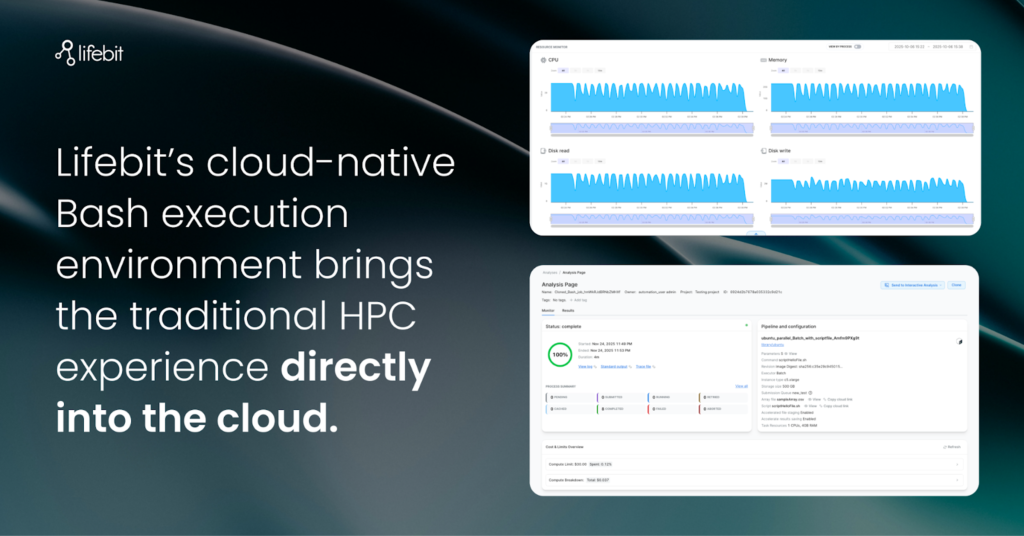
Integrated monitoring surfaces CPU, memory, and cost metrics in real time, removing the need to search across logs, CloudWatch, executors, containers, and nested runtime directories.
✅ No Workflow Knowledge Required
Achieve workflow-level robustness, with zero need to learn Nextflow, WDL, or other DSLs.
✅ Array Jobs for High-Throughput Workloads
Automatically parallelise Bash scripts across thousands of inputs for population-scale research.
✅ Transparent Resource Usage
Real-time CPU, memory, and cost visibility accelerates debugging and optimisation.
✅ One-Click Interactive Sessions
Seamlessly pivot from outputs to Jupyter, VSCode, or RStudio in a single click.
✅ Collaborative, Compliance-Aligned Workspaces
Teams can run shared tools while protecting IP and maintaining strict governance (GDPR, HIPAA, FedRAMP, 5 Safes).
✅ HPC Familiarity with Cloud Elasticity
Run Bash exactly as usual, while gaining cloud-scale compute throughput and automation.
Outcome
Lifebit’s cloud-native Bash engine finally breaks the dependency on workflow DSL specialists, empowering the 90%+ of researchers already fluent in Bash to run secure, governed, reproducible, population-scale analyses without rewriting code or managing cloud infrastructure.
Research becomes faster, more collaborative, and fully compliant, enabling teams to focus on discovery- not orchestration.