

Finding Your Data’s Forever Home with These Trusted Research Environment Providers
Stop Data Breaches: How Lifebit Trusted Research Environment Providers Slash Setup Time by 70%
Trusted research environment providers offer secure computing platforms where sensitive biomedical data can be accessed and analyzed remotely without compromising patient privacy or regulatory compliance. These specialized providers manage the technical infrastructure, security protocols, and compliance frameworks that enable researchers to work with highly sensitive health data while meeting stringent requirements like GDPR, HIPAA, and ISO 27001.
Leading trusted research environment providers typically offer:
- Federated access – analyze data without moving it from its secure location
- Cloud-agnostic platforms – deploy on AWS, Azure, or Google Cloud
- AI-powered analytics – machine learning tools for multi-omic data analysis
- Compliance certifications – GDPR, HIPAA, ISO 27001, EHDS-ready
- Rapid deployment – implementation in 8-12 weeks vs. months or years in-house
- Role-based access controls – multi-tier permissions for safe collaboration
In a 2018 study, 66% of medical researchers cited data sensitivity as their top concern. That fear is justified. A single breach can destroy years of work, erode volunteer trust, and trigger massive regulatory penalties. Yet building a compliant research environment in-house drains resources, takes months, and still leaves gaps in security.
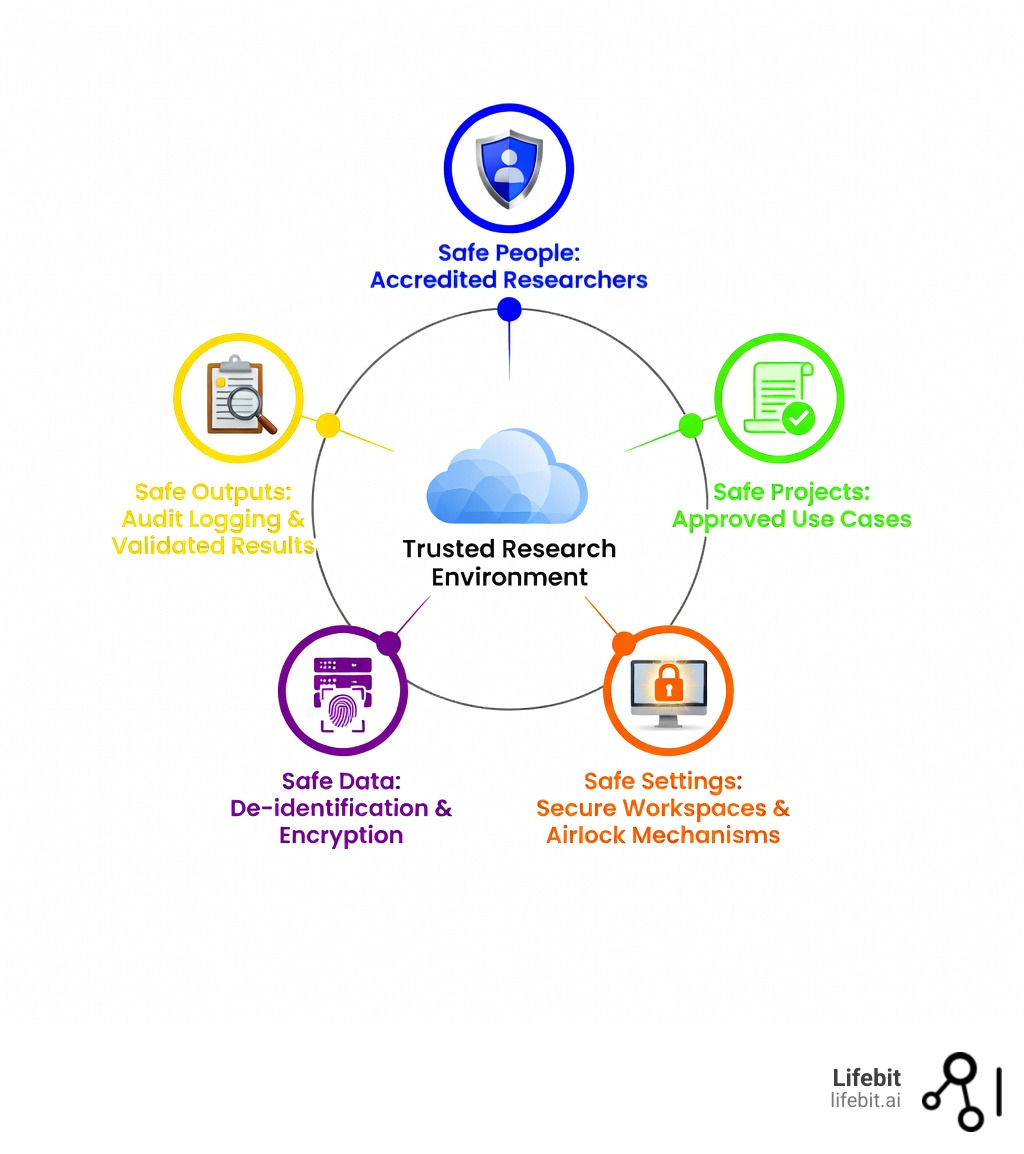
Trusted research environment providers solve this by offering turnkey platforms built on the Five Safes framework: safe people, safe projects, safe settings, safe data, and safe outputs. These aren’t just buzzwords – they’re the proven model from the UK Office of National Statistics that underpins secure data sharing across healthcare, genomics, and public health research globally.
I’m Maria Chatzou Dunford, CEO and Co-founder of Lifebit. With a PhD in Biomedicine and over 15 years in computational biology, AI, and health-tech, I’ve spent my career building trusted research environment providers that power secure, federated data analysis for pharmaceutical and public sector organizations worldwide. Here’s what you need to know when choosing a provider that can actually protect your data while accelerating your research.
Why Lifebit Trusted Research Environment Providers Outperform In-House Builds
When organizations try to build their own Secure Data Environments (SDEs), they often fall into a “trust trap.” As highlighted in scientific research on why TREs are about more than just trust, a truly secure environment isn’t built on a handshake—it’s built on rigorous, automated technical safeguards.
Building these safeguards from scratch is a massive resource drain. It diverts your best engineers away from core research goals and into the weeds of server maintenance and compliance audits. One of the primary advantages of Trusted Research Environments from a specialized provider like us is the speed of implementation. While an in-house build can take 12 to 18 months to reach full accreditation, our trusted research environment providers can have your team up and running in 8 to 12 weeks.
The Five Safes model is incredibly difficult to maintain manually. By partnering with us, you gain a system where these “safes” are baked into the code, providing a level of scalability that in-house solutions simply can’t match.
| Feature | In-House Build | Lifebit-led TRE |
|---|---|---|
| Setup Time | 12+ Months | 8-12 Weeks |
| Compliance | Manual Audits | Automated / Built-in |
| Data Movement | Often requires copying | Federated (No movement) |
| Scalability | Limited by local hardware | Cloud-agnostic & Global |
| Maintenance | High internal FTE cost | Fully managed service |
Core Features to Demand from Trusted Research Environment Providers
If you are evaluating trusted research environment providers, you shouldn’t settle for a basic “digital locker.” A modern TRE must be a collaborative engine. The most critical feature is federated access. This allows you to perform federated research where the data stays behind the custodian’s firewall, and only the analysis results are shared.
Beyond federation, look for these key features of a Trusted Research Environments:
- Airlock Mechanisms: These prevent unauthorized data exports. Any result leaving the environment must pass through a “Safe Output” check to ensure no patient-identifiable information is leaked.
- Multi-tier Role-Based Access: Not every researcher needs access to every variable. Granular permissions ensure that access is restricted based on the specific requirements of an approved project.
- Data De-identification: Automated pipelines that pseudonymize sensitive records before they ever reach a researcher’s workspace.
- Cloud-Agnosticism: Your TRE should work wherever your data lives—whether that’s AWS, Azure, or on-premise servers.
For more on the standard definitions used by the UK Health Data Research Alliance, you can explore the Trusted Research Environments guide.
Technical Infrastructure and AI Integration in Lifebit Trusted Research Environment Providers
We don’t just provide a space for data; we provide the tools to understand it. Our infrastructure is built on modern technologies like Docker containers and Kubernetes, ensuring that your analytical workflows are reproducible and scalable.
Whether you are looking for a Trusted Research Environment on Azure or other cloud providers, our platform handles the heavy lifting. We integrate:
- Automated Harmonization: Converting messy, multi-source data into a standardized format for analysis.
- Multi-omic Integration: Seamlessly combining genomic, transcriptomic, and clinical data.
- AI-Powered Analytics: Built-in support for predictive modeling and machine learning, allowing you to move from variant to target discovery faster than ever before.
Compliance Standards for Lifebit Trusted Research Environment Providers
Compliance is the “license to operate” in health research. Leading trusted research environment providers must stay ahead of a rapidly shifting regulatory landscape. Our solutions are designed to be EHDS-ready, anticipating the requirements of the European Health Data Space.
We adhere to the highest international standards, including:
- GDPR & HIPAA: Ensuring global privacy standards are met for both European and US data.
- ISO 27001: The gold standard for information security management.
- NHS DSP Toolkit & Cyber Essentials Plus: Critical for any organization working within the UK health ecosystem.
Efforts like aligning the approach to Trusted Research Environments ensure that we are always moving toward a common, secure standard that researchers and the public can trust.
Lifebit Trusted Research Environment Providers: Unlocking Global Science
Science doesn’t stop at borders, and neither should your data access. Trusted research environment providers are the key to unlocking international collaboration. By using a federated model, a researcher in London can analyze a dataset in Singapore without the data ever leaving its home country.
This is particularly vital for precision medicine. The ability to safely share and analyze diverse population datasets is the only way to ensure that new treatments work for everyone, not just a small subset of the population. By maintaining data sovereignty while enabling global analysis, researchers can identify efficacy and safety signals across a much broader demographic.
Lifebit Trusted Research Environment Providers for Clinical and Genomic Data
For biopharma and academic institutions, the Secure Research Environment is where the magic happens. These “Data Safe Havens” allow for:
- Drug Discovery: Identifying new drug targets by analyzing massive biobanks.
- Biomarker Identification: Using multi-omic data to find early indicators of disease.
- Clinical Trial Results: Securely analyzing trial data to identify efficacy and safety signals without compromising participant anonymity.
The PHG Foundation highlights that federated TREs are becoming the standard for genomics, as they allow for the scale needed for genomic studies while maintaining the strict privacy required for genetic information.
Maximizing Research Impact with Secure Collaboration
A TRE shouldn’t be a silo; it should be a workspace for efficiency. By using isolated workspaces, we enable multi-institution partnerships where different teams can collaborate on specific projects without seeing each other’s unrelated data.
Every action within our environment is captured in an exhaustive audit log. This transparency builds trust with data custodians and regulators. When you can prove exactly who accessed what data and what analysis they performed, the barriers to data sharing begin to melt away. We explain this in detail in our guide on how TREs secure global health data sharing.
Frequently Asked Questions about Lifebit Trusted Research Environment Providers
What roles are required to manage a Lifebit TRE?
Managing a TRE is a team effort, but it doesn’t have to be a full-time burden for your staff. According to our Lifebit TRE Guide 2026, the four key roles are:
- Cloud Access Administrator: Grants initial environment access (usually only needed in week 1).
- Project Lead: Aligns stakeholders and manages timelines.
- Platform Administrator: Handles user onboarding and workspace configuration.
- Data Steward: Manages data ingestion and access provisioning.
How does Lifebit handle data sovereignty?
Data sovereignty is at the heart of our federated architecture. Unlike traditional trusted research environment providers that might require you to move data to their “central” cloud, our platform ensures the data remains on-shore with the custodian. We provide the Secure Data Environment (SDE) tools to analyze the data locally, so it never leaves its jurisdiction.
What is the typical implementation timeline for a Lifebit TRE?
Speed is one of our greatest strengths. While building an in-house Trusted Research Environment can take years, our pre-configured workspaces and automated compliance checks allow for a rapid deployment of 8 to 12 weeks.
Conclusion: Choose a Trusted Research Environment Provider That Delivers
The future of biomedical research is federated, AI-powered, and uncompromisingly secure. Choosing the right trusted research environment providers is about more than just checking a compliance box—it’s about choosing a partner that enables you to turn global data into real-time insights.
At Lifebit, we deliver the next generation of Trusted Research Environments that empower you to lead in the era of precision medicine. Stop worrying about data breaches and start focusing on your next breakthrough.