

From Lab Bench to Big Data: A Biomedical Data Management Masterclass
Understanding Biomedical Data Management
Biomedical data management is all about handling the vast amounts of information generated in life sciences and healthcare. It covers everything from how data is created to how it’s shared and reused.
Here’s what good biomedical data management helps you do:
- Organize and Store Data: Keep your research data structured and safe for the long term.
- Improve Accessibility: Ensure data can be easily found and used by others.
- Boost Reproducibility: Validate research findings and build trust in science.
- Meet Mandates: Comply with strict rules from funders and publishers, like the NIH DMS Policy.
- Accelerate Discovery: Speed up new insights, drug development, and patient care.
In today’s biomedical landscape, the sheer volume of data is exploding. This makes proper data handling more critical than ever. Researchers, pharmaceutical companies, and public health agencies face constant pressure to turn complex information into meaningful breakthroughs. They need to ensure their data is not just stored, but also easily found, accessible, and ready for advanced analysis. Without solid data management, valuable insights can stay locked away, and research can be slowed down or even lost.
This guide will walk you through the essential steps and best practices for managing biomedical data effectively. We’ll show you how to steer the challenges, accept new standards, and open up the full potential of your research.
I’m Maria Chatzou Dunford, CEO and Co-founder of Lifebit. With a background in computational biology and AI, I’ve spent over 15 years empowering precision medicine and advancing biomedical data management to transform global healthcare.
Biomedical data management terms you need:
Navigating the Biomedical Data Lifecycle: From Planning to Reuse
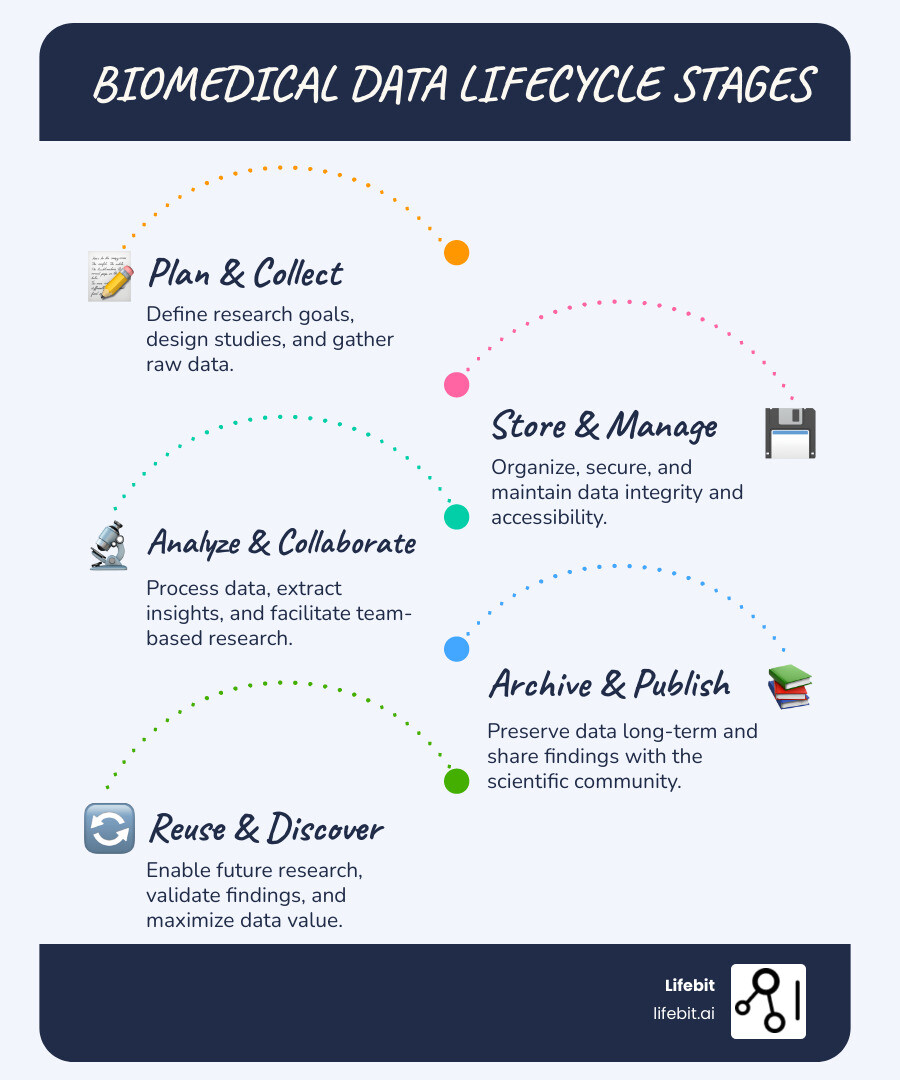
The Biomedical Data Lifecycle isn’t just a straight line; it’s a living, breathing framework that supports your research from the first “Eureka!” to the final data citation. At its core, it represents how we collect, use, and store information. While it generally flows from planning to reuse, we often find ourselves jumping between stages as new insights emerge.
Effective biomedical data management starts long before the first sample is processed. It begins with a Data Management Plan (DMP). Think of a DMP as your research roadmap. It dictates how you will handle data, what formats you’ll use, and how you’ll eventually share your findings. Creating this early isn’t just a “nice to have”—it’s often a requirement for major funders like the NIH. A robust DMP should address data types, related tools/software, standards, data preservation, access/sharing, and oversight.
To keep this lifecycle moving smoothly, we recommend using a Biomedical Research Data Platform Complete Guide approach. This ensures that every stage—Plan & Design, Collect & Create, Store & Manage, and Analyze & Collaborate—is interconnected. By following a Data Management Platform Guide, you can avoid the “dark data” trap, where valuable information is forgotten on a hard drive somewhere, never to be seen again.
The Challenges of Data Collection and Creation
In the “Collect & Create” phase, researchers face the hurdle of data heterogeneity. Biomedical data isn’t just spreadsheets; it includes high-resolution medical imaging (DICOM files), genomic sequences (FASTQ, BAM, VCF), electronic health records (EHR), and real-time sensor data from wearables. Each format requires specific storage considerations and metadata tagging to remain useful. For instance, genomic data is notoriously large, often requiring petabyte-scale storage solutions and specialized compression algorithms that do not compromise the integrity of the sequence information.
Implementing a biomedical data management system in the lab
If you’ve ever spent three hours looking for a file named final_data_v2_USE_THIS_ONE.csv, you know why lab-level organization matters. Implementing a robust system doesn’t require a PhD in computer science; it requires habit.
A practical guide for laboratory researchers suggests starting with three pillars:
- Standard Operating Procedures (SOPs): Write down exactly how data is moved from a machine to storage. This includes automated backup schedules and validation checks to ensure no data was corrupted during transfer.
- Data Dictionaries: Create a “legend” for your variables. If you use the column “Temp_C,” your dictionary should define it as “Temperature in Celsius measured by Probe A, calibrated on 2023-01-01.”
- Unique Subject Identifiers: Never use names or birthdays. Use alphanumeric codes that persist across all datasets. This is critical for longitudinal studies where patient data from multiple years must be linked without revealing the patient’s identity.
These steps are the foundation of a Data Harmonization Complete Guide, making it possible to combine your lab’s data with global datasets later on.
Collaborative analysis and secure data storage
Modern biomedical research is a team sport. Whether you are collaborating across a university or across five continents, you need a Secure Healthcare Data Platform. Gone are the days of emailing Excel files. Today, we use cloud infrastructure that provides version control and metadata tagging. This allows multiple researchers to work on the same dataset simultaneously while maintaining a clear audit trail of who changed what and when.
By adopting Data Lakehouse Best Practices, we can combine the flexibility of data lakes (which store raw data in its native format) with the structured management of traditional databases. This allows for real-time collaboration without compromising data integrity, enabling advanced analytics like machine learning to run directly on the stored data without the need for costly and time-consuming data movement.
FAIR, TRUST, and CARE: The Gold Standards of biomedical data management
In biomedical data management, three sets of principles reign supreme. They aren’t just buzzwords; they are the requirements for modern scientific practice. They provide a framework for ensuring that data is not only preserved but is also ethically handled and scientifically useful.
The FAIR Data Principles are the most well-known:
- Findable: Can a human or a machine find your data using metadata and persistent identifiers (PIDs) like DOIs? Metadata should be rich and clearly describe the data it represents.
- Accessible: Once found, is there a clear way to access the data? This doesn’t always mean “open”; it means the process for requesting access is transparent and automated where possible.
- Interoperable: Does the data play well with others? This is the most difficult pillar. It requires using standard ontologies and vocabularies (like SNOMED CT for clinical terms or Gene Ontology for biological processes) so that datasets from different sources can be merged seamlessly.
- Reusable: Is the documentation rich enough that someone else can use it for a new study? This includes clear licensing (e.g., Creative Commons) and detailed provenance information showing how the data was generated.
Implementing these requires a Data Governance Platform Complete Guide to ensure that every byte of data follows a Health Data Standardization Complete Guide. For example, adopting the OMOP Common Data Model (CDM) allows researchers to perform systematic analysis of disparate observational databases, transforming them into a common format.
Applying TRUST and CARE to biomedical data management
While FAIR focuses on the data itself, the TRUST and CARE principles focus on the “who” and the “how.”
The TRUST Principles (Transparency, Responsibility, User Focus, Sustainability, and Technology) are designed for repositories. They ensure that the place you store your data will actually exist in ten years and that they take their responsibility as data stewards seriously. Transparency involves being open about the repository’s operations and capabilities, while Sustainability ensures that the data remains available even if the original funding source ends.
The CARE Principles, developed by the Global Indigenous Data Alliance, address Indigenous Data Governance. They focus on:
- Collective Benefit: Data ecosystems should be designed to function in ways that enable Indigenous peoples to derive benefit from the data.
- Authority to Control: Indigenous peoples’ rights and interests in their data must be recognized and their authority to control such data be empowered.
- Responsibility: Those working with Indigenous data have a responsibility to share how that data is used to support Indigenous peoples’ self-determination.
- Ethics: Indigenous peoples’ rights and wellbeing should be the primary concern at all stages of the data lifecycle.
This is crucial for ensuring that research benefits the communities providing the data and respects their sovereignty. For sensitive work, we often use Privacy Preserving Statistical Data Analysis on Federated Databases to ensure that data can be analyzed without ever being exposed or moved, respecting both privacy and sovereignty.
Choosing the Right Repository for Your Biomedical Research

Where you put your data matters as much as how you collect it. An effective way to make your data accessible is to store it in a digital repository. But which one? The choice often depends on the nature of the data, the requirements of the funder, and the community standards of the specific scientific field.
There are four main types:
- Domain-specific: These are the “gold standard.” Think of the Protein Data Bank (PDB) for structural biology or GenBank for nucleotide sequences. They are recognized within your specific field and often have expert curators who validate the data.
- Generalist: Repositories like Figshare, Dryad, or Zenodo that accept all types of data. These are excellent for supplemental figures, code, or datasets that don’t have a dedicated domain-specific home.
- Institutional: Many universities have their own repositories (like UVA’s LibraData). These are great for long-term preservation of an institution’s research output but may have lower visibility than domain-specific sites.
- Project-specific: Created for a massive collaboration, like the NIH “All of Us” program or the UK Biobank. These often have very specific access requirements and specialized tools for analysis.
When looking for Medical Research Data Sharing options, we often point researchers toward NIH-supported Scientific Data Repositories. If you are dealing with massive, sensitive datasets, a Federated Data Platform Ultimate Guide approach might be better, allowing users to query data where it lives without the risks associated with moving large files.
Key considerations for biomedical data management repositories
When selecting a home for your data, we look for the “NIH Desirable Characteristics.” These include the use of Unique Persistent Identifiers (like DOIs), robust metadata standards, and long-term sustainability plans. Metadata is particularly important; it should include descriptive metadata (for finding the data), structural metadata (how the data is put together), and administrative metadata (who owns it and how it can be used).
| Feature | Domain-Specific | Generalist |
|---|---|---|
| Best For | Highly specialized data (e.g., Omics) | Supplemental figures, small datasets |
| Curation | Expert human curation often included | Minimal to no curation |
| Findability | High within the specific field | High via search engines (Google) |
| Compliance | Usually meets funder mandates | May require extra metadata work |
| Metadata Depth | High (uses field-specific schemas) | Basic (uses general schemas like Dublin Core) |
Many top-tier repositories now carry the CoreTrustSeal Certification, a mark that they have been audited for trustworthiness. For highly sensitive clinical data, you may need a Trusted Research Environment Complete Guide to provide a secure workspace for researchers to analyze data without downloading it.
Understanding data access types and implications
Not all data can be “Open Access.” In biomedical data management, we must balance the drive for open science with the need for patient privacy. This is often referred to as being “as open as possible, as closed as necessary.”
- Open Access: Anyone can download it without restrictions. This is common for non-human data or de-identified aggregate data.
- Registration Required: You just need to create an account and agree to basic terms of use.
- Controlled Access: You must submit a research proposal to a Data Access Committee (DAC). They verify your identity and ensure your research plan aligns with the consent provided by the participants.
- Closed Data: Metadata is findable, but the data itself is not shared due to extreme sensitivity or legal restrictions.
Navigating Biomedical Data Access requires a Secure Data Environment Complete Guide to ensure that only authorized “vetted” collaborators can see sensitive identifiers, maintaining the trust of the patients who provided the data.
Compliance and Security: Meeting NIH and Funder Mandates
The landscape of research changed significantly in January 2023 with the NIH Data Management and Sharing Policy. Now, almost all NIH-funded researchers must make their data publicly available. This follows the OSTP (Office of Science and Technology Policy) memorandum directing federal agencies to ensure immediate public access to research results. This shift is intended to accelerate discovery and ensure that the public benefits from the research it funds.
To meet these mandates without compromising security, we use technologies like the Trusted Data Lakehouse Clinical Omics Data. This allows biopharma and governments to comply with “open as possible, closed as necessary” rules. Furthermore, Federated Learning in Healthcare is becoming the go-to solution for analyzing data across borders (like between the UK and Singapore) without actually moving the files. This bypasses many of the legal hurdles associated with international data transfer, such as GDPR (General Data Protection Regulation) in Europe and HIPAA (Health Insurance Portability and Accountability Act) in the United States.
The Six Elements of an NIH Data Management Plan
Under the new policy, a DMP must address six specific elements to be approved:
- Data Type: A summary of the types and estimated amount of scientific data to be generated.
- Related Tools, Software, and/or Code: An indication of whether specialized tools are needed to access or manipulate the data.
- Standards: An indication of what standards will be applied to the scientific data and associated metadata.
- Data Preservation, Access, and Associated Timelines: The name of the repository where data will be archived and how long it will be available.
- Access, Distribution, or Reuse Considerations: Any factors affecting subsequent access, such as informed consent or privacy protections.
- Oversight of Data Management and Sharing: How compliance with the plan will be monitored and managed by the institution.
Ensuring long-term sustainability and trustworthiness
A repository has a lifecycle: Introduction, Growth, Maturity, and eventually, Decline or Reinvestment. As researchers, we must choose repositories that have clear plans for the “sunset” phase. What happens to your data if the funding for the repository runs out? Trustworthy repositories often have “succession plans” to move their data to another stable environment if they can no longer operate.
We look for TRUST Principles for digital repositories and evaluate them using a Data Intelligence Platform Ultimate Guide. Metrics like “data citations” and “reuse rates” help us understand the impact of our work and ensure that our data stays valuable for decades. Furthermore, cybersecurity is a growing concern; repositories must implement robust encryption, multi-factor authentication, and regular security audits (such as SOC 2 Type II) to protect against data breaches that could compromise sensitive patient information.
Frequently Asked Questions about Biomedical Data Management
What are the core stages of the biomedical data lifecycle?
The lifecycle includes Plan & Design, Collect & Create, Store & Manage, Analyze & Collaborate, Archive & Preserve, Publish & Share, and Reuse & Find. While it’s generally linear, researchers often jump between stages as a project evolves.
How do FAIR principles improve research reproducibility?
FAIR principles (Findable, Accessible, Interoperable, Reusable) ensure that data is well-documented and structured. This allows independent researchers to find the exact datasets used in a study and replicate the analysis, which is the cornerstone of scientific integrity.
What are the NIH requirements for data management and sharing?
As of 2023, the NIH DMS Policy requires researchers to submit a Data Management and Sharing Plan with their grant applications. It expects researchers to maximize the sharing of scientific data, preferably through established repositories, while respecting patient privacy and legal restrictions.
Conclusion
Mastering biomedical data management is no longer a niche skill—it is a fundamental requirement for the modern scientist. From the initial lab bench notes to the massive datasets fueling AI breakthroughs, how we handle our data determines the speed of medical discovery.
At Lifebit, we are dedicated to future-proofing your research. Our next-generation federated AI platform provides secure, real-time access to global data. By using our Lifebit Federated Biomedical Data Platform, you can stop worrying about data silos and start focusing on the insights that change lives. Whether you are in London, New York, or Singapore, we are here to help you open up the full power of your data.