

Harmonization Explained: From Music to Meaning

What Does Harmonization Mean? Fix Costly Mismatched Rules Fast
So, what does harmonization mean? It’s a term you hear in many different fields, from music to international trade. At its core, harmonization is about bringing different elements into agreement or alignment, making them compatible, or creating a pleasing whole. It is the process of minimizing inconsistencies between different sets of standards, rules, or data points to ensure they can function as a unified system without necessarily being identical.
To understand the depth of this concept, we must look at its etymological roots. The word derives from the Greek harmonía, meaning “joint, agreement, or concord,” and harmos, meaning “joint.” Historically, it referred to the way a carpenter joined pieces of wood. Today, that “joining” happens in boardrooms, laboratories, and international courts. It is the invisible glue that allows global systems to function without constant friction.
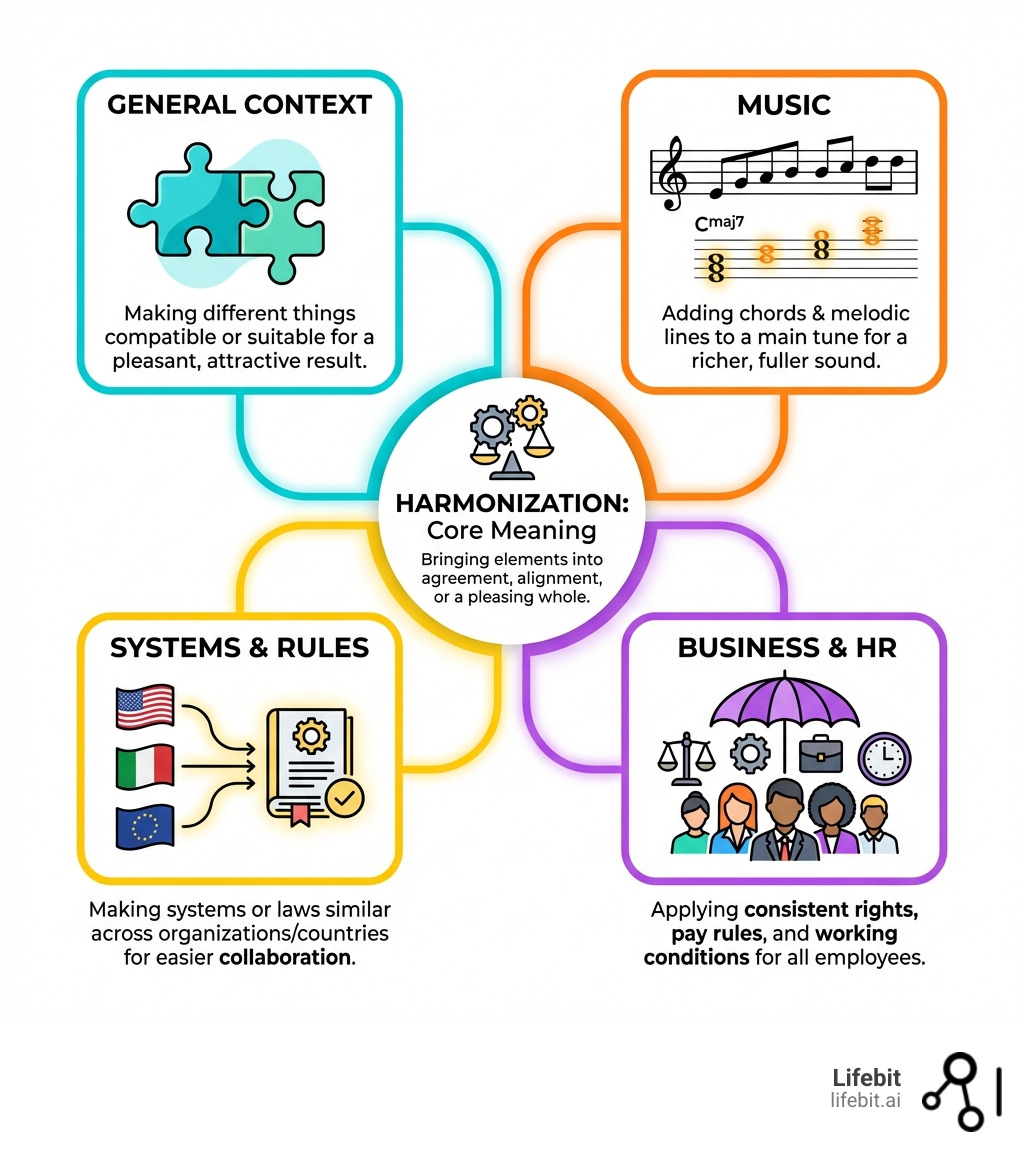
Here’s a detailed look at its main meanings across various sectors:
- General Context: The act of making different things compatible or suitable for each other, often leading to a pleasant or attractive result. It involves the skillful arrangement of diverse parts so they form a coherent whole.
- Music: The process of adding chords and melodic lines to a main tune to create a richer, fuller sound. It is the vertical aspect of music, where multiple notes played simultaneously support the horizontal movement of the melody.
- Systems & Rules: Making systems, laws, or regulations similar across different organizations, companies, or countries. This is critical in international law, where “legal harmonization” allows different nations to trade and interact under a shared understanding of rights and obligations.
- Business & HR: Applying consistent rights, pay rules, and working conditions for all employees within a company or across different entities. This is particularly vital during mergers and acquisitions, where two distinct corporate cultures and benefit structures must be merged into one.
- Data Science & Healthcare: The process of transforming data from various sources into a common format and representation. This allows researchers to aggregate information from different hospitals or countries to find patterns that would be invisible in smaller, isolated datasets.
Understanding these different applications is key. Harmonization isn’t just a buzzword; it’s a critical concept for efficiency, cooperation, and creating better outcomes. Without it, we are left with “discord”—a state where systems clash, trade stalls, and scientific progress is hindered by incompatible data formats.
As Dr. Maria Chatzou Dunford, my career has been dedicated to untangling complex data challenges, deeply understanding what does harmonization mean across different domains, particularly in genomics and AI. My work at Lifebit focuses on making diverse data sources work together seamlessly to drive breakthroughs in healthcare. We see harmonization as the bridge between raw, messy data and life-saving medical insights.
Simple what does harmonization mean glossary:
The Multi-Faceted Definition: What Does Harmonization Mean for Your Bottom Line?

To truly grasp what does harmonization mean, we have to look past the dictionary and see how it functions as a bridge. Linguistically, the word stems from the concept of “harmony”—the quality of two or more things going well together. According to the Oxford Learner’s Dictionaries, it is the quality of things producing an attractive result through skillful plotting or arrangement. In a professional setting, this “skillful plotting” is what separates successful global enterprises from those bogged down by local inconsistencies.
In the professional world, the definition shifts from aesthetics to action. Merriam-Webster defines it as the act of bringing things into consonance or accord. For instance, in the European Union, harmonization is often used to describe the “leveling up” of employment terms. This ensures that blue-collar and white-collar workers share similar rights and conditions, regardless of which member state they reside in. This reduces legal friction and allows for a more mobile, efficient workforce.
Harmonization in Human Resources and Corporate Mergers
When two companies merge, they often bring with them vastly different “melodies” of operation. One company might offer 25 days of annual leave, while the other offers 20. One might have a performance-based bonus structure, while the other relies on seniority. If these are not harmonized, it leads to resentment, legal challenges, and a fractured company culture.
HR harmonization involves:
- Benefit Alignment: Creating a single, fair package that respects the legacy of both organizations while ensuring equity across the new, larger entity.
- Policy Integration: Standardizing codes of conduct, remote work policies, and disciplinary procedures so that every employee, regardless of their original company, is treated under the same framework.
- Cultural Synthesis: Beyond the paperwork, it involves harmonizing the “vibe” or values of the organization to ensure everyone is pulling in the same direction.
Understanding the Core Concept: What Does Harmonization Mean in Daily Life?
In our daily lives, we practice harmonization without even realizing it. It’s the social balance we strike when planning a dinner party for guests with different dietary needs, or the “skilful plotting” an author uses to make diverse subplots converge into a satisfying ending. It is about situational suitability—making sure that different plans, people, or ideas don’t just exist side-by-side but actually complement one another. When we harmonize our schedules with our partners or our budgets with our long-term goals, we are creating a framework for success.
| Context | Core Goal | Result | Impact on Bottom Line |
|---|---|---|---|
| General | Compatibility | Attractive/Pleasant outcome | Improved brand perception |
| Music | Chordal Support | Fuller, richer sound | Higher artistic value |
| Business | Technical Alignment | Efficiency and lower costs | Reduced operational overhead |
| Data | Interoperability | Breakthrough insights | Faster time-to-market for R&D |
| Legal | Regulatory Accord | Reduced litigation | Lower compliance risk |
Harmonization in Practice: Cut Trade Costs and Simplify Global Compliance
When we talk about Harmonization in music theory, we are describing the chordal accompaniment to a melody. Imagine a single singer performing a tune; that’s the melody. Now, add a piano playing triads (three-note chords) built from the root notes of that scale. This is harmonization. It transforms a thin line of sound into a rich, emotional experience. In the same way, harmonizing business processes adds depth and stability to an organization’s operations. It provides the “chords” that support the “melody” of a company’s core mission.
In global commerce, the stakes are even higher. The Impact of standard harmonization on trade is massive. When countries use different rules for car emissions, food safety, or chemical labeling, it creates “technical barriers to trade.” These barriers act as a hidden tax on innovation. By harmonizing these standards—making them similar across borders—companies can reduce compliance costs, eliminate redundant testing, and move goods more freely across the globe.
The Economic Engine: Trade and Regulatory Harmonization
Consider the pharmaceutical industry. Before the creation of the International Council for Harmonisation of Technical Requirements for Pharmaceuticals for Human Use (ICH), drug manufacturers had to perform different sets of clinical trials and safety tests for every country they wanted to sell in. This was incredibly expensive and delayed the availability of life-saving medicines. Through harmonization, regulatory authorities in Europe, Japan, and the US agreed on a common set of scientific requirements. Now, a single set of high-quality data can be used for registration in multiple jurisdictions.
This “regulatory accord” is what allows for the “Brussels Effect,” where the stringent standards set by the European Union often become the global default because it is more efficient for companies to harmonize their entire global production to the highest standard rather than maintaining different versions for different regions.
Harmonization vs. Standardization: What Does Harmonization Mean for Global Rules?
It is common to confuse harmonization with standardization, but they are distinct strategies with different outcomes.
- Standardization is the “one size fits all” approach. It aims to eradicate all variation by adopting a single, unified rule. A prime example is the EU’s mandate for a common USB-C charging port by 2024. Every manufacturer must use the exact same port. There is no room for deviation.
- Harmonization is more flexible and nuanced. It aims to minimize conflict between existing rules while retaining critical local requirements. It provides a common framework so that different systems can “talk” to each other without needing to be identical. It is about finding the common ground that allows for diversity without the chaos of total discordance.
Think of it this way: Standardization is like everyone in a choir singing the exact same note (unison). Harmonization is everyone singing different notes that belong to the same chord, creating a beautiful, complex sound that is much more powerful than a single note alone.
Data Harmonization: Stop Wasting Months Cleaning Data and Start Finding Cures
In the life sciences, the question of what does harmonization mean becomes a matter of scientific progress and, ultimately, saving lives. Consider the human genome: while we are 99% genetically identical, that remaining 1% contains three billion DNA letters of variation. To study diseases effectively, researchers need to look at data from thousands, or even millions, of different people across the globe.
The problem? Data from a hospital in New York might be formatted entirely differently than data from a lab in London or a clinic in Singapore. One might use “Hypertension” while another uses “High Blood Pressure.” One might record age in years, while another uses date of birth. This is where the FAIR Data Principles in Life Sciences come in. FAIR stands for Findable, Accessible, Interoperable, and Reusable.
Harmonization is the critical process that makes data interoperable. It involves several technical layers that transform raw data into a “research-ready” state:
- Structural Harmonization: This involves aligning the physical format of the data. If one dataset is in a CSV file and another is in a JSON format, they must be brought into a common structure, such as the OMOP Common Data Model (CDM), which is a standard for observational health data.
- Semantic Annotation: This is the process of using common “tags” or labels so a computer knows that different terms in different datasets refer to the same clinical concept. For example, mapping “MI,” “Myocardial Infarction,” and “Heart Attack” to a single standardized code (like a SNOMED-CT code).
- Standardized Ontologies: Creating a shared vocabulary for biology and medicine. Ontologies like Gene Ontology (GO) or the Human Phenotype Ontology (HPO) ensure that everyone is speaking the same scientific language, allowing for cross-study comparisons.
- Data Normalization: Adjusting values to a common scale. If one lab measures glucose in mg/dL and another in mmol/L, harmonization ensures they are converted to a single unit so the results can be analyzed together without error.
Achieving Interoperability: What Does Harmonization Mean for Researchers?
For researchers, harmonization means the difference between spending months cleaning spreadsheets and spending those months finding a cure. It is estimated that data scientists spend up to 80% of their time simply preparing and cleaning data. Harmonization automates this, reclaiming that time for actual discovery.
By creating “data commons”—federated systems where data stays secure but can be analyzed together—we accelerate the pace of discovery. Lifebit’s platform, for instance, uses built-in harmonization capabilities like the Trusted Data Lakehouse (TDL) and R.E.A.L. (Real-time Evidence & Analytics Layer) to power large-scale research. This allows public health agencies and biopharma companies to access global biomedical and multi-omic data securely.
In the context of a global pandemic, for example, harmonization allowed scientists to combine data from different countries to identify which variants of a virus were most dangerous in real-time. Without harmonized data, the response would have been fragmented, slow, and far less effective. Harmonization ensures that diverse datasets work in concert to reveal insights that were previously hidden in silos.
Frequently Asked Questions: Solve Your Data Alignment Problems Now
How does harmonization differ from unification?
Unification is the process of making everything exactly the same—a single standard that replaces all others. Harmonization is about reducing variation and conflict while allowing different systems to coexist under a common framework. Think of unification as everyone speaking one language, while harmonization is everyone having a high-quality real-time translator that allows them to understand each other perfectly while keeping their native tongue. Harmonization respects local autonomy while enabling global cooperation.
What are the benefits of harmonization in business?
The primary benefits include massive efficiency gains and significant cost reductions. When regulations or internal processes are harmonized, businesses don’t have to redesign products or workflows for every different country or department. It simplifies compliance, opens up new markets, and allows for smoother international cooperation. It essentially removes the “friction” that slows down global scaling. Furthermore, it improves employee morale by ensuring fair and consistent treatment across different branches of a global organization.
What are the challenges of the harmonization process?
It’s not always a smooth road. Major challenges include cultural inertia (the tendency for people to stick to the “old way”), privacy concerns (especially when dealing with sensitive health data across borders), and proprietary interests (companies wanting to keep their data formats secret to lock in customers). Additionally, the technical complexity of mapping thousands of disparate data points can be daunting. Overcoming these requires strong leadership, a shared strategic vision, and advanced technology like federated AI that respects data sovereignty while enabling collaboration.
Why is harmonization essential for AI in healthcare?
AI is only as good as the data it is trained on. If the data is fragmented, inconsistent, or biased toward one specific population, the AI will produce unreliable or even dangerous results. Harmonization ensures that AI models can access a large, diverse, and high-quality pool of data from around the world. This diversity is necessary for training accurate algorithms for diagnostics, drug discovery, and personalized medicine, ensuring that the AI works for everyone, regardless of their background or location.
What is the “Cost of Non-Harmonization”?
The cost of non-harmonization is often hidden but astronomical. It manifests as redundant testing, delayed product launches, legal disputes over conflicting regulations, and missed scientific breakthroughs. In healthcare, the cost is measured in lives lost because researchers couldn’t access enough data to understand a rare disease. In business, it’s measured in the billions of dollars spent on manual data entry and reconciliation that could have been automated through harmonized systems.
How does federated learning relate to harmonization?
Federated learning is a technique where AI models are trained across multiple decentralized servers holding local data samples, without exchanging them. However, for federated learning to work, the data at each site must be harmonized. If the data at Site A is structured differently than at Site B, the AI model cannot learn effectively from both. Harmonization is the prerequisite that makes federated AI possible, allowing for global insights without moving sensitive data.
Conclusion: Achieve Strategic Goals with Lifebit’s Federated AI Platform
At the end of the day, achieving strategic objectives requires us to look at the bigger picture. Whether we are talking about meshed gears in a machine, multi-omic data in a lab, or international trade agreements, harmonization is the engine of resource optimization. It allows us to move from a fragmented world of “discordant music” to a collaborative environment where every element contributes to a shared vision. In the high-stakes world of drug discovery and public health, this alignment isn’t just a luxury—it’s a necessity for survival and progress.
As we move further into the age of Big Data and Artificial Intelligence, the need for harmonization will only grow. We are generating more information than ever before, but that information is only valuable if it can be connected. Harmonization is the process that turns isolated data points into a global knowledge graph. It is what allows a researcher in Brazil to build upon the findings of a clinician in Japan, creating a truly global scientific community.
At Lifebit, we believe that the future of medicine depends on this alignment. Our Lifebit Federated AI Platform is built to handle the heavy lifting of harmonization, providing secure, real-time access to global data across 5 continents. By managing over 275M patient records on our federated systems, we ensure that the next big medical breakthrough is only a query away, not buried under years of manual data cleaning. We provide the tools to harmonize the world’s most complex data, so you can focus on what matters most: solving the world’s most challenging health problems.
Ready to see harmonization in action?
How Lifebit’s AI Cut Data Harmonization Time by 80%