
How to Choose a Research Collaboration Platform That Actually Works

Research Collaboration Platform: Stop Losing Data, Time, and Discoveries
A research collaboration platform is a specialized digital environment that helps scientific teams share data, manage projects, verify sources, and work together securely – across institutions, countries, and disciplines.
If you’re evaluating your options, here’s what the landscape looks like at a glance:
| Platform Type | Best For | Key Strength |
|---|---|---|
| General tools | Communication | Easy adoption |
| Academic networking platforms | Finding partners | Broad institutional reach |
| Literature and citation tools | Literature review | Large-scale indexing and source checking |
| Survey and participant platforms | Behavioral research | Participant management and response quality controls |
| Life sciences R&D platforms | Biomedical and genomic research | Federated data, compliance, AI |
| Academic-industry management tools | Partnership management | KPI tracking, workflow visibility |
The problem? Most research teams are stitching together tools that were never built for science. The result is fragmented data, lost context, compliance gaps, and hours of wasted effort every week.
Vast majorities of modern research publications now involve multiple authors across institutions. Yet the tools most teams rely on – email, spreadsheets, generic chat apps – create more friction than they remove. Major breakthroughs like the Human Genome Project required coordinated expertise across dozens of institutions. That kind of collaboration demands infrastructure built specifically for scientific rigor, not just task management. For context on how large-scale scientific collaboration changed modern biology, see the Human Genome Project.
I’m Dr. Maria Chatzou Dunford, CEO and Co-founder of Lifebit, and I’ve spent over 15 years working at the intersection of genomics, AI, and high-performance computing – building the exact kind of infrastructure that powers modern research collaboration platforms. In this guide, I’ll walk you through exactly what separates a platform that accelerates discovery from one that quietly kills it.
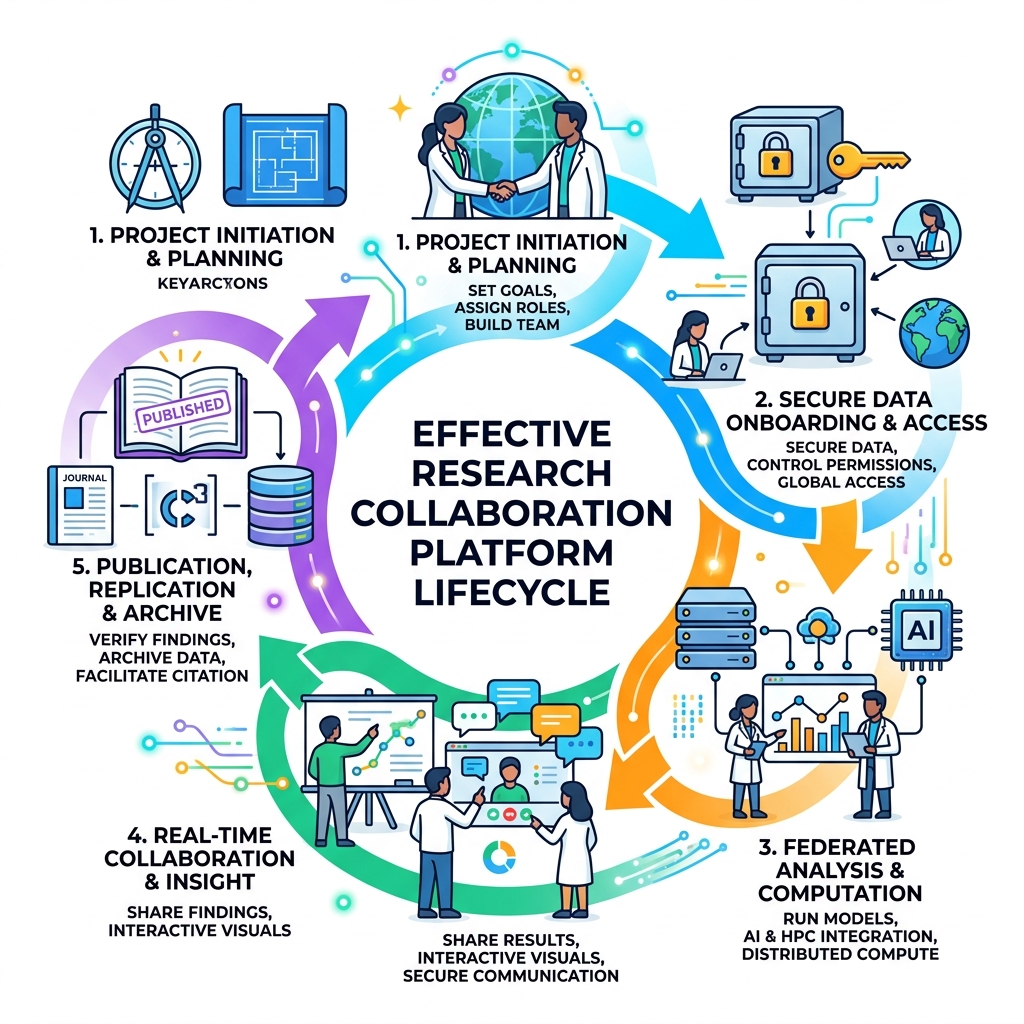
Quick Research collaboration platform terms:
- Clinical trial data management
- Federated AI platforms for secure analysis of biomedical data
- HIPAA compliant analytics platforms
Why General Business Tools Are Killing Your Research Productivity

In the early days of a project, it’s tempting to just “hop on a Slack channel” or “share a Google Doc.” But as any Principal Investigator (PI) can tell you, what starts as a convenience quickly turns into a logistical nightmare. General business tools are designed for office productivity – marketing campaigns, sales pipelines, and HR onboarding. They are not designed for the heavy lifting of scientific workflows, which require strict adherence to the FAIR (Findable, Accessible, Interoperable, and Reusable) data principles.
When we use generic tools, we lose the thread of scientific rigor. A “task” in a project manager does not capture the metadata of a genomic sequence. A “message” in a team chat does not verify the source of a citation across a massive scientific literature base. This gap is why research teams often feel like they are working for their tools rather than their tools working for them. In the context of high-stakes R&D, this isn’t just an inconvenience; it’s a risk to the validity of the entire study.
The Hidden Friction in General Research Collaboration Platforms
The biggest hidden cost of using general tools is context loss. When a post-doc leaves a lab, their insights shouldn’t disappear with their email account. In a generic setup, the “why” behind a data cleaning step or a specific parameter choice is often buried in a chat history that no one can find six months later. This contributes directly to the “reproducibility crisis” currently facing the scientific community, where a significant percentage of published studies cannot be replicated by independent teams.
This leads to:
- Information Fragmentation: Data lives in Dropbox, discussions live in Slack, and analysis happens in a local Jupyter notebook. Nothing is connected, making it impossible to trace the lineage of a specific result.
- Tool Switching Overhead: Researchers waste time moving data between incompatible apps, often resorting to manual data entry which introduces human error.
- Compliance Gaps: Standard cloud storage rarely meets the stringent requirements of HIPAA, GDPR, or SOC 2 when handling sensitive biomedical data. Generic tools often lack the granular permissioning required to share data without exposing the entire directory.
- Erosion of Institutional Memory: Without a centralized research collaboration platform, the collective knowledge of the team is scattered and unsearchable. When a project concludes, the “lessons learned” are often lost to the ether.
Why Specialized Tools Outperform Generic Collaboration Platforms
Specialized platforms are built with the understanding that research is non-linear and evidence-based. They prioritize source verification and citation management as core features, not afterthoughts. Strong research systems also align with broader principles of reproducibility, helping teams document methods, preserve context, and validate findings over time.
Furthermore, specialized tools offer trusted research environments that allow researchers to bring their code to the data, rather than moving sensitive data to their code. This “data-centric” approach is essential for modern science, where datasets are too large and too sensitive to be zipped and emailed. By using metadata entries and version control specifically tuned for datasets, these platforms ensure that every experiment is reproducible – the gold standard of scientific achievement. They also support specific scientific file formats (like BAM, VCF, or DICOM) that generic tools cannot preview or index, allowing for a much more intuitive user experience for the scientist.
5 Essential Features of a High-Impact Research Collaboration Platform
Choosing the right research collaboration platform isn’t just about the user interface; it’s about the underlying architecture. If you want to move from “idea to outcome” faster, your platform must provide more than just a place to chat. It needs to be a federated-data-sharing-complete-guide that enables global cooperation without the usual bottlenecks.
Here are the five features that actually move the needle:
- Secure Data Workspaces: A unified environment where documentation, raw data, and analysis coexist. These workspaces should be isolated to prevent cross-contamination of data while allowing for seamless collaboration within the authorized group.
- Reproducible Analysis Environments: Pre-configured workbenches (like Jupyter or R environments) that ensure if I run a script today, you can run the exact same script tomorrow and get the same result. This includes containerization (e.g., Docker or Singularity) to ensure the software environment is identical across different machines.
- Integrated Data Dictionaries: The ability to harmonize disparate datasets—like joining phenotypic data with genotype data—automatically. This requires a robust ontology management system that can map different naming conventions to a single, unified standard.
- Federated Governance: The power to grant granular access to collaborators across the globe without ever moving the data out of its secure home. This is critical for international consortia where data sovereignty laws prevent the physical transfer of data across borders.
- Source-Grounded AI: AI features that don’t just “hallucinate” answers but pull directly from a library of verified academic papers. This ensures that any AI-generated insights are backed by peer-reviewed evidence.
AI-Powered Workflows in a Modern Research Collaboration Platform
AI is no longer a “nice-to-have” feature; it is the engine of modern R&D. In a high-impact research collaboration platform, AI handles the “grunt work” that typically clogs up the research pipeline. We’ve seen reports that AI can lead to a 3.6x faster time to market and a 50% shorter planning process for complex projects. This is achieved by automating the most labor-intensive parts of the data lifecycle.
Specifically, AI-driven features enable:
- Automated Data Harmonization: AI agents can interpret scientific intent, preparing multimodal datasets (genomic, clinical, imaging) for analysis in minutes instead of months. This includes cleaning “messy” clinical notes and converting them into structured data.
- AI-Driven Cohort Identification: Rapidly identifying specific patient cohorts from millions of records using natural language search. Instead of writing complex SQL queries, a researcher can simply ask, “Find all patients over 50 with Type 2 Diabetes and a specific genetic variant.”
- Secure Predictive Analytics: Running advanced ML models on sensitive data within a governed environment to identify safety signals or new drug targets. This allows for “in-place” machine learning where the model learns from the data without the data ever leaving the secure enclave.
Supporting Diverse Needs from Data Governance to Secure Sharing
Research is rarely a solo sport. Whether it’s a cross-institutional study or a medical-research-data-sharing initiative between a university and a pharma giant, the platform must manage the complexity of different permissions. This involves not just who can see the data, but what they can do with it—can they view it, analyze it, or export the results?
Modern platforms use “Blueprints” to automate repeatable processes, ensuring that every new project starts with the right governance framework already in place. This includes version history for every document and dataset, ensuring that the “source of truth” is never in question. By standardizing these workflows, organizations can reduce the administrative burden on researchers, allowing them to focus on the science rather than the paperwork.
Solving the Data Security and Compliance Nightmare
For many, the word “collaboration” triggers a security alarm. How do you share high-value genomic data with a partner in another country without risking a breach or violating GDPR? The answer lies in the architecture of the platform. Traditional methods of data sharing involve copying and moving files, which creates multiple points of failure and makes it impossible to maintain a clear audit trail.
Standard cloud storage is a passive bucket; a research collaboration platform is an active, governed environment. By following the “Five Safes” framework, these platforms ensure that sensitive information is never exposed to unauthorized eyes. This framework is the gold standard for managing access to sensitive data:
- Safe People: Only verified researchers with the appropriate credentials and training are granted access.
- Safe Projects: Data use is restricted to specific, approved research projects that have clear public or scientific benefit.
- Safe Settings: The environment itself is secure, preventing unauthorized downloads or external connections.
- Safe Data: Data is de-identified or pseudonymized to protect the privacy of individuals.
- Safe Outputs: All results are screened to ensure they do not contain any re-identifiable information before they are allowed to be published or exported.
| Feature | Standard Cloud Storage | Trusted Research Environment (TRE) |
|---|---|---|
| Data Movement | Data is downloaded/moved | Data stays in place; code comes to data |
| Access Control | All or nothing | Granular, per-user, per-dataset |
| Compliance | Basic encryption | HIPAA, GDPR, SOC 2, NIST 800-171 |
| Auditability | Limited logs | Immutable, end-to-end audit logs |
| Analysis | Requires external tools | Integrated, scalable compute (Nextflow, WDL) |
For a deeper dive, see our trusted research environment complete guide.
Protecting Sensitive Data in Global Networks
When working across 80+ countries, security cannot be an afterthought. High-performance platforms implement immutable audit logs that track every single action taken within the environment. If a researcher views a file, runs a pipeline, or even attempts an unauthorized action, it is recorded and tied to their verified credentials (often via ORCID). This level of transparency is what allows institutions to trust one another, as every action is fully accountable and transparent to the data owner.
We also prioritize PHI (Protected Health Information) protection. Features like AI-powered bot detection and automated de-identification ensure that even in large-scale surveys or clinical trials, participant privacy is maintained with 100% accuracy. This is particularly important in the era of “big data,” where the combination of multiple datasets could potentially lead to the re-identification of individuals if not managed correctly.
Addressing Governance for Academic-Industry Partnerships
The stakes are even higher when academic institutions partner with industry. There are concerns about Intellectual Property (IP), data sovereignty, and secure silos. A specialized research collaboration platform allows for building-european-trusted-research-environments where data stays within its original jurisdiction while still being accessible for joint analysis.
This “federated” approach means a pharma company can analyze a university’s biobank data without the university ever “giving away” the physical data. It’s a win-win: the industry gets insights, and the academic institution maintains total control. This model also facilitates “Data Visiting” rather than “Data Sharing,” which is a fundamental shift in how global research consortia operate, ensuring that the data remains under the control of the original custodian at all times.
Enabling and Securing Global R&D Partnerships
The future of science is built on partnerships. Organizations that harmonize fragmented data into a single “source of truth” can save millions annually and reclaim thousands of hours of manual work. That is time and money that can be reinvested into actual discovery. In the competitive landscape of modern R&D, the ability to collaborate effectively is often the difference between being first to market and being obsolete.
Building Collaborative Networks with Trust
To build a network that lasts, you need federated access controls. This means you don’t have to create 500 different logins for 500 different partners. Instead, researchers use their existing institutional credentials (via Single Sign-On or SSO) to log into a secure project workspace. This streamlined access is what enables platforms to connect thousands of academics across dozens of universities seamlessly. It removes the friction of onboarding and ensures that when a researcher leaves an institution, their access is automatically revoked, maintaining the security of the network.
Furthermore, these networks foster a culture of “Open Science” while maintaining the necessary protections for sensitive data. By providing a common platform, researchers can share not just their results, but their methodologies, code, and intermediate data, leading to more robust and verifiable scientific outcomes.
Scaling Innovation Through Secure Industry-Academic Ties
Industry leaders in life sciences—including 70% of the top 50 pharma companies—rely on these platforms to manage their entire R&D pipeline. By using a federated-research-environment-complete-guide, these organizations can:
- Track Impact: Automatically generate KPIs and reports for stakeholders, showing exactly how data is being used and what value it is generating.
- Increase Pipeline Value: Use improved data visibility to make 3x faster decisions on which drug targets to pursue. By having all relevant data in one place, teams can identify failures earlier and pivot to more promising leads.
- Secure Funding: Demonstrate a transparent, compliant research process to grant bodies and investors. In an increasingly regulated environment, the ability to prove data integrity and compliance is a major competitive advantage.
- Accelerate Recruitment: Use integrated participant management tools to find and enroll the right candidates for clinical trials faster, reducing the time and cost of drug development.
By bridging the gap between the agility of industry and the deep expertise of academia, these platforms are creating a new ecosystem for innovation that is faster, safer, and more collaborative than ever before.
Frequently Asked Questions about Research Tools
How do specialized platforms differ from generic business tools?
Specialized platforms are built for scientific rigor. They include features like integrated citation management, support for bioinformatics pipelines (Nextflow, WDL), and compliance with medical data standards (HIPAA, GDPR) that generic chat or project management tools simply don’t offer. They prioritize data reproducibility over simple task completion. Unlike generic tools, they are designed to handle the massive scale of scientific data, such as whole-genome sequences, which can be hundreds of gigabytes in size.
Are there free tiers for academic researchers?
Yes! Many specialized research collaboration platforms offer permanent free tiers for individual academics or small lab groups. Others provide institutional access that allows students and faculty to use the full suite of tools via their university credentials. These plans often include a set amount of storage and compute power, allowing researchers to get started without any upfront costs. Always check for “Academic” or “Education” plans when signing up, as these often provide the best value for the research community.
How do these platforms handle large-scale multi-omic data?
They use elastic compute and federated access. Instead of trying to download a 500GB genomic file to your local laptop, the platform provides a “Collaborative Workbench” where the analysis happens in the cloud, right next to where the data is stored. This allows for real-time analysis of multi-omic and multimodal data without the need for massive local hardware. It also ensures that the data never leaves its secure environment, which is critical for maintaining compliance.
Can I integrate my existing tools with these platforms?
Most modern research collaboration platforms are built with an “API-first” philosophy, meaning they can easily integrate with the tools you already use, such as GitHub for version control, Slack for notifications, or specialized analysis software. This allows you to build a custom workflow that fits your team’s specific needs while still benefiting from the security and governance of a centralized platform.
How does the platform ensure AI results are accurate?
High-quality platforms use “Source-Grounded AI” or Retrieval-Augmented Generation (RAG). This means the AI is restricted to searching only within a specific, verified library of documents (like your team’s research papers or a curated database of academic journals). By grounding the AI in real data, the risk of “hallucinations” is significantly reduced, and every answer can be traced back to a specific source for verification.
Conclusion: Future-Proofing Your Scientific Discovery
The era of “emailing the spreadsheet” is over. As datasets grow more complex and global collaborations become the norm, the only way to stay competitive—and compliant—is to adopt a dedicated research collaboration platform.
At Lifebit, we believe that breakthroughs happen when we remove the barriers between scientists and the data they need. Our next-generation federated AI platform provides the lifebit-trusted-research-environment required to securely access global multi-omic data in real-time.
By unifying your data, your tools, and your team into one governed ecosystem, you aren’t just managing a project; you’re accelerating the future of medicine. Stop fighting your tools and start focusing on your science. The next big discovery is waiting—make sure your team has the platform to find it.