

Detailed Guide to AI/ML Analytics Benefits for Healthcare
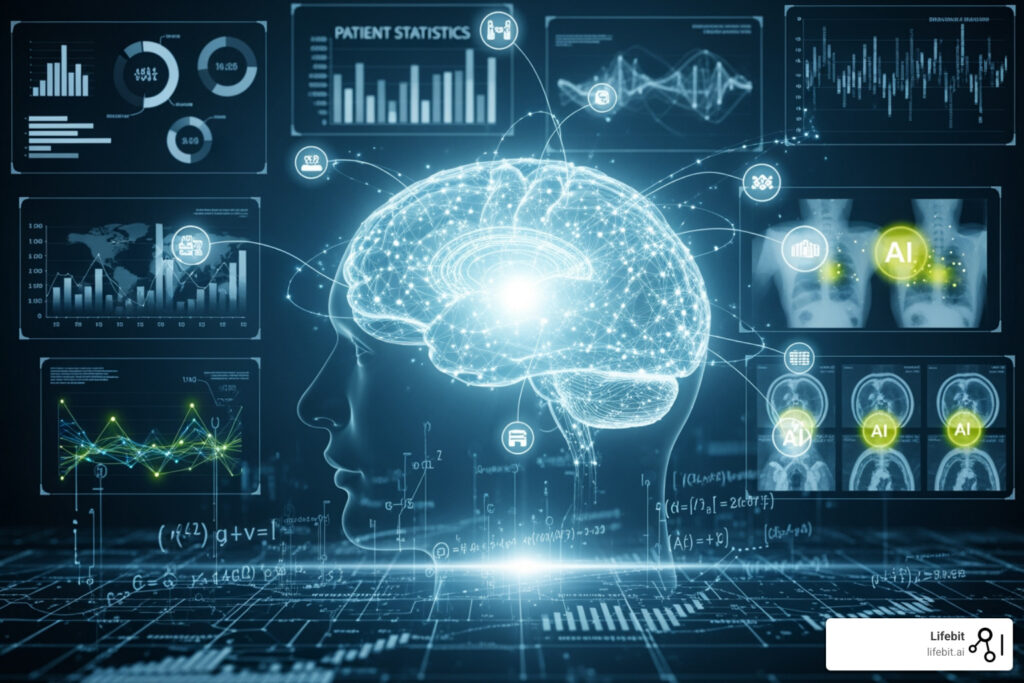
AI/ML Analytics for Healthcare: 692 FDA-Cleared Tools, 90% Faster Planning – Cut Costs and Risk Now
From diagnosing diseases faster than the human eye to personalizing treatment plans down to the individual’s DNA, the impact of Artificial Intelligence (AI) and Machine Learning (ML) in healthcare is no longer a futuristic concept—it is a present-day reality. AI/ML analytics for healthcare are delivering transformative benefits across the entire care continuum, revolutionizing how we prevent, diagnose, and treat illnesses. This guide shows what is working now, where value is created first, and how to deploy safely at scale.
What you will gain from this guide:
- A clear view of high-impact, near-term AI/ML use cases that cut cost and risk.
- Practical guidance on open uping siloed data with secure, federated analytics.
- Regulatory, ethical, and infrastructure essentials to move from pilot to production.
Key Areas of Value Creation
Enhancing Diagnostic Accuracy and Speed: AI excels at identifying complex patterns in medical data that may be invisible to the human eye. In radiology, deep learning models can analyze CT scans, X-rays, and MRIs to detect early signs of cancer, stroke, or other anomalies with a speed and accuracy that can match or even exceed human experts. For example, AI algorithms can flag suspicious lung nodules or identify subtle signs of a brain hemorrhage in seconds, allowing radiologists to prioritize critical cases. In pathology, AI tools are automating the analysis of tissue samples, helping to grade tumors and count mitotic cells with greater consistency, reducing inter-observer variability. Similarly, in cardiology, AI can analyze ECG readouts to detect arrhythmias like atrial fibrillation far more reliably than traditional methods.
Delivering Personalized Treatment Plans: The one-size-fits-all approach to medicine is being replaced by precision medicine, powered by AI. By analyzing an individual’s genetic makeup, lifestyle data from wearables, environmental factors, and clinical history, AI models can predict how a patient will respond to different therapies. This is most advanced in oncology, where AI helps clinicians select targeted treatments based on a tumor’s specific genomic mutations. These models can also predict potential adverse drug reactions, enabling doctors to choose safer, more effective treatment pathways from the outset. This moves treatment from being reactive to proactive and personalized.
Optimizing Hospital Operations and Reducing Costs: Healthcare systems are under immense financial pressure. AI/ML analytics provide powerful tools for optimizing operations. For example, AI can automate administrative tasks like medical coding and billing by analyzing clinical notes, reducing errors and freeing up staff time. Predictive models can forecast patient admissions, enabling hospitals to optimize staff scheduling and bed management to prevent overcrowding and understaffing. In the operating room, AI can optimize surgical schedules based on surgeon availability, equipment, and urgency, minimizing idle time and maximizing throughput. These efficiencies translate directly into significant cost savings and improved resource allocation.
Improving Patient Outcomes with Predictive Analytics: One of the most impactful applications of AI is its ability to predict adverse events before they happen. Hospitals are deploying early warning systems that continuously monitor patient data (vital signs, lab results, clinical notes) to identify those at high risk of developing conditions like sepsis, a leading cause of hospital mortality. By alerting clinical teams hours earlier than traditional methods, these systems enable proactive intervention that can save lives. Similar models are used to predict patient deterioration, risk of falling, or likelihood of hospital readmission, allowing care teams to implement preventative measures and improve overall patient safety and outcomes.
Accelerating Drug Discovery and Development: Bringing a new drug to market is a decade-long, multi-billion-dollar process. AI is drastically accelerating this timeline. In the discovery phase, AI models can scan vast biological and chemical databases to identify promising drug targets and design novel molecules from scratch. During clinical trials, AI helps optimize trial design and identifies the most suitable patient cohorts for inclusion, reducing recruitment time and increasing the likelihood of success. Post-market, AI can analyze real-world evidence from EHRs and claims data to monitor long-term drug safety and effectiveness, a process known as pharmacovigilance.
Advancing Population Health Management: Beyond individual patient care, AI is a critical tool for managing the health of entire populations. Public health agencies use AI to model the spread of infectious diseases, predict future outbreaks, and allocate resources like vaccines and testing kits more effectively. By integrating clinical data with information on social determinants of health (SDOH) like income, education, and access to transportation, AI models can identify at-risk communities and help design targeted public health interventions to address health disparities and improve overall community well-being.
Healthcare systems worldwide are struggling with an unprecedented data explosion. Every patient visit, lab test, genomic sequence, and wearable device generates massive volumes of information. For decades, this valuable data has been locked away in siloed systems—fragmented, inaccessible, and underused. This fragmentation has been a major roadblock to both medical research and the delivery of truly personalized care.
That is changing. AI and Machine Learning are changing healthcare from a reactive, one-size-fits-all system into a proactive, personalized, and predictive model of care. The numbers tell a compelling story: as of October 2023, the FDA had approved 692 AI/ML-enabled medical devices, with more than half focused on radiology alone. Research applications are demonstrating notable results, from AI models that can screen for diabetic retinopathy with 87% sensitivity to radiotherapy planning tools that reduce preparation time by up to 90%.
But the real revolution is not just in individual applications. It is in how AI/ML analytics enable healthcare organizations to finally open up the full potential of their data—at scale, in real time, and across federated environments. Global pharmaceutical companies are leveraging AI to reduce clinical trial cycle times and costs. Public health agencies are using predictive models to foresee and manage disease outbreaks. Hospitals are optimizing staffing, reducing readmission rates, and improving patient flow through intelligent, data-driven insights.
The challenge, however, remains significant. Most organizations still struggle with fundamental barriers: poor data quality, regulatory complexity, legacy IT infrastructure, and the inability to access siloed datasets without compromising patient privacy. For global pharma, public sector agencies, and regulatory bodies managing diverse and sensitive data like electronic health records (EHRs), claims data, and genomics, these are not minor problems—they are existential blockers to innovation.
As Dr. Maria Chatzou Dunford, CEO and Co-founder of Lifebit, I have spent over 15 years building computational biology and AI solutions for precision medicine, including pioneering federated platforms that enable secure, compliant AI/ML analytics for healthcare across global institutions. The organizations that succeed in this new era will be those that can analyze data in situ—without moving it—while empowering everyone from insight consumers to high-code researchers to generate real-time evidence at scale.
Lifebit’s next-generation federated AI platform addresses these needs with built-in harmonization, governance, and analytics that work across distributed data estates. Components such as the Trusted Research Environment (TRE), Trusted Data Lakehouse (TDL), and R.E.A.L. (Real-time Evidence & Analytics Layer) enable:
- In-place analysis across jurisdictions while preserving privacy and sovereignty.
- Scalable, reproducible AI/ML workflows for multimodal data, including omics and imaging.
- Continuous safety surveillance and real-time evidence generation for regulators and payers.
If your goal is to cut costs, reduce risk, and improve outcomes, the path forward is clear: pair high-value clinical and operational use cases with secure, federated access to high-quality data—and operationalize with robust governance from day one.
AI/ML analytics for healthcare glossary:
- AI-driven drug development
- I’m looking for companies that provide AI for population health management.
- What are the leading platforms for creating and managing a chronic disease register using AI?
Introduction: The New Frontier of Medicine
Healthcare is at a pivotal moment, ready for a monumental shift driven by advancements in Artificial Intelligence (AI) and Machine Learning (ML). These technologies are not just buzzwords; they are powerful tools capable of turning vast oceans of health data into actionable, life-saving insights. This shift is critical for achieving the quadruple aim: improving population health, enhancing the patient experience, improving the provider experience, and reducing the per capita cost of care.
The potential of AI/ML analytics for healthcare lies in its ability to derive new insights from the immense volume and variety of data generated daily. From electronic health records (EHRs) and medical imaging to genomic sequences and data from wearable devices, the information available is staggering. Medical device manufacturers are already embedding AI to create smarter tools that assist healthcare providers and improve patient care. The true power of AI/ML in software lies in its capacity to learn from real-world data and continuously improve performance—enabling safer, more precise decisions over time.
What matters now is operationalizing this potential. That means connecting siloed datasets securely, standardizing them for analysis, and deploying AI/ML models that are clinically validated, governed, and continuously monitored. Healthcare organizations that successfully implement these technologies are already seeing measurable improvements in patient outcomes, operational efficiency, and cost reduction.
What are AI and ML in Healthcare?
At its core, Artificial Intelligence (AI) is a broad field of computer science dedicated to creating systems that can perform tasks that typically require human intelligence. This includes capabilities like learning, reasoning, problem-solving, perception, and language understanding. In the context of healthcare, AI is not about replacing clinicians but augmenting their abilities. It is used to design sophisticated clinical decision-support systems that assist in diagnosing complex diseases, personalizing treatment plans, and streamlining the management of patient care.
Machine Learning (ML) is a critical subset of AI focused on building algorithms that learn from data to make predictions or decisions, without being explicitly programmed for each task. Instead of following a rigid, pre-defined set of “if-then” rules, ML models are trained on vast datasets to identify subtle patterns and relationships. This capability is particularly valuable in healthcare, where the complexity, volume, and velocity of data (from genomics to real-time sensor readings) often exceed human cognitive capacity. The model learns the “rules” from the data itself.
Key AI/ML Methodologies in Healthcare
The power of AI/ML comes from a diverse toolkit of learning approaches. The choice of method depends on the problem to be solved and the type of data available.
-
Supervised Learning: This is the most common approach in healthcare AI today. Models learn from data that has been manually labeled with the correct outcome by human experts. For example, to build an AI tool for detecting diabetic retinopathy, developers would train a model on thousands of retinal scans, with each image labeled as either “disease present” or “disease absent.” The model learns the visual features associated with the disease. Once trained, it can be used to classify new, unlabeled scans. This approach is the backbone of many FDA-cleared diagnostic tools for radiology, pathology, and dermatology, but its success is heavily dependent on the availability of large, high-quality, accurately labeled datasets.
-
Unsupervised Learning: In contrast to supervised learning, unsupervised algorithms work with unlabeled data. Their goal is to find hidden structures, patterns, or groupings within the data itself. A common application in healthcare is patient segmentation or clustering. For instance, an unsupervised model could analyze the electronic health records of thousands of patients with Type 2 diabetes and identify distinct subgroups based on patterns in their lab values, comorbidities, and medication histories. These data-driven patient clusters might reveal previously unknown disease subtypes, which could then inform the development of more targeted and effective care pathways for each group.
-
Reinforcement Learning: This advanced technique involves training an “agent” to make a sequence of decisions in a dynamic environment to maximize a cumulative reward. The agent learns through trial and error. A promising application is in developing dynamic treatment regimens (DTRs) for chronic diseases. For example, a reinforcement learning model could be used to personalize insulin dosing for a diabetic patient. The model would receive real-time data from a continuous glucose monitor and suggest adjustments to insulin delivery. It would receive a “reward” for keeping blood sugar within the target range and a “penalty” for hyperglycemic or hypoglycemic events, learning the optimal dosing strategy for that specific patient over time.
-
Deep Learning (DL): A powerful family of ML techniques that uses multi-layered artificial neural networks, deep learning has been the driving force behind recent breakthroughs in AI, especially in analyzing complex, unstructured data. Its hierarchical structure allows it to automatically learn relevant features from raw data like pixels in an image or sequences in a genome. This has revolutionized medical imaging analysis, enabling models to achieve human-level performance in tasks like classifying skin lesions or segmenting tumors in 3D MRI scans. However, the complexity of these models can make them “black boxes,” which has spurred the development of Explainable AI (XAI) methods to make their decision-making processes more transparent and trustworthy for clinical use.
-
Natural Language Processing (NLP): A specialized branch of AI focused on enabling computers to understand, interpret, and generate human language. A vast amount of critical health information—up to 80% by some estimates—is locked away in unstructured text, such as clinical notes, pathology reports, and scientific literature. NLP techniques are essential for unlocking this data. For example, NLP models can scan a physician’s notes to automatically extract key information like diagnoses, symptoms, medications, and lab results (a task called Named Entity Recognition). This structured data can then be used for clinical trial matching, public health surveillance, or populating disease registries, turning narrative text into analyzable, actionable information.
Practical Applications of AI/ML in the Healthcare Ecosystem
In practice, these methodologies combine to enable a wide range of transformative applications:
-
Intelligent Task Automation: AI is significantly reducing the administrative burden that contributes to clinician burnout. NLP models can transcribe doctor-patient conversations and automatically populate the EHR, saving hours of documentation time. In revenue cycle management, AI can review clinical documentation to suggest the correct medical codes for billing, improving accuracy and reducing claim denials. This automation allows clinicians and administrative staff to redirect their focus toward higher-value, patient-facing activities. Studies show that automation can reduce administrative burden by up to 40%, freeing valuable clinical time.
-
Advanced Pattern Recognition in Multimodal Data: Human clinicians are excellent at integrating different types of information, but AI can take this to another level by analyzing complex, high-dimensional data at a scale no human can manage. For example, a model could integrate a patient’s genomic data, proteomics, pathology images, and clinical history to identify a unique multi-omic signature that predicts response to a specific immunotherapy. Detecting these subtle, cross-domain correlations is crucial for advancing precision medicine and discovering novel biomarkers for early disease detection and risk prediction.
-
Population-Scale Data Analysis: The ability to process imaging, EHR, claims, registry, and multi-omic data at a population scale generates robust, real-world evidence for regulators, payers, and public health bodies. This capability is fundamental to modern population health management. For example, by analyzing data from millions of individuals, health systems can identify geographic hotspots for chronic diseases, understand the factors driving health disparities, and measure the real-world effectiveness of different interventions at an unprecedented scale.
-
Predictive Modeling for Proactive Care: Predictive models are shifting healthcare from a reactive to a proactive paradigm. A prime example is sepsis prediction. These models continuously monitor real-time data streams from the EHR—including heart rate, respiratory rate, temperature, white blood cell count, and lactate levels. When the combined pattern of these variables indicates a high probability of impending sepsis, the model triggers an alert for the clinical team to intervene, often hours before a patient would show clear clinical signs. Studies have shown such systems can reduce sepsis-related mortality by up to 20%. Similar models are used to forecast disease progression, flag patients at risk of acute kidney injury, and anticipate hospital resource needs. Predictive models can identify high-risk patients with accuracy rates exceeding 85% in many applications.
-
Dynamic Clinical Decision Support: AI-powered clinical decision support (CDS) systems deliver data-driven recommendations directly into the clinical workflow at the point of care. These systems go beyond simple alerts. They can suggest a differential diagnosis based on a patient’s symptoms and history, recommend the most appropriate imaging test, or help personalize a medication plan based on the patient’s genetic profile and comorbidities. This helps reduce clinical variability, improve adherence to evidence-based best practices, and ultimately enhance patient safety.
AI vs. Machine Learning: Why the Distinction Matters
While often used interchangeably, understanding the difference between AI and ML is crucial for planning projects, building teams, and setting realistic expectations.
- Scope: AI is the broader discipline of building systems that emulate facets of human intelligence. ML is a specific set of statistical methods that enable a system to learn from data, which is one way—albeit a very powerful one—to achieve AI.
- Goal: The goal of an AI system is to perform an intelligent task or orchestrate an end-to-end workflow (e.g., a complete diagnostic support system). The goal of an ML model is more specific: to learn an accurate function from data (e.g., a model that predicts the 30-day readmission risk for a heart failure patient).
- Methods: AI systems can be built using a variety of techniques, including rule-based logic engines, optimization algorithms, knowledge graphs, and ML models. ML focuses specifically on algorithms such as linear regression, decision trees, gradient boosting, and deep neural networks.
- Healthcare Applications: An AI system might be an entire platform for managing diabetic patients, which uses an ML model to predict hypoglycemic events, a rule-based engine to send alerts to the care team, and a natural language chatbot for patient communication. The ML model is a critical predictive engine within the broader AI system.
- Implementation Complexity: Deploying a standalone ML model (e.g., an image classifier) requires rigorous validation, performance monitoring, and integration with a picture archiving and communication system (PACS). Implementing a full AI system often involves deeper integration with existing clinical workflows (like the EHR), change management across multiple departments, and the orchestration of several interconnected components.
For a deeper dive into how these approaches enable precision care, explore AI for Precision Medicine.
Responsible adoption also requires strong governance and ethics. Models must be transparent, monitored for performance drift and concept drift, and rigorously evaluated for bias to ensure they do not perpetuate or amplify existing health disparities. Upholding safety and equity is paramount. Pairing robust MLOps (Machine Learning Operations) with secure, privacy-preserving data access ensures that AI amplifies—rather than undermines—clinical judgment and patient trust. Healthcare organizations must establish clear governance frameworks before deployment, including protocols for model validation, continuous performance monitoring, and incident response.