

9 Best Data Governance Platforms for Biopharma in 2026

Data governance in biopharma isn’t a nice-to-have. It’s the difference between a pipeline that moves and one that stalls in compliance reviews, data access requests, and siloed datasets that nobody can actually use.
The stakes are real: genomic data, clinical trial records, real-world evidence — all sensitive, all regulated, all scattered across institutions, clouds, and borders. The wrong platform means months of harmonization work, failed audits, and research bottlenecks. The right one means your teams can actually do science.
This list covers the top data governance platforms built for biopharma realities: federated access, HIPAA/GDPR compliance, genomic-scale data handling, and audit trails that hold up under regulatory scrutiny. Platforms were evaluated on compliance depth, federated and secure access capabilities, biopharma-specific features, scalability, and real-world deployment track record.
1. Lifebit
Best for: Federated, multi-institutional biopharma research and national precision medicine programs requiring strict data sovereignty.
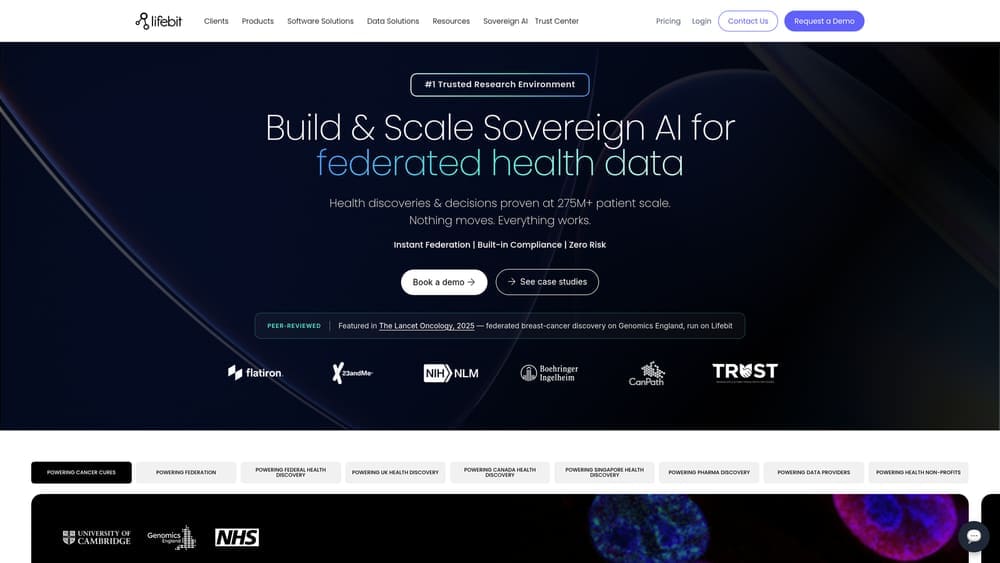
Lifebit is a federated data governance and research platform purpose-built for regulated health and life sciences data, combining a Trusted Research Environment, AI-powered harmonization, and a federated architecture that lets you analyze data without moving it.
Where This Tool Shines
Most governance platforms ask you to centralize data before you can govern it. Lifebit inverts that entirely. Its Federated Data Platform lets researchers query and analyze data across institutions, borders, and cloud environments without the data ever leaving its source. For cross-border biopharma consortia and national health programs navigating GDPR, NHS data frameworks, and similar sovereignty requirements, this isn’t a nice feature — it’s the architecture that makes compliance possible at scale.
Lifebit is deployed by organizations including NIH, Genomics England, and Singapore’s Ministry of Health, with over 275 million records managed across 30-plus countries. The platform’s AI-Automated Airlock, described as a first-of-its-kind governed export system, adds another layer of auditability when data does need to move — every export is tracked, approved, and logged.
Key Features
Federated Data Platform: Analyze data across institutions and borders without data movement, preserving sovereignty and simplifying cross-border compliance.
Trusted Research Environment (TRE): Secure, compliant cloud workspaces deployed in your own cloud environment — you own it, you control it, with no vendor lock-in.
Trusted Data Factory (TDF): AI-powered harmonization to OMOP CDM and FHIR standards, designed to compress what traditionally takes months into 48 hours.
AI-Automated Airlock: A governed, auditable data export system that enforces approval workflows and maintains complete export audit trails for regulatory review.
Trusted TargetID (TTID): AI-driven target identification that works across genomic and clinical data simultaneously, built for drug discovery acceleration.
Built-in Compliance: FedRAMP, HIPAA, GDPR, and ISO 27001 compliance are architectural, not bolt-on, from day one of deployment.
Best For
Government health agencies running national precision medicine programs, biopharma R&D teams managing multi-institutional genomic data, and CIOs or Chief Data Officers who need a platform that handles federated access, harmonization, and compliance without requiring a year-long implementation.
Pricing
Custom enterprise pricing. Lifebit deploys in your cloud environment, so pricing reflects the scope of the program. Contact their team for a quote.
2. Collibra
Best for: Enterprise data governance teams needing mature lineage, stewardship workflows, and policy management across complex data estates.
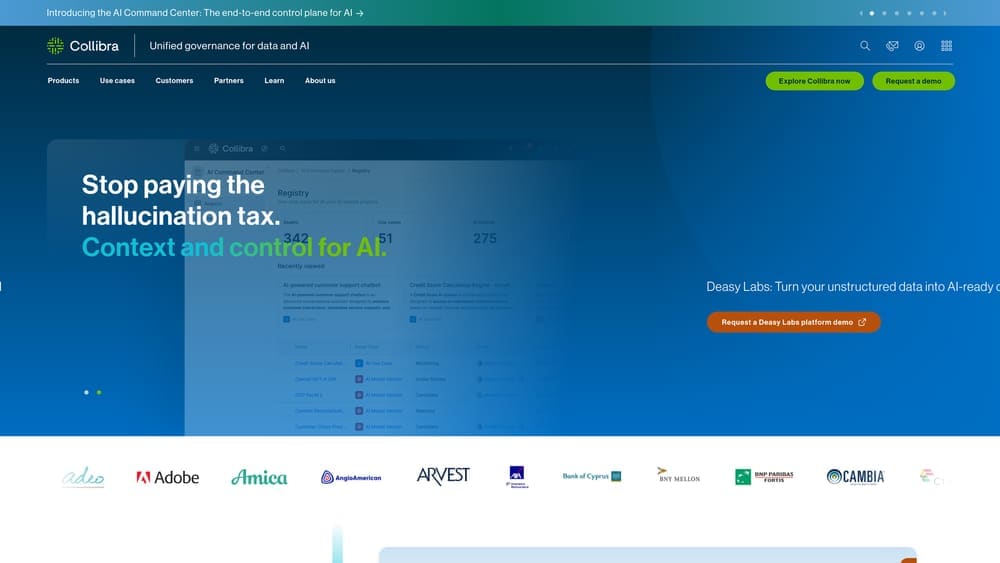
Collibra is an established enterprise data governance and catalog platform with a strong track record in data lineage, business glossary management, and stewardship workflows across large organizations.
Where This Tool Shines
Collibra’s strength is governance maturity. Its data catalog, lineage visualization, and stewardship workflow capabilities are among the most developed in the enterprise market. For biopharma organizations that need to document data flows across complex systems, assign data ownership, and enforce policies at scale, Collibra provides a robust operational framework.
Where it shows limits is in biopharma-specific use cases. It isn’t designed around federated architectures or genomic-scale data handling, and organizations with cross-border data sovereignty requirements will need to architect those solutions separately. Collibra works best as a governance layer on top of an existing data infrastructure, rather than as an end-to-end research platform.
Key Features
Data Catalog with Business Glossary: Centralized catalog with lineage tracking and a business glossary that aligns technical and business definitions of data assets.
Stewardship Workflows: Configurable workflows for data quality scoring, issue resolution, and ownership assignment across teams and domains.
Policy Management: Regulatory compliance mapping and policy enforcement tools for frameworks including HIPAA and GDPR.
Enterprise Integrations: Broad connector ecosystem supporting integration with major data warehouses, cloud platforms, and ETL tools.
Best For
Large biopharma or life sciences organizations with established data infrastructure that need to layer mature governance, lineage, and stewardship capabilities on top — particularly where data catalog and policy documentation are the primary requirements.
Pricing
Enterprise pricing with custom quotes. Collibra is typically a significant investment suited to large-scale deployments.
3. Informatica Intelligent Data Management Cloud (IDMC)
Best for: Organizations needing a broad, horizontal data management platform covering quality, MDM, catalog, and integration across hybrid and multi-cloud environments.
Informatica IDMC is a comprehensive data management platform that brings data quality, master data management, cataloging, integration, and governance under one umbrella, powered by its AI engine called CLAIRE.
Where This Tool Shines
Informatica’s breadth is its defining characteristic. If your biopharma organization is wrestling with data quality issues, inconsistent master data across source systems, and the need for a unified catalog — all at the same time — IDMC addresses all of it from a single platform. The CLAIRE AI engine automates data classification, quality scoring, and relationship discovery at scale.
The tradeoff is specialization. IDMC is a horizontal platform built to serve many industries, which means biopharma-specific requirements like genomic data handling, federated analysis, or GxP compliance workflows require additional configuration. Organizations already running complex hybrid or multi-cloud environments will find the connector ecosystem particularly valuable.
Key Features
CLAIRE AI Engine: AI-powered data quality scoring, classification, and relationship discovery that reduces manual metadata management effort.
Master Data Management: Unified MDM capabilities for managing complex, overlapping source systems across enterprise environments.
Unified Data Catalog: Lineage tracking and impact analysis across hybrid and multi-cloud data assets.
Connector Ecosystem: Extensive pre-built connectors for cloud platforms, databases, SaaS applications, and enterprise systems.
Best For
Biopharma organizations with complex, multi-system data environments where data quality, MDM, and catalog capabilities are the primary needs — especially those already running hybrid or multi-cloud architectures.
Pricing
Modular enterprise licensing with custom quotes. Pricing varies based on which IDMC modules are selected.
4. Palantir Foundry
Best for: Large-scale operational data integration in highly regulated environments with complex, disparate data sources and significant implementation resources.
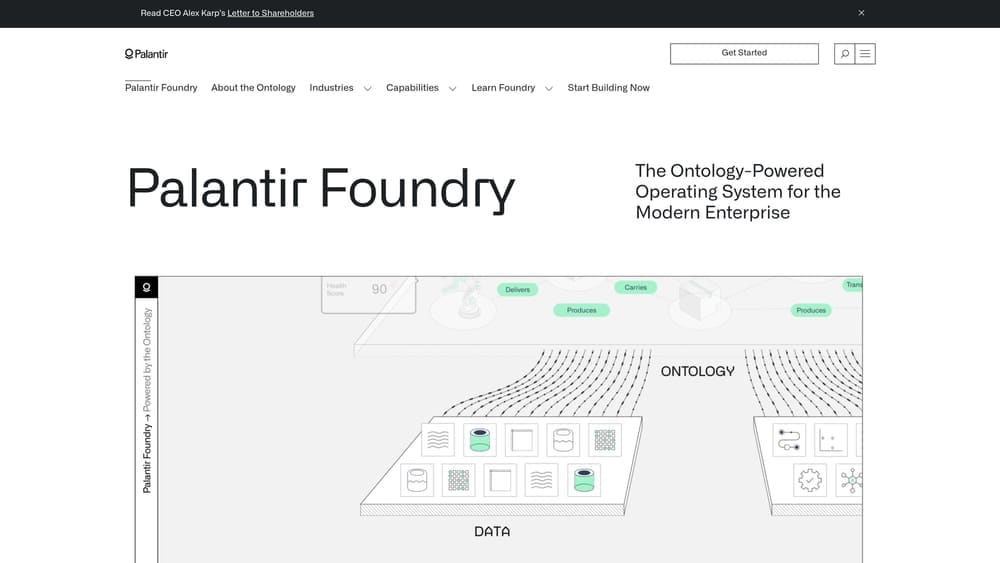
Palantir Foundry is an operational data integration and analytics platform built around an ontology-based data model, with a strong track record in government, defense, and regulated industries.
Where This Tool Shines
Foundry’s ontology-based approach to data modeling is genuinely distinctive. Rather than treating data as rows and tables, it models data as objects and relationships — which maps naturally to complex real-world domains like clinical research, where a patient, a trial, a drug, and an outcome are all interconnected entities. This makes it powerful for operational workflows tied to governed data assets.
The practical consideration is implementation complexity. Foundry typically requires substantial professional services investment and is most effective at large-scale enterprise deployments. Organizations evaluating it should plan for significant onboarding timelines and internal resource commitment. Its government and defense security pedigree is a genuine credential for regulated-industry work.
Key Features
Ontology-Based Data Modeling: Models data as objects and relationships, enabling operational workflows that reflect real-world complexity.
Enterprise Data Integration: Strong capabilities for integrating disparate, heterogeneous data sources across large organizations.
Workflow Automation: Workflow tools tied directly to governed data assets, enabling operational decision-making at scale.
Regulated-Industry Security: Government and defense-grade security architecture with a track record in high-security environments.
Best For
Large biopharma and health organizations with significant implementation resources, complex operational data integration needs, and a requirement for government-grade security posture.
Pricing
Enterprise pricing with custom quotes. Foundry deployments are typically large-scale investments with substantial implementation costs.
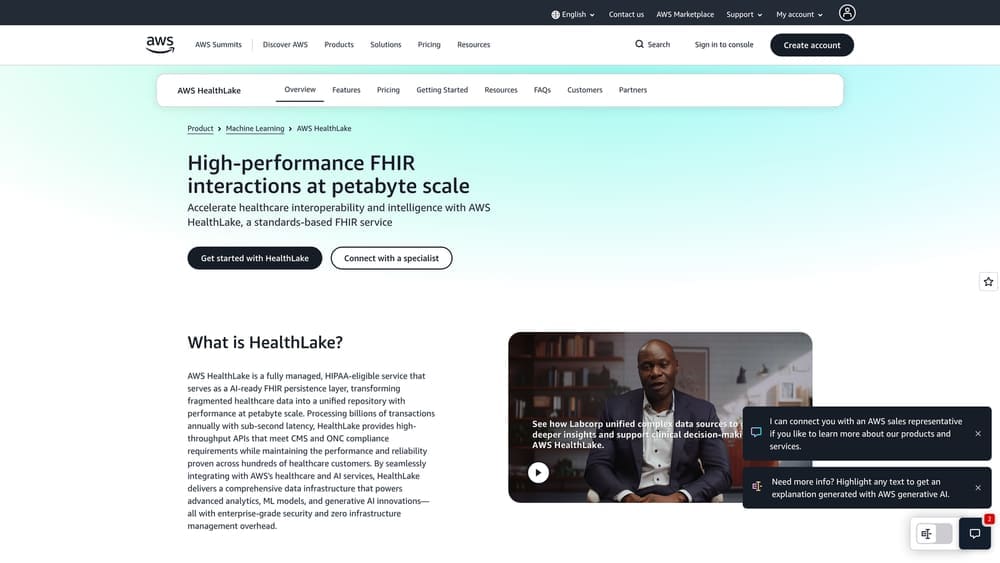
5. AWS HealthLake
Best for: Biopharma and health systems on AWS that need a managed, HIPAA-eligible FHIR data store with integrated analytics capabilities.
AWS HealthLake is a managed service for storing, transforming, and analyzing health data in FHIR R4 format, built natively on AWS infrastructure with HIPAA-eligible status.
Where This Tool Shines
If your organization is already running on AWS and your primary data governance challenge involves structured clinical and health data in FHIR format, HealthLake delivers a clean, managed solution. The built-in NLP capabilities for unstructured clinical text add genuine value for organizations dealing with clinical notes and free-text data alongside structured records.
The scope limitation is worth understanding clearly. HealthLake is designed around FHIR-structured health data — it isn’t built for genomic or multi-omic data natively, and its governance capabilities are narrower than dedicated governance platforms. Think of it as a strong, managed FHIR data layer rather than a comprehensive biopharma governance solution.
Key Features
Native FHIR R4 Data Store: Managed ingestion, storage, and querying of health data in FHIR R4 format without infrastructure management overhead.
HIPAA-Eligible Managed Service: Built on AWS infrastructure with HIPAA eligibility, simplifying compliance for US health data requirements.
Integrated NLP: Natural language processing for extracting structured information from unstructured clinical text and notes.
AWS Ecosystem Integration: Direct integration with AWS analytics, machine learning, and data services for downstream analysis.
Best For
Biopharma and health system organizations already committed to AWS that need a governed, managed FHIR data layer — particularly those working primarily with structured clinical data rather than genomic or multi-omic datasets.
Pricing
Pay-as-you-go pricing based on data stored and API calls made. AWS pricing calculators can provide estimates based on expected data volume and usage patterns.
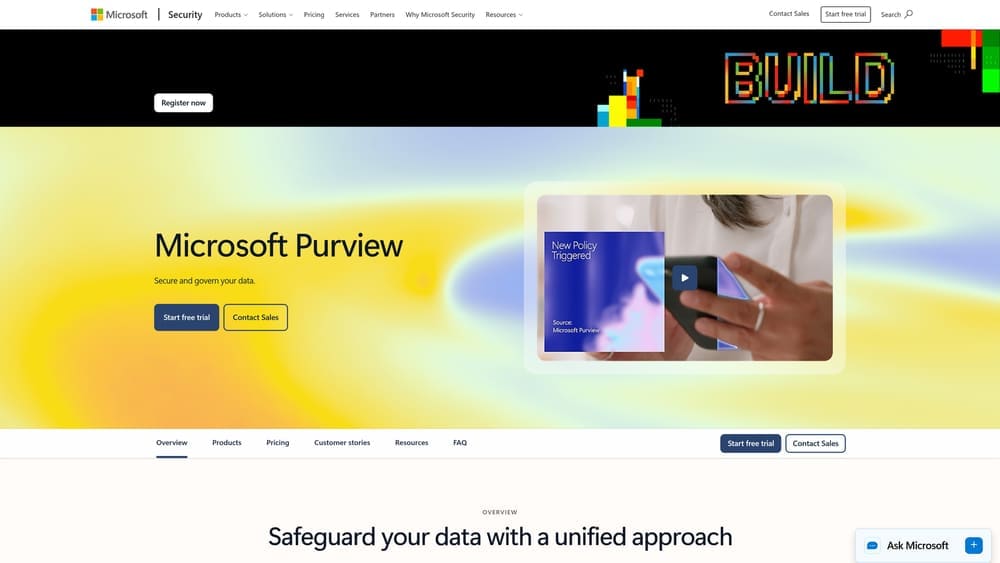
6. Microsoft Purview
Best for: Biopharma organizations running on Microsoft Azure and the Microsoft 365 ecosystem that need unified data governance and compliance management.
Microsoft Purview is a unified data governance and compliance platform that integrates deeply across Azure, Microsoft 365, and Microsoft Fabric, offering data discovery, classification, sensitivity labeling, and policy enforcement.
Where This Tool Shines
Purview’s value proposition is tight integration with the Microsoft ecosystem. For organizations where data lives across Azure Synapse, Microsoft Fabric, SharePoint, and Teams, Purview provides automated discovery and classification that works across all of it without requiring separate connectors or configurations. The Compliance Manager component helps organizations map their controls to regulatory frameworks, which is useful for biopharma teams managing overlapping requirements.
Outside the Microsoft ecosystem, Purview’s value diminishes considerably. It’s optimized for organizations that have made a strategic commitment to Azure and Microsoft services. For multi-cloud or non-Microsoft environments, other platforms will deliver more consistent coverage.
Key Features
Automated Data Discovery and Classification: Scans and classifies data across Microsoft services automatically, reducing manual cataloging effort.
Sensitivity Labeling and DLP: Applies sensitivity labels and data loss prevention policies across Microsoft 365 and Azure services.
Data Map with Lineage: Unified data map with lineage tracking across Azure, Microsoft 365, and Fabric environments.
Compliance Manager: Framework-based compliance management tool for mapping controls to regulatory requirements including HIPAA and GDPR.
Best For
Biopharma organizations with a strong Azure and Microsoft 365 footprint that want governance capabilities tightly integrated into their existing Microsoft environment without deploying a separate platform.
Pricing
Core Purview features are included with select Microsoft 365 and Azure plans. Premium governance and compliance features are available at additional cost through higher-tier licenses.
7. Atlan
Best for: Data-forward biopharma teams prioritizing self-service data discovery, cross-functional collaboration, and modern catalog UX.
Atlan is a modern, collaboration-first data catalog platform designed around a Slack-like user experience, making data discovery and annotation accessible to technical and non-technical users alike.
Where This Tool Shines
Atlan’s differentiation is usability. Where traditional data catalogs can feel like internal documentation systems that nobody actually uses, Atlan builds discovery and annotation into a collaborative interface that encourages active participation from data teams. Automated lineage, role-based access controls, and integrations with tools like dbt, Snowflake, and BigQuery make it practical for modern data stack environments.
For biopharma organizations with heavy regulatory compliance requirements, Atlan is less mature than established enterprise governance vendors. It’s a strong fit for data teams that want to improve discoverability and collaboration — less so for organizations where regulatory audit trails and compliance depth are the primary drivers.
Key Features
Collaboration-First Interface: Slack-like UX for data discovery, annotation, and team discussion around data assets — designed to drive actual adoption.
Automated Lineage and Metadata: Automated lineage tracking and metadata management across connected data sources.
Role-Based Access Controls: Granular access controls and data ownership workflows for managing who can see and use specific data assets.
Modern Data Stack Integrations: Pre-built integrations with dbt, Snowflake, BigQuery, Looker, and other widely used data tools.
Best For
Biopharma data and analytics teams focused on improving data discoverability and cross-functional collaboration, particularly those running modern cloud data stacks where ease of adoption is as important as governance depth.
Pricing
Tiered pricing with team and enterprise plans available. Contact Atlan for enterprise pricing details.
8. Alation
Best for: Biopharma data teams that need governed self-service analytics with behavioral intelligence to surface trusted, high-quality datasets.
Alation is a data intelligence platform that uses behavioral analytics to identify and surface the datasets researchers and analysts actually trust and use, supporting governed self-service discovery across the enterprise.
Where This Tool Shines
Alation’s behavioral analytics layer is its most distinctive capability. Rather than relying solely on manual curation to identify trusted data, it analyzes how data is actually being used — which datasets get queried, which get cited in reports, which have active stewardship — and surfaces that signal to help users find reliable data faster. For biopharma organizations where analysts spend significant time validating data before using it, this can meaningfully reduce friction.
Alation also has a track record in pharma and financial services contexts, giving it more regulated-industry credibility than some newer catalog platforms. Its stewardship workflows and policy enforcement capabilities are solid, though organizations with complex federated or genomic-specific requirements will likely need complementary tooling.
Key Features
Behavioral Analytics: Analyzes actual data usage patterns to identify and surface trusted, frequently used datasets — reducing time spent validating data quality.
Data Catalog with Stewardship Workflows: Comprehensive catalog with curation workflows, data ownership assignment, and quality management tools.
Policy Enforcement and Access Governance: Policy management and data access governance capabilities for regulated environments.
Query Intelligence: SQL-based data discovery and query intelligence that helps analysts find relevant data through search and exploration.
Best For
Biopharma analytics teams that need to reduce time-to-trusted-data and support governed self-service analytics across large, complex data environments — particularly where data quality validation is a recurring bottleneck.
Pricing
Enterprise pricing with custom quotes based on organization size and deployment scope.
9. Varonis
Best for: Biopharma security and compliance teams focused on detecting overexposed sensitive data, enforcing access controls, and managing insider threat risk.
Varonis is a data security governance platform that takes a security-first approach to governance: automated discovery of sensitive data exposure, behavior-based threat detection, and least-privilege access enforcement.
Where This Tool Shines
Varonis occupies a different position from the catalog and lineage platforms on this list. Its primary lens is security: where is your sensitive data exposed, who has access they shouldn’t, and is anyone behaving anomalously? For biopharma organizations managing valuable IP, patient data, and clinical trial records, that threat model is highly relevant. Insider threats, misconfigured permissions, and overexposed sensitive files are real risks in research environments.
The audit trail and compliance reporting capabilities — covering HIPAA, GDPR, and SOX — make Varonis useful for compliance teams that need to demonstrate access controls and data handling practices to regulators. It complements, rather than replaces, a data catalog or governance platform: Varonis governs who touches data and flags anomalies; other platforms govern how data is discovered, cataloged, and used for research.
Key Features
Automated Sensitive Data Discovery: Scans file systems, cloud storage, and databases to identify and classify sensitive and regulated data at risk of overexposure.
Behavior-Based Threat Detection: Monitors user and entity behavior to detect access anomalies and potential insider threats in real time.
Least-Privilege Access Enforcement: Identifies and remediates excessive permissions, enforcing least-privilege access across data environments.
Compliance Audit Trails: Detailed audit logs and compliance reporting for HIPAA, GDPR, and SOX requirements.
Best For
Biopharma security and compliance teams responsible for managing access risk, detecting data exposure, and maintaining audit-ready compliance documentation — particularly organizations with large unstructured data environments where permission sprawl is a concern.
Pricing
Enterprise pricing with custom quotes. Varonis typically prices based on data environment size and the scope of protected systems.
Which Platform Is Right for Your Biopharma Program
The right platform depends entirely on where your governance challenge actually lives. Here’s a quick-reference guide by use case.
Federated, cross-border research with data sovereignty requirements: Lifebit is the clear fit. Its federated architecture is purpose-built for this problem, and its deployment track record with national health programs speaks to real-world scale.
AI-powered harmonization to OMOP or FHIR at speed: Again, Lifebit’s Trusted Data Factory is the most purpose-specific option here, designed to compress months of harmonization work into days.
Enterprise lineage, stewardship, and policy management: Collibra and Informatica IDMC are the mature enterprise choices, with Informatica offering broader platform coverage and Collibra offering deeper governance workflow specialization.
Organizations committed to Microsoft Azure: Microsoft Purview integrates cleanly and is cost-effective if you’re already in that ecosystem.
AWS-native FHIR data governance: AWS HealthLake is the natural choice for AWS-first organizations working primarily with structured clinical data.
Security-first governance and access risk management: Varonis addresses a distinct problem set and works well alongside catalog platforms rather than as a replacement for them.
Modern data team collaboration and discoverability: Atlan and Alation both serve this space well, with Alation’s behavioral analytics offering a useful differentiator for teams focused on surfacing trusted data faster.
If your program involves federated data access, genomic-scale handling, or cross-border compliance, start with Lifebit. It’s the only platform on this list built specifically for that combination of requirements. Get-Started for Free and see how it handles your specific data environment.
Related Lifebit reading
Continue with these pillar guides:
- The complete guide to Trusted Research Environments — what a TRE is, the Five Safes framework, and why federated architectures became the procurement default after the UK Biobank incident.
- Federated learning in healthcare — how machine-learning models train across hospitals and biobanks without the data ever leaving its source.
- The biomedical data lakehouse — the open-format storage layer that powers clinical, research, and AI workloads from one copy of the data.
- Federated data governance — how each data custodian retains control while participating in multi-institution research and AI.
- Lifebit’s federated biomedical data platform — see how Genomics England, Singapore Synapxe, NIH, and Boehringer Ingelheim use Lifebit to run Sovereign AI on federated health data.