

European Health Data Space · Pharma guide
EHDS for Pharma What it asks, how to prepare
From 26 March 2029, health data your company holds in the EU must be made available for approved research. Clinical trial and genomic data follow in 2031. This guide sets out what the law expects of drug companies, where most teams have gaps, and a four-step plan to close them without handing your data over.
Last reviewed 28 October 2026 · Checked against Regulation (EU) 2025/327 · General information, not legal advice
2029
Records, registries, claims and biobank data in scope
2031
Clinical trial, genomic, omics and cohort data join
3 months
To deliver data once asked, plus 3 if extended
10 years
Longest data permit, renewable once
€20M / 4%
Top fine, for misuse such as re-identifying people
What it is
What is the European Health Data Space?
The European Health Data Space (EHDS) is an EU regulation, (EU) 2025/327, in force since 26 March 2025. It does two things: it gives people control of their own electronic health records anywhere in the EU, and it sets one set of rules for reusing health data for research, innovation and policy. From 2029, organizations that hold health data in the EU, drug companies included, must make it available to approved users through national health data access bodies.
Chapter II · Primary use
Care: your records travel with you
Patients and doctors can access patient summaries, prescriptions, images and lab results across borders. This mostly affects hospitals and electronic health record vendors.
Chapter IV · Secondary use
Research: data reused under a permit
Approved researchers, companies and public bodies can use health data for research, product development, AI training and policy. This is the part that changes how pharma shares and uses data.
New to the topic? Read our plain-language EHDS explainer.
Key dates
When does the EHDS apply to pharma?
Five dates matter. The two that change your operations are 26 March 2029 and 26 March 2031.
26 Mar 2025
Regulation in force.
26 Mar 2027
Each country names its health data access body. EU technical rules due for permits, secure environments and quality labels.
26 Mar 2029
Secondary use applies. Health records, claims, registries, device and biobank data in scope.
26 Mar 2031
Clinical trial and study data, genomic and other omics data, and research cohorts join.
26 Mar 2035
Countries outside the EU can join the cross-border network.
Source: Regulation (EU) 2025/327, Articles 105 and 55(6). Dataset descriptions follow Implementing Regulation (EU) 2026/2098, adopted September 2026.
What the EHDS expects from pharma
What must pharma do under the EHDS?
Drug companies play two roles. As a health data holder you must share. As a data user you can apply to use Europe's data. Only micro enterprises are exempt from the holder duties.
As a health data holder: what you must do
Article 60
Deliver data on request
When the access body asks, make the requested data available within 3 months, extendable once by 3 months.
Articles 60 and 77
Describe your datasets
Publish a description of each dataset in your country's catalog, in the EU metadata format, and check it every year.
Article 52
Flag protected data
Mark data covered by IP, trade secrets or regulatory data protection. It must still be shared, with safeguards the access body sets.
Article 71
Respect opt-outs
Leave out anyone who has opted out of secondary use, under the mechanism each country provides.
Article 87
Keep processing in the EU
Pseudonymization, anonymization and secure processing of personal data stay in the EU or a country with a GDPR adequacy decision.
Articles 63 and 64
Expect enforcement
Missed deadlines can bring daily penalty payments and fines of up to €10 million or 2% of worldwide turnover.
As a data user: what you can do, and the rules
Article 53
Use data for R&D and AI
Permitted purposes include scientific research, product development and innovation, and training and testing AI systems.
Articles 67 and 68
Apply for a data permit
One application can cover several countries. Decision within 3 months; a permit lasts up to 10 years, renewable once.
Article 69
Or ask for a statistic
A data request returns an anonymous statistical answer only. You never see the underlying records.
Article 73
Work inside a secure environment
Analysis happens in a secure processing environment. Only anonymous, non-personal results may leave.
Article 61
Publish your results
Make anonymous results public within 18 months of finishing, and credit the EHDS.
Articles 61 and 64
Never re-identify
Re-identifying people, or taking personal data out of the environment, carries fines of up to €20 million or 4%.
Data in scope
Which pharma data falls under the EHDS, and when?
Article 51 lists 17 categories. These are the ones most drug companies hold.
Data you may hold
Article 51 point
In scope from
Electronic health record data, for example from real-world evidence partnerships
(a)
26 Mar 2029
Claims, dispensing and other administrative data
(e)
26 Mar 2029
Product, disease and patient registries
(k), (l), (o)
26 Mar 2029
Data generated by medical devices
(h), (n)
26 Mar 2029
Biobanks and linked databases
(q)
26 Mar 2029
Clinical trial, study and performance study data
(m)
26 Mar 2031
Genetic, epigenomic and genomic data
(f)
26 Mar 2031
Proteomic, transcriptomic, metabolomic and other omics data
(g)
26 Mar 2031
Research cohorts, questionnaires and surveys, after first publication
(p)
26 Mar 2031
Countries may add categories and set stricter safeguards for genomic, omics and biobank data (Article 51(2) and (4)).
The gap
Common gaps, and what ready looks like
Law firms advising the industry name weak preparation as one of the most underestimated EHDS risks. These are the six gaps we see most often.
Requirement
Common starting point
What ready looks like
Know what you hold
Datasets spread across functions, partners and vendors, with no single list
One inventory of EU health datasets, each with an owner, legal entity and legal basis
Describe it for the catalog
No machine-readable descriptions
Dataset descriptions in the EU metadata format, ready for the national catalog
Protect trade secrets
Handled case by case in contracts
Protected data flagged once, with safeguards built into how access works
Deliver within 3 months
Each request is a new extract project
A repeatable pipeline, or a standing secure environment that answers every permit
Opt-outs and pseudonymization
Done by hand per study
Opt-outs filtered and identifiers pseudonymized automatically, in the EU
Prove what happened
Logs scattered across vendors
One audit trail per permit: who accessed what, when, and what left
How to close the gap
A four-step plan to be ready before 2029
Start now: the technical rules land in March 2027, which leaves about two years to build and test.
1
Now to mid 2027
Map
Inventory EU health datasets and owners
Confirm holder status for each legal entity
Flag trade secret and protected data
Name one accountable owner
2
2027
Design
Read the March 2027 technical rules
Choose how you will answer permits
Write dataset descriptions
Ask your country about trusted data holder status
3
2027 to 2028
Build and test
Stand up a secure environment in your EU cloud
Automate opt-outs and pseudonymization
Add an airlock for outputs
Run a mock permit end to end
4
From 26 Mar 2029
Operate
Answer permits within the deadline
Check catalog entries every year
Use EU data for your own research
Add trial and genomic data before 2031
Choosing your model
Two ways to answer a data permit
The law lets holders upload data to the access body's secure environment. Where a country allows it, a holder that runs its own compliant environment can become a trusted health data holder (Article 72).
Option A
Ship a copy for each permit
A new extract and transfer for every permit
Copies of protected data sit outside your control
Audit trail split between you and the access body
Effort grows with every request
Least change to how you work today
Option B · Federated Trusted Research Environment
Run a secure environment in your own EU cloud
Approved users work where the data lives; only anonymous results leave
Protected data never copied out
One audit trail for every permit
The same environment serves your own research and AI work
Ready for trusted data holder status where your country offers it
How Lifebit helps
The analysis travels.
The data stays.
Lifebit's Federated Trusted Research Environment runs in your cloud account, in the EU region you choose.
1
Permit arrives. Only the people named in it get a workspace.
2
Analysis runs on site. Code goes to the data; every action is logged to a named user.
3
Airlock checks outputs. Only anonymous results leave.
4
Same platform, your research. Size cohorts, pick sites and train AI across countries without moving records.
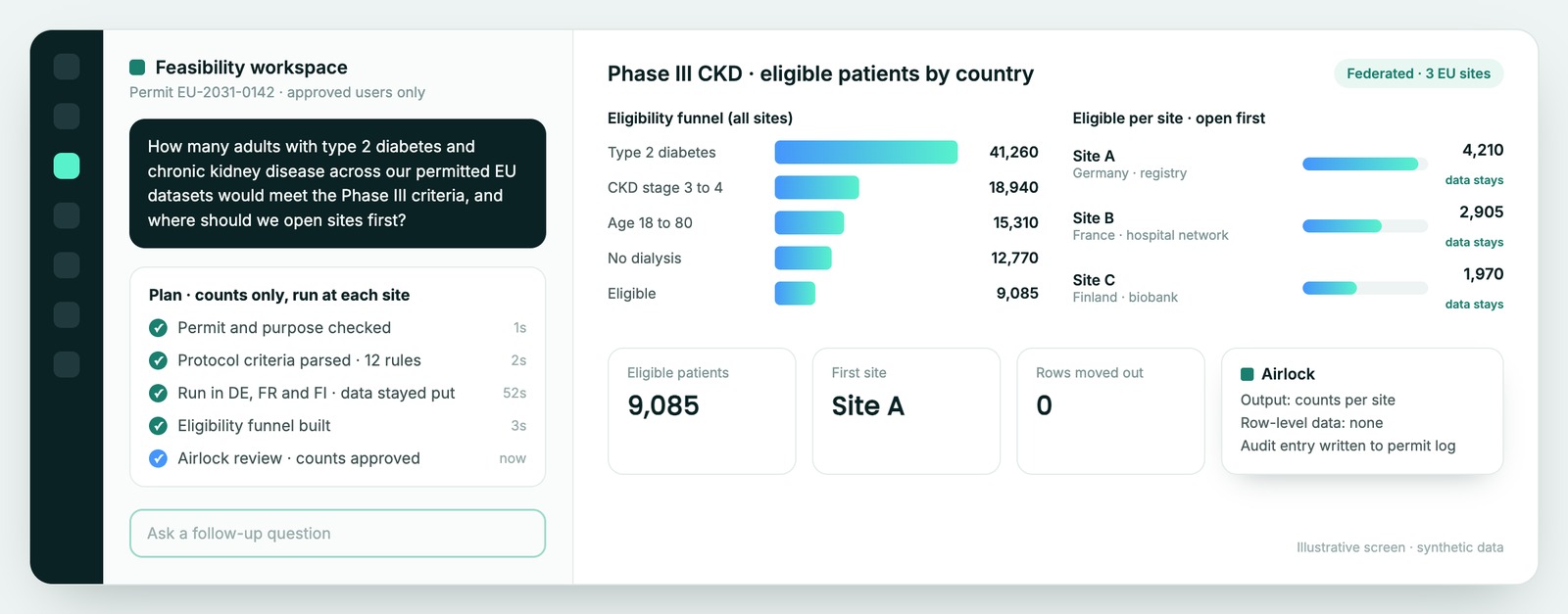
Illustrative screen with synthetic data
Self-check
Are you EHDS ready? Eight questions
Fewer than six yeses means 2029 will be tight. The white paper has the full checklist and what each answer means.
We have one list of the EU health datasets we hold.
We know which legal entities count as health data holders.
Trade secret and protected data is flagged.
Our datasets are described in the EU metadata format.
We could deliver a dataset within 3 months today.
Opt-outs and pseudonymization are automated.
We have an audit trail for every data access.
Trial and genomic data have a plan for 2031.
Why Lifebit
Built for national research environments

Since 2020
Genomics England's Research Environment runs on Lifebit, and was chosen again in 2026 after a formal procurement.
First
The UK's first multi-party federated analysis between two research environments, with NIHR Cambridge in 2022.
Your cloud
Deployed in your own account and region. ISO 27001, ISO 27701 and SOC 2 Type II.
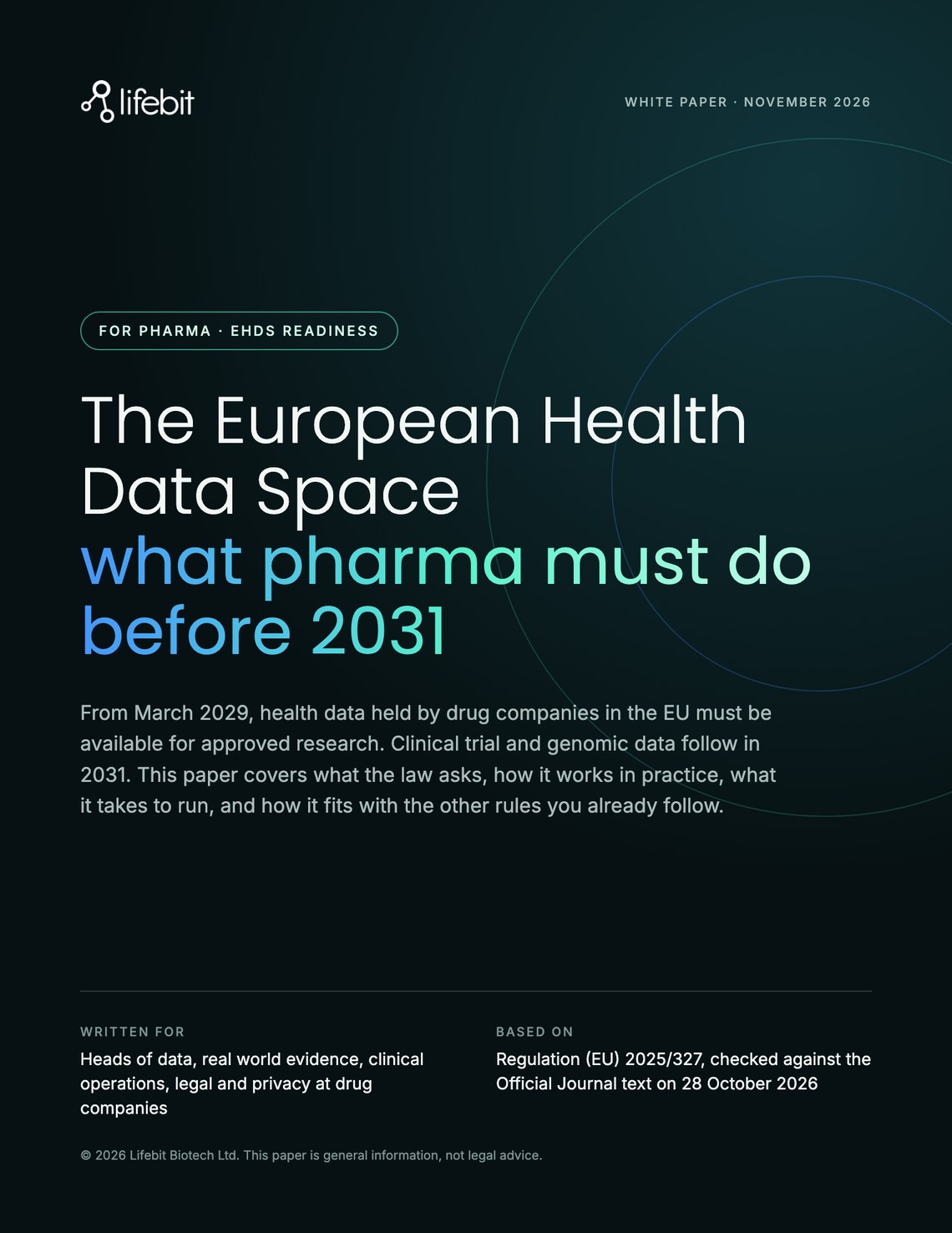
Free white paper · 14 pages · The European Health Data Space
What pharma must do before 2031
- The law and the dates, article by article
- Trade secrets and trials in Europe
- The technology, people and upkeep it takes
- How it fits with GDPR, the AI Act and 30+ other rules
- A readiness checklist and a fact check
FAQ
EHDS questions from pharma teams
Does the EHDS apply to pharmaceutical companies?
Yes. Any company that develops health products or does health research and holds electronic health data in the EU is a health data holder. Only micro enterprises, with fewer than 10 staff and €2 million turnover or less, are exempt.
When do EHDS obligations start?
Secondary use rules apply from 26 March 2029. Clinical trial, genomic, omics and cohort data come into scope on 26 March 2031.
Is clinical trial data included?
Yes, from 26 March 2031. Article 51(1)(m) covers data from clinical trials, studies, investigations and performance studies.
Can we refuse access to protect trade secrets?
Not by default. Protected data must still be made available, with safeguards set by the access body. The access body must refuse only where a serious risk to IP or trade secrets cannot be addressed (Article 52).
How long do we have to provide data?
Three months from the access body's request, extendable once by another three months (Article 60).
What is a health data access body?
The national authority that assesses applications, issues data permits and supervises secondary use. Each EU country must name one by 26 March 2027.
What is a secure processing environment?
A controlled workspace where approved users analyze data under a permit. Personal data cannot be taken out; only anonymous results leave after review (Article 73). It is the same idea as a Trusted Research Environment.
Can pharma use EHDS data to train AI?
Yes. Training, testing and evaluating algorithms, including AI systems, is a permitted purpose under Article 53, inside a secure processing environment.
What are the fines?
Up to €10 million or 2% of worldwide turnover for breaching holder or user duties, and up to €20 million or 4% for prohibited uses, re-identification or taking personal data out of a secure environment (Article 64).
Does our data have to leave our systems?
By default holders provide data to the access body's secure environment. Countries may designate trusted health data holders that run their own compliant environment, so the data stays in place (Article 72).
How does the EHDS relate to GDPR?
It builds on GDPR rather than replacing it. Pseudonymized access still needs a GDPR legal basis, and data protection authorities enforce opt-outs with GDPR-level fines.
Is Lifebit EHDS certified?
No EHDS certification for secure processing environments exists yet; the EU's technical requirements are due in March 2027. Lifebit's environments already follow the model the law describes and hold ISO 27001, ISO 27701 and SOC 2 Type II.
Key terms
EHDS terms in plain words
Health data holder
Any organization in health or care that holds electronic health data, including drug and device makers. Micro enterprises are exempt.
Health data access body
The national authority that issues data permits and oversees reuse of health data.
Data permit
Permission to use specified data for a stated purpose, for up to 10 years, inside a secure environment.
Data request
A request for an anonymous statistical answer, without access to the data itself.
Secure processing environment
A controlled workspace where approved users analyze data; only anonymous results leave.
Trusted health data holder
A holder a country designates to assess requests and run its own compliant secure environment.
HealthData@EU
The EU network that links national access bodies so one application can cover several countries.
Dataset description
A catalog entry describing a dataset in the EU's standard metadata format, based on HealthDCAT-AP.
Data quality and utility label
A label showing a dataset's quality and coverage. Mandatory for publicly funded datasets.
Sources
Regulation (EU) 2025/327 on the European Health Data Space, Official Journal of the EU, 5 March 2025 · Implementing Regulation (EU) 2026/2098 on dataset description metadata · European Commission, EHDS overview · TEHDAS2 joint action guidance on secure processing environments and data delivery.
Prepared by Lifebit's data governance team. Last reviewed 28 October 2026. This page is general information, not legal advice.