

Navigating the GDPR Maze: A Simple Guide to Data Protection
GDPR Compliant Data: The €20M Risk That Can Shut Down Your Research
GDPR compliant data is personal information processed under the EU General Data Protection Regulation (GDPR). For any organization handling personal data, the stakes are simple: you either build compliance into everyday operations or you accept legal, financial, and reputational risk. In the context of modern life sciences, this is not merely a bureaucratic hurdle; it is a fundamental requirement for the viability of long-term research projects and the maintenance of public trust.
To stay compliant, organizations must adhere to a rigorous set of standards:
- Process data lawfully and transparently – establish and document a clear legal basis for each processing activity. This involves not just choosing a basis, but ensuring it aligns with the actual expectations of the data subjects.
- Implement technical safeguards – apply encryption, access controls, logging, and where appropriate pseudonymization. These measures must be “state-of-the-art” and regularly tested for effectiveness.
- Respect data subject rights – enable individuals to access, correct, restrict, export, and delete their data when applicable. This requires a backend infrastructure capable of locating specific data points across vast datasets.
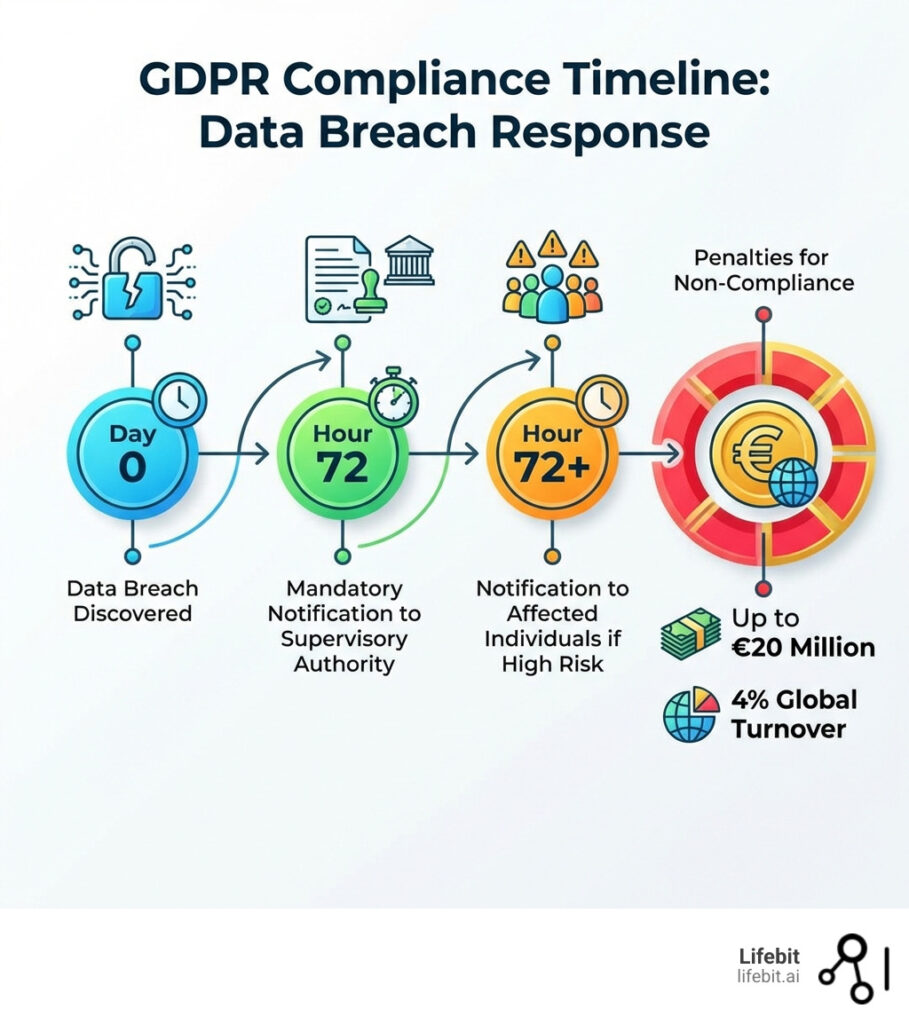
- Report breaches within 72 hours – notify the relevant supervisory authority quickly when required. This necessitates a robust incident response plan that is practiced and ready for immediate execution.
- Demonstrate accountability – keep records, train teams, and complete impact assessments for higher-risk processing. Accountability is the “show your work” principle of the GDPR.
Ignore these rules and you face fines up to €20 million or 4% of global annual turnover. Beyond the financial hit, non-compliance destroys patient trust and partner confidence, which are often harder to rebuild than any system. For a research institution, a single major breach or a finding of non-compliance can lead to the immediate suspension of funding, the revocation of access to biobank resources, and the termination of international collaborations.
In healthcare, biomedical research, and genomics, compliance is exponentially harder. You are not just protecting names and email addresses; you are safeguarding genetic sequences, phenotypic traits, clinical notes, imaging, and clinical trial outcomes that can sometimes identify individuals even without obvious identifiers. The “mosaic effect”—where disparate pieces of non-identifiable data are combined to re-identify a person—is a constant threat in high-dimensional biological data. Add multi-site collaborations, siloed hospital systems, and cross-border data access, and the risk profile becomes both technical and legal.
This is why “GDPR compliant data” is not a checkbox. It is an operating model that covers:
- Governance: who may access which datasets, for what purpose, with what approvals, and for what duration.
- Security: strong multi-factor authentication, least-privilege access, encrypted storage at rest and in transit, and immutable audit trails.
- Privacy: minimization, pseudonymization where suitable, and careful handling of special category data (Article 9).
- Operational readiness: repeatable workflows for Data Subject Access Requests (DSARs), retention/deletion, vendor management, and incident response.
I’m Maria Chatzou Dunford, CEO of Lifebit. We built our platform to support GDPR compliant data in federated environments, so teams can run analysis where the data already resides instead of copying sensitive datasets across borders or between organizations. In practice, federated governance helps reduce unnecessary duplication, simplify control, and align real-world research with modern privacy expectations. By bringing the analysis to the data, we eliminate the primary risk vector: the movement of sensitive information.
Quick gdpr compliant data definitions:
The GDPR Framework: Protect Your Data or Pay the Price
GDPR protects “personal data” – any information that can identify an individual directly or indirectly. This includes obvious identifiers (name, email), online identifiers (IP addresses, device IDs, cookie identifiers), and many types of health and research metadata when it can be linked back to a person. The regulation can apply to legacy datasets too, including data collected before 2018, if you still process it today. See the official definition of personal data.
For teams working with biomedical and multi-omic datasets, the definition matters because “identifying” is not limited to a single column in a spreadsheet. A combination of attributes (age band, rare disease, hospital site, timestamp, genomic variants) can re-identify someone even when traditional identifiers are removed. This is often referred to as “quasi-identifiers.” In the era of big data, the threshold for what constitutes personal data has lowered significantly because the computational power available to re-identify individuals has increased. That is why building GDPR compliant data practices requires understanding both:
- What you store: raw files (FASTQ, BAM, VCF), derived features (gene expression matrices), and linked metadata (clinical phenotypes).
- How it is used: exploratory analysis, collaborative sharing, machine learning model training, and peer-reviewed publication.
- Who can access it: internal research teams, external collaborators, third-party processors (cloud providers), and sub-processors.
The Spectrum of Identifiability
To manage GDPR compliant data, you must distinguish between pseudonymization and anonymization. This distinction is the most common source of legal confusion in research consortia.
| Feature | Pseudonymization | Anonymization |
|---|---|---|
| Definition | Replacing identifiers with artificial ones (keys) | Irreversibly removing all identifiers and linkability |
| Reversibility | Potentially reversible with the key | Irreversible by any reasonable means |
| GDPR Status | Subject to GDPR (Personal Data) | Outside GDPR scope (Non-personal Data) |
| Risk Reduction | Reduces direct identification risk | Eliminates identification risk |
| Utility | High utility for research (longitudinal) | Lower utility for detailed analysis |
| Key Use Case | Clinical trials, patient registries | Public aggregate statistics, open-access summaries |
A practical way to apply this distinction:
- Use pseudonymization when you still need to link records across time (longitudinal studies, pharmacovigilance, patient registries, repeat sampling). You must still treat the dataset as personal data, apply access controls, and protect the re-identification key with extreme security. Under GDPR, pseudonymized data is still personal data.
- Use anonymization only when you can confidently make re-identification unlikely in context, including when datasets might be combined with other publicly available information. If you cannot demonstrate that irreversibility, you should assume GDPR still applies. True anonymization is a very high bar to reach in genomics, where a person’s DNA is, by definition, a unique identifier.
Identifying Sensitive GDPR Compliant Data (Article 9)
“Special categories” like genetic and health data require extreme care. Processing is prohibited unless you meet strict conditions, such as explicit consent or substantial public interest. In research settings, this often means aligning your protocol, ethics approvals, participant information, and security controls with the lawful basis you rely on. Article 9(2)(j) provides a specific derogation for scientific research, but it is subject to “appropriate safeguards” outlined in Article 89.
A common operational failure is not knowing where special category data exists once it spreads across environments (data lakes, analytic sandboxes, shared workspaces, exports). Our platform uses automated AI to help identify and label sensitive attributes across datasets so teams can apply consistent policies, controls, and approvals. This “data discovery” phase is critical for maintaining a valid Record of Processing Activities (ROPA).
The Legal Basis for Processing
You must establish a lawful basis under Article 6, and document it in your records and privacy information. The most common lawful bases are:
- Consent: Clear, affirmative, and specific. It must be as easy to withdraw as it is to give.
- Contractual Necessity: Required to fulfill a contract with the individual.
- Legal Obligation: Required by law (e.g., reporting adverse events to regulators).
- Vital Interests: Life-or-death situations where the subject cannot give consent.
- Public Interest: Tasks for the public good, often used by government research bodies.
- Legitimate Interests: Balanced against individual rights. This requires a formal “Legitimate Interests Assessment” (LIA).
In practice, compliance means matching the lawful basis to the real processing purpose and keeping it consistent across your tooling, vendors, and workflows. If your purpose changes (for example, from a defined study analysis to a broader reuse), treat it as a governance event: reassess your basis, update documentation, and consider whether a Data Protection Impact Assessment (DPIA) or additional safeguards are required. The transition from primary use (the original study) to secondary use (future research) is a high-risk area that requires careful legal mapping.
7 Principles to Shield Your Organization from Risk
Article 5 defines the bedrock of GDPR compliant data. These principles apply whether you’re a startup, a hospital, a government program, or a global biopharma. They are also the principles regulators use when deciding whether your organization acted responsibly. Understanding these principles is the difference between a compliant culture and a reactive one.
- Lawfulness, Fairness, Transparency: Process data ethically and communicate clearly with data subjects about what you are doing.
- Purpose Limitation: Use data only for specified, legitimate reasons. Do not “scope creep” into other research areas without new authorization.
- Data Minimization: Collect only what is necessary. If you only need age brackets, do not collect exact dates of birth.
- Accuracy: Keep records up to date. In clinical research, this is also a requirement for Good Clinical Practice (GCP).
- Storage Limitation: Delete data when no longer needed. Define clear retention periods for every dataset.
- Integrity and Confidentiality: Ensure robust security. This includes protection against accidental loss, destruction, or damage.
- Accountability: You must be able to prove compliance. This is the most active principle, requiring documentation of every decision.
Read the guide to the data protection principles.
What these principles look like in real biomedical operations:
- Purpose limitation means a dataset collected for a specific trial or registry cannot automatically be reused for a different research question without a governance check. This often involves a Data Access Committee (DAC) review.
- Minimization means only the fields required for the analysis should be accessible in the workspace, even if the raw system contains far more. This can be achieved through “views” or filtered exports.
- Storage limitation means you need retention schedules for raw sequencing files, intermediate outputs, logs, and derived datasets, not just the final report. Many organizations fail by keeping “temporary” analysis files indefinitely.
- Integrity and confidentiality means strong identity and access management (IAM), audit logs, and secure compute – not “secure storage” alone. It also involves protecting data against ransomware and other cyber threats.
Implementing Privacy by Design (Article 25)
Privacy must be proactive, not reactive. “Data protection by design and by default” means embedding safeguards into every tool from the start. This includes setting default access settings to “deny all,” implementing controlled export routes, and establishing clear rules for who can run which analyses. Privacy by Design also involves using Privacy-Enhancing Technologies (PETs) such as differential privacy or homomorphic encryption where appropriate.
In higher-risk scenarios (for example, large-scale processing of health/genetic data, new analytics methods like AI, or novel data linkages), a Data Protection Impact Assessment (DPIA) is mandatory. The DPIA is the practical control that forces clarity: what is being processed, what could go wrong (risk to the individual), what mitigations exist, and who is ultimately accountable. A good DPIA is a living document that is updated as the project evolves.
Accountability and Record Keeping (Article 30)
You must maintain Records of Processing Activities (ROPA). This typically includes:
- The purpose(s) of processing.
- Categories of data subjects (e.g., patients, healthy volunteers) and personal data.
- Recipient categories (including processors/sub-processors and cloud regions).
- International transfers (if any) and the legal safeguards used (e.g., SCCs).
- Retention periods for different data types.
- Technical and organizational security measures (TOMs).
While some SME record-keeping requirements offer narrow exemptions, most biomedical organizations processing special category data will still need robust documentation because of the sensitivity and scale involved. Regulators will ask for your ROPA first during any audit.
A frequent compliance gap is that records exist in policy documents but not in day-to-day systems, making them hard to keep current. Our platform automates parts of this by embedding metadata for data interactions and access decisions, helping teams demonstrate how sensitive datasets were governed during real analysis, not just how they were governed “on paper”. This creates a “compliance-as-code” environment where the system enforces the policy.
Rights and Requests: Empowering the Data Subject
GDPR grants individuals control over their data through several key rights. Even in research-heavy organizations, these rights can still apply, and you need a clear method to decide what you can fulfill, what exemptions apply (where applicable), and how you will respond consistently. Article 89 of the GDPR allows for some derogations from these rights when data is processed for scientific research, but only if specific safeguards are in place.
- Right to be Informed: Know how and why data is used (Privacy Notices).
- Right of Access: Get a copy of your data (DSARs).
- Right to Rectification: Correct inaccurate info.
- Right to Erasure: The “right to be forgotten.” In research, this is often limited if it would render impossible or seriously impair the achievement of the research objectives.
- Right to Restriction: Limit data processing while a dispute is resolved.
- Right to Data Portability: Move data in machine-readable formats.
- Right to Object: Stop processing for specific reasons, such as direct marketing.
- Automated Decisions: Rights against sole machine-based profiling that has legal effects.
From an operational standpoint, rights management is not just a legal workflow. It is a systems problem. To respond accurately, you need to know where personal data lives across:
- Primary databases and data warehouses.
- Analysis workspaces and derived outputs (e.g., temporary files created by a bioinformatician).
- Logs and audit trails (which may have different retention rules).
- Backups and archives.
- Third-party processors (SaaS tools, cloud storage).
Managing Data Subject Access Requests (DSARs)
You must handle DSARs within one month (extendable by two months for complex cases). This requires verified workflows for identity checks, data deletion across backups where applicable, and exporting data in formats like JSON or CSV. Failure to respond to a DSAR is one of the most common reasons for individuals to complain to supervisory authorities.
A DSAR process that works in practice usually includes:
- Intake and identity verification: Ensuring the requester is who they say they are.
- Scoping: Identifying which systems, which identifiers, and which date ranges are relevant.
- Collection and review: Gathering the data and ensuring you do not unlawfully disclose third-party data (redaction).
- Execution: Export, rectification, restriction, or deletion.
- Evidence: Recording what you did, when, and under what rationale for accountability purposes.
Our platform makes these requests executable across complex, federated datasets by maintaining consistent metadata and access controls across environments. This allows a DPO to search for a specific participant ID across multiple federated sites and trigger a deletion or export request from a single interface.
International Data Transfers (Chapter V)
One of the most complex aspects of GDPR compliant data is the transfer of data outside the European Economic Area (EEA). Following the “Schrems II” ruling, organizations must ensure that data transferred to “third countries” (like the US or China) has an equivalent level of protection. This often requires:
- Adequacy Decisions: Transferring to countries the EU deems safe.
- Standard Contractual Clauses (SCCs): Legal contracts approved by the Commission.
- Transfer Impact Assessments (TIAs): Assessing the laws of the recipient country to ensure they don’t undermine the SCCs.
- Supplementary Measures: Technical safeguards like encryption where the key is held only in the EEA.
Federated analysis is a powerful solution here because it allows researchers in the US to analyze data in the EU without the data ever leaving the EU’s jurisdiction. This bypasses the need for complex TIAs and reduces the legal risk of international collaboration.
The Role of the Data Protection Officer (DPO)
A DPO is mandatory for organizations processing sensitive health or genetic data at scale. They monitor compliance, train staff, and act as the primary contact for authorities like the ICO (UK) or CNIL (France). The DPO must be independent and have a direct line to senior management.
In mature programs, the DPO also helps translate GDPR requirements into usable controls: setting policies for retention, research access, international collaboration, and incident readiness. That role is vital for maintaining a culture of data protection, especially when multiple teams (IT, security, research, clinical ops, legal) share responsibility. The DPO is not just a “no” person; they are a strategic advisor who enables research to happen safely.
GDPR FAQ: Avoid the €20 Million Penalty
What are the penalties for non-compliance?
Fines are tiered based on the nature of the violation:
- Lower Tier: Up to €10 million or 2% of global turnover. This usually applies to administrative failures, like failing to maintain a ROPA or failing to notify a breach.
- Higher Tier: Up to €20 million or 4% of global turnover. This applies to violations of the core principles, data subject rights, or international transfer rules.
Violations of basic principles or data subject rights trigger the higher tier. See the official PDF of Regulation (EU) 2016/679 for details.
How does GDPR affect employee data?
GDPR covers payroll, recruitment, and workplace monitoring. Employers must provide clear privacy notices and ensure data minimization. Consent is rarely a valid basis in an employment context due to the power imbalance; contractual necessity or legitimate interests are typically used. Employee health data (e.g., sick notes) is considered special category data and requires higher protection.
What are the rules for children’s data?
Children require heightened protection because they may be less aware of the risks involved. Parental consent is mandatory for those under 16 (though some EU states have lowered this to 13). All privacy information must be written in clear, simple language that a child can easily understand. In pediatric research, this often involves “assent” forms alongside parental consent.
Can I use data for “secondary research”?
Yes, but it requires a valid legal basis. Article 5(1)(b) states that further processing for scientific research purposes shall not be considered incompatible with the initial purposes. However, you must still implement safeguards under Article 89, such as pseudonymization, and ensure that the secondary use is within the reasonable expectations of the data subjects.
Is genomic data always personal data?
In almost all practical research scenarios, yes. Because a person’s genome is unique and stable over time, it is considered a “biometric” identifier. Even if you remove the name and date of birth, the genetic sequence itself can often be linked back to an individual or their relatives through public genealogy databases. Therefore, genomic data should almost always be treated as GDPR compliant data subject to Article 9 protections.
What is a “Trusted Research Environment” (TRE)?
A TRE is a secure computing environment that allows researchers to analyze sensitive data without being able to download the raw records. It is a key “technical measure” for GDPR compliance, as it enforces data minimization and prevents unauthorized data exfiltration. TREs are becoming the standard for large-scale health data initiatives like the UK’s NHS England Data Platform.
Conclusion: Future-Proof Your Data Strategy Now
GDPR is not just a hurdle; it is a commitment to ethical science and trustworthy innovation. The accountability principle requires you to prove compliance at every step, which means designing your processes so that security, governance, and documentation happen by default. As data volumes grow and AI-driven analysis becomes the norm, the complexity of maintaining GDPR compliant data will only increase.
A future-proof approach to GDPR compliant data typically includes:
- Clear lawful bases and documented purposes for each dataset, reviewed annually.
- Built-in minimization (only the necessary fields, only to the necessary users, for the necessary time).
- Strong security controls (multi-factor authentication, encryption, immutable auditability).
- Operational workflows for DSARs, retention, and incident response that are tested through “fire drills.”
- Governance that supports collaboration without uncontrolled copying, utilizing federated models where possible.
At Lifebit, we solve these complexities. Our federated AI platform provides secure, real-time access to global biomedical and multi-omic data so researchers can collaborate across London, New York, Israel, Singapore, Canada, and Europe without routinely moving sensitive data across borders. This approach not only satisfies the legal requirements of Chapter V but also provides a superior user experience for researchers who need high-performance compute close to the data.
Our Trusted Research Environment (TRE) and Trusted Data Lakehouse (TDL) deliver AI-driven insights and safety surveillance while supporting strict privacy and governance expectations. By automating the enforcement of data access policies and providing transparent audit trails, we help organizations move from “paper compliance” to “operational compliance.” Stop compromising between speed and security. The future of research is federated, secure, and fully compliant.