

Instant Insights: Revolutionizing Healthcare with Real-Time Analytics
Why Real-Time Healthcare Analytics is Changing Patient Care
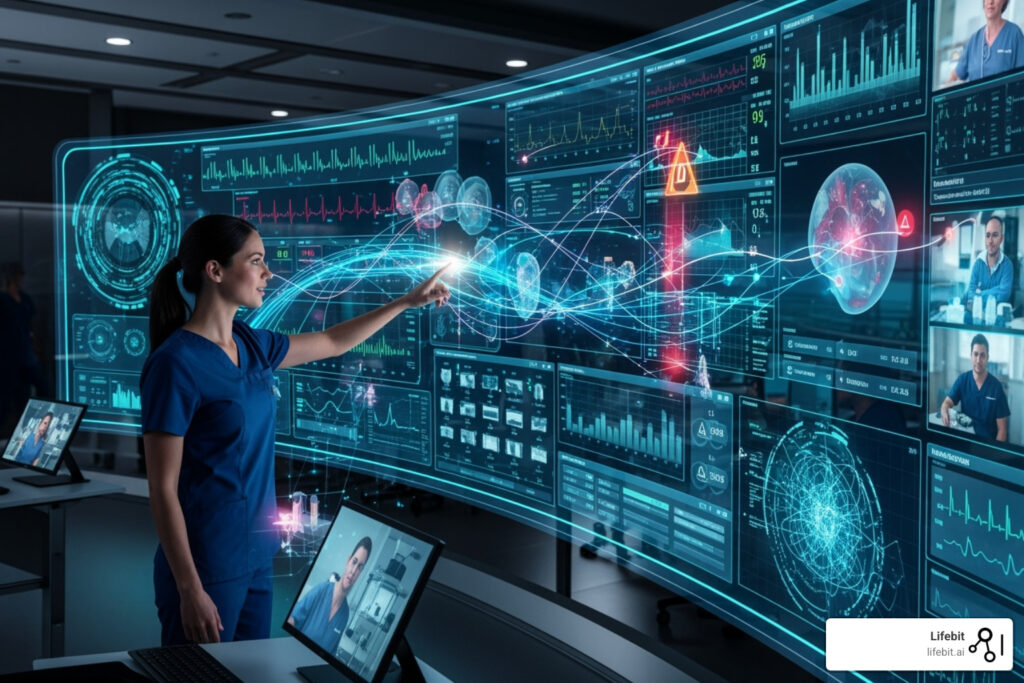
Real-time healthcare analytics is revolutionizing how medical professionals deliver care by processing and analyzing health data instantly as it’s generated. Unlike traditional batch processing that can take 24 hours to several days, real-time analytics provides immediate insights that enable faster clinical decisions and proactive interventions.
Key benefits of leveraging real-time analytics in healthcare:
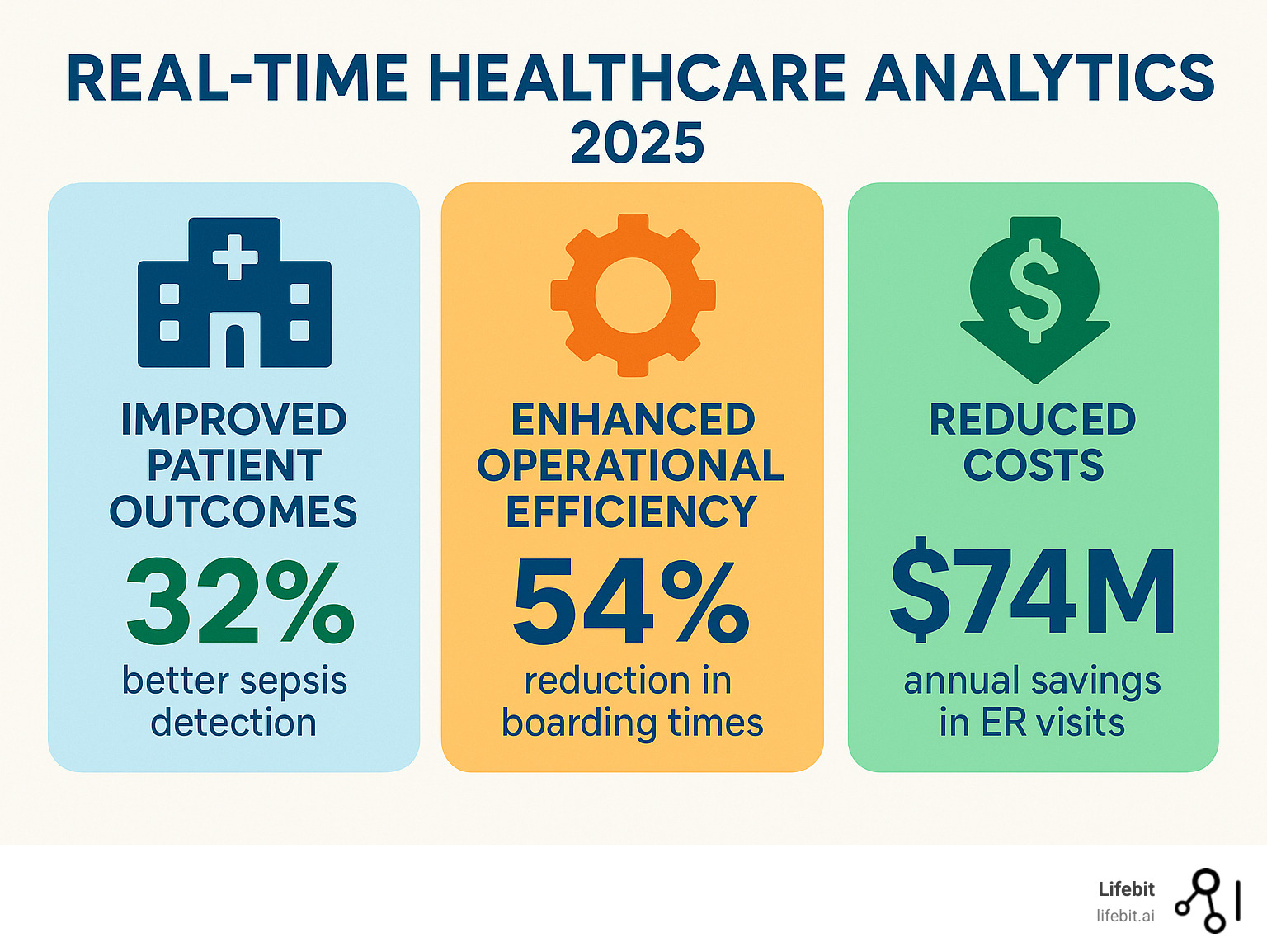
- Improved Patient Outcomes – Early detection of conditions like sepsis (32% improvement in detection rates with AI)
- Improved Operational Efficiency – Reduced boarding times by 54% and lost cases by 20%
- Cost Reduction – $74M saved annually in ER visits through optimized patient flow
- Proactive Care – Shift from reactive treatment to preventive interventions
- Better Resource Allocation – Real-time staffing and capacity management
The healthcare industry is experiencing a fundamental shift from volume-based to value-based care. This change demands immediate access to patient data, operational metrics, and predictive insights to make informed decisions at the point of care.
Consider this scenario: On a Tuesday night, a nurse in the emergency department receives a real-time alert on her smartphone: the department will be overcrowded within 1.5 hours. This isn’t science fiction – it’s happening today in hospitals using real-time analytics to predict patient surges and optimize resources.
The COVID-19 pandemic accelerated healthcare’s digital change, compressing a decade of technological adoption into just 10 weeks. Healthcare organizations that previously relied on daily or weekly data reports now need instant insights to manage patient flow, track disease spread, and coordinate care across multiple facilities.
I’m Maria Chatzou Dunford, CEO and Co-founder of Lifebit, where I’ve spent over 15 years developing computational biology and AI solutions that enable secure, federated analysis of biomedical data. My experience building real-time healthcare analytics platforms has shown me how instant data access can transform patient outcomes and operational efficiency across global healthcare systems.
Must-know real-time healthcare analytics terms:
- AI for biomarker discovery
- Best AI for Genomics
- trusted research environment
How Real-Time Analytics Improves Patient Outcomes
Imagine a world where your doctor knows you’re getting sick before you do. Where treatment plans are designed specifically for your unique genetic makeup. Where your smartwatch doesn’t just count steps, but actually saves your life.
This isn’t science fiction – it’s happening right now thanks to real-time healthcare analytics. By processing health data the moment it’s created, we’re moving from a healthcare system that waits for problems to one that prevents them.
Early Disease Detection and Proactive Intervention
Every year, sepsis kills about 270,000 people in the United States alone. The cruel irony? Many of these deaths could be prevented if we caught the condition just a few hours earlier.
Traditional healthcare has always been reactive. A patient shows symptoms, tests are ordered, results come back hours or days later, and then treatment begins. But sepsis doesn’t wait for our schedules – it can kill within hours.
Real-time healthcare analytics changes this entire equation. Instead of waiting for batch reports that might be outdated before anyone reads them, algorithms continuously monitor patient data from EHRs, lab results, and bedside monitors. They’re looking for subtle patterns that even experienced doctors might miss.
The results are remarkable. AI systems can improve sepsis detection rates by up to 32% compared to traditional methods. The Sepsis Early Risk Assessment (SERA) system exemplifies this approach, using predictive risk models to identify patients at risk before they show obvious symptoms.
Think of it like having a medical detective that never sleeps, never gets tired, and can process thousands of data points simultaneously. When something looks suspicious – maybe a subtle change in heart rate combined with a slight temperature increase and an unusual lab value – the system immediately alerts the medical team.
This shift from “what happened” to “what’s happening right now” is saving lives every day.
Personalized Treatment and AI-Powered Diagnosis
The “standard” treatment that works for most patients may not be best for you, as your unique genetic makeup, lifestyle, and medical history all influence treatment response. Real-time healthcare analytics powered by AI makes truly personalized medicine possible, moving beyond a “one-size-fits-all” approach to provide treatment recommendations tailored to your unique biological profile.
The process is fascinating. AI systems analyze vast amounts of data including genetic information, lifestyle factors, and your complete medical history to create a comprehensive picture of your health. Machine learning algorithms trained on millions of patient records can identify which treatments work best for people with your specific characteristics.
This isn’t just theoretical. AI systems are already helping doctors interpret complex medical images, spot subtle abnormalities, and suggest potential diagnoses based on massive databases of medical knowledge. The goal isn’t to replace doctors – it’s to give them superhuman analytical capabilities.
The impact on patient outcomes is significant. Treatments become more effective because they’re designed for you specifically. Side effects decrease because the system can predict how you’ll likely respond to different medications.
To understand more about how this data revolution is changing healthcare, explore our insights on Real-World Data and Big Data in Biomedicine.
The Role of Wearables and Patient-Generated Data
Your smartphone probably has more computing power than the computers that sent humans to the moon. Your smartwatch can monitor your heart rhythm more continuously than most hospital equipment from just a decade ago. This isn’t just convenient – it’s revolutionary.
Wearable devices like fitness trackers and smartwatches are becoming powerful health monitoring tools that work 24/7. They collect heart rate data, activity levels, sleep patterns, and even ECG readings – creating an unprecedented window into your health outside the doctor’s office.
The real magic happens when this continuous stream of data integrates with real-time healthcare analytics systems. Suddenly, your doctor doesn’t just see you during your annual checkup – they can monitor your health trends continuously and spot problems early.
Consider this incredible story: a 12-year-old girl received an alert from her Apple Watch about an unusually high heart rate. When her family sought medical attention, doctors found a rare tumor on her appendix. That smartwatch literally saved her life by detecting something wrong before anyone else noticed.
Remote patient monitoring is particularly powerful for people with chronic conditions. Instead of waiting for symptoms to worsen, healthcare providers can track patients continuously and adjust treatments in real-time. This approach improves patient outcomes while reducing the need for expensive emergency interventions.
The beauty of patient-generated data is that it captures your real life, not just the snapshot your doctor sees during brief clinic visits. This continuous, real-world data is invaluable for both individual care and advancing medical research.
Learn more about how this patient-generated information is advancing healthcare in our guide to the Benefits of Real-World Data in Clinical Research.
Enhancing Operational Efficiency with Real-Time Healthcare Analytics
In a hospital, timing is everything. Real-time healthcare analytics acts as a conductor, ensuring every part of the system works in harmony to maximize efficiency and deliver exceptional care. By turning chaotic environments into well-orchestrated operations, it allows administrators to shift from reactive problem-solving to proactive, predictive management, fundamentally changing daily hospital operations.
Optimizing Hospital Operations with Real-Time Healthcare Analytics
Emergency departments are often the heartbeat of any hospital, and when that heartbeat becomes irregular, the entire system feels the strain. Long wait times, overcrowded beds, and patients leaving without being seen are symptoms of a system that lacks real-time visibility into its operations.
Enter the “Mission Control” model – a concept borrowed from NASA’s operational centers. Picture a command center where healthcare professionals monitor patient flow, bed availability, and resource allocation in real-time, just like mission controllers track spacecraft. This isn’t science fiction; it’s happening in hospitals today with remarkable results.
A large healthcare system implemented this data-driven Mission Control approach and achieved extraordinary outcomes. Boarding was reduced by 54 percent on average, as measured daily at 5 a.m., while lost cases dropped by 20 percent in just the first six months. The Physician on Duty program, part of this initiative, created a contribution margin equal to 74 percent of its labor cost in its first year through additional admissions and prevention of lost cases.
The Medical University of South Carolina (MUSC) exemplifies this approach by using real-time healthcare analytics to continuously monitor patient health. By drawing on EHR data and machine learning, they can classify signs of sepsis onset and coordinate care activities that might be falling behind schedule. This proactive approach enables timely intervention, potentially saving lives through immediate data insights.
The change is profound: instead of finding bottlenecks hours after they occur, hospital staff receive instant alerts about potential issues. This allows them to redirect resources, adjust staffing, and optimize patient flow before problems escalate. For healthcare leaders interested in this approach, the research paper FROM NASA TO HEALTHCARE: REAL-TIME DATA ANALYTICS (MISSION CONTROL) IS RESHAPING HEALTHCARE SERVICES provides deeper insights into implementation strategies.
Strategic Staff and Resource Allocation
Healthcare is facing an unprecedented staffing crisis. The US healthcare system is projected to face a shortage of up to 195,400 nurses by 2031 and up to 124,000 physicians by 2030. In this environment, every staffing decision matters more than ever before.
Real-time healthcare analytics transforms how hospitals approach this challenge by predicting staffing needs with remarkable precision. Instead of relying on gut feelings or historical averages, hospitals can now use sophisticated algorithms that analyze patient admission patterns, seasonal trends, and real-time capacity data.
Intel’s recent research demonstrates this power in action. Four hospitals used time series analysis – a statistical technique that identifies patterns within admission records – to forecast future demand with impressive accuracy. This allows for dynamic staffing adjustments, ensuring the right number of personnel are available exactly when needed.
The impact goes beyond just having enough staff. Physician burnout, often caused by bureaucratic tasks like billing and insurance approvals, can be reduced when real-time analytics automate and optimize operational processes. According to Medscape’s 2023 report, administrative burden is a top contributor to physician stress, making operational efficiency not just a business imperative but a workforce wellness issue.
Resource allocation extends far beyond personnel. During the COVID-19 pandemic, hospitals used real-time analytics to track test kit quantities, PPE availability, and ventilator capacity. This enabled swift, data-driven decisions about where to deploy scarce resources most effectively.
A Clinical Data Integration Platform becomes essential for this level of optimization. By consolidating data from patient records, billing systems, scheduling platforms, and financial databases, healthcare systems gain a comprehensive, real-time view of their operations. This integrated approach allows administrators to make proactive decisions that minimize waste while maximizing both efficiency and patient satisfaction.
Supporting Public Health and Pandemic Response
The COVID-19 pandemic proved that real-time healthcare analytics is essential for public health. In a crisis, the ability to track disease spread, viral mutations, and resource availability in real-time is critical for an effective response, far surpassing traditional, slower surveillance methods. For instance, real-time analysis of CT scans helped clinicians make immediate treatment decisions for COVID-19 patients, while integrated platforms tracked scarce resources like test kit quantities, PPE availability, and hospital capacity across facilities, enabling data-driven deployment.
The applications extend well beyond pandemics. Healthcare organizations use predictive analytics to combat various health threats by identifying outbreak patterns and coordinating responses. Real-time pharmacovigilance is another crucial use case, allowing for the immediate detection of adverse drug reactions. Instead of waiting months, systems can flag potential medication issues as they emerge, protecting patients and enabling rapid safety interventions. Learn more about Real-Time Adverse Drug Reaction Surveillance and how it’s changing medication safety.
The lesson is clear: healthcare systems that leverage real-time data are better equipped to protect both individuals and entire populations.
Overcoming Challenges and Looking to the Future

While real-time healthcare analytics offers incredible benefits, implementing these systems comes with real-world challenges that need thoughtful solutions. The good news? Technology is evolving rapidly to address these problems, and the future holds exciting possibilities that will make healthcare smarter, safer, and more personalized than ever before.
Navigating Data Integration, Privacy, and Security
Picture this: a patient visits three different specialists in one week, each using a different electronic health record system. Despite treating the same person, these doctors can’t easily share information or see the complete picture of the patient’s health. This fragmentation is one of the biggest obstacles facing real-time healthcare analytics today.
The reality is that many EHR systems are poorly interconnected, creating data silos that prevent healthcare providers from accessing comprehensive patient information. Clinicians often feel frustrated because they can’t measure the quality of their work effectively or access complete medical histories, which directly impacts the care they can provide.
Data privacy and security add another layer of complexity. Healthcare data is incredibly sensitive, and regulations like HIPAA exist for good reason. Any real-time analytics solution must include robust security measures – data encryption, access controls, and anonymization techniques – to protect patient information without compromising functionality.
The challenge becomes even more complex when we consider the Challenges of Using Real-World Data in Research. Researchers need access to large datasets to develop better treatments and interventions, but they must do so while maintaining strict privacy standards and regulatory compliance.
Federated analytics offers a promising solution to these challenges. This approach allows healthcare organizations to derive insights from data without actually moving sensitive information between systems. Instead of centralizing data, the analytics come to the data, improving both security and compliance while breaking down silos.
Future Trends in Real-Time Healthcare Analytics
The future of healthcare is being written right now, and real-time healthcare analytics is holding the pen. Several exciting trends are emerging that promise to transform how we approach patient care and medical research.
Precision medicine is moving beyond one-size-fits-all treatments toward truly personalized care. Future systems will integrate incredibly detailed data – including continuous genomic and proteomic information – to create treatment plans custom to each individual’s unique biology. Imagine receiving medication dosages adjusted in real-time based on how your body is processing the drug at that exact moment.
Federated learning is revolutionizing how healthcare organizations collaborate while protecting patient privacy. This technology allows AI models to learn from data across multiple hospitals and research institutions without the sensitive information ever leaving its original location. It’s like having a study group where everyone contributes knowledge without sharing their private notes. Our research on Innovating Healthcare RWD Strategies for Pharma Companies explores how this approach is changing pharmaceutical research.
Edge computing brings data processing closer to where it’s needed most. Instead of sending patient data to distant servers for analysis, processing happens right at the hospital or even on wearable devices. This dramatically reduces delays and enables ultra-fast responses for critical situations like surgical guidance or emergency alerts.
Advanced AI models are becoming more sophisticated every day. These systems will soon provide even more accurate predictions, nuanced diagnostic support, and intelligent automation of time-consuming administrative tasks that currently burden healthcare providers.
Genomics integration is becoming routine rather than exceptional. As genetic sequencing becomes standard practice, real-time integration into electronic health records will enable personalized pharmacogenomics – predicting how individuals will respond to specific medications based on their genetic makeup, all happening in real-time during clinical decision-making.
These advances point toward a healthcare system that’s not just more efficient, but genuinely more intelligent and responsive to individual patient needs. The future of medicine isn’t just about treating disease – it’s about preventing it, personalizing it, and making every healthcare interaction more effective and compassionate.
Frequently Asked Questions about Real-Time Healthcare Analytics
When healthcare professionals first encounter real-time healthcare analytics, they often have similar questions about implementation, benefits, and practical applications. Having worked with countless healthcare organizations implementing these systems, I’ve found these three questions come up most frequently.
What is the primary benefit of real-time healthcare analytics?
The game-changing advantage of real-time healthcare analytics is changing healthcare from a reactive “wait and see” approach to a proactive “predict and prevent” model. Instead of responding to problems after they occur, we can now anticipate and intervene before they escalate.
This shift creates a ripple effect of improvements throughout healthcare delivery. Clinicians gain instant access to patient status updates, quality measures, complete medical histories, and risk scores – all updating in real-time. This means a nurse can receive an alert about a patient’s deteriorating condition before visible symptoms appear, or an administrator can predict an emergency department surge hours before it happens.
The financial impact is equally impressive. Hospitals using real-time analytics report reducing boarding times by 54% and preventing lost cases by 20%. When you can make decisions based on what’s happening right now rather than yesterday’s data, every aspect of care delivery becomes more efficient and effective.
How does AI work with real-time analytics?
Think of AI as your incredibly smart colleague who never sleeps and can process thousands of data points simultaneously. AI algorithms continuously analyze the stream of real-time data flowing from EHRs, monitoring devices, lab results, and even wearables to spot patterns that humans might miss.
The magic happens in the speed and complexity of analysis. While a human clinician might review a patient’s recent lab results and vital signs, AI can simultaneously analyze that same patient’s complete medical history, compare it to thousands of similar cases, factor in current medication interactions, and identify subtle early warning signs of conditions like sepsis – all within seconds.
For example, AI can detect early sepsis indicators by analyzing minute changes in heart rate variability, blood pressure trends, and lab values that might seem normal individually but together suggest developing sepsis. Similarly, AI can predict patient admission surges by analyzing historical patterns, current emergency department flow, and even external factors like weather or local events.
The result? Healthcare providers receive actionable recommendations exactly when they need them, enabling faster, more informed decisions that improve patient outcomes.
What are the first steps to implementing real-time analytics?
Starting your real-time healthcare analytics journey doesn’t require overhauling your entire system overnight. The key is beginning with a focused, high-impact use case that will demonstrate clear value and build momentum for broader implementation.
Choose your first battle wisely. The most successful implementations start with specific, measurable challenges like sepsis detection in the ICU, emergency department patient flow optimization, or predictive staffing for high-demand units. These focused applications allow you to prove value quickly while learning valuable lessons about data integration and user adoption.
Data quality is your foundation. Before diving into analytics, ensure you have access to clean, standardized data from your key systems – EHRs, lab systems, monitoring devices, and administrative databases. Many organizations find that their biggest challenge isn’t the analytics platform itself, but consolidating and harmonizing data from multiple sources.
Platform selection matters tremendously. You need a solution that can handle real-time data ingestion and analysis while maintaining strict security and compliance standards. Technologies like Change Data Capture (CDC) are essential for moving beyond traditional batch processing to true real-time insights.
The most successful implementations also invest heavily in change management and training. Even the most sophisticated analytics platform won’t improve outcomes if clinicians don’t understand how to interpret and act on the insights it provides.
Conclusion
We’ve reached a pivotal moment in healthcare history. Real-time healthcare analytics isn’t just another tech buzzword – it’s fundamentally changing how we care for patients and run healthcare systems. Think about it: we’ve moved from waiting days for test results to getting instant alerts when a patient’s condition changes. That’s not just progress; that’s change.
The numbers speak for themselves. Hospitals using real-time analytics are detecting sepsis 32% more effectively, reducing patient boarding times by 54%, and saving millions in operational costs. But beyond the statistics, there’s something more profound happening. We’re shifting from a healthcare system that reacts to problems to one that prevents them.
This change means your doctor can spot warning signs before you even feel sick. It means hospitals can prepare for patient surges before they happen. And it means treatments can be custom specifically to your genetic makeup and lifestyle, not just your symptoms.
Of course, making this vision a reality isn’t simple. Healthcare data is scattered across different systems, privacy regulations are strict, and security concerns are real. That’s where innovative approaches like federated analytics become crucial. Instead of moving sensitive data around (which creates security risks), we can analyze it right where it lives.
At Lifebit, we’ve built our federated platform specifically to solve these challenges. Our system enables secure, real-time access to global biomedical data without the headache of moving it around. With built-in capabilities for data harmonization, advanced AI analytics, and federated governance, we’re helping hospitals, research institutions, and pharmaceutical companies open up the full potential of their data while keeping it completely secure.
The future we’re building isn’t just about better technology – it’s about better outcomes for everyone. Patients get more personalized care, doctors make more informed decisions, and healthcare systems run more efficiently. It’s a win-win-win scenario that seemed impossible just a few years ago.
Ready to see how real-time healthcare analytics can transform your organization? Explore Lifebit’s federated data platform and find what’s possible when you combine cutting-edge technology with a deep understanding of healthcare’s unique challenges.