

Trusted Data Solutions That Won’t Break Your Heart or Your Budget
How Trusted Data Solutions Cut Research Costs by 60% and Secure 187M+ Records
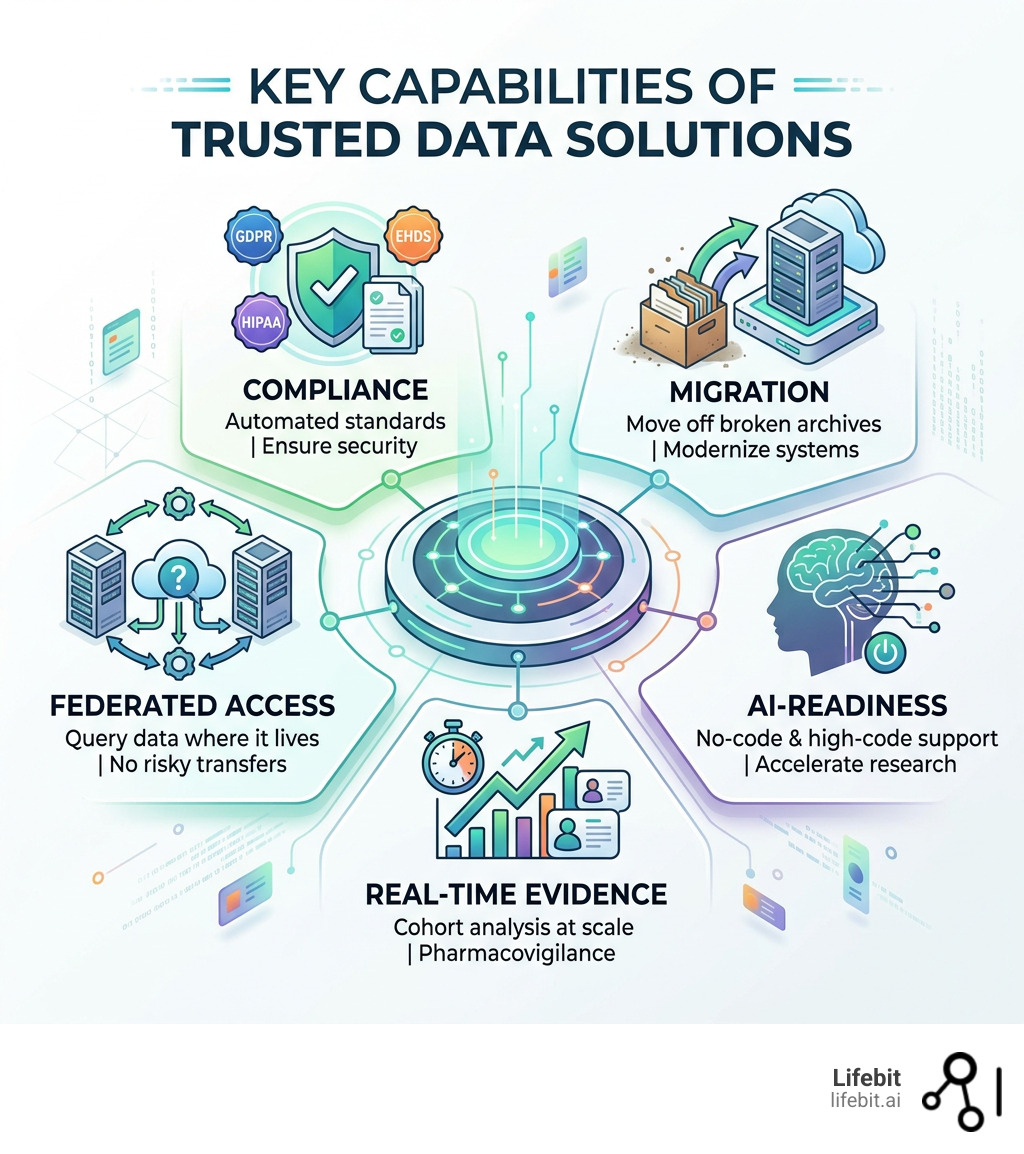
Trusted data solutions are platforms, tools, and services that give organizations secure, compliant, and scalable access to complex datasets — without sacrificing data privacy or research speed.
Here’s a quick look at what the best trusted data solutions deliver:
| Capability | Why It Matters |
|---|---|
| Federated data access | Query data where it lives — no risky transfers |
| Compliance automation | Meet GDPR, HIPAA, and EHDS standards without manual effort |
| Legacy data migration | Move off broken archives before they cost you more |
| AI-ready environments | Enable no-code and high-code researchers on the same platform |
| Real-time evidence generation | Power pharmacovigilance and cohort analysis at scale |
If you’re managing siloed EHR records, genomics datasets, or aging archive systems, you already know the pain. Data is everywhere — and yet somehow still out of reach. Legacy infrastructure breaks under modern data volumes. Migration projects stall on compliance questions. And the cost of doing nothing keeps climbing.
The numbers make this concrete. Marketing data alone contains up to 60% errors. Email archive systems built a decade ago simply weren’t designed for today’s communication channels. And in biomedical research, the stakes are even higher — slow data access doesn’t just waste budget, it delays therapies that patients are waiting for.
I’m Maria Chatzou Dunford, CEO and Co-founder of Lifebit, and I’ve spent over 15 years building computational tools and federated platforms that make trusted data solutions a reality for pharma, public sector, and healthcare research organizations worldwide. I’ll break down exactly what separates solutions that scale from those that silently drain your budget and put your compliance at risk.
Related content about Trusted data solutions:
Trusted Data Solutions: 5 Ways to Stop Losing Millions to Legacy Data
Managing data shouldn’t feel like a hostage situation. Yet, many organizations find themselves trapped by “archive debt”—paying premium prices to store data they can’t easily access, in systems that don’t talk to each other. When we talk about Trusted data solutions, we aren’t just talking about storage; we’re talking about the bridge between stagnant information and actionable intelligence.
Whether you are migrating 20 years of legacy email archives or trying to link clinical trial data to long-term survival outcomes, the “old way” of moving files around is dead. It’s too slow, too risky, and far too expensive. In the current landscape, the cost of data storage is often eclipsed by the cost of data inaccessibility. When a researcher or a legal team cannot retrieve a specific record within minutes, the resulting delay ripples through the entire organization, leading to missed market opportunities or regulatory penalties.
Consider the financial impact of “dark data”—information that is collected, processed, and stored during regular business activities but generally fails to be used for other purposes. For a mid-sized pharmaceutical company, dark data can account for up to 80% of their total data volume. Without trusted data solutions, this information is a liability rather than an asset. It incurs storage costs and increases the attack surface for cyber threats without providing any analytical value. Modern solutions flip this script by implementing intelligent indexing and automated classification, ensuring that every byte of data is searchable, compliant, and ready for analysis from the moment it is ingested.
Furthermore, the transition to these solutions is often hindered by the fear of “data egress” fees and the complexity of multi-cloud environments. Many legacy providers intentionally make it difficult to move data out of their ecosystems. A truly trusted solution breaks these chains by prioritizing interoperability and using open standards, allowing organizations to move their data to the environments where it can do the most good—whether that is a high-performance computing cluster for genomic sequencing or a secure cloud bucket for long-term preservation.
The Crisis of Legacy Data: Why Your Current Archive is Failing
Most legacy systems were built for a world that no longer exists. They were designed for static spreadsheets and simple emails, not the massive volumes of multi-omic data, instant messaging, and cloud collaboration tools we use today. The architecture of the early 2000s simply cannot support the “Data Gravity” of the 2020s, where the sheer size of datasets makes moving them to applications nearly impossible.
When your infrastructure is outdated, you face three primary “heartbreak” scenarios:
The Maintenance Trap: You are spending a significant portion of your IT budget just keeping the lights on for legacy archiving systems that are being discontinued or reaching end-of-life. These “zombie systems” often require specialized knowledge to maintain—knowledge that leaves the company as senior engineers retire. This creates a single point of failure where a hardware glitch could result in permanent data loss because the original vendor no longer provides patches or replacement parts.
The Discovery Gap: When a legal hold or a discovery request comes in, can you find the data? If your archive isn’t “discovery ready,” you’re looking at weeks of manual labor and potential fines. In high-stakes litigation or regulatory audits, the inability to produce records in a timely manner is often interpreted as a lack of control, leading to harsher penalties. Trusted data solutions integrate eDiscovery tools directly into the storage layer, allowing for near-instantaneous keyword searching and metadata filtering across billions of records.
The Scalability Wall: As communication channels explode—incorporating Slack, Microsoft Teams, Zoom transcripts, and IoT sensor data—older systems simply can’t keep up with the volume. This leads to data loss or, worse, shadow IT where employees store sensitive info in unmanaged places like personal Dropbox accounts or local hard drives just to get their work done. This fragmentation destroys the “single source of truth” and makes comprehensive data governance impossible.
Trusted data solutions solve this by prioritizing “technology refresh” cycles and elastic scaling. Instead of patching a sinking ship, these solutions allow for a clean transition to cloud-native archiving. In these environments, data retention and legal holds are managed by software-defined policies rather than hardware limitations. This means that as your data grows from petabytes to exabytes, your infrastructure scales automatically, ensuring that performance never degrades even as the complexity of your data estate increases.
Modernizing Infrastructure with Lifebit’s Trusted Data Solutions
We believe that data should be a business accelerator, not a security risk. Modernizing your infrastructure requires a strategic assessment of what you actually have. Do you need to migrate every single byte? Or can you use intelligent tools to clarify which data to move, which to retain for legal reasons, and which to delete? This process, often called “data defensible deletion,” can reduce migration costs by up to 40% by eliminating redundant, obsolete, or trivial (ROT) data before the move even begins.
Our approach to Trusted data solutions focuses on creating secure data environments that allow for high-performance migration and extraction. By using automated workflows, we can help organizations transition from legacy on-premise setups to agile, hybrid-cloud ecosystems. This isn’t just about moving files; it’s about transforming the data into a format that is ready for the next generation of research tools.
Solving Migration Risks with Trusted Data Solutions
Migration is often where the “budget breaking” happens. Common risks include data corruption, loss of metadata (which ruins your chain of custody), and projects that run months over schedule. To mitigate this, we recommend a multi-phased approach:
- Strategic Planning: Use detailed checklists to manage the transition. This includes mapping out data dependencies and identifying “hot” data that needs to be accessible during the migration versus “cold” data that can be moved during off-peak hours.
- Data Integrity Checks: Ensure every record moved is certified for compliance. We use cryptographic hashing to verify that the data at the destination is a bit-for-bit match of the source data, providing a verifiable audit trail for regulators.
- Expert Support: Lean on teams with decades of experience who have completed thousands of projects. The nuances of migrating legacy medical records or complex financial ledgers require more than just a software tool; they require an understanding of the underlying data schemas.
Ensuring Compliance with Trusted Data Solutions
In the biomedical and public sectors, compliance isn’t optional—it’s the foundation of trust. Whether it’s GDPR in Europe or HIPAA in the US, your data solution must provide a Complete guide to Trusted Research Environments to ensure that only authorized users touch sensitive information.
The best Trusted data solutions implement “least-privilege” controls and the “Five Safes” framework: Safe People, Safe Projects, Safe Settings, Safe Data, and Safe Outputs. This means a researcher only sees the specific data points they need for their study, and nothing more. Every access point is logged in an immutable audit trail, ensuring you are always “audit-ready.” Furthermore, these environments are designed to prevent data “leakage” by disabling unauthorized downloads and print-screen functions, ensuring that while the insights can leave the environment, the sensitive raw data never does.
Securing the AI Era: Privacy-First Data Access
We are entering the age of “Agentic AI,” where AI agents can query data on behalf of users. This creates a massive security headache. If an AI agent has excessive privileges, it could accidentally expose sensitive patient info or proprietary research while trying to answer a simple prompt. Traditional perimeter-based security is useless here; you need security that is baked into the data itself.
This is where AI-powered security within Trusted data solutions becomes vital. By using out-of-band processing—where the security platform consumes only metadata without ever touching the raw data itself—organizations can achieve a level of oversight that was previously impossible. This approach allows for real-time monitoring of AI behavior, flagging any queries that seem to be “fishing” for sensitive patterns or attempting to reconstruct anonymized records.
Key benefits of this security model include:
- 99% Reduction in manual policy implementation: Stop writing manual rules for every user. Instead, use natural language policies that the system translates into technical permissions across your entire data estate.
- 60% Operational savings: Automation reduces the need for massive security teams to oversee every query. By automating the “gatekeeper” role, you allow your highly skilled security staff to focus on proactive threat hunting rather than routine access requests.
- Multi-cloud Security: Whether your data is in a public cloud, a data lakehouse, or a private server, your policies should be uniform. A trusted solution provides a single pane of glass to manage permissions, regardless of where the physical bits are stored.
As we move toward more complex AI models, including Large Language Models (LLMs) that require massive amounts of training data, the role of trusted data solutions becomes even more critical. These solutions provide the “clean room” environments where models can be trained on sensitive data without the risk of the model “memorizing” and later leaking private information. Techniques like differential privacy and synthetic data generation are integrated into the workflow, allowing for the benefits of AI innovation without the catastrophic privacy risks.
Unlocking Global Biomedical Insights at Scale
The most exciting frontier for Trusted data solutions is in global health. Clinical trials typically last 12-18 months, but the real impact of a drug might not be seen for 5-10 years. To understand long-term survival, researchers need to link trial data to real-world evidence (RWE) like mortality registries, electronic health records (EHRs), and even wearable device data. This multi-modal approach provides a 360-degree view of patient health that a single clinical trial never could.
Lifebit’s federated architecture allows this to happen across borders. We currently enable access to over 187 million patients across 35+ countries. Because the data stays at its source (e.g., within a hospital’s own server in the UK or Singapore), privacy is maintained while insights are shared globally. This bypasses the legal and ethical quagmire of moving sensitive genomic data across international lines, which is often prohibited by national sovereignty laws.
Powering Global Research with Trusted Data Solutions
Traditional data sharing involves moving massive files, which is a nightmare for security and a drain on the budget. Federated querying changes the game. You send the “question” to the data, and only the “answer” (the result) comes back. This is the core of the “Data-to-Code” model, where the analysis tools are brought to the data, rather than the other way around.
This is particularly powerful for:
- Oncology and Rare Diseases: Finding a cohort of patients with a specific genetic variant is much faster when you can query 100+ institutions simultaneously. In the past, a researcher might spend years contacting individual hospitals to find enough patients for a statistically significant study. With federated trusted data solutions, this can be done in an afternoon.
- Pharmacovigilance: Detecting drug safety signals in real-time by monitoring harmonized EHR and claims data. If a specific side effect begins appearing in a specific demographic across multiple countries, federated systems can flag this trend months before traditional reporting methods would.
- Faster Recruitment: Organizations using our Guide to Federated Research Environments have seen cohort recruitment accelerate by up to 60%. By identifying eligible patients through automated screening of EHRs, trials can start sooner and reach completion faster, bringing life-saving treatments to market more quickly.
Furthermore, the use of Common Data Models (CDMs) like OMOP allows for the harmonization of disparate datasets. This means that a researcher can run the same analysis script against data from a hospital in New York and a clinic in Tokyo without having to manually rewrite the code for different database schemas. This level of standardization is what truly enables global research at scale.
Frequently Asked Questions
What are the main risks of traditional biomedical data management and sharing?
The biggest risks are data silos and privacy breaches. When data is siloed, research cycles slow down because scientists spend 80% of their time just trying to find and clean data. Furthermore, moving raw data across borders often violates local regulations like GDPR or the upcoming EHDS (European Health Data Space) rules, leading to massive legal risks and potential multi-million dollar fines. There is also the risk of “data obsolescence,” where data stored in proprietary formats becomes unreadable as the software that created it disappears.
How do trusted data solutions reduce operational costs?
They eliminate the “hidden costs” of data management. By automating policy enforcement and permissions, you reduce the manual workload on IT and security teams by up to 99%. Additionally, moving to the cloud eliminates the need to maintain expensive, aging hardware for legacy archives. You also save on “opportunity costs”—the value of the research and insights that are lost when data is inaccessible. By making data “research-ready,” you accelerate the time-to-insight, which has a direct impact on the bottom line.
Why is federated data access better for global research?
Federated access is the only way to scale research without breaking privacy laws. It allows data owners to maintain 100% control and ownership of their files. Researchers get the insights they need in real-time, but the sensitive raw data never leaves its secure home. This builds trust between institutions, as they can collaborate without the fear of losing control over their most valuable intellectual property. It also reduces the technical burden on researchers, who no longer need to manage massive data transfers or worry about local storage capacity.
How do these solutions handle different data types?
Modern trusted data solutions are designed to be “multi-modal.” This means they can ingest and index everything from structured SQL databases and spreadsheets to unstructured data like medical images (DICOM files), genomic sequences (FASTQ/BAM), and even handwritten clinical notes through the use of Natural Language Processing (NLP). By bringing all these data types into a single, searchable ecosystem, organizations can perform much more complex cross-functional analysis.
What is the role of a Trusted Research Environment (TRE)?
A TRE is a secure space where researchers can access and analyze sensitive data under strict controls. It acts as a “digital safe room.” The TRE provides the necessary computing power and analytical tools (like R, Python, or SAS) within a locked-down environment. It ensures that no raw data can be exported, and only the final, aggregated results of the research are allowed to be taken out, following a thorough disclosure control process.
Conclusion: Stop Drowning in Data and Start Driving Discovery
The transition from legacy “broken” archives to Trusted data solutions is no longer a luxury—it’s a survival requirement in an increasingly data-driven world. Whether you’re trying to cut costs on email archiving, ensure compliance with evolving global privacy laws, or trying to cure a rare disease through international collaboration, the quality of your data management determines your success. Organizations that fail to modernize will find themselves buried under the weight of their own information, while those that embrace trusted solutions will lead the next wave of innovation.
At Lifebit, our federated AI platform—including our Trusted Research Environment (TRE) and Trusted Data Lakehouse—is built to ensure that your budget goes toward innovation, not infrastructure maintenance. We help you turn fragmented, multi-modal data into a research-ready ecosystem that respects privacy and scales with your ambitions. By removing the technical and regulatory barriers to data access, we empower your team to focus on what they do best: solving the world’s most complex challenges.
Ready to leave the legacy headaches behind and unlock the full potential of your data estate? Start building your Trusted Data Marketplace today and see how federated AI can transform your research, streamline your operations, and secure your organization’s future in the AI era.