

Watching Your Back with Patient Safety Surveillance
The Silent Crisis Patient Safety Surveillance Is Built to Solve
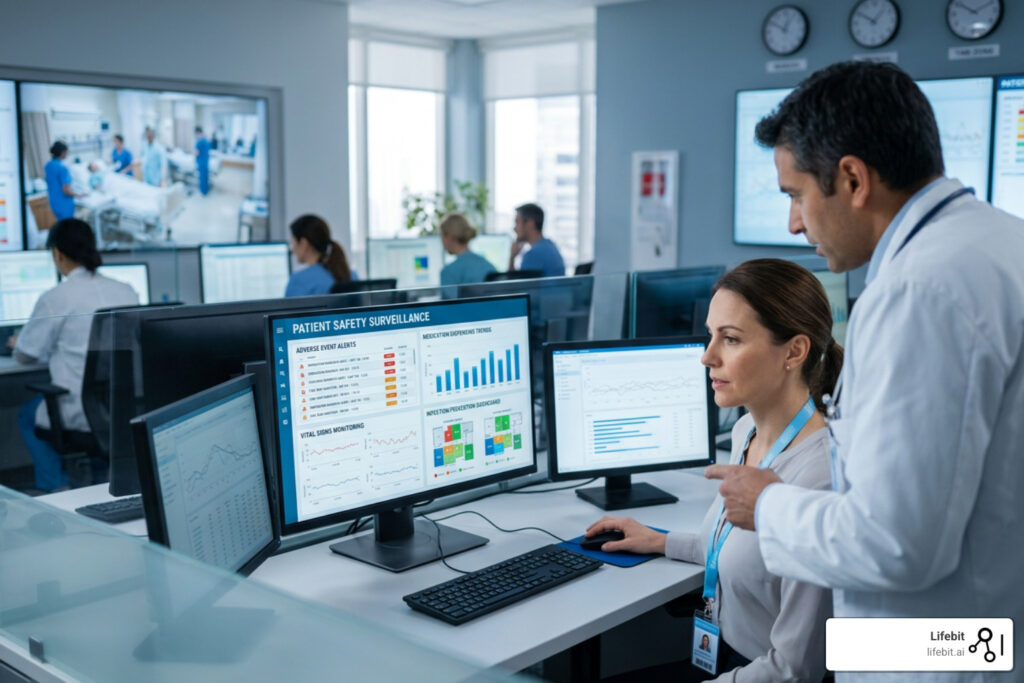
Patient safety surveillance is the systematic, ongoing monitoring of healthcare processes and outcomes to detect, measure, and prevent harm to patients. It represents a fundamental shift from retrospective analysis—looking at what went wrong after a patient has already been harmed—to real-time or near-real-time oversight designed to intercept errors before they reach the patient.
Here is what it covers in practice:
- What it monitors: Healthcare-associated infections (HAIs), adverse drug events (ADEs), surgical complications, pressure injuries, falls with injury, and venous thromboembolism (VTE).
- How it works: Through national reporting systems, automated trigger tools, continuous vital sign monitoring, and algorithmic chart review powered by natural language processing (NLP).
- Who uses it: Hospitals, public health agencies, regulators, and life sciences companies involved in post-marketing surveillance.
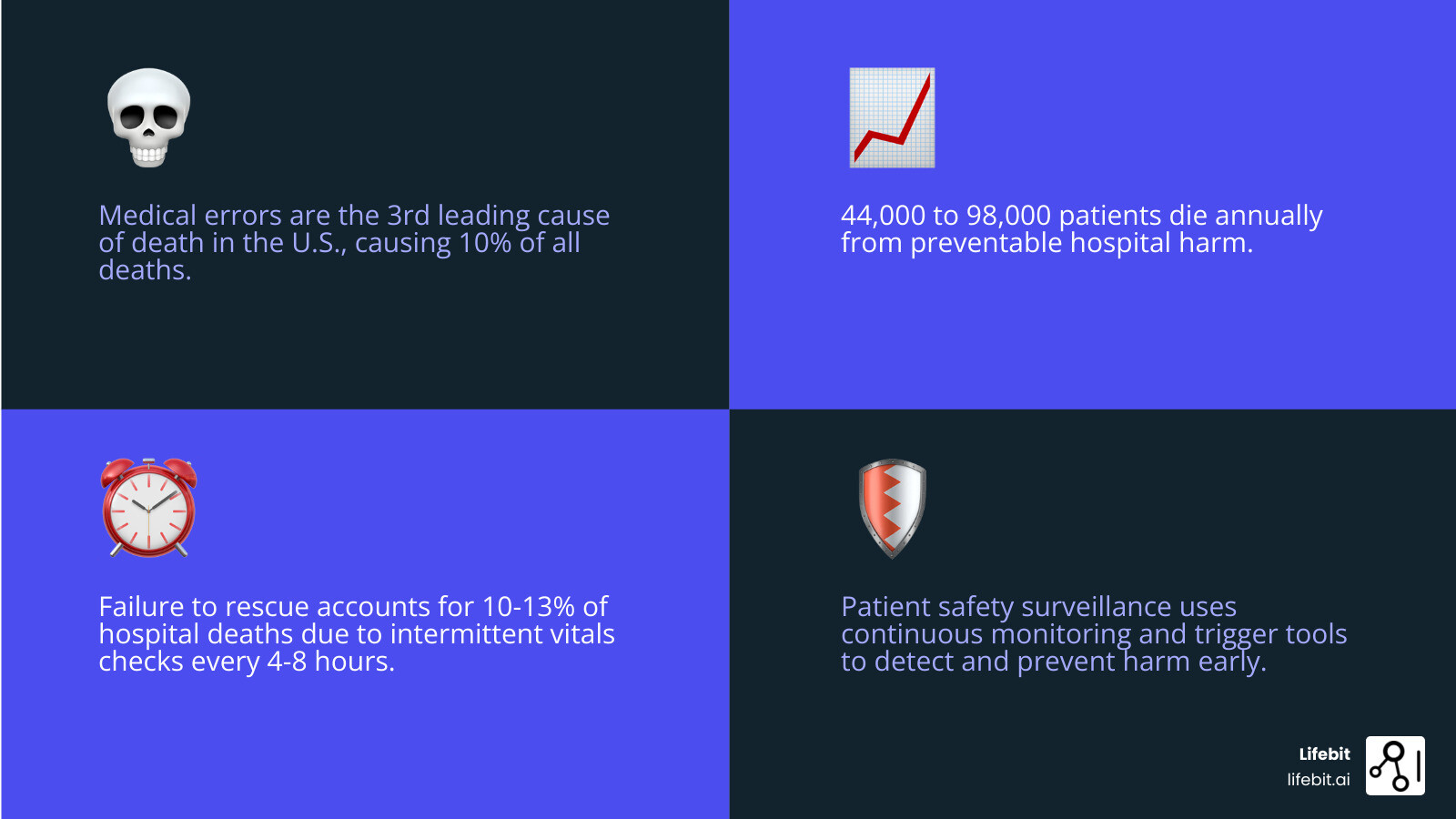
- Why it matters: Medical errors are the third leading cause of death in the U.S., accounting for 10% of all deaths — and most of that harm is preventable.
The scale of the problem is hard to ignore. The landmark 1999 Institute of Medicine report, To Err Is Human, estimated that between 44,000 and 98,000 patients die every year in the U.S. from harm caused by the healthcare system itself. More recent studies, including a high-profile analysis from Johns Hopkins, suggest the real number today may exceed 250,000 deaths annually. This makes medical error more lethal than respiratory disease, accidents, stroke, and Alzheimer’s.
To understand why this happens, we must look at the “Swiss Cheese Model” of system failure. In a complex healthcare environment, there are many layers of defense: policies, technology, and clinical expertise. However, each layer has holes (weaknesses). When these holes align, a hazard passes through all layers, resulting in a patient injury. Patient safety surveillance acts as a continuous scanner, identifying when these holes are beginning to align.
Yet in most general care hospital units, nurses check vital signs every 4 to 8 hours. If a patient deteriorates silently between those checks—perhaps due to sepsis or respiratory depression—nobody knows until it is too late. That gap — known as failure to rescue — accounts for an estimated 10% to 13% of all patient hospital deaths. Surveillance technology provides the “eyes” that never blink, closing the gap between intermittent checks.
I’m Maria Chatzou Dunford, CEO and Co-founder of Lifebit, where I’ve spent over 15 years building AI-powered, federated data platforms that enable real-time patient safety surveillance across secure, compliant healthcare environments. In this guide, I’ll walk you through exactly how to implement it.
Patient safety surveillance helpful reading:
Stop Medical Errors: Why Patient Safety Surveillance is Your Best Defense

The grim reality is that medical errors account for 10 percent of all deaths in the U.S., making them the third leading cause of death. When we talk about patient safety surveillance, we aren’t just talking about filling out forms; we are talking about creating a “fault-tolerant” system.
In industries like aviation or nuclear power, systems are designed to assume humans will make mistakes. These are known as High Reliability Organizations (HROs). The surveillance infrastructure in an airplane cockpit is there to catch those mistakes before they lead to a crash. Healthcare is finally catching up to this HRO philosophy. By shifting the focus from individual provider error to systemic harm detection, we can address the fact that nearly one in 25 hospital patients has at least one healthcare-associated infection (HAI) every single day.
The Human and Economic Cost
Beyond the mortality statistics, there is the “Second Victim” phenomenon. When a medical error occurs, the primary victim is the patient. However, the healthcare provider involved often becomes a second victim, experiencing significant psychological trauma, guilt, and career-ending stress. Effective surveillance protects staff by providing a safety net that catches errors before they become tragedies.
Economically, the burden is staggering. Preventable medical errors cost the U.S. economy approximately $20 billion annually. A single hospital-acquired pressure injury can increase a patient’s stay by several days and cost the facility upwards of $10,000 in non-reimbursed care. Surveillance systems pay for themselves by reducing these “never events”—serious incidents that should never occur in a hospital setting.
Effective surveillance doesn’t just wait for a nurse to notice a problem; it uses HAI data to proactively identify trends. Whether it is tracking central line-associated bloodstream infections (CLABSI) or hospital-acquired pressure injuries (HAPI), the goal is to move from a reactive “oops” to a proactive “stop.” This requires a culture of safety where data is used for improvement rather than punishment.
Unlocking Insights from National and State-Level Safety Frameworks
To implement a robust program, we must look at existing frameworks that standardize how we talk about harm. Without standardized definitions, it is impossible to benchmark performance or identify true outliers. National systems like the National Healthcare Safety Network (NHSN) provide the blueprint for this work.
| Feature | NHSN Patient Safety Component | State-Level PSSIS (e.g., Vermont) |
|---|---|---|
| Primary Focus | Healthcare-Associated Infections (HAIs) | Serious Reportable Adverse Events |
| Data Source | Clinical records, lab data, pharmacy | Hospital incident reports, causal analysis |
| Reporting Type | Mandatory for CMS/Optional for others | Statutory requirement (18 V.S.A. Chapter 43A) |
| Confidentiality | Federal protections | State-level immunity from subpoena |
Systems like the Vermont Statutes: Patient Safety Surveillance and Improvement System are essential because they provide legal protections. When hospitals know their data is confidential and privileged, they are more likely to report “near misses”—those close calls where an error occurred but did not reach the patient. Near misses occur 10 to 100 times more frequently than actual harm events, providing a much larger dataset for learning.
Standardizing Data with the Patient Safety Component (PSC)
The NHSN Overview and PSC Manual details how to track process measures. This includes monitoring antimicrobial use and resistance (AUR), multidrug-resistant organisms (MDRO), and Clostridioides difficile (CDI). By standardizing these definitions, we ensure that a CLABSI in New York is measured the same way as one in London or Singapore.
This consistency is the bedrock of AI for pharmacovigilance, where large-scale data harmonization allows us to spot safety signals across entire populations. For instance, if a specific batch of surgical mesh is causing a higher-than-average rate of complications, a standardized surveillance system can flag this across multiple hospital systems simultaneously.
The Role of the National Quality Forum (NQF)
The NQF maintains a list of “Never Events,” such as surgery performed on the wrong body part or an infant discharged to the wrong person. Surveillance systems are increasingly being tuned to monitor the precursors to these events. For example, by monitoring the “time-out” process in operating rooms through digital checklists, hospitals can ensure that the safety protocols designed to prevent wrong-site surgery are actually being followed in 100% of cases.
Cut Costs by 78%: Explicit Review vs. AI-Driven Patient Safety Surveillance
Traditional safety monitoring often relied on “implicit review”—having a doctor or nurse look at a chart and say, “I think something went wrong here.” This is expensive, subjective, and slow. It is also prone to hindsight bias, where the reviewer’s knowledge of the bad outcome colors their judgment of the care provided.
The Medicare Patient Safety Monitoring System (MPSMS) shifted the paradigm toward “explicit review.” This uses predefined algorithms to scan records for specific triggers, such as an unexpected transfer to the ICU or a sudden drop in hemoglobin.
- Cost Efficiency: Explicit review costs roughly $74 per chart, compared to $350 for traditional implicit clinical review. This allows hospitals to review 100% of charts rather than a small, non-representative sample.
- Reliability: By using algorithms, you achieve an inter-rater reliability agreement rate of nearly 95%, whereas two doctors reviewing the same chart implicitly often agree less than 60% of the time.
At Lifebit, we take this a step further. Our AI for pharmacovigilance ultimate guide explains how automated NLP (Natural Language Processing) can scan unstructured notes—like physician progress notes, nursing handovers, or even patient emails—to find the 95% of adverse events that are never reported through official channels. This is critical because voluntary reporting systems are notoriously underutilized; clinicians often feel they don’t have the time to fill out a report for every minor incident.
The Global Trigger Tool (GTT) Methodology
The Institute for Healthcare Improvement (IHI) developed the Global Trigger Tool, which identifies “triggers” (clues) that an adverse event may have occurred. Examples include:
- Medication Triggers: Use of Naloxone (suggests opioid overdose) or Vitamin K (suggests warfarin over-anticoagulation).
- Surgical Triggers: Return to the OR or a post-operative drop in hematocrit.
- Patient Care Triggers: Readmission within 30 days or a fall during the stay.
By automating the detection of these triggers, surveillance systems can provide a “Safety Score” for a unit in real-time, allowing managers to intervene if they see a spike in triggers.
Core Principles of Effective Patient Safety Surveillance
To make your surveillance program work, you need to follow three core principles:
- Intent: Focus on patient-centered harm rather than blaming providers. The goal is to fix the system, not punish the person.
- Relevance: Prioritize topics that have a high public health impact, such as those identified by AHRQ. Don’t try to monitor everything at once; start with high-risk, high-volume areas like medication administration.
- Transparency: Use clearly disclosed algorithms so everyone understands how “harm” is being defined. If a nurse understands why a patient was flagged as high-risk for a fall, they are more likely to trust the system.
This transparent approach is central to our real-time pharmacovigilance complete guide, ensuring that safety data is actionable and trusted by clinicians.
Solving the “Failure to Rescue” Crisis with Continuous Patient Safety Surveillance
The “failure to rescue” crisis occurs when a patient’s condition worsens in a general care unit and goes unnoticed. Standard practice involves checking vitals every 4–8 hours, but 8% of in-hospital cardiac arrests are unwitnessed and unmonitored. A patient can go from stable to septic in a matter of two hours—well within the window of a standard nursing check.
Surveillance monitoring provides a continuous electronic “safety net.” Unlike ICU monitoring, which has very tight thresholds that lead to constant beeping, surveillance monitoring in general units uses wider thresholds (e.g., an SpO2 of 80%) and a 15-second delay to filter out transient movements or sensor noise.
The results are staggering:
- Opioid-induced respiratory depression deaths dropped from 0.02% to 0.0009% with monitoring.
- Setting an 80% SpO2 threshold reduced alarms by 88%, significantly reducing the burden on staff.
- Adding a 15-second delay cut those remaining alarms by another 71%, ensuring that only sustained, clinically significant events triggered an alert.
Fix Alarm Fatigue: Overcoming Resistance and Data Gaps
One of the biggest hurdles in patient safety surveillance is clinician resistance, often driven by alarm fatigue. If a system cries wolf 100 times a day, nurses will eventually ignore it—or worse, turn it off. This is a well-documented phenomenon where the sheer volume of alerts desensitizes staff, leading to critical warnings being missed.
To fix this, we must use smarter analytics and Human Factors Engineering (HFE). HFE focuses on designing systems that account for human limitations and strengths. For example, instead of a loud siren for every alert, a surveillance system might use “tiered alerts”—a visual cue on a dashboard for low-risk trends and a haptic vibration on a mobile device for high-risk emergencies.
Case Study: The Power of Trigger Tools
A “trigger tool” approach used by Allina Health identified 333 additional HAPI (Hospital-Acquired Pressure Injury) events that were completely missed by voluntary reporting. This wasn’t just more data; it was better data that allowed for predictive modeling. By identifying the early signs of skin breakdown through nursing documentation analysis, they could deploy specialized pressure-relieving mattresses before a stage 1 injury progressed to stage 3.
However, predictive models are only as good as the documentation they feed on. In one study of CLABSI tracking, 23% of records were missing central line removal dates. If the data is missing, the surveillance system cannot accurately calculate the “days at risk.” We recommend using human factors engineering to integrate surveillance into existing workflows. Instead of adding a “new task,” the surveillance should happen in the background, pulling data directly from the EHR (Electronic Health Record).
The “Five Rights” of Clinical Decision Support
To ensure surveillance is effective and accepted by staff, it should follow the Five Rights:
- The Right Information: Evidence-based and actionable.
- To the Right Person: The nurse at the bedside, not just a manager in an office.
- In the Right Format: A clear, concise alert, not a wall of text.
- Through the Right Channel: Mobile device, EHR pop-up, or central dashboard.
- At the Right Time: Early enough to intervene, but not so early that it’s irrelevant.
This proactive stance is a cornerstone of post-marketing drug surveillance strategies, where the goal is to identify rare side effects that didn’t appear in clinical trials.
Frequently Asked Questions about Patient Safety Surveillance
What is the difference between surveillance and intermittent monitoring?
Intermittent monitoring is a “snapshot” taken every few hours by a staff member (e.g., manual blood pressure checks). Surveillance is a “movie”—a continuous stream of data that uses algorithms to alert staff only when a serious, sustained trend of deterioration is detected. Surveillance is designed to catch the “in-between” moments where patients often slip through the cracks.
How do trigger tools identify more harm events than voluntary reporting?
Voluntary reporting relies on a busy clinician remembering to file a report, which often only happens for the most severe cases. Trigger tools automatically scan the data for “red flags” (like the administration of an overdose reversal agent or an abrupt change in lab values). Research shows trigger tools can identify over 200% more cases of harm than voluntary processes alone because they are objective and exhaustive.
What are the legal protections for hospitals reporting to PSSIS?
In jurisdictions like Vermont, data reported to the Patient Safety Surveillance and Improvement System is legally protected. It is immune from subpoena and exempt from public records laws. This “safe harbor” is crucial; it ensures that hospitals can be honest about mistakes and conduct thorough root-cause analyses without fear that their internal investigations will be used against them in a court of law.
Can AI surveillance replace clinical judgment?
Absolutely not. AI and surveillance tools are designed to be “decision support” systems. They highlight potential risks that a human might miss due to cognitive overload or fatigue. The final clinical decision always rests with the healthcare professional. Think of it as a co-pilot that alerts the pilot to a storm cloud on the radar that isn’t yet visible through the windshield.
How does federated learning improve patient safety?
Federated learning allows AI models to be trained on data from multiple hospitals without the sensitive patient data ever leaving its original location. This means a surveillance algorithm can learn from the safety events of 100 different hospitals, becoming incredibly accurate at predicting rare complications, while still maintaining 100% data privacy and compliance with regulations like HIPAA or GDPR.
Conclusion
The future of patient safety surveillance lies in moving from “what happened” to “what is about to happen.” We are entering an era of predictive safety, where the combination of wearable sensors, high-fidelity EHR data, and advanced machine learning will allow us to build models that catch a pressure injury, a fall, or a septic event before the physical symptoms even manifest.
This shift requires more than just technology; it requires a commitment to data liquidity and transparency. For too long, safety data has been siloed within individual departments or facilities. To truly eliminate preventable harm, we must be able to analyze safety signals at scale, across entire populations and diverse demographics.
At Lifebit, we are pioneering this shift with our federated AI platform. By enabling secure, real-time access to global biomedical data, we help organizations run AI-driven safety surveillance without ever moving sensitive patient data. This ensures compliance while delivering the insights needed to save lives. We believe that in the near future, a hospital without a continuous surveillance system will be as unthinkable as an airplane without a black box or a cockpit without a radar.
Ready to close the “failure to rescue” gap and build a truly fault-tolerant healthcare system? Secure your data with the Lifebit Federated Biomedical Data Platform and start building a safer healthcare future today.