

9 Best HIPAA Compliant Data Analytics Platforms in 2026
Healthcare organizations sit on massive datasets that could transform patient outcomes, accelerate research, and cut costs. The problem? Most analytics tools weren’t built for regulated data. One wrong configuration, one unauthorized access, one data breach—and you’re facing millions in fines, destroyed trust, and potential criminal liability.
HIPAA compliance isn’t optional. It’s the baseline.
This guide cuts through the noise to show you which platforms actually deliver compliant analytics without sacrificing speed or capability. We evaluated each platform on security architecture, compliance certifications, analytics capabilities, and real-world deployment track records. Here are the top platforms worth your time.
1. Lifebit
Best for: Government health agencies and precision medicine programs requiring federated analytics without data movement
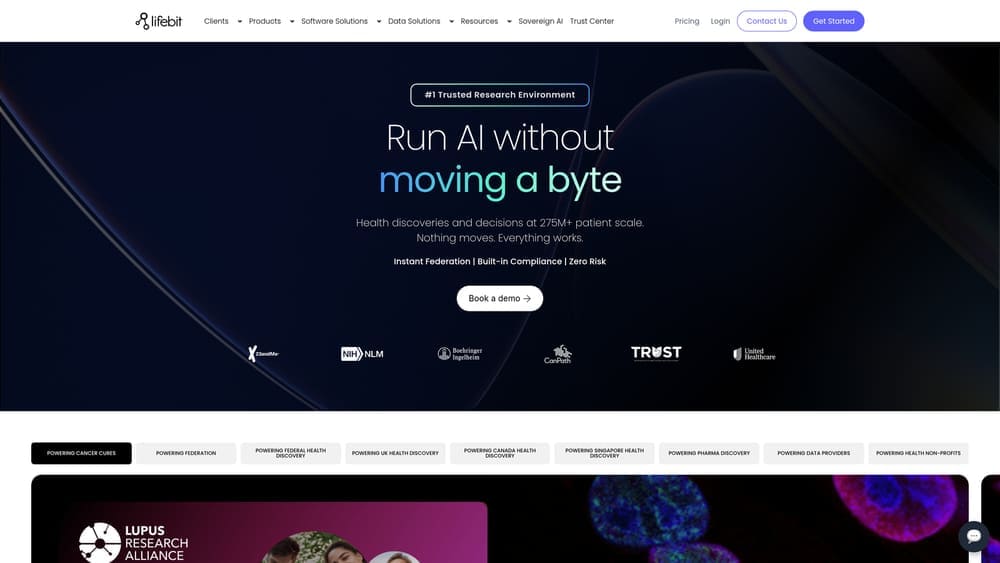
Lifebit is a federated data platform enabling secure analytics on sensitive biomedical data without ever moving it from its source location.
Where This Tool Shines
The fundamental challenge in healthcare analytics is that the most valuable insights come from combining datasets that can’t legally or practically be moved. Lifebit solves this with true federated analytics—your data stays exactly where it is, under your control, while the platform brings the computation to the data.
This architecture matters most when you’re dealing with national health programs, multi-institutional research, or cross-border collaborations where data movement creates compliance nightmares. The platform is trusted by organizations like NIH and Genomics England managing over 275 million records.
Key Features
Federated Analytics: Analyze data where it lives without movement, eliminating the largest compliance risk in healthcare analytics.
AI-Powered Data Harmonization: The Trusted Data Factory harmonizes disparate datasets in 48 hours instead of the typical 12-month timeline.
Comprehensive Compliance: FedRAMP, HIPAA, GDPR, and ISO 27001 compliant from day one of deployment.
AI-Automated Airlock: First-of-its-kind governance system for secure data exports with automated compliance checks.
Cloud-Agnostic Deployment: Deploy in your cloud environment with full control and no vendor lock-in.
Best For
Government health agencies building national precision medicine programs, biopharma R&D leaders accelerating drug pipelines, and academic consortia managing siloed, sensitive data across institutions. If your challenge is analyzing data that can’t be moved due to regulatory, sovereignty, or contractual constraints, this is the platform built for that exact problem.
Pricing
Custom enterprise pricing based on deployment scope and data volume. Contact for detailed quotes tailored to your specific use case.
2. Snowflake Healthcare Data Cloud
Best for: Large health systems with massive data volumes requiring elastic scaling and data sharing
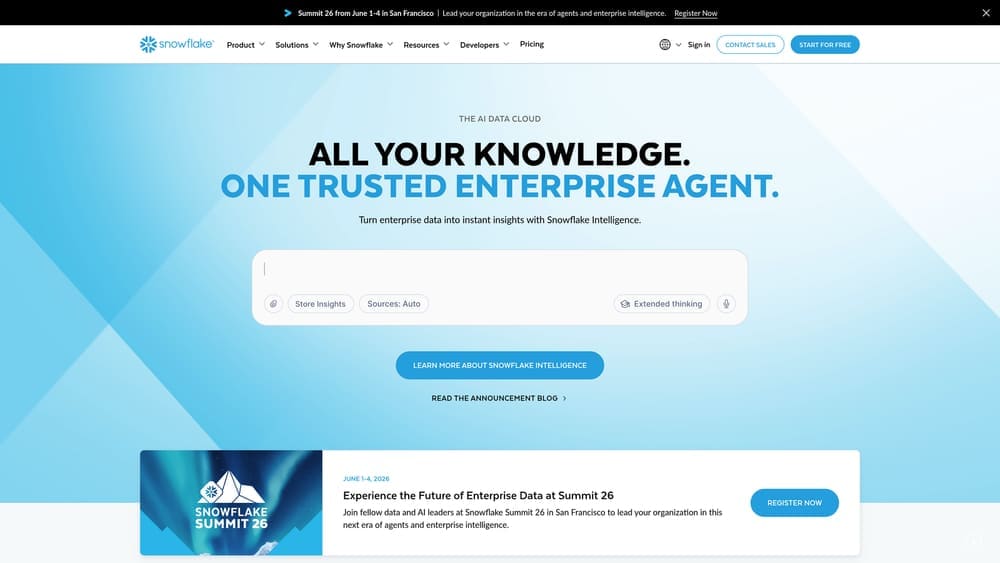
Snowflake Healthcare Data Cloud is a cloud data platform with healthcare-specific features designed for large-scale analytics.
Where This Tool Shines
Snowflake excels when you need to handle unpredictable workloads that range from routine reporting to massive ad-hoc analyses. The automatic scaling means you’re not paying for capacity you don’t use, and you’re not waiting when demand spikes.
The data sharing capability through Snowflake Marketplace is particularly valuable for health systems collaborating with payers, research partners, or public health agencies. You can share governed datasets without copying data or managing complex access systems.
Key Features
Native HIPAA Compliance: Signed Business Associate Agreements and built-in security controls designed for healthcare data.
Data Sharing Without Movement: Snowflake Marketplace enables secure data collaboration without creating copies or exposing raw data.
Automatic Scaling: Compute and storage scale independently based on actual usage, eliminating capacity planning guesswork.
Healthcare Data Models: Pre-built schemas and partner ecosystem for common healthcare analytics use cases.
Multi-Cloud Support: Run on AWS, Azure, or Google Cloud based on your existing infrastructure investments.
Best For
Large health systems with variable analytics workloads, organizations participating in data sharing collaborations, and teams that need to combine internal data with external datasets from partners or vendors.
Pricing
Usage-based pricing starting at $2 per credit with consumption varying by workload. Enterprise agreements available for predictable, high-volume usage.
3. Google Cloud Healthcare API
Best for: Organizations working with FHIR, HL7, and DICOM medical data standards
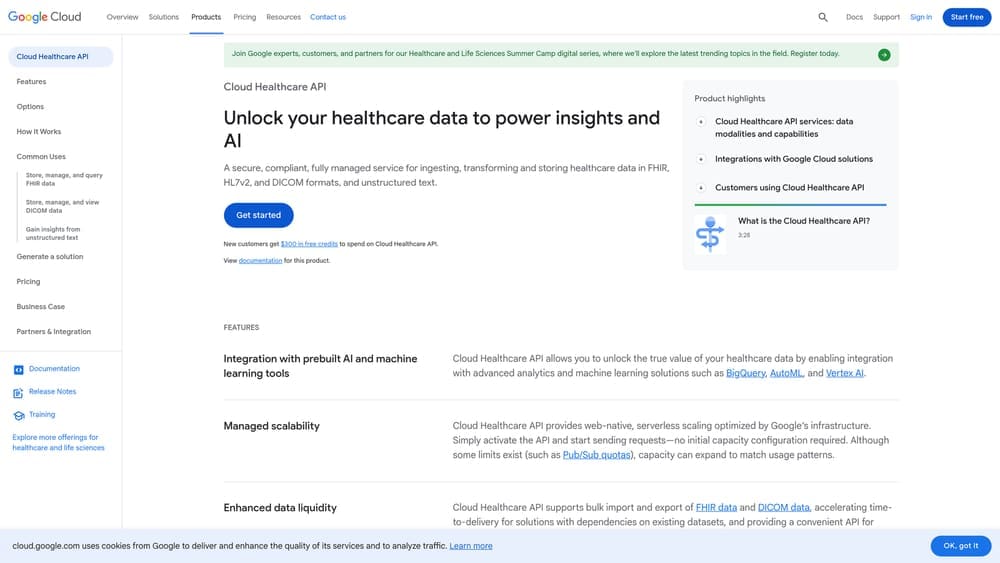
Google Cloud Healthcare API is a managed healthcare data service with native support for medical data standards.
Where This Tool Shines
If your analytics depend on interoperability standards like FHIR or you’re working with medical imaging data, Google Cloud Healthcare API provides native support that eliminates custom integration work. The platform understands these formats at a fundamental level.
The de-identification API is particularly strong, using Google’s machine learning capabilities to automatically detect and protect PHI across structured and unstructured data. This is critical when you need to create de-identified datasets for research or third-party analytics.
Key Features
Native Standards Support: FHIR, HL7v2, and DICOM support built directly into the platform without custom parsers.
De-Identification API: Automated PHI detection and protection using advanced machine learning models.
BigQuery Integration: Direct connection to Google’s analytics engine for SQL-based analysis at scale.
Vertex AI Access: Build and deploy machine learning models directly on healthcare data without moving it.
HIPAA Compliance: Covered by Google’s Business Associate Agreement with comprehensive security controls.
Best For
Healthcare organizations already invested in Google Cloud infrastructure, research teams working with FHIR-based data exchanges, and imaging centers managing large DICOM datasets.
Pricing
Pay-as-you-go model based on storage and operations. Storage starts around $0.10 per GB with additional charges for API calls and data processing.
4. Microsoft Azure Health Data Services
Best for: Enterprise healthcare organizations using Microsoft ecosystem tools
Microsoft Azure Health Data Services is an enterprise healthcare data platform integrated with the Microsoft ecosystem.
Where This Tool Shines
If your organization runs on Microsoft infrastructure—Active Directory for identity, Power BI for reporting, Teams for collaboration—Azure Health Data Services integrates seamlessly with tools your teams already use. This reduces training overhead and leverages existing licenses.
The MedTech service is particularly valuable for organizations working with IoT medical devices or remote patient monitoring data. It handles the ingestion, transformation, and normalization of device data at scale.
Key Features
FHIR and DICOM Services: Managed services for healthcare data standards with automatic scaling and updates.
Built-In De-Identification: Tools for creating compliant de-identified datasets for research and analytics.
Power BI Integration: Direct connections for building dashboards and reports without data movement.
Azure Active Directory: Enterprise-grade access management with granular permissions and audit trails.
MedTech Service: Specialized service for ingesting and normalizing medical device and IoT data.
Best For
Healthcare organizations standardized on Microsoft infrastructure, enterprises requiring tight integration with Active Directory and Power BI, and health systems managing remote patient monitoring programs.
Pricing
Consumption-based pricing with FHIR service starting at $0.06 per 10,000 API calls. Storage and compute charges apply separately based on usage.
5. AWS HealthLake
Best for: Organizations building machine learning models on clinical data
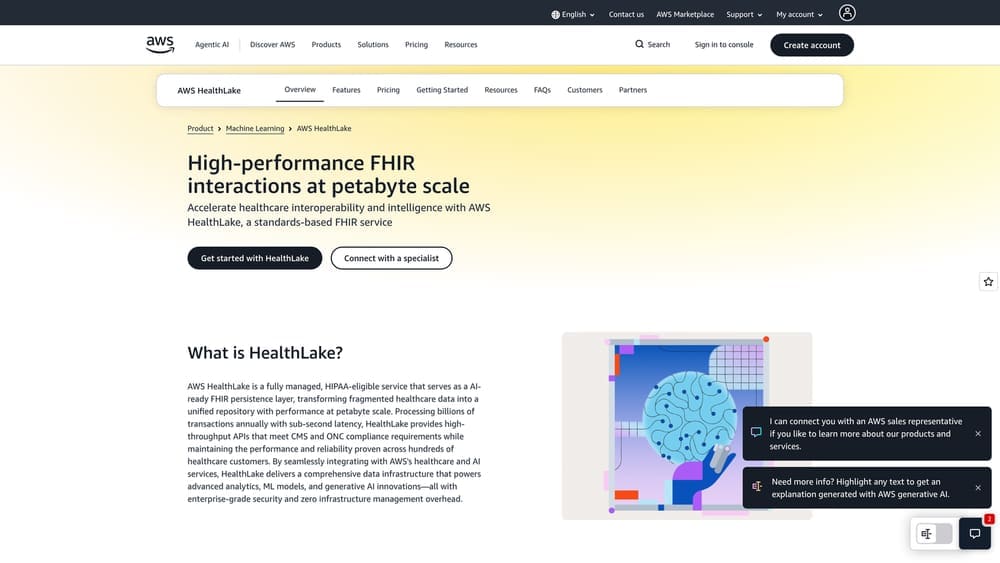
AWS HealthLake is a FHIR-native data lake service designed for healthcare analytics and machine learning.
Where This Tool Shines
HealthLake’s automatic transformation of healthcare data into FHIR format removes a massive integration burden. You can ingest data from multiple sources and HealthLake handles the normalization, making it immediately queryable and usable for analytics.
The natural language processing for clinical notes is exceptionally powerful. It extracts structured data from unstructured physician notes, radiology reports, and discharge summaries—turning narrative text into analyzable data points.
Key Features
Automatic FHIR Transformation: Ingests diverse healthcare data formats and automatically converts them to FHIR standard.
Medical NLP: Extracts structured information from clinical notes using Amazon Comprehend Medical.
SageMaker Integration: Direct connection to AWS machine learning platform for building and deploying models.
HIPAA Eligibility: Covered under AWS Business Associate Agreement with comprehensive compliance controls.
Scalable Data Lake: Handles petabyte-scale healthcare data with automatic indexing and optimization.
Best For
Research organizations building predictive models, health systems looking to extract value from unstructured clinical notes, and data science teams already using AWS infrastructure.
Pricing
Based on data stored and processed. Storage costs approximately $0.046 per GB per month with additional charges for data ingestion and queries.
6. Databricks for Healthcare
Best for: Research teams doing advanced analytics and machine learning on healthcare data
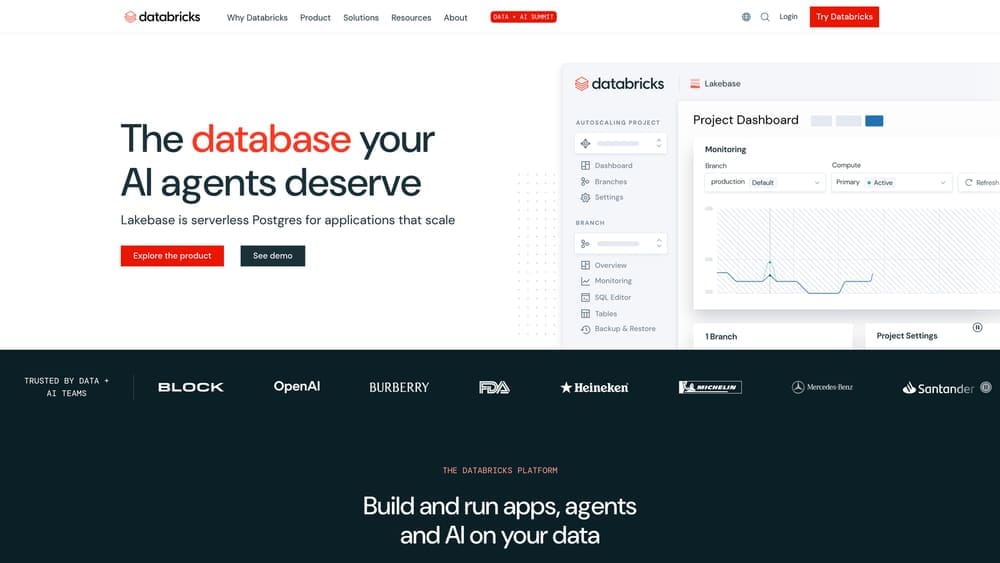
Databricks for Healthcare is a unified analytics platform combining data engineering, data science, and machine learning.
Where This Tool Shines
Databricks excels when your analytics workflow involves multiple personas—data engineers preparing datasets, data scientists building models, and analysts creating reports—all working on the same platform. The collaborative notebooks enable teams to work together without constant data handoffs.
The lakehouse architecture solves a persistent problem in healthcare analytics: maintaining a single source of truth while supporting both structured reporting and exploratory data science. You’re not maintaining separate data warehouses and data lakes.
Key Features
Lakehouse Architecture: Unified platform supporting both structured analytics and machine learning workloads.
Delta Lake: Reliable data management with ACID transactions and time travel for audit compliance.
Collaborative Notebooks: Shared workspace for data engineers, scientists, and analysts to collaborate in real-time.
HIPAA Compliance: Business Associate Agreement available with comprehensive security and audit controls.
MLflow Integration: Built-in machine learning lifecycle management for reproducible model development.
Best For
Academic medical centers with active research programs, biopharma organizations doing computational drug discovery, and health systems building advanced analytics capabilities with data science teams.
Pricing
DBU-based pricing starting around $0.07 per DBU for jobs compute. All-purpose compute for interactive analytics costs more. Enterprise agreements available for committed usage.
7. SAS Health
Best for: Healthcare organizations requiring regulatory reporting and traditional statistical analysis
SAS Health is an established analytics platform with deep healthcare expertise and regulatory reporting capabilities.
Where This Tool Shines
SAS has been in healthcare analytics for decades, and that experience shows in the depth of pre-built models and regulatory submission support. If you need to submit data to CMS, state health departments, or regulatory agencies, SAS knows the exact formats and validation rules required.
The statistical analysis capabilities remain unmatched for complex methodologies. When your research requires advanced statistical techniques or you’re publishing in peer-reviewed journals, SAS provides the rigor and documentation that reviewers expect.
Key Features
Comprehensive Statistical Analysis: Industry-leading capabilities for advanced statistical methodologies and clinical research.
Pre-Built Healthcare Models: Extensive library of validated analytics models for common healthcare use cases.
Regulatory Submission Support: Tools and templates for CMS, state, and federal reporting requirements.
Flexible Deployment: Available as on-premises installation or cloud-based deployment based on organizational requirements.
Established Validation: Decades of use in healthcare with extensive documentation and peer-reviewed publications.
Best For
Healthcare organizations with regulatory reporting obligations, research institutions requiring rigorous statistical analysis, and enterprises with existing SAS investments and trained staff.
Pricing
Enterprise licensing model with custom quotes based on modules selected and number of users. Pricing varies significantly based on deployment type and feature set.
8. Palantir Foundry
Best for: Complex healthcare data environments requiring sophisticated access controls and data lineage
Palantir Foundry is a data integration and analytics platform designed for complex, highly regulated environments.
Where This Tool Shines
Foundry’s ontology-based approach to data modeling creates a semantic layer that makes complex healthcare data understandable to non-technical users. Clinicians can explore data using medical terminology without understanding database schemas.
The granular access controls operate at row and column level, enabling sophisticated data governance scenarios. You can expose different views of the same dataset to different users based on their roles, credentials, or data use agreements—critical for multi-institutional collaborations.
Key Features
Ontology-Based Modeling: Semantic data layer that represents healthcare concepts in clinically meaningful terms.
Granular Access Controls: Row and column-level permissions enabling sophisticated data governance across organizations.
Complete Data Lineage: Provenance tracking showing exactly how every data point was derived and transformed.
FedRAMP Authorization: Authorized for government use with comprehensive security controls and compliance documentation.
Multi-Source Integration: Handles diverse data sources from EHRs, claims, labs, and external datasets in a unified platform.
Best For
Government health agencies, large integrated delivery networks managing complex data sharing agreements, and research consortia requiring sophisticated governance across multiple institutions.
Pricing
Enterprise pricing model typically starting at $1 million annually. Pricing scales based on user count, data volume, and deployment complexity.
9. Qlik Sense Healthcare
Best for: Healthcare organizations needing self-service analytics with minimal technical overhead
Qlik Sense Healthcare is a self-service analytics platform with healthcare-specific templates and connectors.
Where This Tool Shines
Qlik’s associative analytics engine enables exploration patterns that traditional BI tools struggle with. Users can click on any data point and instantly see all related data across the entire dataset—valuable when investigating quality issues or unexpected patterns in clinical data.
The pre-built healthcare dashboards and KPIs get teams productive immediately. Instead of starting from scratch, you deploy templates for common use cases like readmission tracking, ED throughput, or population health management, then customize from there.
Key Features
Associative Analytics Engine: Unique approach enabling free-form exploration of relationships across entire datasets.
Healthcare KPI Dashboards: Pre-built templates for common healthcare metrics and reporting requirements.
EHR and Claims Connectors: Direct integration with major EHR systems and claims data sources.
HIPAA Compliance: Business Associate Agreement available with security controls for protected health information.
Mobile Analytics: Full-featured mobile apps enabling secure access to dashboards from any device.
Best For
Mid-sized healthcare organizations, ambulatory practices looking to analyze their own data, and health systems wanting to enable self-service analytics for clinical and operational teams.
Pricing
Per-user licensing model with Professional tier starting around $30 per user per month. Enterprise pricing available for larger deployments with volume discounts.
Making the Right Choice
Every platform covered here meets HIPAA requirements. That’s table stakes. The differentiator is which one fits your specific use case without forcing architectural compromises.
Government health agencies and precision medicine programs dealing with data that can’t move need federated capabilities. Lifebit was built specifically for this problem—analyzing data where it lives without the compliance risks of data movement. When you’re managing national health programs or cross-border collaborations, this architecture isn’t a nice-to-have. It’s the only viable approach.
Large health systems with existing cloud investments should leverage their current provider. If you’re already on Azure with Active Directory and Power BI, Azure Health Data Services integrates seamlessly. AWS shops building ML capabilities benefit from HealthLake’s SageMaker integration. Google Cloud users working with FHIR data get native standards support.
Research-heavy organizations doing advanced analytics and machine learning will find Databricks or Snowflake more aligned with data science workflows. Both platforms support the iterative, exploratory work that characterizes modern healthcare research. Databricks excels when you need collaborative notebooks for mixed teams. Snowflake shines when elastic scaling and data sharing are priorities.
Traditional healthcare analytics with regulatory reporting requirements? SAS remains the proven choice. The depth of pre-built models, regulatory submission support, and statistical rigor make it hard to replace for organizations with these specific needs.
The right choice depends on three factors: where your data lives, what you need to do with it, and how fast you need to move. Organizations managing siloed data across institutions need federation. Teams building ML models need platforms designed for data science workflows. Enterprises with regulatory reporting obligations need established validation and submission support.
Start by mapping your actual requirements—not just today’s needs, but where your analytics capabilities need to be in two years. The platform you choose will shape what’s possible. Choose based on your constraints, not features lists.
Get started for free to see how federated analytics can unlock insights from your most sensitive data without the compliance risks of traditional approaches.
Related from Lifebit
The Federated Trusted Research Environment (TRE)
Production federated TRE platform for federal health programs — deployed at NIH National Library of Medicine (as a minor application within its ATO), Genomics England, the Danish National Genome Center, and CanPath. Patient data stays at source; analytics run across institutions; results travel through policy-controlled airlock.