

Why Do Data Transfer Agreements Take 18–36 Months And What Does It Cost You?

Quick answer. Data Transfer Agreements take 18–36 months because they attempt to reconcile three fundamentally opposing forces at once: institutional risk mitigation, cross-border regulatory regimes (GDPR, SCCs, national data authorities) and IT security auditing on both sides of the contract. The financial cost includes $1M+ per year in wasted bioinformatics labor and years-long delays to precision medicine R&D. Federated access replaces the DTA with a Governed Access Protocol — data never moves, analytics travel to it, and cohort access compresses to weeks.

Before even a single pipeline can be run, global pharmaceutical companies and clinical data networks find themselves paralyzed by a shared legal bottleneck: the Data Transfer Agreement (DTA). What should be a routine administrative transaction devolves into an 18–36-month legal standoff, stalling critical oncology and rare-disease R&D while consuming millions in bioinformatics labor.
Table of contents
The structural gridlock of modern DTAs
A data transfer agreement is legally structured to protect patient confidentiality, assign proprietary rights and guarantee information security. However, when applied to multi-site clinical trials or collaborative real-world evidence (RWE) generation, traditional legal frameworks collapse under their own weight.
This gridlock is exacerbated when scaling across borders, turning localized contracts into highly complex international data transfer agreements that must simultaneously satisfy divergent sovereign mandates.
The timeline stalls during three primary phases of negotiation
- Institutional governance disalignment: The data provider’s primary goal is risk mitigation and liability isolation. The commercial sponsor or research institution seeks unencumbered data access and intellectual property (IP) downstream rights. Reconciling these fundamentally opposing positions takes months of redlining.
- Evolving cross-border regulatory regimes: Navigating a data transfer agreement under the GDPR framework requires deep, localized expertise. Compliance teams must navigate evolving operational hurdles under standard contractual clauses (SCCs) alongside newer frameworks like the EU Data Act, which introduces strict limits on long-term data lock-ins and unexpected cross-border transfers.
- IT environment & information security auditing: Legal teams cannot sign a contract until the receiving infrastructure is verified. This forces complex cross-organizational security reviews, where IT departments debate cloud encryption keys, localized access controls and multi-tenant pipeline architectures.
Regulatory spotlight: the cost of global friction
Recent legal analyses emphasize that navigating international data transfer frameworks remains highly volatile. The introduction of new trans-Atlantic frameworks and strict requirements from individual national data protection authorities means a baseline intercompany data transfer agreement that works within one corporate umbrella can still face extensive scrutiny when dealing with clinical third parties across borders.
For the broader picture on why the current data-sharing model itself is broken, see our companion piece: why genomics data sharing is still broken in 2026.
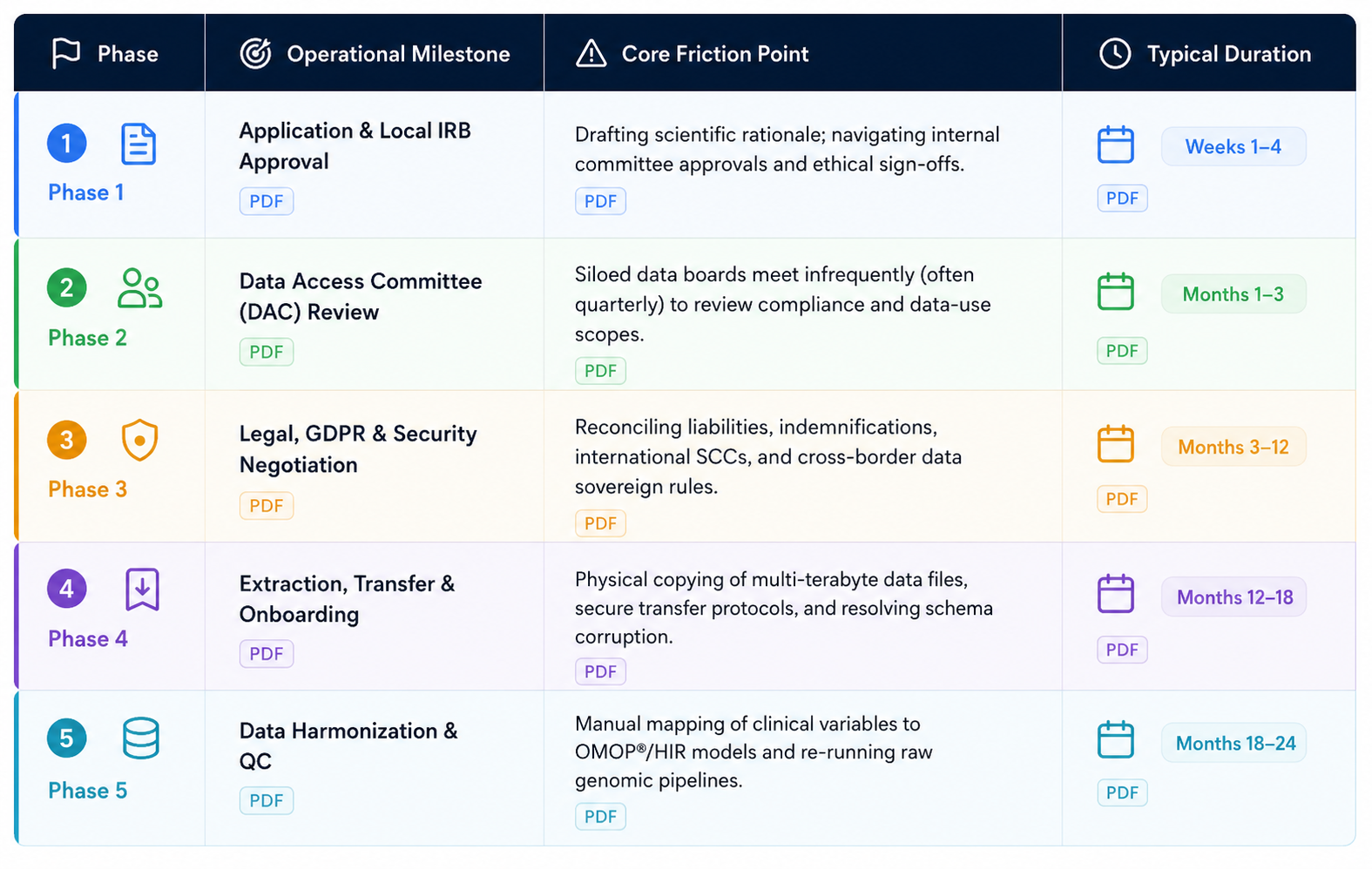
Let’s deconstruct the 24-month timeline friction
To understand why data access routinely takes years, it is useful to trace the operational milestones from the day a researcher identifies a cohort to the day the first analysis executes. It is a linear cascade of administrative dependencies:
The hidden cost of wasted labor
The financial impact of a prolonged DTA lifecycle extends far beyond direct legal bills. The true burn rate lies in the systemic degradation of clinical and bioinformatic resources.
- Bioinformatics labor waste: $1,000,000+ per year spent on manual pipeline re-engineering and uncoordinated cohort re-mapping.
- Average access latency: 18–36 months required to negotiate and execute an international biomedical DTA.
Consider a typical pharmaceutical data science group. While a contract is stalled, highly specialized bioinformaticians are either idle or forced to build temporary, fragmented pipelines based on a generic data transfer agreement sample or placeholder data mockups.
The paradigm shift: federated access over data transfer
The ultimate structural flaw of a traditional data transfer agreement research workflow is the assumption that data must move to be analyzed. This physical copy-and-paste model is what triggers intense legal friction, as data custodians lose visibility and custody over their patient registries the moment data is transferred.
At Lifebit, we completely redefine this model. Instead of moving sensitive data across jurisdictional lines and waiting years for DTA executions, we deploy a Federated Data Platform powered by a Trusted Research Environment (TRE).
By utilizing a Governed Access Protocol, the data never leaves its original secure cloud environment or regional enclave. Instead of moving the data to the compute infrastructure, the analytical pipelines (such as Nextflow-native workflows) and AI queries travel to the data. For the strategic view on which governance model fits your organization, see our practical guide to federated vs centralized data governance.
How Lifebit compresses years into weeks
- Zero data movement: Because the original clinical and genomic datasets remain entirely under the custodian’s local cloud infrastructure, the primary driver for international legal disputes is eliminated. Data sovereignty is maintained natively.
- Automated harmonization: Lifebit’s platform automates data harmonization and structuring into universal models like OMOP or FHIR in under 48 hours, entirely avoiding the month-long manual curation phase.
- Pre-built global compliance: Security controls (FedRAMP, HIPAA, ISO 27001, SOC 2) are fully integrated into the architecture from day one. Backed by automated tools like Lifebit Airlock, data exports undergo rigid, rule-based privacy filtering to guarantee zero patient de-identification leaks.
By deploying federated access, pharmaceutical companies can query over 275 million patient records as a single unified cohort, transforming data access from a multi-year legal risk into an instantaneous, secure click.
Researchers get immediate results, pipelines remain fully reproducible and life-saving precision therapies reach the market years ahead of schedule.
Looking to enable secure genomic collaboration without moving sensitive datasets?
Discover how Lifebit’s federated Trusted Research Environment enables researchers to access and analyze data where it resides while maintaining governance, compliance and institutional control.
FAQs about Data Transfer Agreements
Why can’t we just use a standard Data Transfer Agreement (DTA) template to speed up clinical research?
While standard templates or standard contractual clauses (SCCs) for GDPR exist, they rarely survive multi-site or cross-border clinical trials intact. Every data custodian operates under a unique risk profile and institutional governance mandate. The primary deadlock occurs because templates cannot pre-resolve conflicting claims over downstream intellectual property (IP) and data sovereignty. For instance, a commercial pharmaceutical sponsor will demand exclusive rights to discoveries made using the data, while a public research hospital is legally obligated to protect public benefit and restrict commercial data exploitation. Reconciling these opposing mandates requires custom “redlining” that drags on for months.
Is anonymizing clinical data enough to bypass the 18–36-month DTA negotiation process?
While completely anonymized data technically falls outside the scope of strict regulations like GDPR, true anonymization is practically impossible for high-dimensional biomedical data (like whole-genome sequencing combined with longitudinal electronic health records). Because genetic data is inherently unique, the risk of “re-identification” via data linkage remains high. Data protection authorities and institutional review boards (IRBs) recognize this risk, meaning they treat genomic datasets as pseudonymized rather than anonymized.