

Federated vs Centralized Data: A Practical Guide for Genomics Teams

Quick answer. Centralized data governance copies datasets into a single repository, making harmonization easy but creating regulatory, security and scalability bottlenecks. Federated data governance keeps data at source and moves the analysis to the data instead — reducing legal friction, preserving sovereignty and scaling naturally across institutions. For genomics teams working across borders, federated (or hybrid) models are increasingly the default.

The rapid growth of genomic sequencing, multi-omics research and international collaborations has transformed how research organizations manage health data. As genomic datasets grow into petabyte-scale assets, traditional approaches to data sharing are increasingly being challenged by privacy regulations, security requirements and operational complexity.
For genomics teams, one of the most important strategic decisions is choosing between a centralized and federated approach to data management. This guide explores the differences between federated vs centralized data, examines the strengths and limitations of each model and provides practical recommendations for genomics teams navigating modern data-sharing challenges.
Table of contents
- Understanding data governance models
- What is centralized data governance?
- Challenges of centralized data models
- What is federated data governance?
- Advantages of federated data governance
- Challenges of federated governance
- Federated vs centralized: side-by-side comparison
- Federated vs centralized BI considerations
- How Power BI governance fits in
- Which model is best for genomics teams?
- The future of genomic data governance
- FAQs about federated vs centralized data
Understanding data governance models
Before comparing these two models, it’s crucial to understand the broader concept of data governance. A data governance model defines:
- Who owns the data
- Who can access it
- How data quality is maintained
- How compliance requirements are enforced
- How data is shared across teams and institutions
Organizations typically adopt one of three governance approaches:
Centralized data governance model
In a centralized data governance model, a single authority controls policies, infrastructure, standards and access decisions.
Characteristics:
- Central repository or data warehouse
- Standardized processes
- Unified security controls
- Consistent metadata and quality standards
- Centralized administration
Federated data governance model
A federated data governance model distributes responsibility across participating institutions or domains while maintaining shared standards and interoperability.
Characteristics:
- Data remains at source locations
- Local ownership and stewardship
- Shared governance frameworks
- Federated identity and access management
- Distributed analytics capabilities
Hybrid governance models
Many organizations implement a combination of centralized and federated approaches, balancing standardization with local autonomy.
What is centralized data governance?
In a centralized approach, health data from multiple institutions is copied or transferred into a central repository where researchers conduct analysis. Historically, this has been the dominant model in biomedical research.
Easier data harmonization
When all datasets reside in a single environment, researchers can standardize formats, ontologies and metadata structures more efficiently.
Simplified analytics
Researchers gain access to unified datasets, centralized compute resources, shared analysis pipelines and simplified machine learning workflows.
Improved interoperability
Centralized repositories facilitate linking genomic, clinical, imaging and laboratory data into complete research datasets. Research published in Briefings in Bioinformatics notes that centralized models excel at data linkage, harmonization and interoperability, making them particularly useful for complex biomedical research initiatives.
Challenges of centralized data models
Centralized systems come with significant trade-offs.
Regulatory complexity
Cross-border transfer of genomic data often encounters GDPR restrictions, national sovereignty laws, institutional governance requirements and consent limitations. Data Transfer Agreements alone can take 18–36 months to execute, stalling entire research programs.
Security risks
Moving sensitive genomic data creates additional attack surfaces. A single repository may become a high-value target for cyber threats due to the concentration of valuable information.
Long approval timelines
Many centralized initiatives require data transfer agreements, legal reviews, ethics approvals and technical onboarding. This often results in access delays measured in months rather than weeks.
Scalability constraints
As datasets grow exponentially, transferring and storing copies becomes increasingly expensive and operationally difficult.
What is federated data governance?
A federated data governance model takes a fundamentally different approach.
Rather than moving data to researchers, federated systems move approved analysis to the data. This “compute-to-data” paradigm allows institutions to retain control while participating in collaborative research.
Under a federated architecture, data remains within local environments, institutions maintain stewardship, standardized interfaces enable collaboration and queries and algorithms travel instead of datasets. This approach has gained significant momentum across genomic research networks and healthcare collaborations. For deeper context, see our companion piece on why genomics data sharing is still broken in 2026.
Advantages of federated data governance
Enhanced data sovereignty
Data owners retain direct control over storage, access permissions, security policies and compliance enforcement. This is particularly important for genomic datasets that contain highly sensitive personal information.
Improved regulatory compliance
Because data remains within its jurisdiction, federated systems reduce many legal barriers associated with cross-border transfers. According to recent biomedical research, federated architectures simplify compliance and consent management because data stays at source institutions rather than being transferred to external repositories.
Much faster collaboration
Federated environments can eliminate lengthy data-transfer processes while enabling approved researchers to access insights more rapidly.
Much better scalability
Adding new data partners does not require migrating entire datasets into a central repository. New nodes can join the federation while maintaining local infrastructure.
Reduced data duplication
A key benefit highlighted in modern federated research environments is the ability to minimize unnecessary data copies while preserving local control.
Challenges of federated governance
Organizations commonly encounter technical integration challenges. Participating institutions may use different data models, different metadata standards and different infrastructure stacks. Achieving interoperability requires substantial coordination.
Governance complexity
Unlike a centralized model, governance responsibilities are distributed across stakeholders. Clear agreements must define data access procedures, security requirements, stewardship responsibilities, audit processes and performance limitations. Federated queries across multiple locations can introduce latency and operational overhead.
Sustainability concerns
Long-term funding and operational support remain challenges for many federated initiatives.
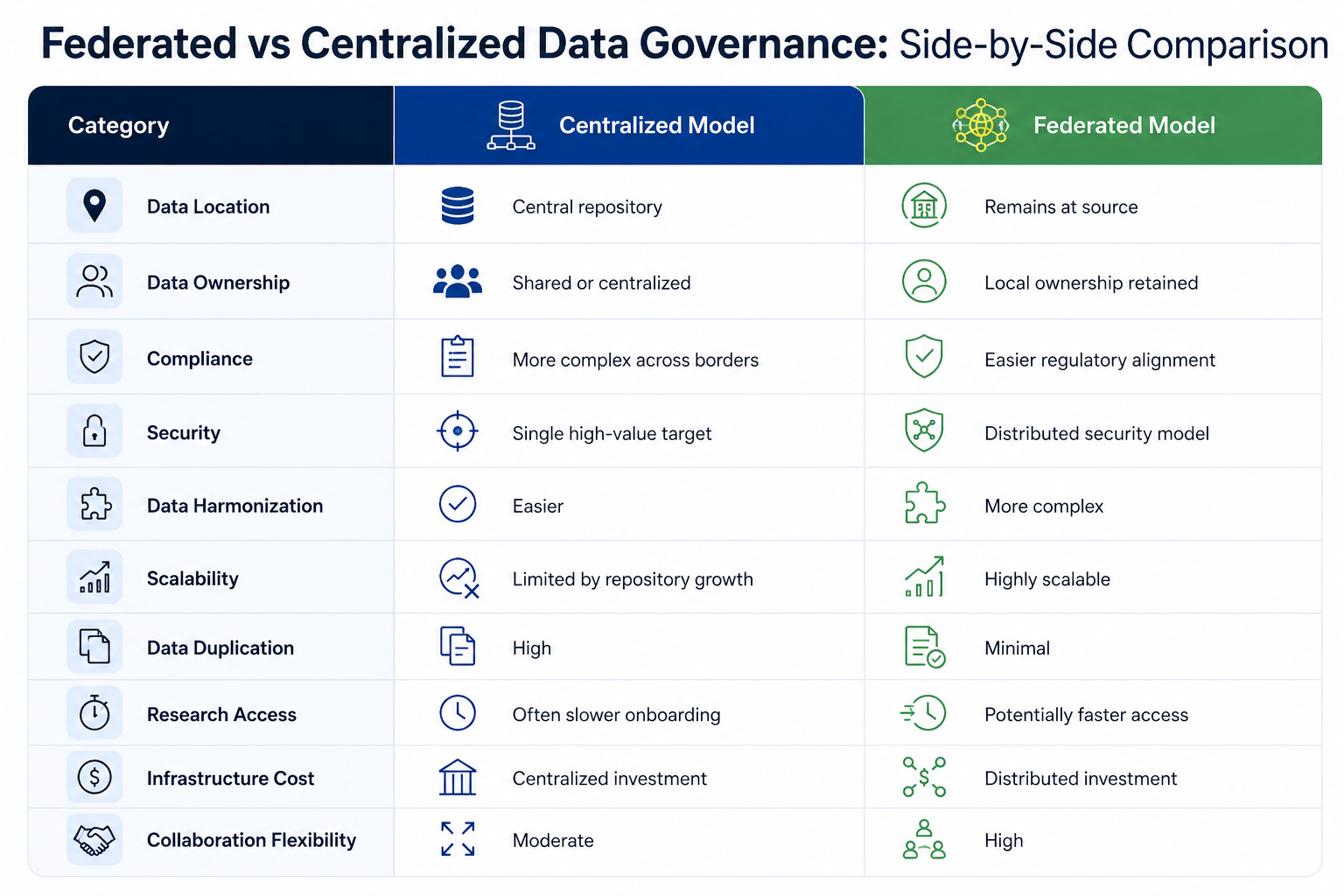
Federated vs centralized data governance: side-by-side comparison
Federated vs centralized data governance BI considerations
The discussion around federated vs centralized data governance BI extends beyond genomics. Business intelligence teams often face similar challenges.
Centralized BI governance
A centralized BI environment typically provides standardized dashboards, a single source of truth, consistent metrics and enterprise-wide reporting. However, it may become a bottleneck when business units require rapid innovation.
Federated BI governance
A federated BI model empowers individual domains to create analytics solutions while adhering to common governance standards. Benefits include greater agility, domain-specific expertise and faster decision-making. The challenge is maintaining consistency across metrics and reporting frameworks.
How Power BI governance fits into the discussion
Organizations implementing Microsoft analytics platforms often evaluate their Power BI governance model within the broader centralized-versus-federated debate.
Centralized Power BI governance model: centralized workspace management, standardized reports, controlled publishing processes and strong compliance oversight.
Federated Power BI governance model: business-unit ownership, self-service analytics, domain-level accountability and shared governance standards.
Many enterprises increasingly adopt hybrid governance approaches that combine centralized standards with federated execution.
Which model is best for genomics teams?
The answer, of course, depends on each research objective.
Choose centralized governance when
- Data harmonization is the highest priority
- Cohort assembly requires extensive data integration
- Infrastructure resources are readily available
- Regulatory requirements permit data transfer
Choose federated governance when
- Data sovereignty is critical
- International collaboration is required
- Privacy concerns are significant
- Data volumes make replication impractical
Consider hybrid models when
- Multiple institutions participate
- Compliance requirements vary
- Both local autonomy and shared standards are necessary
Large-scale genomics initiatives are moving toward federated architectures because they provide a practical balance between collaboration and control. Research examining major European biomedical data-sharing initiatives found that federated approaches are particularly effective for scaling sensitive-data collaboration while maintaining local stewardship and legal compliance.
The future of genomic data governance
As genomic datasets continue to expand, organizations are recognizing that copying data is no longer sustainable. If you’re evaluating secure research environments, read our guide to Trusted Research Environments (TREs).
The future likely belongs to models that:
- Keep data in place
- Enable secure remote analysis
- Support interoperable standards
- Preserve institutional control
- Accelerate collaboration
Rather than asking if federated or centralized governance is universally better, genomics leaders should evaluate which approach best aligns with their scientific, regulatory and operational goals.
Looking to enable secure genomic collaboration without moving sensitive datasets?
Discover how Lifebit’s federated Trusted Research Environment enables researchers to access and analyze data where it resides while maintaining governance, compliance and institutional control.
FAQs about federated vs centralized data
1. Is federated data governance better than centralized data governance?
The right choice depends on your organization’s goals, regulatory requirements and scale. A centralized data governance model provides stronger consistency, standardized controls and easier data harmonization. However, it can become a bottleneck as data volumes and stakeholder groups grow.
A federated data governance model distributes ownership to domain experts while maintaining shared governance standards. This approach typically offers greater scalability, faster decision-making and improved data sovereignty, making it increasingly attractive for genomics and healthcare organizations handling sensitive data across multiple institutions.
2. Why are genomics organizations moving toward federated data governance?
Genomics teams increasingly work with highly sensitive datasets that are subject to privacy laws, institutional policies and cross-border restrictions. Federated architectures allow data to remain within its original environment while enabling approved researchers to perform analysis remotely. This reduces the need for large-scale data transfers and helps organizations comply with data sovereignty requirements.
3. Can federated governance create data quality and consistency problems?
Without clear governance policies, different domains may define metrics, metadata, quality rules or compliance controls differently. This can lead to inconsistencies that affect reporting, analytics and AI initiatives.
Successful federated programs address this challenge by centralizing governance standards while decentralizing execution. This means local teams own their data, but enterprise-wide policies for security, metadata, privacy and quality are enforced consistently through shared frameworks and automation.