

7 clinical challenges surrounding health data standardization (and how to overcome them)

Introduction to health data standardization
Understanding the clinical challenges in health data standardization is essential for maximizing the potential of these datasets.
The clinical challenges in health data standardization are at the forefront of health research.
Understanding the clinical challenges in health data standardization is crucial to address the growing volume of health data.
The amount of health data required to address critical questions continuously grows in research and healthcare. New technologies have made it possible to create large health datasets, collected from all over the world and across numerous organizations. These technologies include digitizing medical tools, accumulating electronic health records (EHRs), and lower-cost genome sequencing.
These vast datasets can provide important insights that may ultimately enhance lives. Recent groundbreaking studies that illustrate the power of big data in health research include:
- the 100,000 Genomes study on rare diseases.
- research reporting the host characteristics triggering severe COVID-19 on approximately 60,000 participants.
- research confirming that high blood pressure is a risk factor for dementia– here, the National Institutes of Health (NIH) All of Us database of EHRs on +125,000 participants was utilized.
However, to be able to use all this valuable data in analysis, it must first be standardized and made interoperable in order to accurately combine data from multiple sources.
This article specifically focuses on the clinical challenges associated with health data transformation, and the solutions to connect high quality datasets, to inform clinical decision making and progress life sciences research.
To tackle the clinical challenges in health data standardization, data must be made interoperable.
This article delves into the clinical challenges in health data standardization and potential solutions.
What are the challenges surrounding clinical data standardization?
Addressing the clinical challenges in health data standardization is vital for improving patient outcomes.
Health data transformation is crucial for ensuring consistency, interoperability, and quality of data across different systems and institutions. However, there are several challenges that include:
These challenges highlight the need for effective clinical challenges in health data standardization.
- Diverse data sources
Clinical data originates from various sources, including different collection sites, EHR systems, medical devices, and more. These sources may use different data models, schemas, and formats for clinical data collection. This makes it challenging to integrate and standardize the data. - Data volume and complexity
Healthcare organizations often have vast amounts of data to process (terabytes in volume), which can include structured data (e.g. lab results) and unstructured data (e.g. clinical notes). - Data heterogeneity
Health data is documented in different formats, languages, and units. Standardizing units of measurement, terminologies, and health codes is a challenge, especially when dealing with data from different organizations and geographic regions. - Interoperability
Designing interoperable application programming interfaces (APIs) that allow different health systems to communicate and seamlessly exchange standardized data is technically challenging. Ensuring these APIs are well-documented and adhere to industry standards is crucial. - Quality and consistency
When clinical data is standardized, ensuring data quality and consistency is essential. Inaccurate or incomplete data can lead to erroneous clinical or research decisions. - Evolving standards
Healthcare data standards and terminologies are continually evolving to accommodate new knowledge, technology advancements, and changes in healthcare practices. It is crucial to keep up with these changes, although time consuming. - Security and privacy
When standardizing clinical data, organizations must maintain patient privacy and adhere to data security regulations (e.g. HIPAA). Further, moving the data to provide third party access ultimately increases the security risks.
Efforts to understand the clinical challenges in health data standardization can lead to better integration.
The quality of data is affected by clinical challenges in health data standardization.
Organizations must adapt to the clinical challenges in health data standardization to remain competitive.
Addressing evolving clinical challenges in health data standardization requires ongoing training.
The identification of clinical challenges in health data standardization is crucial for policy making.
Utilizing common data models can help address clinical challenges in health data standardization.
Identifying solutions to connect high-quality datasets
Common Data Models (CDMs) are being increasingly utilized in the healthcare sector to overcome the lack of consistency in health data. Collaborative health research on data across nations, sources, and systems is made possible by the standard approach. Examples include the Observational Medical Outcomes Partnership (OMOP) CDM and Clinical Data Interchange Standards Consortium (CDISC) medical standards.
What is OMOP?
CDISC standards play a role in mitigating clinical challenges in health data standardization.
OMOP is an open community data standard created to standardize observational data formats and content and to facilitate quick analyses. The OHDSI standardized vocabulary is a key part of the OMOP CDM. The OHDSI vocabularies enable standard analytics and allow the organization and standardization of medical terms to be used across the various clinical domains of the OMOP CDM.
Research shows that clinical challenges in health data standardization can impact health outcomes.
What is CDISC?
By focusing on clinical challenges in health data standardization, researchers can drive innovation.
CDISC creates data standards for the gathering, analyzing, and sharing of clinical trial data in conjunction with a wide spectrum of international professionals. Researchers, pharmaceutical and biotech firms, governmental organizations (such as the Food and Drug Administration (FDA), Pharmaceuticals and Medical Devices Agency (PMDA), and the National Medical Products Administration (NMPA)), and technology suppliers all utilize CDISC standards. The standards help to make data more easily accessible, interoperable, and reusable so that clinical research and global health can be improved.
| CDISC | OMOP | |
| Type of data | Clinical trial data | Observational data |
| Mode of collection | Collected via an experiment | Collected through real-world settings |
| Size of data | Small size (megabytes) | Gigantic (terabytes) |
| Use of data | Collected for the purpose of running a clinical trial | Collected for multiple research use cases |
Addressing clinical challenges in health data standardization involves collaboration among stakeholders.
Effective strategies to overcome clinical challenges in health data standardization are essential.
Continuous improvement in clinical challenges in health data standardization will lead to better decision making.
Featured resource: Read our whitepaper on Lifebit’s approach to data standardization
To leverage a breadth of health data types, both clinical trial and non-clinical trial health data, researchers must transform these datasets to CDMs. However, this is time consuming and costly, with data scientists estimated to devote 80% of their work to organizing and cleaning data.
Researchers should be able to spend time on what matters most – analysis that will derive meaningful insights to benefit the lives of patients.
To empower researchers to effectively collaborate over their data, industry providers are now offering support services for the standardization of data to CDMs. This saves researchers’ time and effort, with providers offering fully-dedicated, expert teams that have developed proprietary ETL pipelines to streamline the standardization process while maintaining data quality standards. Working with providers who are experts in both the standardization of clinical trial and observational data types can help connect these datasets for a variety of use cases, powering clinical and research breakthroughs.
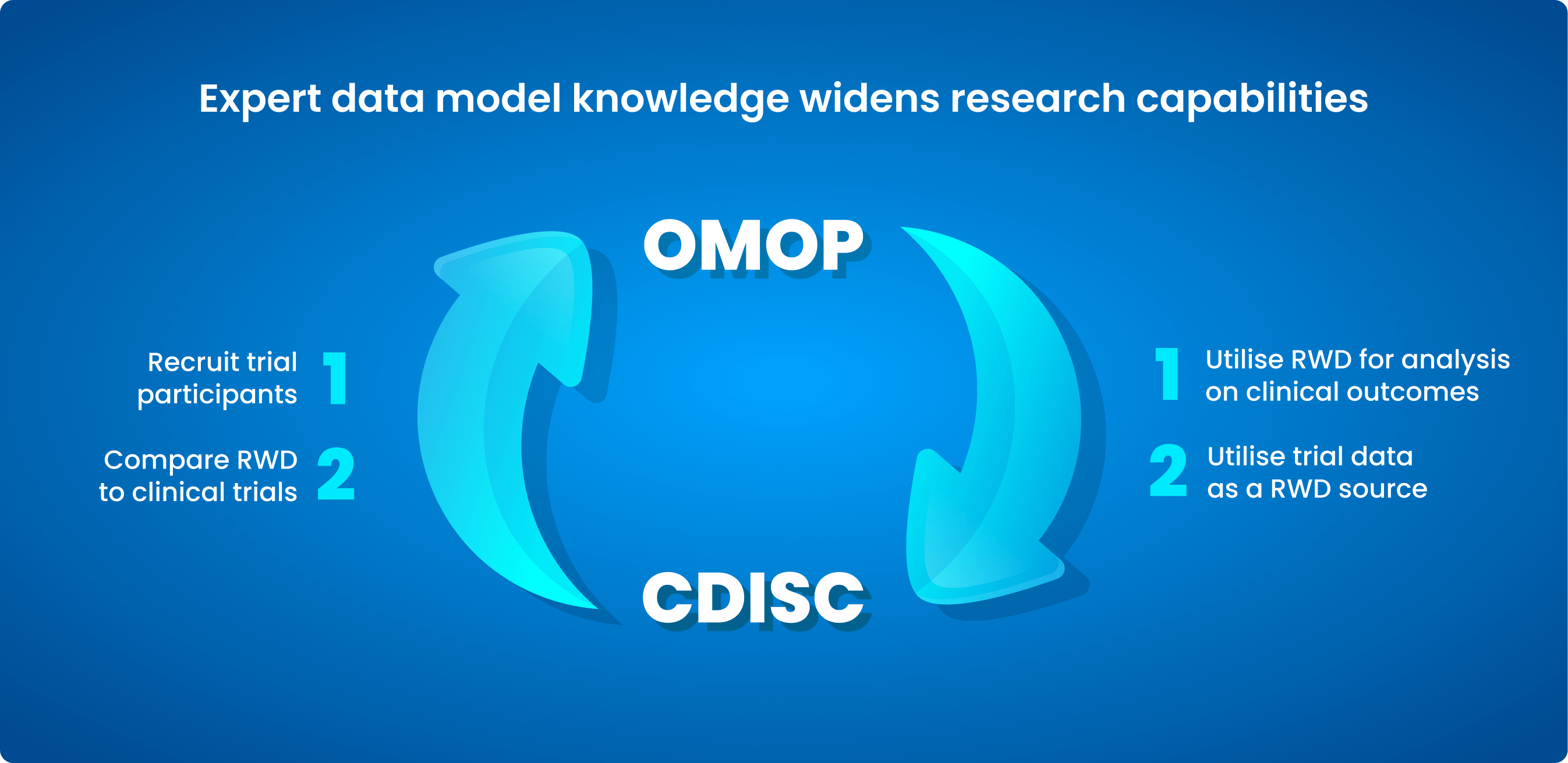
Finally, throughout the process of data standardization, data security and patient privacy should always remain a primary concern.
When data is moved, for example to provide to an industry partner to standardize the data, it can become vulnerable to interception (and furthermore the movement of large datasets is often very costly). Trusted research environments and data federation allow virtual access to the data through Application Program Interfaces (APIs), avoiding moving or copying the data.
By using this approach, data can be standardized and made interoperable for collaborative research without compromising security.
Summary
Health data comes from various sources and exists in multiple formats. Combining this data to gain novel insights can only be achieved if the data is made interoperable. Standardizing health datasets requires overcoming clinical challenges related to resources, technological capabilities and data governance to safely empower data consumers to maximize research insights and discoveries.
Look out for the next blog in our series, where we will describe further, specific benefits that standardization of health data can bring to researchers and clinicians.
Once data is standardized, users can bring standardized analytical tools to where the data resides in its secure environment. However, access to and analysis of the data must also be harmonized to maximize insights that can be gained.
About Lifebit
Lifebit provides health data standardization services for clients, including Genomics England, Boehringer Ingelheim, Flatiron Health and more, to help researchers transform data into discoveries.
Lifebit’s services are making health data usable quickly.
Find out more about the value of data standardization at our upcoming webinar, Data Harmony, on 14 September 2023. Secure your place today.